Breaking: OpenAI Undergoes Major Reorganization, President Brockman Assumes Command

marsbitPubblicato 2026-05-16Pubblicato ultima volta 2026-05-16

Introduzione

OpenAI has announced a major internal reorganization just months before its anticipated IPO. The company is merging its three flagship product lines—ChatGPT, Codex, and the API platform—into a single, unified product organization. The most significant leadership change involves co-founder and President Greg Brockman moving from a background technical role to take full, permanent control over all product strategy. This follows the indefinite medical leave of AGI Deployment CEO Fidji Simo. Additionally, ChatGPT's longtime lead, Nick Turley, has been reassigned to enterprise products, with former Instagram executive Ashley Alexander taking over consumer offerings. The consolidation, internally framed as a strategic move towards an "Agentic Future," aims to break down internal silos and create a cohesive "Super App." This planned desktop application would integrate ChatGPT's conversational abilities, Codex's coding power, and a rumored internal web browser named "Atlas" to autonomously perform complex user tasks. The reorganization occurs amid significant internal and external pressures. OpenAI has recently seen a wave of high-profile departures, including Sora co-lead Bill Peebles and other senior technical leaders, leading to concerns about a thinning executive bench. Externally, rival Anthropic recently secured funding at a staggering $900 billion valuation, surpassing OpenAI's own. Google's upcoming I/O developer conference also poses a competitive threat. Analysts sugges...

[New Zhiyuan] A seismic shift hit OpenAI overnight! Its three ace products—ChatGPT, Codex, and the API—have been urgently merged, with the president taking personal command! With rival Anthropic's valuation soaring to $900 billion, this is a life-or-death battle before OpenAI's IPO. The era of the super app is coming.

Just moments ago, another blockbuster news shook the tech world on Saturday morning.

OpenAI officially announced, without warning, the largest and most dramatic organizational restructuring in the company's history on the eve of its IPO.
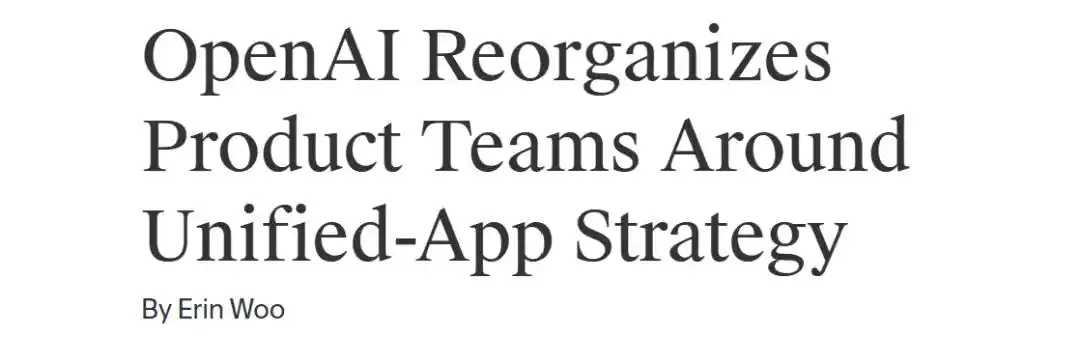
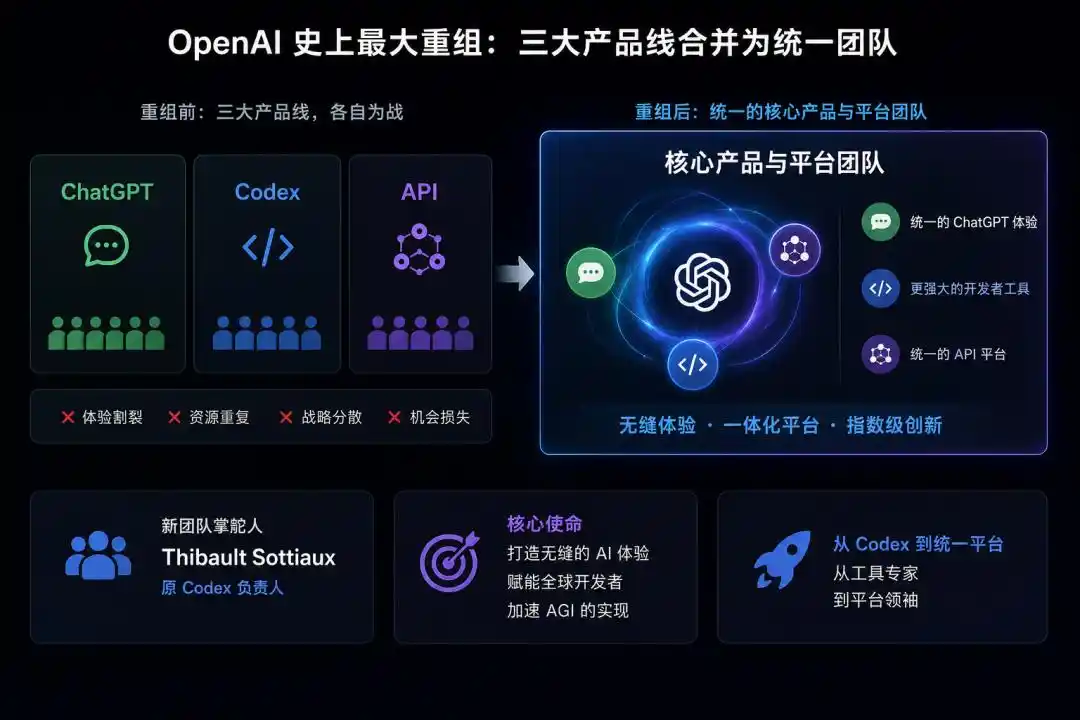
ChatGPT, Codex, and the lifeblood of the developer ecosystem—the API—all three core product lines have been dismantled and merged in place into a unified product organization!
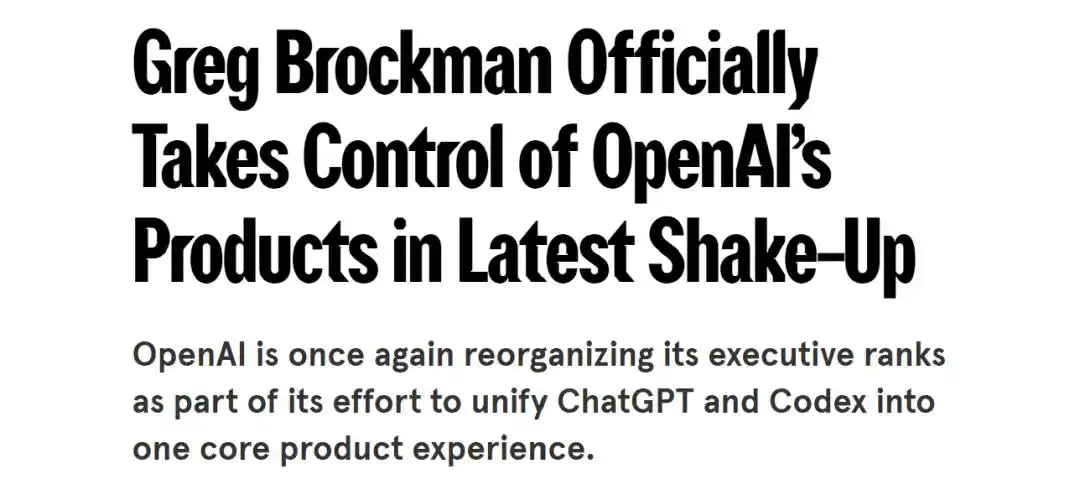
Even more shocking, Greg Brockman, OpenAI's co-founder, president, and the technical titan who once resigned in anger over Sam Altman's ousting, has formally been pushed into the spotlight to take full control of product strategy!

On the surface, this is a strategic focus by OpenAI for the Agent era.

But in essence, this is clearly a gripping "Silicon Valley Game of Thrones": the founding figure of ChatGPT has been reassigned, core executives have left one after another, and the head of AGI is on indefinite medical leave...
Now, OpenAI's competitors are circling like vultures.

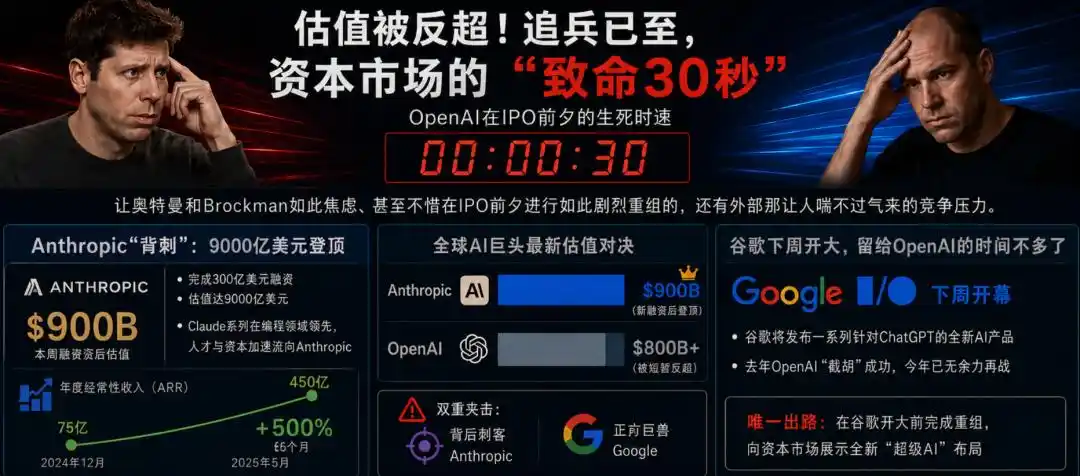
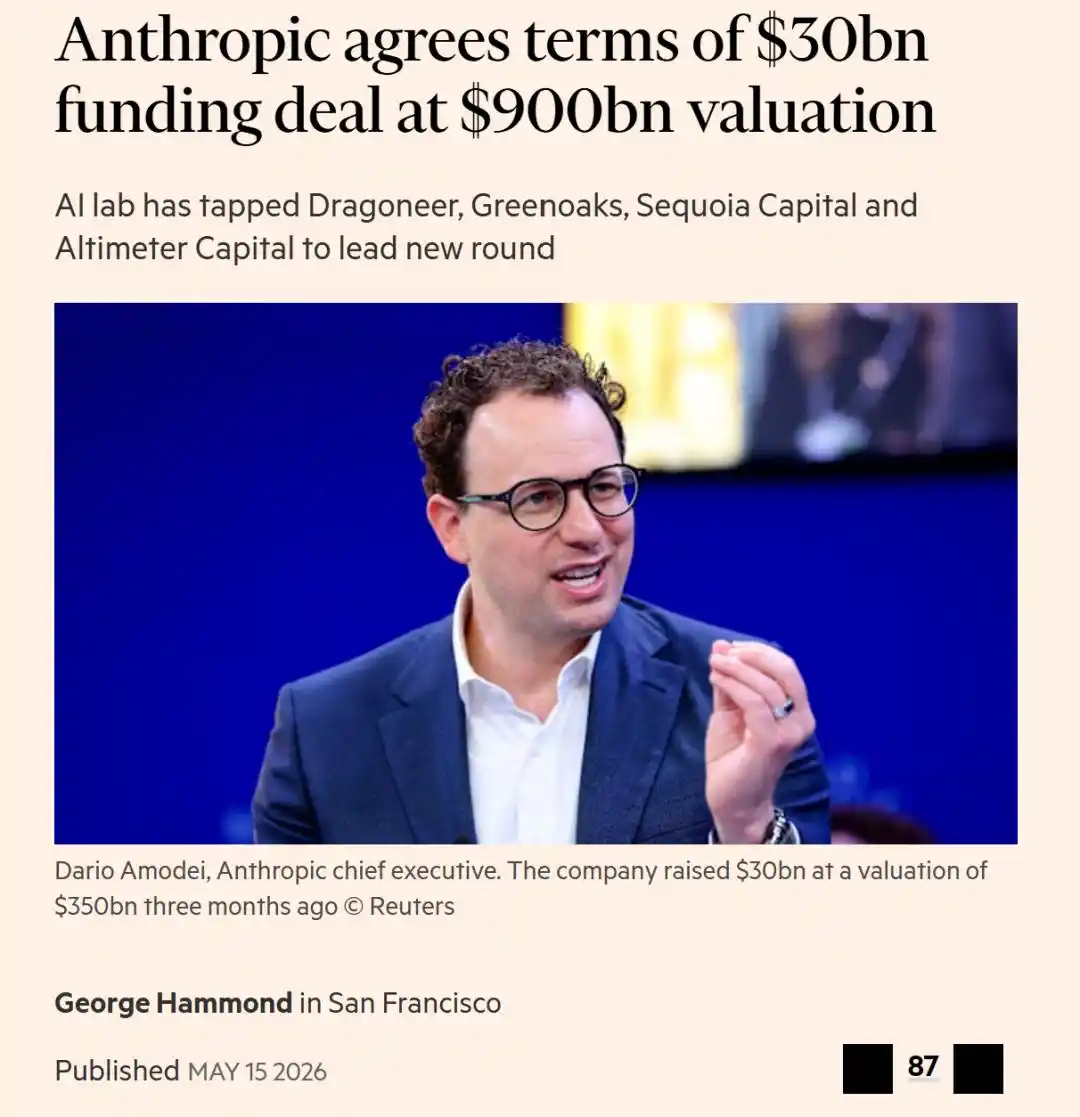
Anthropic just secured $30 billion in funding, its valuation skyrocketing to $900 billion, achieving an epic overtaking of OpenAI; Google is sharpening its knives ahead of next week's I/O conference.

With 900 million weekly active users hanging in the balance, the world's strongest AI empire is facing its moment of life or death!
The Sudden Replacement of a Leader, and the Shadow King Steps Forward

The most jaw-dropping aspect of this reshuffle is OpenAI's ruthless handling of its core contributors.

The "Father" of ChatGPT is Reassigned

If one were to name the most prominent功臣(meritorious figure) at OpenAI over the past two years, Nick Turley would definitely be on the list.

As the person fully responsible for ChatGPT since its launch, Nick Turley nurtured ChatGPT from an obscure "freebie" into today's global #1 super app with 900 million weekly active users.
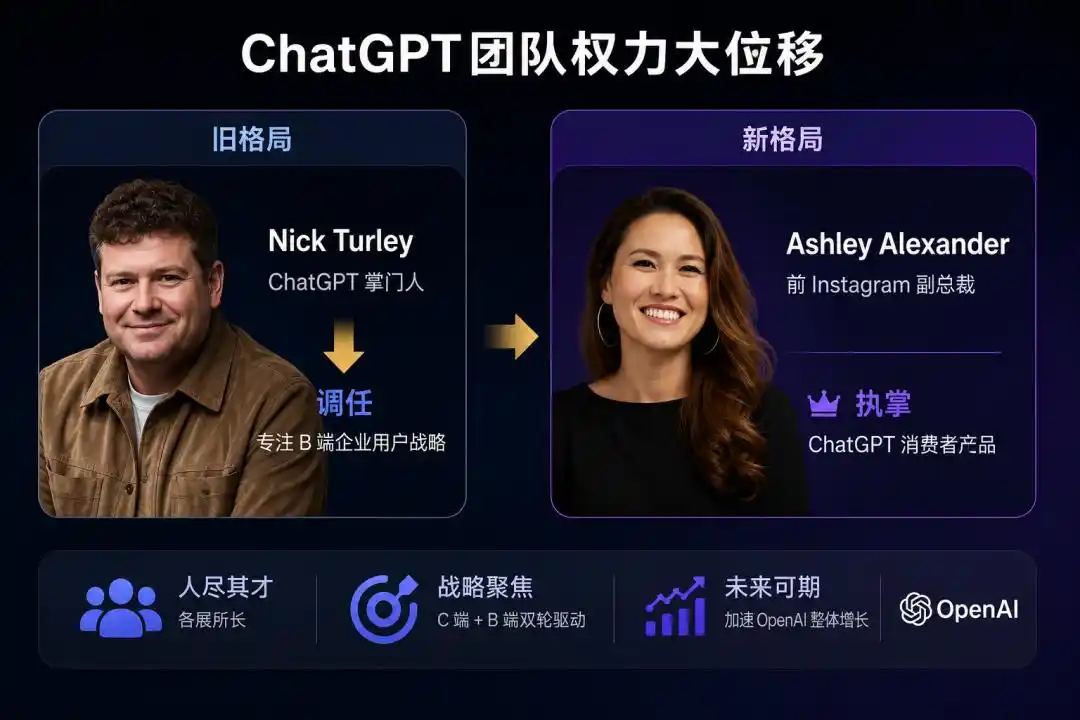
However, in this power reshuffle, this distinguished "father" of ChatGPT was transferred by a single order away from the most core, most high-profile consumer product line to lead the relatively mundane "Enterprise Users" direction.

"He is no longer responsible for any consumer products," WIRED coldly announced the curtain call of a ChatGPT founding figure in the C端(main consumer) stronghold.

Taking over his position as head of consumer products is former Instagram VP Ashley Alexander.

This executive, originally responsible for healthcare applications at OpenAI, has parachuted directly into the heart of the traffic.

The Warlord Returns: Brockman's "Rule from Behind the Curtain" Ends

If Nick Turley's reassignment is a "change of generals," then Greg Brockman's personal assumption of command is a seismic change at OpenAI's highest power level.
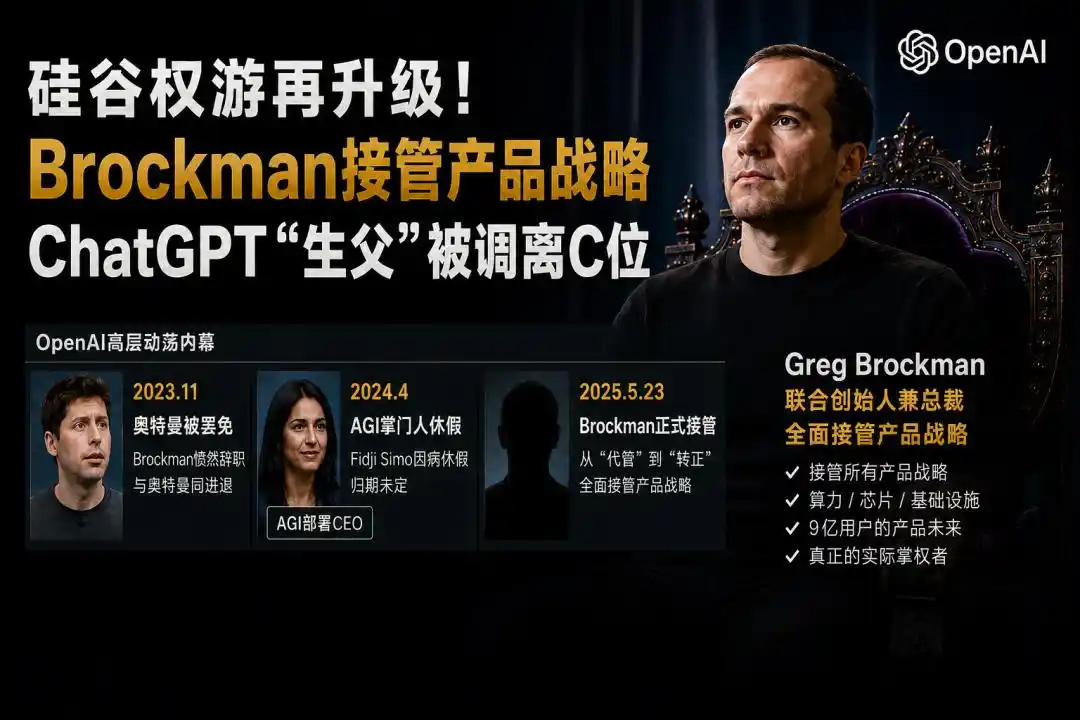
As OpenAI's co-founder and president, Brockman has always been a formidable figure in tech circles.

He could walk away from his iron rice bowl in solidarity when Altman was purged by the board, and after returning, he could silently grind away on AI infrastructure in the background.

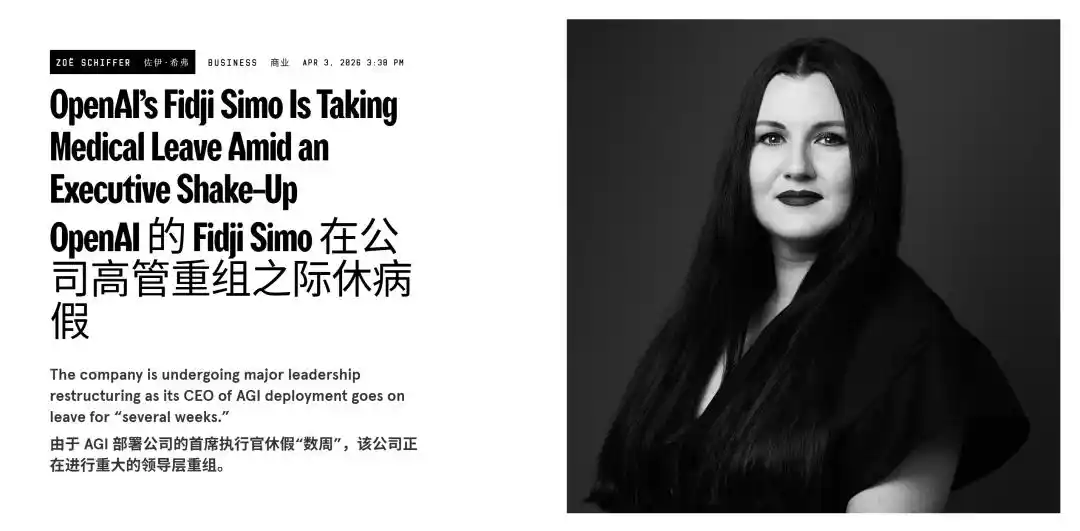
Recently, Fidji Simo, OpenAI's nominal "AGI Deployment CEO," has been on continuous leave since early April due to a severe recurrence of a chronic illness, with no definite return date. Brockman had previously only been overseeing products on an acting basis.

But this Friday, OpenAI directly issued a memo to all employees: Brockman's "acting" role is now official.

He will fully and permanently take charge of all product strategy at OpenAI!

The "Shadow King" who was building roads and bridges in the technical back-end has finally been forced into the spotlight.

From now on, he will not only manage computing power, chips, and the Blackwell supply chain, but also oversee what 900 million people chat about in ChatGPT every day, becoming the true de facto ruler.
Three Lines Merge into One! Altman's Audacious Gambit: The "Super App" Arrives

Why force-merge the three major product lines at this critical juncture?

In leaked internal memos, Brockman provided the answer in highly provocative industry language.

"We are consolidating our product work to move into the Agentic Future with the greatest focus, winning across both consumer and enterprise!"

For the first time in history, OpenAI's top brass has so explicitly admitted: OpenAI's original product lines have reached an unwieldy point where change is unavoidable.

From "Three Chariots" to "A Single Iron Plate"

Before the reorganization, OpenAI's three major product lines were almost operating independently.

ChatGPT: Responsible for looking pretty, capturing C端 traffic, and attracting 900 million weekly active users;

Codex: Responsible for quietly making money, grinding away at programming and code generation, a holy grail for programmers;

API: Responsible for taxing developers worldwide, building an ecosystem moat.

But in Brockman's eyes, this fragmentation is unacceptable. As AI capabilities evolve, these three things are naturally converging.

If today's ChatGPT can't write code or autonomously run APIs, it's just a pretty chat interface; Codex, without ChatGPT's interactive interface, cannot become a productivity tool usable by novices.

Therefore, the three teams are now dissolved on the spot and merged into a new core Products and Platforms team. The helm of this behemoth team is none other than the former head of Codex—Thibault Sottiaux.

Once, he made Codex OpenAI's fastest-growing王牌(ace) product and achieved great feats; now, he has become Brockman's number one general.
The Ultimate Trump Card: The Desktop Devourer Codenamed "Super App"

Accompanying this reorganization, OpenAI's real big move has finally surfaced.

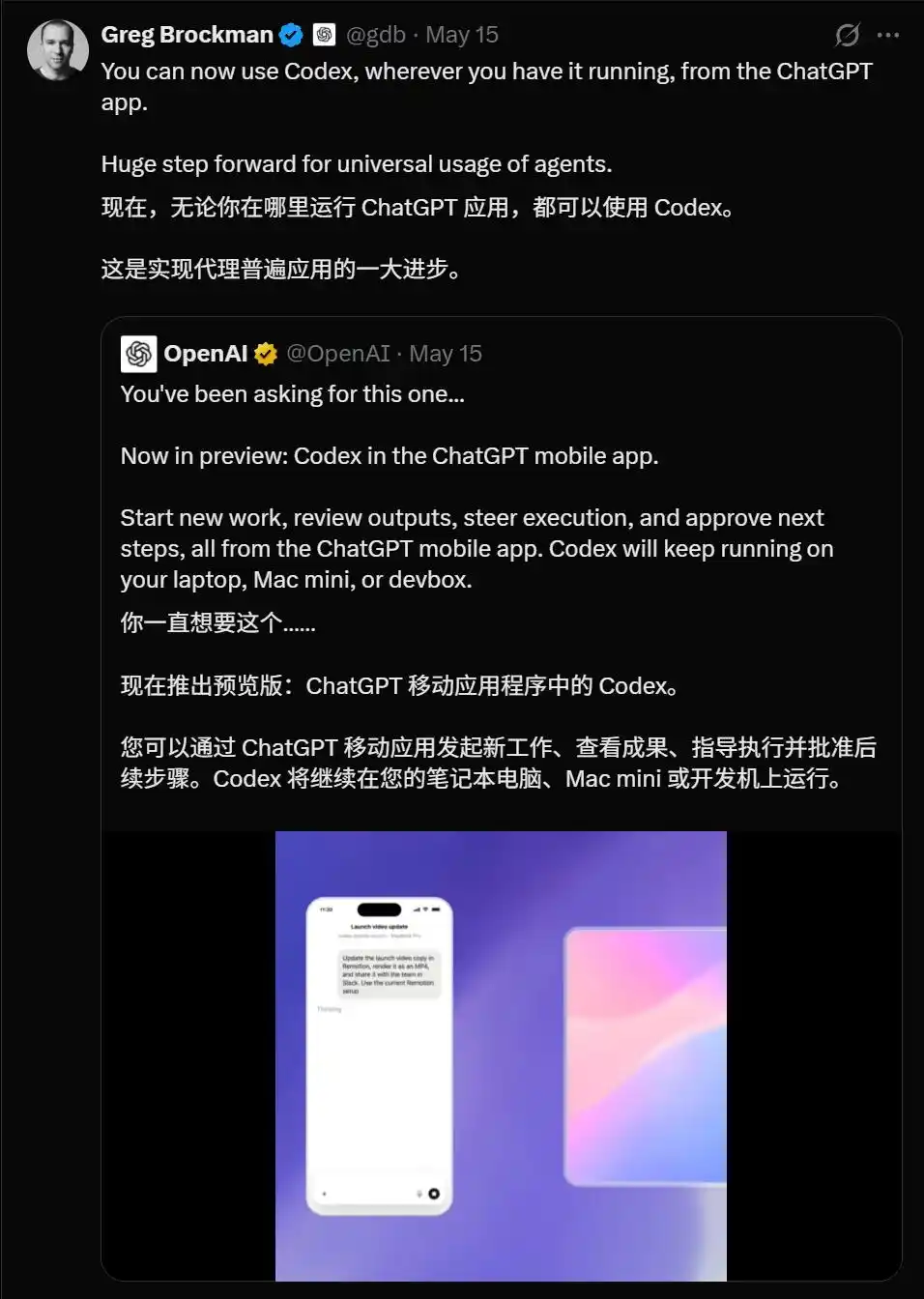
Thibault Sottiaux is currently secretly leading the development of an ultimate weapon internally referred to as the "Super App."

This is far more than just an upgraded web version of ChatGPT. It's a unified desktop application that combines ChatGPT, the Codex programming agent, and OpenAI's yet-to-be-released "Atlas web browser" into one!

This means OpenAI is leaping completely beyond the constraints of a "chat box."
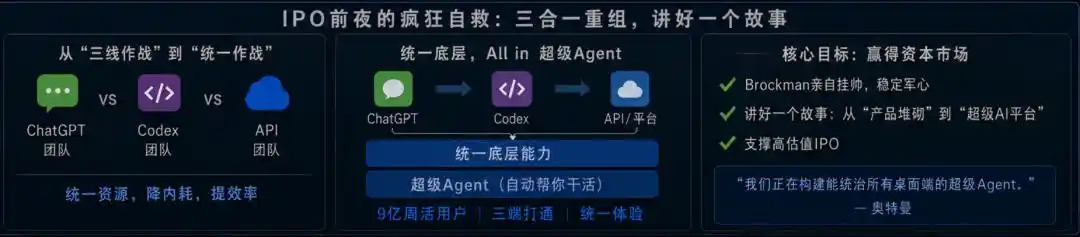
From now on, this super app lives on your computer desktop. It has its own browser (Atlas) and can view webpages; it has the strongest code execution ability (Codex) and can write scripts; it has ChatGPT's brain and understands your intent.

It doesn't require you to copy and paste; it can "autonomously perform complex digital tasks on behalf of the user."

This is the "Agentic Future" in Altman and Brockman's eyes—the era of Agents!

Hollowing Out of Executives: Bleeding and Hidden Worries Behind the Frenzy

This news might seem like a positive "proactive strike."

But if you carefully read OpenAI's recent list of personnel changes, you'll discover a terrifying fact: OpenAI's executive layer is almost hollowed out.
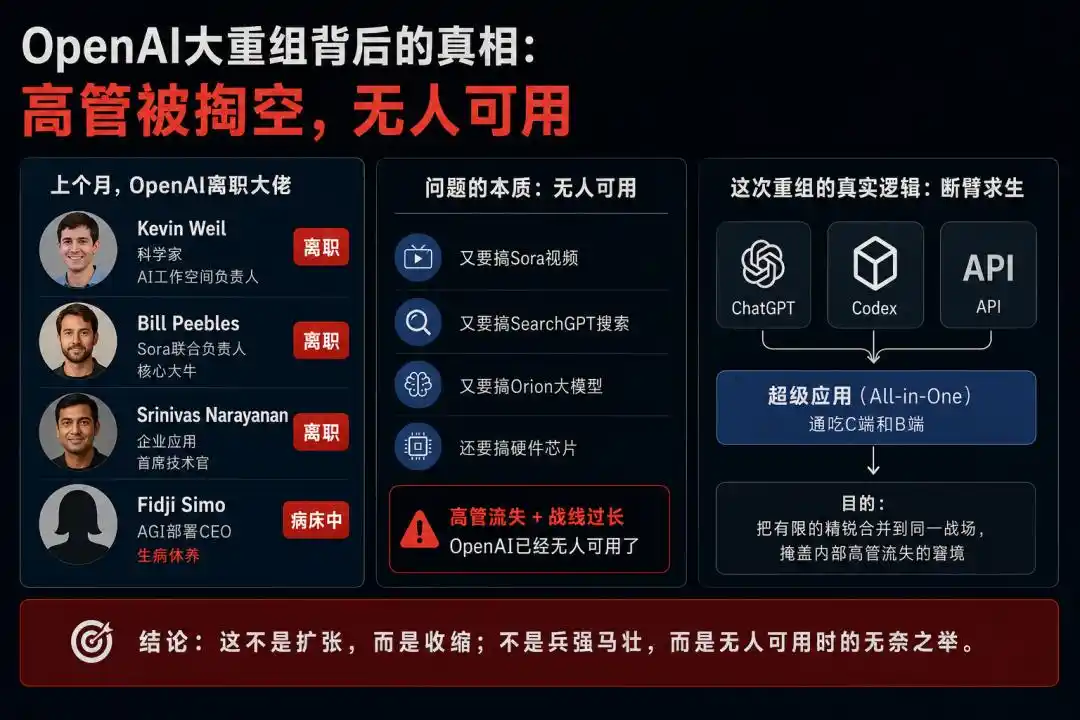
Just one month before this reorganization, a tsunami-like wave of personnel shockwaves hit OpenAI internally.

Last month, a batch of神仙大佬(god-tier experts) left OpenAI.

Kevin Weil, Head of Scientist AI Workspace at OpenAI, left!

Bill Peebles, the prominent co-lead and core expert of Sora, left!

Srinivas Narayanan, Chief Technology Officer for Enterprise Applications, left!

Not to mention, the "AGI Deployment CEO" Fidji Simo, who should be strategizing, is currently confined to a hospital bed, only able to remotely discuss plans with Brockman from her room.
So, the underlying logic of this major reorganization isn't because OpenAI is strong and well-staffed, but because they are running out of people.

After continuously losing multiple technical VPs, CTOs, and project leads, OpenAI's front lines have stretched too thin—they have to work on Sora video, SearchGPT search, the Orion large model, and even hardware chips.

Brockman mashing ChatGPT, Codex, and the API into one is essentially a断臂式(amputation-style) contraction.

Merging the limited elite forces onto the same battlefield, using a "Super App" that caters to both C端 and B端 to cover up the embarrassment of internal executive attrition.

Valuation Overtaken! Pursuers Have Arrived, the "Deadly 30 Seconds" in Capital Markets

What's making Altman and Brockman so anxious, even forcing them to undergo such a drastic reorganization on the eve of the IPO, is also the suffocating competitive pressure from outside.

Silicon Valley's AI throne changed hands just this week.

Anthropic's "Backstab": A $900 Billion Behemoth is Born

This very week, OpenAI's most fatal rival, Anthropic—founded by former employees who left—quietly finalized a new round of funding that颠覆行业格局(disrupted the industry landscape).

In this massive $30 billion funding round led by top consortia, Anthropic's valuation was directly pushed to a staggering $900 billion!
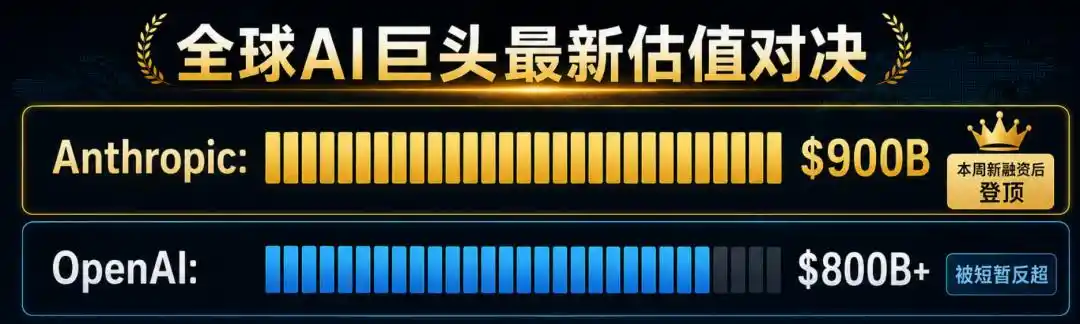
What does $900 billion mean? It surpasses OpenAI's latest valuation in the private market at a stroke, becoming the world's highest-valued independent AI unicorn!
Worse, Anthropic has executed precise降维打击(dimensionality reduction attacks) against OpenAI in the programming field. The Claude series models have been压得抬不起头(pressing OpenAI down) in long-context and code generation.

Technical talent is fleeing madly to Claude, capital is pouring madly into Anthropic. If OpenAI keeps clinging to its ChatGPT webpage that only chats, its empire could crumble on the eve of its public listing.

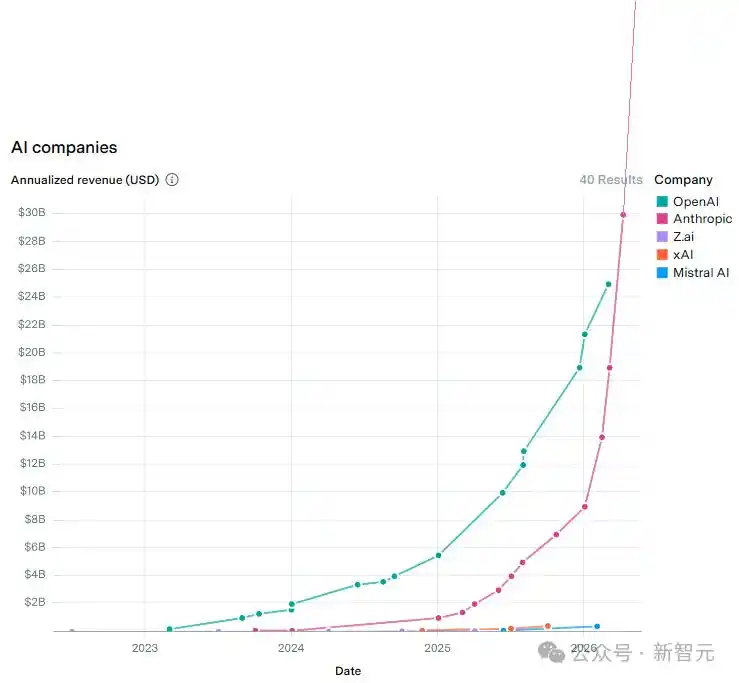
In May, Anthropic's annual recurring revenue has skyrocketed to $45 billion, with revenue growing 500% in just 5 months. This steep revenue curve is unprecedented in the entire history of tech business!

Google Unleashes Next Week, Time is Running Out for OpenAI

Besides the assassin from behind, Anthropic, the titan directly ahead—Google—is also死死盯着(dead set on) OpenAI.

Next week, the Google I/O annual developer conference will officially open. According to Silicon Valley sources, Sundar Pichai has prepared a basketful of new AI products targeting ChatGPT.
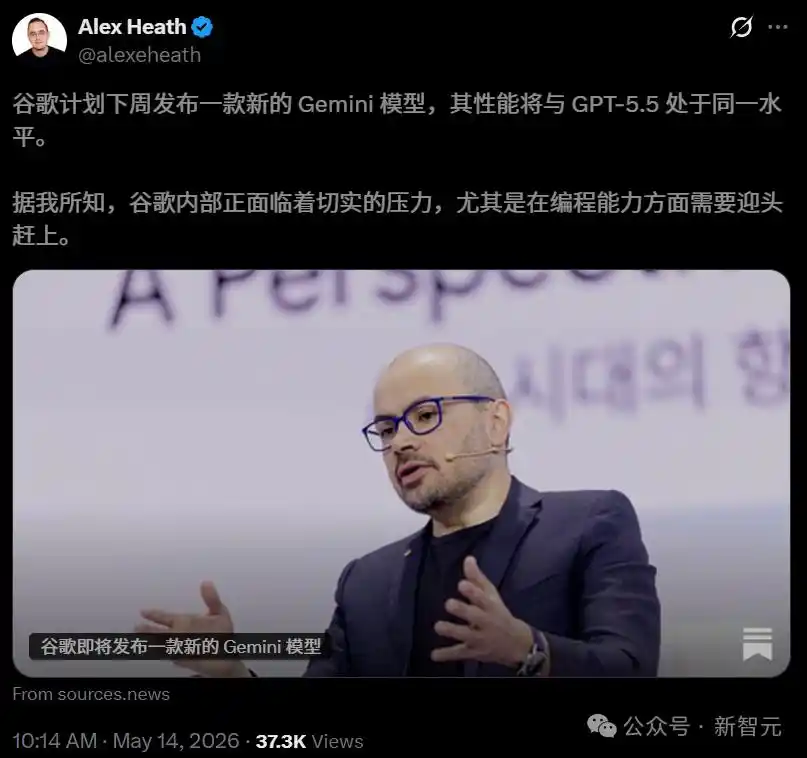
Last year, OpenAI stole Google's thunder by launching GPT-4o the day before Google I/O; this year, the hollowed-out OpenAI no longer has the spare capacity to stage a launch event for another "steal."

The only way is to adjust its organizational structure before Google unleashes its大招(big moves), telling Wall Street: Don't just look at Anthropic's high valuation, we're already working on a tripartite Super App.

The Final Battle: Frenzied Self-Rescue on the Eve of the IPO

According to WIRED's exclusive exposé, behind this reorganization lies another open secret in Silicon Valley: OpenAI plans to正式推进(advance its) IPO within this year.

For any super unicorn preparing to go public, capital markets most忌讳(dislike) "unclear storylines" and "internal executive infighting and attrition."

During the critical window for listing, if OpenAI's prospectus reads: We have a ChatGPT team, an independent Codex team, an API team, and these three teams fight daily for computing resources, Wall Street analysts would undoubtedly heavily discount the valuation.

Through this reorganization, Altman is telling an extremely sexy new story to the capital markets.

"We don't have messy products; we only have unified underlying capabilities. We are about to launch a super Agent that dominates all desktops, has 900 million weekly active users, and can automatically perform tasks for you."

Having Brockman, this highly respected founder in Silicon Valley, personally take charge of products is also meant to boost the confidence of shaky investors: Look, although some have left, the company's technical soul is still pioneering on the front lines.

From the non-profit lab founded in a San Francisco apartment to the commercial empire now frantically reorganizing for its IPO, OpenAI is navigating the most perilous voyage since its birth.

Brockman stepping forward is both answering a call in a crisis and making a last stand.

When ChatGPT, Codex, and the Atlas browser merge into that terrifying "Super App" in the near future, will we see the ultimate key to AGI?

Silicon Valley's battle for the AI throne has just entered its bloodiest stage of close combat.

References:

https://www.wired.com/story/openai-reorg-greg-brockman-product/

https://www.theinformation.com/briefings/openai-reorganizes-product-teams-around-unified-app-strategy?rc=epv9gi

This article is from the WeChat public account "新智元(New Zhiyuan)", author: 新智元(New Zhiyuan)

Crypto di tendenza

Domande pertinenti

QWhat is the most significant organizational change announced by OpenAI according to the article?

AThe most significant change is the merger of OpenAI's three core product lines—ChatGPT, Codex, and the API—into a single, unified product organization.

QWho is taking full, long-term control of all product strategy at OpenAI following the reorganization?

AGreg Brockman, the co-founder and President of OpenAI, is taking full, long-term control of all product strategy.

QWhat is the name of the 'ultimate weapon' or secret project that OpenAI is reportedly developing internally?

AOpenAI is reportedly developing a secret project internally referred to as the 'Super App,' which aims to unify ChatGPT, the Codex programming agent, and the unreleased 'Atlas' web browser into a single desktop application.

QWhat major external competitive pressure is mentioned as a key reason for OpenAI's urgent restructuring?

AA major external pressure is the recent $300 billion funding round for rival Anthropic, which valued the company at $900 billion, surpassing OpenAI's valuation and intensifying competition.

QWhat broader strategic goal does the reorganization aim to support, as stated in an internal memo?

AAccording to an internal memo from Greg Brockman, the reorganization aims to consolidate product efforts to advance into the 'Agentic Future' (the era of AI agents) with maximum focus and to achieve comprehensive victory in both consumer and enterprise markets.

Letture associate

Must-Watch Events Next Week|CLARITY Act Could Face Senate Vote; SpaceX, Circle to Report Earnings (8.3-8.9)

**Summary: Key Events and Developments to Watch (August 3-9)** The upcoming week is marked by significant financial disclosures, key legislative deadlines, and notable product updates. **Major Financial Events:** Several companies are scheduled to release their Q2 2026 earnings. American Bitcoin (ABTC) will report on August 3, followed by SpaceX and Hut 8 Mining Corp. on August 4, and Circle on August 5. Notably, a significant portion of SpaceX shares (up to 12% of total shares) will be unlocked on August 6 following their earnings release. **Key Legislative Deadline:** The U.S. Senate faces an August 7 deadline to secure 60 votes for the CLARITY Act, a bipartisan bill aiming to establish a federal regulatory framework for cryptocurrencies. The Senate may hold a full vote on the bill during the week. **Economic Data:** The U.S. July Non-Farm Payrolls report will be released on August 7, providing crucial labor market data. **Technology & Product Updates:** * **Shutdowns:** DeFi portfolio tracker Zapper and wallet app Ctrl Wallet will cease operations on August 3. * **Upgrades:** LayerZero will deprecate its v1 relayers on August 3. XRP Ledger's new version 3.3.0, featuring five new functions, is expected next week. * **AI:** Elon Musk announced that the advanced Grok 4.6 AI model is set for release around August 7. * **Bitcoin:** The BIP-110 forced signaling for a potential Bitcoin network change is scheduled to begin around August 8. **Other Notable Events:** Chinese robotics firm Unitree Tech has set its preliminary price inquiry for its IPO for August 5. South Korean exchange Upbit will delist AQT and AERGO tokens on August 3.

marsbit24 min fa

Must-Watch Events Next Week|CLARITY Act Could Face Senate Vote; SpaceX, Circle to Report Earnings (8.3-8.9)

marsbit24 min fa

Stocks Are Plummeting More Sharply Than Cryptocurrencies. Where Has the Money Gone?

Stock Markets Plunge Deeper Than Cryptocurrencies: Where Did the Money Go? In late July, Seoul's Kospi index triggered circuit breakers for two consecutive days, plummeting over 40% from its June high. The collapse was led by heavyweight stocks like SK Hynix, whose record profits still disappointed investors, and devastating leveraged ETFs, with one major product losing over 83% of its value. This signaled a global, forced deleveraging targeting the most crowded trades. Interestingly, while stocks exhibited extreme volatility akin to crypto markets, Bitcoin rose nearly 15% in July after a prior steep drop. Analysis shows the money fleeing equities did not flow into Bitcoin. Instead, Bitcoin had already absorbed its sell-off in May-June, when U.S. spot Bitcoin ETFs saw historic outflows. The true safe-haven beneficiary was gold, whose price rose over 20% year-on-year, highlighting a decoupling between Bitcoin and gold as "digital gold." The sell-off was a targeted unwinding of leveraged positions in tech and semiconductors, accelerated by broker-dealer risk management and shifts in the AI narrative, including new competition from Chinese memory chipmakers. The retreat path was clear: from high-valuation tech stocks to cash and U.S. Treasuries, then to gold. For Bitcoin to attract sustained institutional inflows, conditions like eased global liquidity pressure, a "soft-landing" Fed rate cut, and U.S. regulatory clarity via legislation like the stalled CLARITY Act are needed. Currently, Bitcoin is not a safe haven but an already-cleared asset. Its low correlation with tech stocks, however, makes it a potential diversification play for institutional portfolios once the storm passes. The money isn't here yet, but the positioning is underway.

marsbit24 min fa

Stocks Are Plummeting More Sharply Than Cryptocurrencies. Where Has the Money Gone?

marsbit24 min fa

In Conversation with Ray Dalio: We Are Currently in an AI Bubble, with 1% of My Portfolio in Bitcoin

Ray Dalio, founder of Bridgewater Associates, warns in an interview that the current AI boom shows classic bubble characteristics, which could lead to significant economic downturns as seen in past cycles like 1929 or 2000. He explains that speculative enthusiasm, fueled by debt and overvaluation, often precedes a crash when rising rates or taxation force asset sales, causing widespread losses and recession. Dalio also outlines his "Big Cycle" theory, describing an approximate 80-year pattern where widening wealth gaps, massive government deficits, and shifting geopolitical power (like China's rise) create internal conflict and global instability. He emphasizes that we are in a late-cycle, transitional phase where traditional powers like the US and UK face decline. For personal wealth protection, Dalio advises diversification beyond cash into assets like stocks, bonds, real estate, and particularly gold, which he prefers over Bitcoin. While he holds about 1% of his portfolio in Bitcoin as a non-printable hard asset, he views gold as more secure from technological or governmental threats. Regarding AI's impact, Dalio believes it will disproportionately benefit capital owners, worsening inequality by replacing both physical and cognitive labor. He suggests that human intuition and emotional intelligence, combined with AI, will be key for future workers. On taxation, Dalio argues that wealth taxes are impractical and risk triggering asset sell-offs, reducing productive investment. He points to the UK as a cautionary example of debt, low productivity, and political strife. Geopolitically, Dalio foresees a more regionalized world, with the US showing weakness in prolonged conflicts like with Iran, akin to past imperial declines. The ideal outcome, he suggests, is coexisting powerful blocs (e.g., Americas, China-Asia Pacific) without major war.

marsbit4 h fa

In Conversation with Ray Dalio: We Are Currently in an AI Bubble, with 1% of My Portfolio in Bitcoin

marsbit4 h fa

Daily 7.2 Trillion KRW: Foreign Capital's Record Net Buying on Friday! Wall Street Says Headwinds for Korean Stock Fund Flows Have Subsided

South Korean stock market sees a dramatic shift in fund flows. On July 31, foreign investors made a record net purchase of approximately KRW 7.2 trillion in KOSPI stocks, marking a fundamental reversal from the persistent large-scale net outflows seen in previous months. This contributed to a significant narrowing of foreign net selling in July to KRW 9.8 trillion, down sharply from KRW 48.4 trillion in June and KRW 44.5 trillion in May. Simultaneously, domestic institutional pressure eased. South Korean pension funds and asset managers turned to a net buying position in July, purchasing KRW 1.0 trillion worth of KOSPI shares, contrasting with net sales in May and June. Market volatility is expected to be dampened by new financial regulations. Effective July 31, the Financial Services Commission tightened access for retail investors to single-stock leveraged ETFs by raising the minimum cash deposit requirement. Trading volumes for these products subsequently dropped to about 50% of their monthly average. Citigroup Research maintains its year-end KOSPI target of 10,000 points. The firm cites several supportive factors: the substantial easing of headwinds from capital outflows, a robust fundamental outlook for the semiconductor sector, historically low market valuations, strong economic fundamentals, and the potential for policy support from financial authorities if needed.

marsbit4 h fa

Daily 7.2 Trillion KRW: Foreign Capital's Record Net Buying on Friday! Wall Street Says Headwinds for Korean Stock Fund Flows Have Subsided

marsbit4 h fa

Trading

Spot

Articoli Popolari

Come comprare ACE

Benvenuto in HTX.com! Abbiamo reso l'acquisto di Fusionist (ACE) semplice e conveniente. Segui la nostra guida passo passo per intraprendere il tuo viaggio nel mondo delle criptovalute.Step 1: Crea il tuo Account HTXUsa la tua email o numero di telefono per registrarti il tuo account gratuito su HTX. Vivi un'esperienza facile e sblocca tutte le funzionalità,Crea il mio accountStep 2: Vai in Acquista crypto e seleziona il tuo metodo di pagamentoCarta di credito/debito: utilizza la tua Visa o Mastercard per acquistare immediatamente FusionistACE.Bilancio: Usa i fondi dal bilancio del tuo account HTX per fare trading senza problemi.Terze parti: abbiamo aggiunto metodi di pagamento molto utilizzati come Google Pay e Apple Pay per maggiore comodità.P2P: Fai trading direttamente con altri utenti HTX.Over-the-Counter (OTC): Offriamo servizi su misura e tassi di cambio competitivi per i trader.Step 3: Conserva Fusionist (ACE)Dopo aver acquistato Fusionist (ACE), conserva nel tuo account HTX. In alternativa, puoi inviare tramite trasferimento blockchain o scambiare per altre criptovalute.Step 4: Scambia Fusionist (ACE)Scambia facilmente Fusionist (ACE) nel mercato spot di HTX. Accedi al tuo account, seleziona la tua coppia di trading, esegui le tue operazioni e monitora in tempo reale. Offriamo un'esperienza user-friendly sia per chi ha appena iniziato che per i trader più esperti.

68 Totale visualizzazioniPubblicato il 2024.12.10Aggiornato il 2026.06.02

Come comprare ACE

Discussioni

Benvenuto nella Community HTX. Qui puoi rimanere informato sugli ultimi sviluppi della piattaforma e accedere ad approfondimenti esperti sul mercato. Le opinioni degli utenti sul prezzo di ACE ACE sono presentate come di seguito.

活动图片













