Brazil Moves To Ban Algorithmic Stablecoins While $SUBBD Disrupts Creator Economy

bitcoinistPubblicato 2026-02-05Pubblicato ultima volta 2026-02-05

Introduzione

Brazil's Central Bank is drafting regulations that would require stablecoins to be fully backed by reserves, effectively banning algorithmic models. This aligns with a global regulatory shift away from speculative financial instruments. Concurrently, capital is rotating towards utility-focused tokens with tangible revenue models. The SUBBD Token ($SUBBD) is highlighted as a project leveraging AI and Web3 to disrupt the $85 billion creator economy by reducing platform fees and decentralizing content monetization. It has raised over $1.4 million in its presale and offers staking rewards, positioning itself as a deflationary utility token amidst a market moving towards compliant, infrastructure-based crypto assets.

Trusted Editorial content, reviewed by leading industry experts and seasoned editors. Ad Disclosure

Quick Facts:

  • ➡️ Brazil’s Central Bank is drafting rules requiring stablecoins to be 100% backed by reserves, effectively banning algorithmic models.
  • ➡️ The regulation signals a global shift away from speculative financial engineering toward compliant, backed assets.
  • ➡️ SUBBD Token ($SUBBD) leverages AI and Web3 to reduce creator fees and decentralize the $85B content industry.
  • ➡️ Capital is rotating from regulatory-risk sectors into utility projects with tangible revenue models and infrastructure.

Brazil’s Central Bank (BCB) is drafting regulations that could wipe algorithmic stablecoins off the map in Latin America’s largest crypto market. Following Law 14,478 (the ‘Crypto Assets Law’), regulators have taken a rigid stance: asset-referenced tokens must be fully backed. No arbitrage tricks, no complex debt positions—just 1:1 reserves. This pivot threatens the very existence of decentralized stablecoins in the region.

It puts Brazil in lockstep with the EU’s MiCA framework, prioritizing safety over financial experiments. For issuers like Ethena ($USDe), or ghosts of cycles past like Terra’s $UST, the compliance window is shutting fast.

The BCB’s consultation papers suggest that without direct convertibility to the Real or a foreign currency, “stable’ assets face an outright ban. That’s huge for DeFi liquidity, considering Brazil is a global heavyweight in stablecoin adoption.

As regulatory walls close in on financial engineering, smart money is rotating toward sectors with actual cash flow. The speculative premium on ‘money games’ is vanishing. In its place? Infrastructure projects solving real headaches.

This rotation is starkest in the $250B creator economy, where platform risk is a daily reality, not a theory. Amidst this flight to quality, SUBBD Token ($SUBBD) has emerged, merging AI efficiency with blockchain transparency to dismantle the monopolistic fees of Web2.

AI Integration Solves The $85 Billion Creator Monetization Gap

While regulators squeeze complex derivatives, the content sector faces a different crisis: middlemen taking up to 70% of the cut. SUBBD Token ($SUBBD) tackles this by using Ethereum architecture to cut out the intermediary, but it goes beyond simple payments.

The platform aims to integrate proprietary AI tools, like an AI Personal Assistant and voice cloning tech, directly into the workflow. Suddenly, influencers can scale output without bloating their costs.

Here’s the difference. Most ‘creator coins’ are just speculative toys. SUBBD Token ($SUBBD) acts as the fuel for an entire ecosystem. By gating exclusive content and powering AI tools, the project creates deflationary pressure that algorithmic stablecoins often lack.
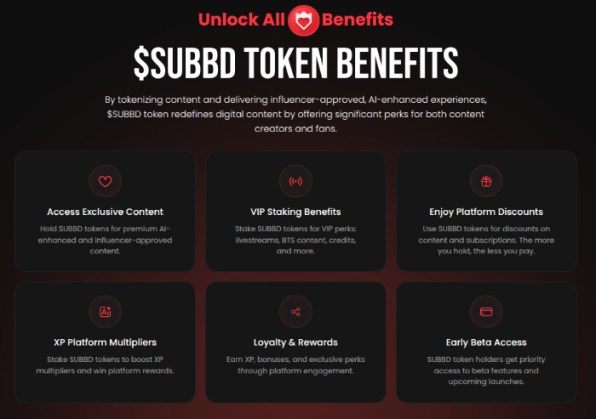
Creators aren’t just paid in crypto; they use the infrastructure to actually build their product.

The governance model flips the script. $SUBBD holders vote on features and onboarding, shifting power from opaque corporate algorithms back to the community. For investors tired of regulatory headaches in DeFi, this looks like a pivot to ‘revenue-based’ assets. It’s a hedge against the macro volatility rocking purely speculative markets.

FIND OUT MORE ABOUT SUBBD TOKEN ON ITS OFFICIAL PAGE

$SUBBD Presale Momentum Builds Amid Shift To Utility Tokens

The market’s hunger for utility is showing up in the numbers. SUBBD Token has already raised over $1.4M in its presale. With the token currently priced at $0.05749, early entrants see potential upside compared to legacy platforms lacking Web3 integration. However, a price increase is looming, so if you want in do so before the rise.

Not sure how to buy in? Check out our ‘How to Buy SUBBD Token‘ guide.

There’s a clear divergence in the market: DeFi TVL is stagnant, but AI-crypto hybrids are cooking.

It helps that the staking structure discourages ‘mercenary’ capital. $SUBBD offers a fixed 20% APY for the first year. Crucially, this yield comes from ecosystem growth, not the fragile arbitrage loops Brazilian regulators are hunting down.

Plus, stakers get XP multipliers and ‘Daily BTS drops,’ gamifying the experience (and aligning incentives).

Built on Ethereum, $SUBBD taps into deep liquidity while offering a specialized layer for content monetization. As Brazil forces the market to grow up, projects with clear revenue models are positioning themselves to capture capital fleeing regulatory grey zones.

CHECK OUT THE $SUBBD PRESALE ON ITS OFFICIAL PAGE

This article is not financial advice. Cryptocurrency markets are volatile and involve significant risk. Regulations regarding stablecoins and crypto assets vary by jurisdiction. Always conduct your own due diligence before investing.

Editorial Process for bitcoinist is centered on delivering thoroughly researched, accurate, and unbiased content. We uphold strict sourcing standards, and each page undergoes diligent review by our team of top technology experts and seasoned editors. This process ensures the integrity, relevance, and value of our content for our readers.

Ben Wallis

Follow

Ben is a freelance writer, and AI editor specializing in crypto developments (mainly altcoins) and the intricate ways global economics shape the digital asset space. His B.Ed. in Education provides a unique foundation for his writing, enabling him to distill complex crypto concepts and market shifts into clear, digestible insights. This skill is key to helping readers adapt and apply their understanding to the ever-evolving world of crypto investment. Passionate about making crypto accessible, Ben crafts content designed to educate a broad audience, from current market events to the essential foundational knowledge that underpins them. His goal is to empower readers through understanding. When he’s not immersed in crypto analysis and breaking down complex topics, Ben is an avid Pokémon fan and enjoys all things Disney.

Full Profile

Related Posts

DDC Extends Its Bitcoin Accumulation Streak: The $LIQUID Presale Brings Smoother Cross-Chain Actions

Bhutan Offloads $22M in Bitcoin as Mining Costs Surge: Institutional Eyes Shift to High-Yield L2s

Bullish Reports Massive Q4 Loss; Investors Pivot to $BMIC Presale

Nevada Fails To Stop Coinbase Prediction Markets: $LIQUID Brings Liquidity Together

Buterin Bites Back At ‘Copy-Paste’ $ETH Clones: $HYPER Presale The Solution That’s Needed?

Buterin Offloads $ETH As Prices Dip: Why Capital’s Rotating Into The $MAXI Presale

Domande pertinenti

QWhat is the main regulatory change Brazil's Central Bank is proposing for stablecoins?

ABrazil's Central Bank is drafting regulations that require stablecoins to be 100% backed by reserves, effectively banning algorithmic stablecoin models that lack direct convertibility to the Real or a foreign currency.

QHow does the SUBBD Token ($SUBBD) aim to disrupt the creator economy?

ASUBBD Token leverages AI and Web3 technology to reduce platform fees for creators, decentralize the content industry, and provide tools like AI Personal Assistants and voice cloning to help scale content creation efficiently.

QWhat is the current price of $SUBBD in its presale, and what incentive is offered to early stakers?

AThe token is currently priced at $0.05749 in its presale. Early stakers are offered a fixed 20% APY for the first year, along with XP multipliers and 'Daily BTS drops' to gamify and incentivize participation.

QWhy are algorithmic stablecoins facing increased regulatory scrutiny globally?

AAlgorithmic stablecoins are facing scrutiny because they often rely on complex financial engineering and arbitrage mechanisms instead of tangible reserves, posing higher risks of instability and loss for investors, as seen in the collapse of Terra's UST.

QWhat problem in the $250B creator economy does SUBBD Token specifically address?

ASUBBD Token addresses the problem of middlemen and platforms taking up to 70% of creators' earnings by using blockchain to cut out intermediaries and providing a decentralized monetization ecosystem with lower fees.

Letture associate

The Shutdown of Claude Mythos Revealed the True Cost of Renting AI to Me

The sudden shutdown of Claude Mythos this week starkly highlights a critical, often overlooked risk for founders: when your core capability relies entirely on someone else's platform, your fate is not in your own hands. The key question becomes: who truly owns the intelligence your product depends on? For years, the debate around open-source models focused on cost. Now, the evidence is clear: fine-tuned open-source models can achieve frontier-level quality for specific, mission-critical tasks at a fraction of the cost. However, the deeper issue is control. Relying on a third-party API is like renting; it works until the landlord changes the rules, raises the rent, or asks you to leave—as Mythos experienced. The lesson is not to stop using frontier models—they are incredible infrastructure. The goal is ownership. Ownership means starting with a powerful open-source model and shaping it around what makes your company unique: your data, workflows, domain expertise, and definition of "good." Over time, the model becomes less generic and more reflective of your business, creating durable value. The optimistic conclusion is that AI's future doesn't hinge on one superior model. There is no single frontier. The frontier includes proprietary models, models fine-tuned on company-specific knowledge, specialized models for narrow problems, and intelligent routers orchestrating model ensembles. The most interesting development is not models getting smarter, but intelligence becoming increasingly customizable. The winning companies will be those that transform intelligence into a unique, owned asset. Looking ahead, the vision is not one model dominating all, but many teams owning the part of the frontier that matters most to them.

marsbit21 min fa

The Shutdown of Claude Mythos Revealed the True Cost of Renting AI to Me

marsbit21 min fa

Tiger Research: U.S. Strategic Bitcoin Reserve - Should the Market Be Happy or Disappointed?

Tiger Research analyzes the evolution of U.S. legislative efforts regarding a strategic Bitcoin reserve, concluding the market impact is limited in the short term but potentially positive long-term. The core event was a March 2025 executive order by former President Trump, which designated confiscated Bitcoin as a strategic reserve and promised not to sell existing holdings (approx. 190k BTC). As it contained no mandate to purchase new Bitcoin, the market reacted negatively, with prices dropping 5.7%. Legislative history shows a significant retreat from initial ambitions. The 2024 "BITCOIN Act" proposed mandatory purchases of 1 million BTC over five years. Reintroduced in 2025, it stalled due to high fiscal costs, concerns over dollar hegemony, and opposition from the Treasury Secretary. The current frontrunner, the 2026 "American Retirement and Monetary Advancement (ARMA) Act," is a compromise. It lacks any purchase requirement, instead focusing on consolidating existing government-held Bitcoin and legally prohibiting its sale for at least 20 years. While ARMA has higher passage odds due to bipartisan support and no purchase mandate, its immediate market effect is neutral. It eliminates potential government selling pressure but creates no new demand. The long-term significance is that formally establishing Bitcoin as a national reserve asset in law could later reignite debates on mandatory purchases. Therefore, the path to a government buyer is longer than initially priced by the market, but the directional narrative remains intact.

marsbit24 min fa

Tiger Research: U.S. Strategic Bitcoin Reserve - Should the Market Be Happy or Disappointed?

marsbit24 min fa

US Stock Market Trend (June 16): SpaceX Rises 42% in Two Days, New Fed Chairman Takes Office Today

**U.S. Stocks Trend (June 16): SpaceX Soars 42% in Two Days, New Fed Chair Takes Office Today** Markets surged on Monday following former President Trump's social media announcement of a completed U.S.-Iran deal to reopen the Strait of Hormuz, pending a June 19 signing. The news triggered a broad risk-on rally: oil prices crashed, tech stocks soared, bond yields fell, and defensive sectors lagged. **Market Performance:** The Nasdaq jumped 3.07%, led by semiconductor stocks like Micron (+9.2%). The S&P 500 gained 1.65%, and the Dow rose 0.92% to a record high. However, the Russell 2000 small-cap index underperformed (+0.72%). SpaceX continued its hot streak, rising another 5% pre-market after disclosures of large buys by an Australian billionaire and Cathie Wood's ARK. Boeing also rallied on the transportation optimism. Conversely, energy stocks like Chevron fell over 3% on the oil price plunge, with other defensive sectors also selling off. The day's action showed a clear rotation of funds from energy/defensive plays into AI and tech narratives. **Macro & Outlook:** The VIX fear index fell 8.37%. Treasury yields declined, and WTI crude dropped over 5%. Attention now shifts to a packed schedule: the Bank of Japan is widely expected to hike rates to 1.0% on Tuesday. The Fed's June meeting concludes Wednesday, marking new Chair Wash's debut. While rates are expected to hold, his tone on stubborn inflation and the "dot plot" will be crucial for gauging the 2024 rate path. The formal Iran deal signing is set for Friday. **Trend Perspective:** While the peace deal is a genuine positive, Monday's explosive rally may have gotten ahead of itself, pricing in a swift resolution to inflation concerns. The shortened trading week faces a triple test: BoJ tightening, the Fed's policy stance, and deal implementation details. Tech and semiconductors, which led the surge, remain vulnerable to any disappointment from these key events. The real price discovery begins with the central banks' communications this week.

marsbit45 min fa

US Stock Market Trend (June 16): SpaceX Rises 42% in Two Days, New Fed Chairman Takes Office Today

marsbit45 min fa

Trading

Spot
Futures
活动图片