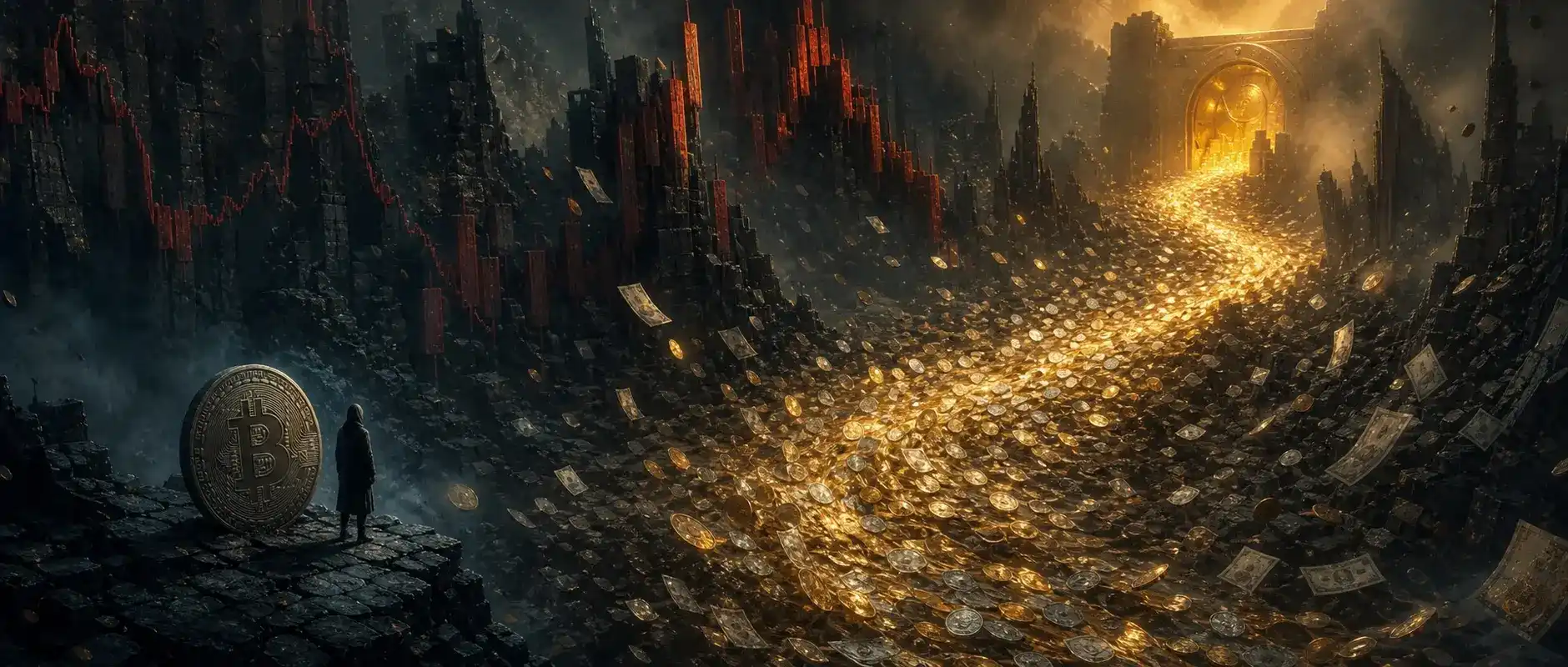
Both Are for Hedging Risks, Why Can't Bitcoin Outperform Gold?

marsbitPubblicato 2026-01-26Pubblicato ultima volta 2026-01-26

Introduzione

The article explores why Bitcoin has underperformed gold as a safe-haven asset during recent geopolitical tensions, such as those triggered by Trump’s tariff threats and Arctic instability. While gold rose 8.6%, Bitcoin fell 6.6%, challenging its "digital gold" narrative. According to NYDIG research, Bitcoin’s high liquidity and 24/7 trading make it function like an "ATM" during crises—easily sold for quick cash—rather than a store of value. In contrast, gold is held rather than liquidated, supported by strong structural demand from central banks. The analysis concludes that gold remains the preferred hedge for short-term, episodic risks, while Bitcoin is better suited for long-term concerns like fiat debasement or systemic financial crises.

Author:Francisco Rodrigues

Compiled by: Deep Tide TechFlow

Deep Tide Introduction:

Bitcoin has long been touted as "digital gold," but this narrative is facing a severe challenge amid recent market volatility triggered by Trump's tariff policies and geopolitical tensions in the Arctic. While gold prices have steadily climbed and approached the $5,000 mark, Bitcoin has performed sluggishly.

Research from NYDIG (New York Digital Group) points out that Bitcoin's high liquidity and 24/7 trading characteristics make it an "ATM" for investors to exchange for cash during panic periods, rather than a safe haven. This article delves into why Bitcoin is losing to traditional gold as a hedge against short-term policy shocks.

Full text as follows:

During uncertain times, Bitcoin behaves more like an "ATM machine," with investors quickly selling it to raise cash.

Key Points:

  • Hedging Disconnect: Amid recent geopolitical tensions, Bitcoin fell by 6.6%, while gold rose by 8.6%. This strongly demonstrates Bitcoin's continued vulnerability during periods of market stress.
  • "ATM" Effect: In uncertain times, Bitcoin acts more like an "automated teller machine (ATM)"—investors rapidly sell it to raise cash quickly, contradicting its reputation as a "stable digital asset."
  • Misalignment of Hedging Properties: Gold remains the preferred hedge against short-term risks, while Bitcoin is better suited for long-term monetary risks and geopolitical uncertainties spanning years rather than weeks.

In theory, Bitcoin should shine during uncertain times due to its censorship-resistant, hard-money properties. In practice, however, it has become the first asset investors sell when things get tense.

Over the past week, as geopolitical tensions escalated—following Trump's threats to impose tariffs on NATO allies over the Greenland acquisition and speculation about potential military action in the Arctic—markets retreated, and volatility spiked sharply.

Since January 18, when Trump first threatened tariffs in his push to acquire Greenland, Bitcoin has depreciated by 6.6%, while gold has risen by 8.6%, hitting new highs near $5,000.

The reason lies in how each asset fits into investment portfolios during stressful periods. Bitcoin's round-the-clock trading, deep liquidity, and instant settlement features make it the easiest asset for investors to reduce when they need to raise cash quickly.

According to Greg Cipolaro, Global Head of Research at NYDIG, gold, though less accessible, tends to be held rather than sold. This makes Bitcoin behave more like an "ATM machine" during panic periods, undermining its reputation as "digital gold."

"During periods of stress and uncertainty, liquidity preference dominates, and this dynamic hurts Bitcoin far more than gold," Cipolaro wrote.

"Despite its liquidity relative to its size, Bitcoin maintains higher volatility and is reflexively sold off as leverage is liquidated. Thus, in risk-off environments, regardless of its long-term narrative, it is often used to raise cash, reduce value at risk (VAR), and de-risk portfolios, while gold continues to serve as a true liquidity sink," he added.

The behavior of large holders (whales) doesn't help either.

Central banks have been buying gold at record levels, creating strong structural demand. Meanwhile, according to NYDIG's report, long-term Bitcoin holders are selling.

On-chain data shows that vintage coins (tokens that have not moved for a long time) are consistently flowing to exchanges, indicating a steady stream of selling pressure. This "seller overhang" suppresses price support. Cipolaro added, "The gold space exhibits the exact opposite dynamic. Large holders, especially central banks, continue to hoard the metal."

Another reason for this mismatch is how the market prices risks. The current turmoil is seen as episodic, driven by tariffs, policy threats, and short-term shocks. Gold has long been regarded as a hedge against such uncertainties.

In contrast, Bitcoin is better suited for addressing long-term concerns, such as fiat debasement or sovereign debt crises.

"Gold excels during moments of immediate loss of confidence, war risks, and fiat debasement that do not involve a complete systemic collapse," Cipolaro added.

"In contrast, Bitcoin is better suited for hedging long-term monetary and geopolitical disorder, as well as the slow erosion of trust over years rather than weeks. As long as the market perceives the current risks as dangerous but not yet fundamental, gold remains the preferred safe-haven asset."


Domande pertinenti

QWhy did Bitcoin's price drop while gold's price rose during recent geopolitical tensions?

ABitcoin dropped 6.6% while gold rose 8.6% because Bitcoin's high liquidity and 24/7 trading make it an easy asset to sell for quick cash during panic, whereas gold is held as a stable store of value and benefits from structural demand like central bank purchases.

QWhat is the 'ATM effect' mentioned in the article regarding Bitcoin?

AThe 'ATM effect' refers to Bitcoin being treated like an automatic teller machine during uncertain times, where investors quickly sell it to raise cash, undermining its reputation as a 'digital gold' or safe-haven asset.

QHow do the holding behaviors of large investors differ between Bitcoin and gold?

ALarge Bitcoin holders (whales) and long-term holders are selling, creating steady sell pressure, while central banks and large gold investors are accumulating gold, creating strong structural demand and price support.

QWhat types of risks is gold better suited to hedge against compared to Bitcoin?

AGold is better for hedging short-term, episodic risks like immediate loss of confidence, war threats, or policy-driven market shocks, whereas Bitcoin is more suited for long-term concerns such as fiat debasement or sovereign debt crises over years, not weeks.

QWhy does Bitcoin's liquidity work against it in risk-off environments?

ABitcoin's high liquidity and 24/7 trading allow investors to easily and quickly sell it to reduce risk exposure or raise cash during market stress, leading to reflexive selling and volatility, unlike gold which is held and not as readily liquidated.

Letture associate

Not Speculation but a Necessity: The 4 Unique Values of Prediction Markets

Polymarket's recent $4 billion funding round and soaring valuation of $15 billion highlight the explosive growth of prediction markets, with trading volume reaching $25.7 billion in March 2026—a 10.6% monthly increase. This analysis argues that prediction markets serve critical non-speculative functions, positioning them as essential tools rather than mere gambling platforms. Prediction markets offer four unique values: entertainment consumption, insurance-like protection, risk hedging, and truth discovery. Firstly, they stimulate economic activity by engaging users in event-based betting, similar to the broader sports industry. Secondly, they act as a form of decentralized insurance, allowing users to hedge against specific, well-defined risks (e.g., weather events) transparently and without traditional overhead costs. Thirdly, institutions and individuals use these markets to hedge against geopolitical and commodity price risks, as demonstrated during the U.S.-Iran conflict and the launch of 24/7 commodity markets on platforms like Kalshi. Finally, prediction markets counter media bias by aggregating crowd-sourced information, often achieving 30% higher accuracy than surveys due to users' vested interests. Experts like Bitwise’s Jeff Park and SIG’s Jeff Yass emphasize the markets' role in risk transfer and financial innovation. As these platforms evolve, they are poised to become trillion-dollar markets, offering more reliable, decentralized mechanisms for information pricing and risk management.

marsbit9 min fa

Not Speculation but a Necessity: The 4 Unique Values of Prediction Markets

marsbit9 min fa

Interview with Jeff Hoffman: How Web3 and AI Are Reshaping the Trillion-Dollar Social Travel Market

Interview with Jeff Hoffman: Web3 and AI Reshaping the Trillion-Dollar Social Travel Market Jeff Hoffman, co-founder of Priceline, discusses how Web3 and AI are transforming the social travel industry. He highlights that the current travel market is fragmented and inefficient, dominated by traditional online travel agencies (OTAs) that act as intermediaries with opaque models. Web3 introduces direct connections, transparency, and faster settlements, shifting value back to travelers. Key trends driving this change include demand for flexible rewards, digital payments, and trust in communities over ads. Hoffman joined Staynex not for its Web3 label, but because it addresses industry inefficiencies by integrating booking, payments, AI-driven itineraries, and rewards into a single ecosystem. This Web2.5 model combines Web2 scale with Web3 incentives. He emphasizes the team’s focus on execution over hype as a key reason for his involvement. Looking ahead, blockchain will enable transparent rewards and seamless cross-border payments, while AI provides personalization. Together, they will turn travel into a continuous relationship rather than a transaction. Hoffman predicts traditional OTAs will persist, but value will shift to platforms that own payment, loyalty, and community networks. Social travel represents a significant, underestimated opportunity in Web3.

marsbit39 min fa

Interview with Jeff Hoffman: How Web3 and AI Are Reshaping the Trillion-Dollar Social Travel Market

marsbit39 min fa

Trading

Spot
Futures
活动图片