In recent days, with the listing effect of Binance, Meme tokens on BSC have once again gained market attention. The massive wealth effect and traffic have refocused the market on this five-year-old public chain. However, looking beyond the surface and re-examining, what we see is actually a qualitative transformation of an ecosystem.
If the initial BNB Chain in 2020 primarily accumulated its initial users and transactions from the spillover due to high gas fees and low efficiency on ETH, then 2025 was a critical year for BNB Chain to proactively achieve self-transcendence.
Looking back on this year, BNB Chain is no longer just a cheaper alternative but has begun to possess the fundamental capability to stably and sustainably host real financial and payment scenarios.
New highs were reached in users, liquidity, and trading volume. TVL grew by 40.5%, the on-chain stablecoin market cap increased by over 100% to $14 billion, and RWA asset scale exceeded $1.8 billion.
From the results, the on-chain activity of BNB Chain is not a short-term burst but shows a continuous and stable growth trend.
Core scenarios such as annual transactions, stablecoins, payments, and RWA maintained high-frequency usage. The network had to operate continuously under long-term high load, rather than relying on occasional peaks to prove its performance. It was in this real production environment that BNB Chain withstood the test, achieving zero downtime for the year and maintaining stable operation amidst high-intensity transactions and asset transfers.
Supporting these figures is not a single technological breakthrough but a year-long continuous advancement in underlying engineering capabilities. In 2025, BNB Chain underwent deep iterations of its underlying protocols and clients. Block time and throughput capacity were systematically restructured, endowing the chain itself with high concurrency, low latency, and long-term scalable execution capabilities. Block time was compressed from the previous 3-second level to sub-second levels, finality was significantly advanced, and network bandwidth was expanded to over 133 million gas/second, enabling the chain to continuously handle daily loads as high as 5 trillion gas in high-concurrency environments. Coupled with the seamless integration of the stablecoin payment network and the large-scale introduction of compliant RWA assets, this helped BNB Chain achieve key leaps in technology, assets, and ecology.
Driven by multiple factors, BNB Chain has been able to touch the threshold of infrastructure for billions of users. Moreover, it is no longer just serving crypto-native users but has begun to provide a blockchain foundation that can be accepted and used by the broader public and the real financial system.
The significance of 2025 for BNB Chain lies not in any single extreme metric, but in validating one thing: under real, sustained, high-intensity usage conditions, a public chain can be operated as infrastructure, rather than remaining in the theoretical performance stage. It is this experience that forms the practical foundation for the 2026 technical roadmap—higher TPS, lower latency, fairer execution, and more完善的 middleware and development tools.
2025: With the Highest Daily Active Users, Is Technology Still Important?
During the AMA at BNB Chain's fifth-anniversary celebration, CZ stated that attracting more Web3 users requires powerful and attractive products for projects.
This statement aptly summarizes the strategic主线 (main thread) of BNB Chain's development throughout 2025.
Going back to the beginning of 2025, in the context of modularization significantly reducing costs and L2s being everywhere, BNB Chain's narrative was not particularly sexy, and its moat was not wide. BNB Chain did not rush to chase trends but focused on underlying technological restructuring, laying the groundwork for its explosion in the second half of the year and its climb to the top in daily active users.
Through the Lorentz and Maxwell hard forks, BNB Chain's block time was compressed from 3 seconds to 0.75 seconds, and with the upcoming Fermi fork, further down to 0.45 seconds. Network throughput capacity increased to the level of 133 million gas/s, transaction confirmation time entered the sub-2-second range, MEV sandwich attacks were reduced by 95%, and transaction costs were significantly lowered in high-concurrency environments.
For some users, these changes might seem like mere parameter improvements—'faster'. But in practical operation, the shortening of block time made high-frequency interactive applications usable for the first time. The increase in throughput capacity meant the chain no longer had to throttle during sudden traffic spikes. The reduction in confirmation time and fees directly changed the psychological expectation of whether on-chain operations are worth it for ordinary users.
In other words, the work in the first half of the year solved a core contradiction for BNB Chain: how to achieve performance comparable to centralized servers without sacrificing decentralization.
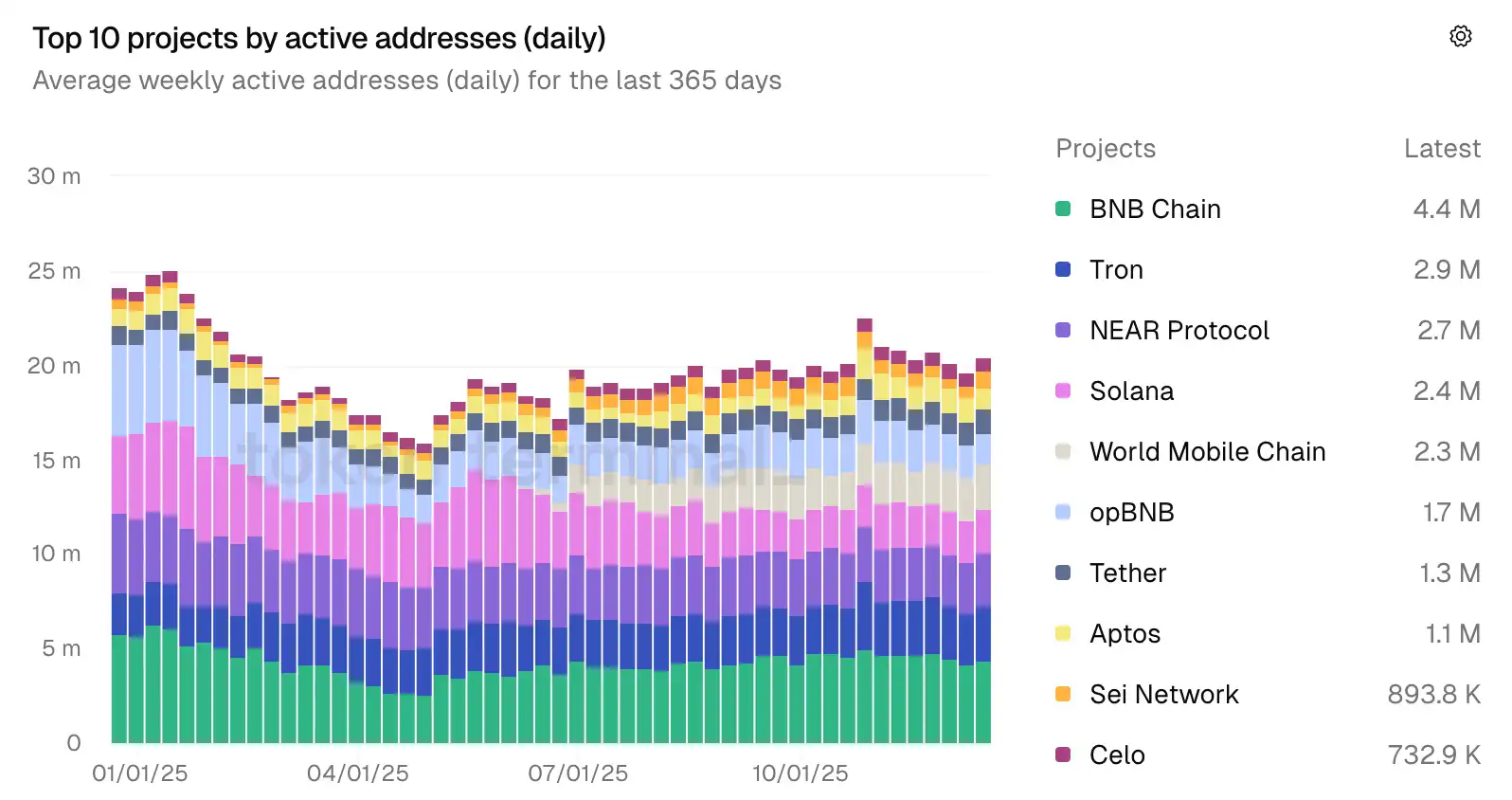
The effects were also evident. High-frequency behaviors such as stablecoin trading, DEX interactions, and on-chain transfers grew rapidly. BNB Chain became one of the public chains with the highest number of daily active addresses during multiple time windows. The latest data from Token Terminal shows that BNB Chain's daily active addresses reached 4.4 million, ranking at the top among blockchains. The average daily number of on-chain transactions in 2025 stabilized at tens of millions, hitting a historical high of 31 million transactions in a single day in October, a 150% year-on-year increase in peak value. Meanwhile, TVL increased by 40.5% year-on-year, the stablecoin market cap on-chain doubled, peaking at $14 billion.
Entering the second half of 2025, BNB Chain quickly switched modes, transitioning from an engineer to a product manager. Leveraging the solid foundation laid in the first half, it successfully accommodated massive stablecoin payment and RWA demands.
$14.7 Billion in Stablecoins and 4 Million Daily Active Users
If crypto before 2024 was driven by speculation, then 2025 transformed into an era dominated by utility, primarily stablecoins. This year, USDC issuer Circle went public, and Franklin Templeton, with $1.6 trillion in assets under management, launched JUSD.
Stablecoins are evolving from mere trading mediums into channels connecting traditional finance and the Web3 world. Stablecoins are no longer just tools for DeFi but are beginning to assume roles closer to real-world payments and capital turnover.
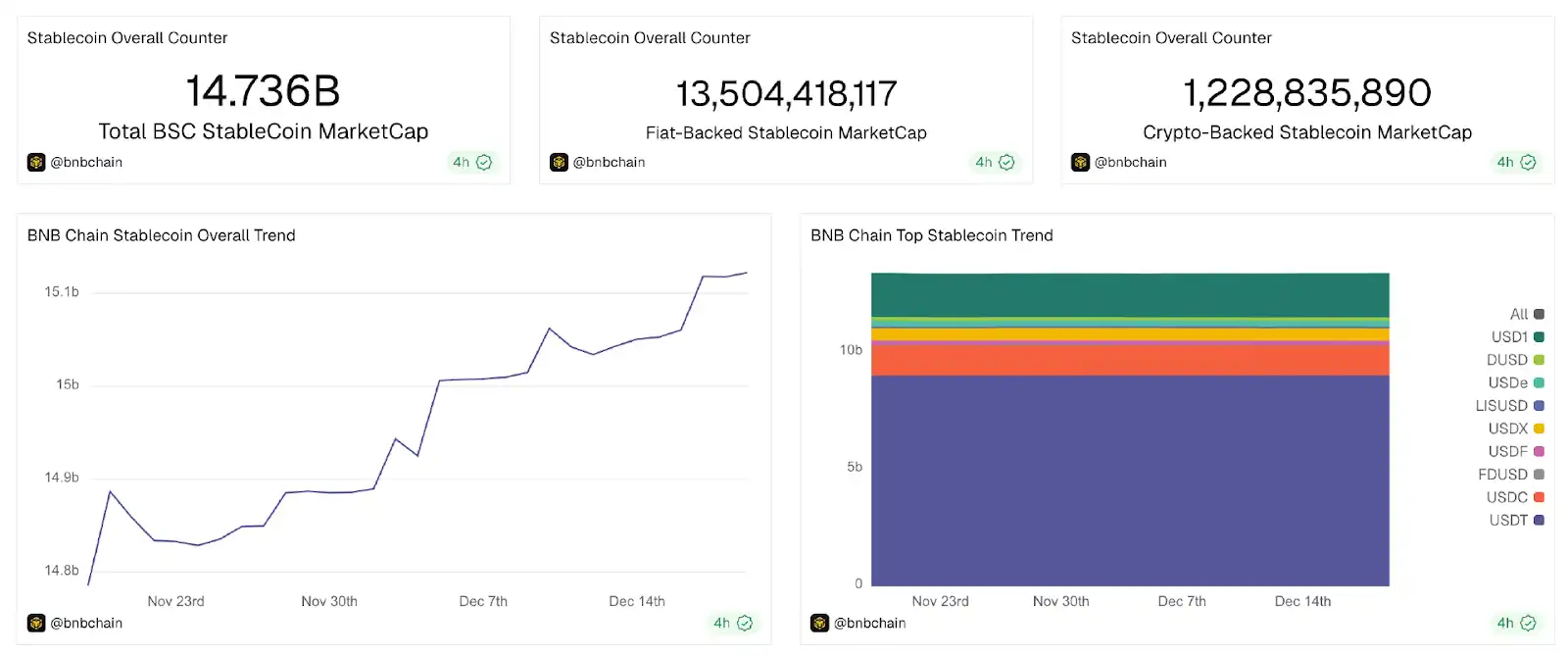
In this transformation, BNB Chain, with its 2-second settlement and transaction fees as low as $0.005, became the fastest-growing platform. Latest data shows that the value of stablecoins on the BNB Chain network exceeds $14.7 billion, with BSC and opBNB serving over 4 million daily active users.
The adoption of stablecoins depends not only on the assets themselves but also on their operating environment. If stablecoins are to serve billions of users, the underlying chain must be cheap, fast, and seamless. The upgrades BNB Chain implemented in the first half laid the foundation for stablecoin普及 (popularization).
Through gas-free transactions, opBNB, and other scaling solutions, the cost of stablecoin transfers was compressed to near zero, significantly lowering the barrier to using stablecoins for payments. On BSC and opBNB, stablecoin transfers are completed almost instantly, providing a near-Web2 experience for on-chain payments, salary disbursements, and merchant settlements.
The supply of stablecoins on BNB Chain has doubled to approximately $14 billion, making it one of the most active stablecoin networks globally. Against this backdrop, the stablecoin ecosystem itself began to change. United Stables chose to natively issue its stablecoin, U, on BNB Chain. Unlike traditional stablecoins reliant on a single collateral asset, U employs a multi-stablecoin reserve model, allowing mainstream dollar stablecoins including USDT, USDC, and USD1 to be directly used as collateral to mint U.
From an ecological perspective, the introduction of U is not an isolated event but a natural outcome of the maturation of BNB Chain's stablecoin system. As the scale of on-chain stablecoins continues to expand and address activity keeps increasing, the demand for unified liquidity and higher capital efficiency also grows. United Stables' multi-collateral model is a response to this demand. Its design reduces the efficiency loss caused by repeatedly splitting different stablecoins, helps consolidate on-chain liquidity, and simplifies the usage path of funds in trading, payments, and DeFi applications.

Another landmark event in 2025 was Abu Dhabi's MGX investing $2 billion in Binance through the stablecoin USD1. USD1 is a dollar-pegged stablecoin supported by the Trump family's World Liberty Financial, backed by highly liquid asset reserves and deployed on mainstream blockchains like BNB Chain and ETH.
This investment sent a clear signal: stablecoins are no longer confined to the crypto industry but have become a tool connecting traditional capital with on-chain finance. And BNB Chain is an important carrier network for this channel.
Furthermore, BNB Chain, in collaboration with YZi Labs, launched a massive $1 billion Builder Fund to accelerate the development of existing and future developers on BNB Chain, particularly those building applications that can make stablecoins truly流动起来 (flow). The fund provides not only capital but also technical incubation and compliance consulting.
According to the development blueprint disclosed by BNB Chain, sectors such as on-chain payroll systems, programmable vaults, stablecoin-native credit cards, invoice tokenization, CBDC bridging and custody, green finance, and supply chain automation are poised for explosive growth. These upcoming booming sectors share common characteristics: they are efficient, automated, and globally accessible, rather than focusing on crypto attributes. The positioning of stablecoins therein is closer to a universal unit of the digital economy, and BNB Chain aims to become the underlying operating system hosting these functions.
It is worth noting that the growth of the stablecoin ecosystem on the BNB Chain network is not an isolated爆发 (outbreak) but is deeply intertwined with RWA.
BNB Chain and RWA Mutually Enable Each Other
This year, we no longer debate the feasibility of asset tokenization. Traditional financial giants like BlackRock, CMBI (China Merchants Bank International), VanEck, and Franklin Templeton are moving hundreds of billions of dollars in assets on-chain. In this on-chain movement, BNB Chain,凭借 (relying on) its massive user base and ecological strategy, has become one of the largest infrastructures承载 (hosting) RWA capital.
BlackRock deployed its USD Institutional Digital Liquidity Fund, BUIDL Fund, to BNB Chain with technical support from Securitize and Wormhole. Moreover, this fund can also be used as collateral on the Binance exchange. This means on-chain funds are no longer obscure financial products but have become a liquidity layer for the crypto market.
CMBI tokenized its US dollar money market fund, with assets under management exceeding $3.8 billion, on BNB Chain. It is reported that this fund ranks first among its peers in the Asia-Pacific region according to Bloomberg. Investors can subscribe to shares on BNB Chain using stablecoins.
The deployment of a series of RWA assets on BNB Chain is not a one-sided benefit but a deeper two-way promotional relationship. RWA and BNB Chain are forming a positive feedback flywheel that complements and amplifies each other.
Asset tokenization is only the first step. Without sufficient trading depth and turnover, these tokens are merely on-chain digital certificates, unable to unleash real financial value. Illiquidity is the biggest pain point hindering the large-scale爆发 (explosion) of RWA.
As a mature ecosystem, BNB Chain provides three key elements for RWA assets: high throughput, low fees, and a庞大的 (massive) user base. Compared to other expensive public chains (public chains), BNB Chain's low gas fees and high TPS make high-frequency trading and instant settlement possible, significantly lowering the barrier for user participation in RWA investments. Simultaneously, BNB Chain users are among the most active groups in Web3, meaning RWA assets can directly reach a vast pool of potential investors upon launch.
In fact, CZ had already revealed the key to RWA's prosperity on BNB Chain during the BNB Chain 5th-anniversary AMA: without users, there are no trades; without trades, there is no liquidity.
When Ondo Global Markets announced the introduction of 100+ US stocks and ETFs to BNB Chain, with deep integration into Binance Wallet, a剧烈的化学反应 (violent chemical reaction) occurred in the market. Thanks to BNB Chain's large number of daily active users, the trading volume of Ondo's tokenized stocks surged from a previous single-day peak of $84 million to $170 million.
Standing at the beginning of 2026 and looking back on the entirety of 2025, this was a milestone year for BNB Chain. It moved from participating in public chain competition with performance and cost, towards benchmarking itself against global traditional finance and internet payment systems with real usage scale, stable operational capability, and compliant accessibility. Over the past year, zero downtime under sustained high load, the规模化增长 (scaled growth) of stablecoins and RWA, and the systematic optimization of underlying performance and cost structure collectively proved that BNB Chain is no longer in the stage of technological feasibility.
Looking forward, BNB Chain's development focus will no longer be solely on chasing higher metrics but on further improving execution quality and user experience on top of the existing scale—faster confirmation speeds, lower usage costs, a fairer trading environment, and middleware and tool systems more friendly to complex scenarios like stablecoins, RWA, payments, and AI.
Looking ahead to 2026, BNB Chain's goal is to truly solidify sub-second performance, global payment capability, and compliant asset hosting into a default capability, enabling developers to build applications with near-Web2 experience on top of it, and allowing ordinary users to utilize blockchain services without perceiving the underlying complexity. When blockchain is no longer seen as a new technology but naturally integrates into daily economic activities like the internet or payment systems, the大规模采用 (mass adoption) of Web3 will truly arrive. And 2025 was a decisive step taken by BNB Chain in this direction.