Bloomberg Terminal Earns Billions Annually from Data Intermediation, Now 6 Institutions Are Putting Data Directly On-Chain

marsbitPubblicato 2026-04-16Pubblicato ultima volta 2026-04-16

Introduzione

Six major financial institutions — Fidelity, Euronext, Tradeweb, OTC Markets Group, Singapore Exchange (Forex), and Exchange Data International — have begun publishing proprietary market data directly on-chain via Pyth Network. This move bypasses traditional data intermediaries like Bloomberg, which has long dominated the financial data market with annual revenues of approximately $10 billion from its terminal business alone. The shift enables developers on over 100 blockchains to access high-quality, real-time financial data — including ETF valuations, fixed income data, FX rates, and OTC securities — without long-term contracts, steep fees, or proprietary hardware. This development is critical for the scalability of real-world asset (RWA) tokenization in DeFi, as reliable, institutional-grade data must be available on-chain before assets can be traded or used as collateral in decentralized protocols. Pyth’s model differs from earlier oracle solutions like Chainlink by sourcing data directly from institutional traders and exchanges rather than aggregating from third-party sources. While this approach offers higher speed and accuracy, it also involves a more centralized network of known publishers. The move challenges the decades-old monopoly of data middlemen and could significantly reduce barriers to entry for developers building DeFi products tied to traditional financial markets.

Author: Thejaswini M A

Compiled by: Deep Tide TechFlow

Deep Tide Introduction: Six mainstream Wall Street institutions, including Fidelity, Euronext, and Tradeweb, have begun publishing market data directly onto the blockchain through Pyth, allowing any developer to access it for free. This breaks the 44-year monopoly model of data intermediaries like Bloomberg—no more two-year contracts, no more annual fees of $27,000, and no more dedicated keyboards. More importantly, this is a prerequisite for the true scaling of RWA (Real World Assets) in DeFi: data must be on-chain before assets.

In 1981, Michael Bloomberg was fired from Salomon Brothers. He was 39 years old at the time, had worked there for 15 years, and left with a $10 million severance package, deeply dissatisfied with how Wall Street handled information. His reaction to being fired, by any reasonable standard, was insane: he started showing up at Merrill Lynch's office every morning with coffee, wandering the halls, handing coffee to strangers, and explaining that he was going to build them a computer that knew everything. The traders took the coffee but were less certain about the computer.

Forty-four years later, each of these computers costs $27,000 per year. There are 350,000 of them globally, and Bloomberg earns approximately $10 billion annually from this business. Its entire structural genius lies in this: it inserted itself between the institutions that own the data and the people who need it, charging a toll for everything that passes through. The data was never Bloomberg's—Merrill Lynch had the data, Goldman Sachs had the data, every trading firm on Wall Street had the data. Bloomberg just built a tollbooth, convinced everyone that the tollbooth was the destination, and then raised prices every year because what could you do, go back to calling your broker?

This model withstood every technological change over four decades because no one could figure out a better distribution mechanism. Until last Wednesday.

On April 9, six institutions that had been feeding data into the tollbooth began publishing elsewhere: Euronext, Fidelity, Tradeweb, OTC Markets Group, Singapore Exchange's foreign exchange division, and Exchange Data International started publishing directly on-chain through Pyth's new data marketplace, accessible to any developer on 100 blockchains. You don't need a contract, a two-year minimum commitment, or a dedicated keyboard with yellow-green buttons.

Remember this: the funny thing about building a monopoly on other people's data is that those other people eventually notice.

The financial data industry is worth about $30 billion annually, one of the least discussed monopolies in the world, probably because the only people who care about it are the ones already paying for it.

Bloomberg controls about 33% of the global financial data market, with terminal business alone generating over $10 billion in annual revenue. Refinitiv, now acquired by the London Stock Exchange Group for $27 billion, holds about 20%. ICE Data Services reports market data revenue of $2.8 billion. Then there's FactSet, S&P Global, Morningstar, and some regional players serving niche markets. The top four suppliers combined control the vast majority of how financial data flows from generating institutions to demanding companies.
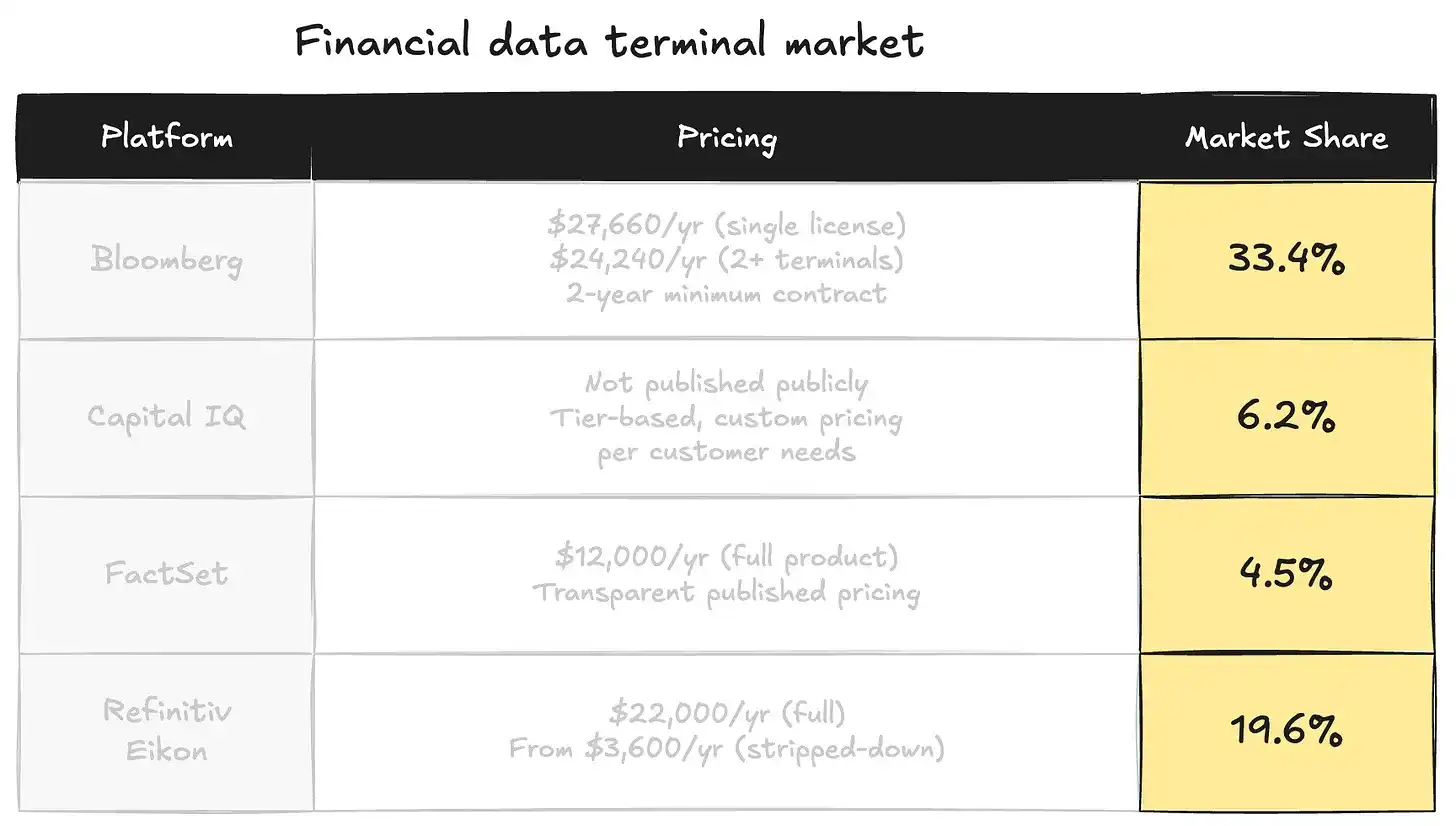
All these companies follow the same model. Institutions like exchanges, trading firms, banks, and asset managers generate pricing data as a byproduct of their work. They sell or license this data to suppliers. The suppliers package, standardize the data, add analytical tools on top, and then sell it to everyone else at a significant markup, with long-term contracts and proprietary access methods that make switching painful. Bloomberg subscriptions lock you in for two years. Canceling early costs 50% of the remaining contract value. And everything about the Bloomberg experience is designed to make leaving feel harder than staying. The keyboard is different. The data format is different. Even the messaging system that half of Wall Street uses to communicate with each other runs on Bloomberg, meaning switching terminals also means abandoning your contact list.

This has lasted forty years because suppliers solved a genuinely difficult problem: getting data from hundreds of sources, cleaning and standardizing it, and delivering it with low latency through global infrastructure. Bloomberg earned its place.

But blockchain is a better distribution mechanism. Maybe not for everything, and not yet at full scale. But for the specific problem of connecting institutions that have data with developers who want to build with it, a programmable, publicly accessible on-chain infrastructure is structurally superior to a proprietary terminal with a two-year contract. By turning data into an API without switching costs, you provide permissionless, self-service access to any developer on any chain. This is what Pyth is doing.

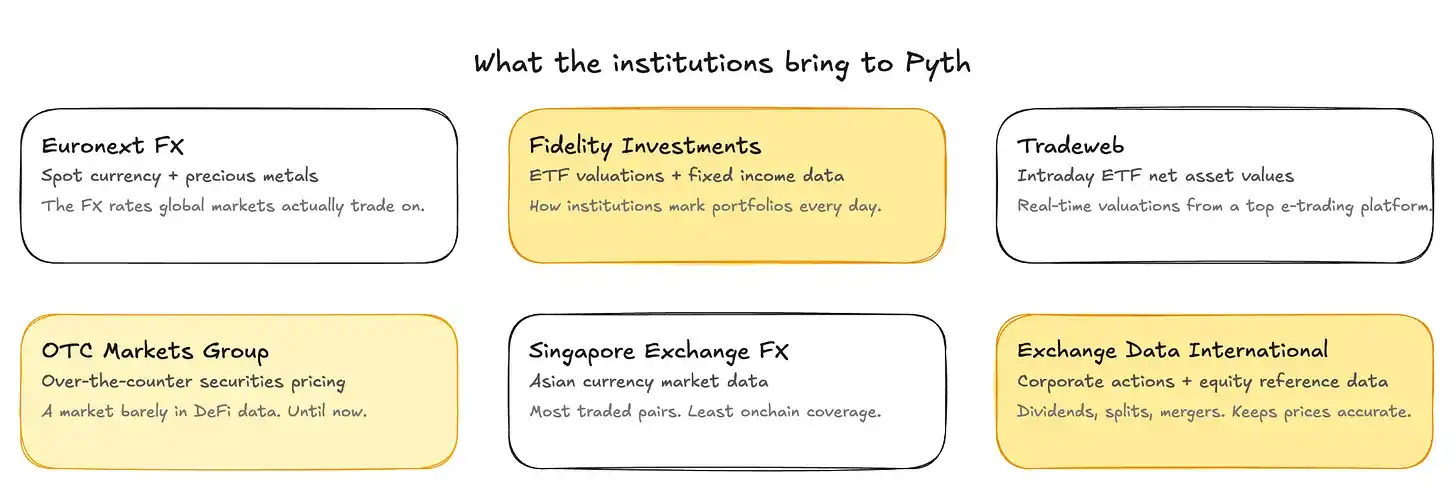
Euronext, Exchange Data International, Fidelity Investments, OTC Markets Group, Singapore Exchange's foreign exchange division, and Tradeweb are starting to publish their proprietary market data directly on-chain through Pyth's new data marketplace.

Euronext FX: Spot currencies and precious metals. Foreign exchange rates used for actual trading in global markets.

Fidelity: ETF valuations and fixed income data. Data used by institutions daily to mark their portfolios to market.

Tradeweb: Intraday ETF pricing. Real-time valuations from one of the largest electronic trading platforms.

OTC Markets Group: Over-the-counter securities. A market almost absent in today's DeFi data.

Singapore Exchange FX: Asian currency pairs. The largest but least on-chain covered foreign exchange market by trading volume.

Together, these six institutions cover a significant portion of asset classes that DeFi has never been able to reliably build because the data feeding these assets wasn't institutional-grade.
Why Data Must Precede Assets

Everyone in crypto has been talking about the tokenization wave for two years now: tokenized treasuries, tokenized bonds, tokenized stocks. The entire discussion assumes the hard part is putting the assets on-chain.

But the hard part is the data. Before you can trade tokenized treasuries in a DeFi protocol, you need to know what they are worth right now, down to the second, with the same accuracy that a Goldman Sachs trading desk uses to price this instrument. Before you can build lending protocols around real-world assets, you need continuously running price feeds from institutions that actually market-make, not scraped from a website and updated every few minutes.

DeFi protocols need accurate, real-time traditional financial data for derivatives, loans, and structured products, but have historically relied on limited or slower data sources. This is why DeFi has been mostly crypto-to-crypto since its inception. The data feeding these products wasn't reliable enough, fast enough, or from institutions with enough credibility in compliance conversations.

Pyth Pro, an institutional subscription tier launched by Pyth in September 2025, offers price feeds with 1-millisecond latency on over 2,200 instruments. Polymarket integrated Pyth Pro in April 2026 to settle new markets for traditional assets including major stock indices, commodities, and U.S. stocks, replacing manual or exchange-specific data sources with standardized data aggregated from over 125 trading firms. Hyperliquid now uses Pyth's price feeds to run perpetual contracts for oil and gold. Data quality is reaching a level where serious financial products can be built on top without apology.

The tokenization wave needs this layer to operate at scale. Without reliable fixed income price feeds, you cannot build reliable fixed income products on-chain.

The Oracle War

The original oracle problem in cryptocurrency was simple: smart contracts live on-chain, prices live off-chain. Something needed to connect the two. Chainlink was the dominant oracle for most of DeFi's history, solving this by running a large network of independent nodes that fetch prices from third-party sources (exchanges, aggregators, data APIs) and submit them on-chain. Many independent sources, many independent nodes, reasonable decentralization, acceptable latency.

Pyth took a different approach from the start, going directly to the institutions that are actually trading. Now over 120 institutions publish data through Pyth, including global exchanges, trading firms, and market makers. Jane Street doesn't secondhand describe the Bitcoin price to Pyth; it becomes a publisher. Data comes from the source, not from someone describing the source.

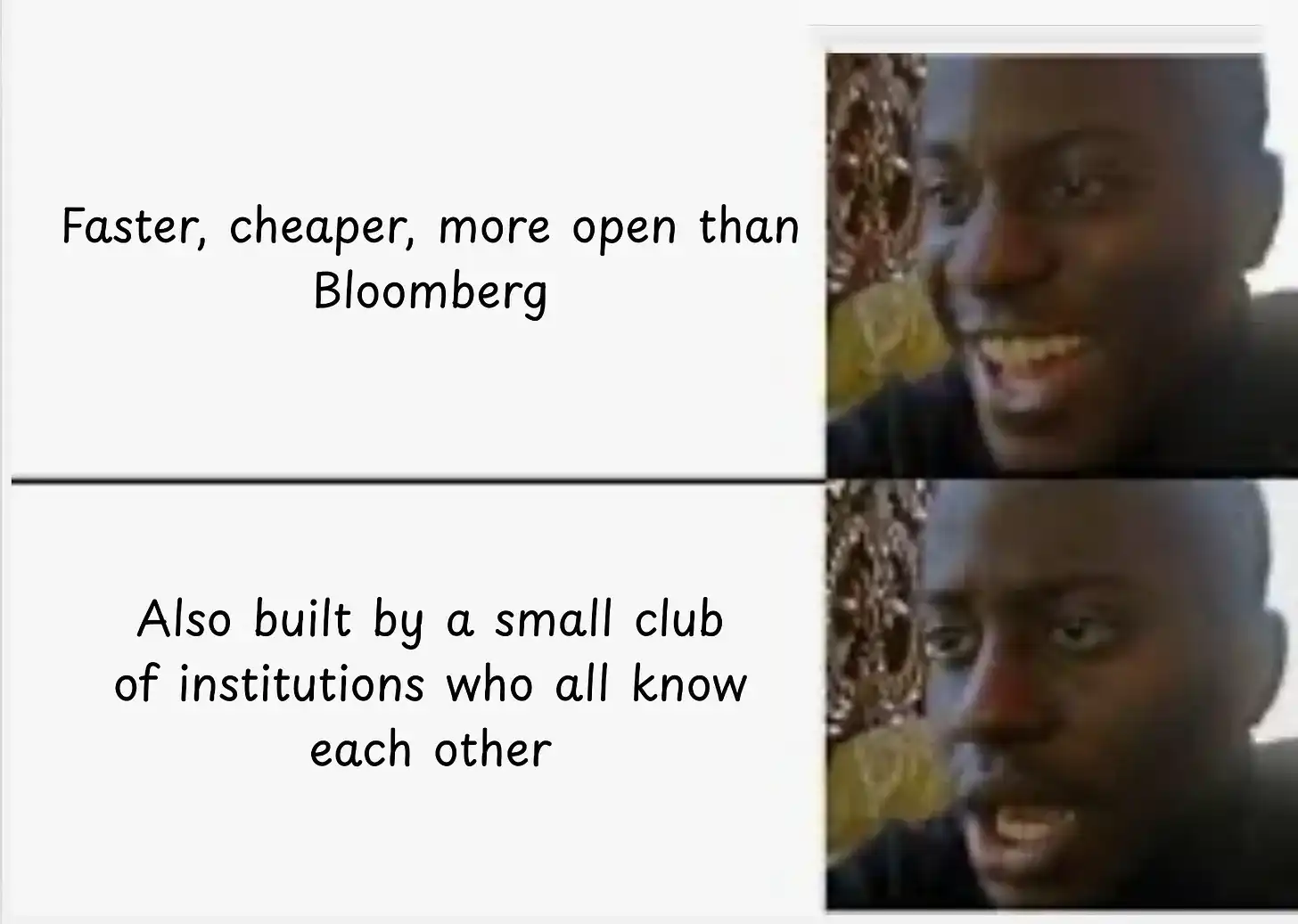
This is faster, more accurate, and more directly tied to real market activity than aggregated price feeds. In a structural sense, it's also more centralized: a smaller club of publishers who mostly know each other and validate their own data. Pyth has staking and slashing mechanisms designed to create economic incentives around accuracy. But a better way to put it is that Pyth chose speed and data quality over maximizing decentralization. For institutional finance, this might be the right trade-off.
The Cost of Centralization

Pyth was created with significant involvement from Jump Crypto, an organization that played a major role in the events of 2022, which most people in crypto prefer not to revisit. The publisher network is a small club, institutions mostly know each other and validate data amongst themselves. Staking and slashing mechanisms create economic incentives for accuracy, but Pyth is both faster and higher quality than what came before, and also more centralized than the marketing suggests. You are not replacing a monopoly with a commons. You are replacing one centralized system with another that happens to run on a blockchain.

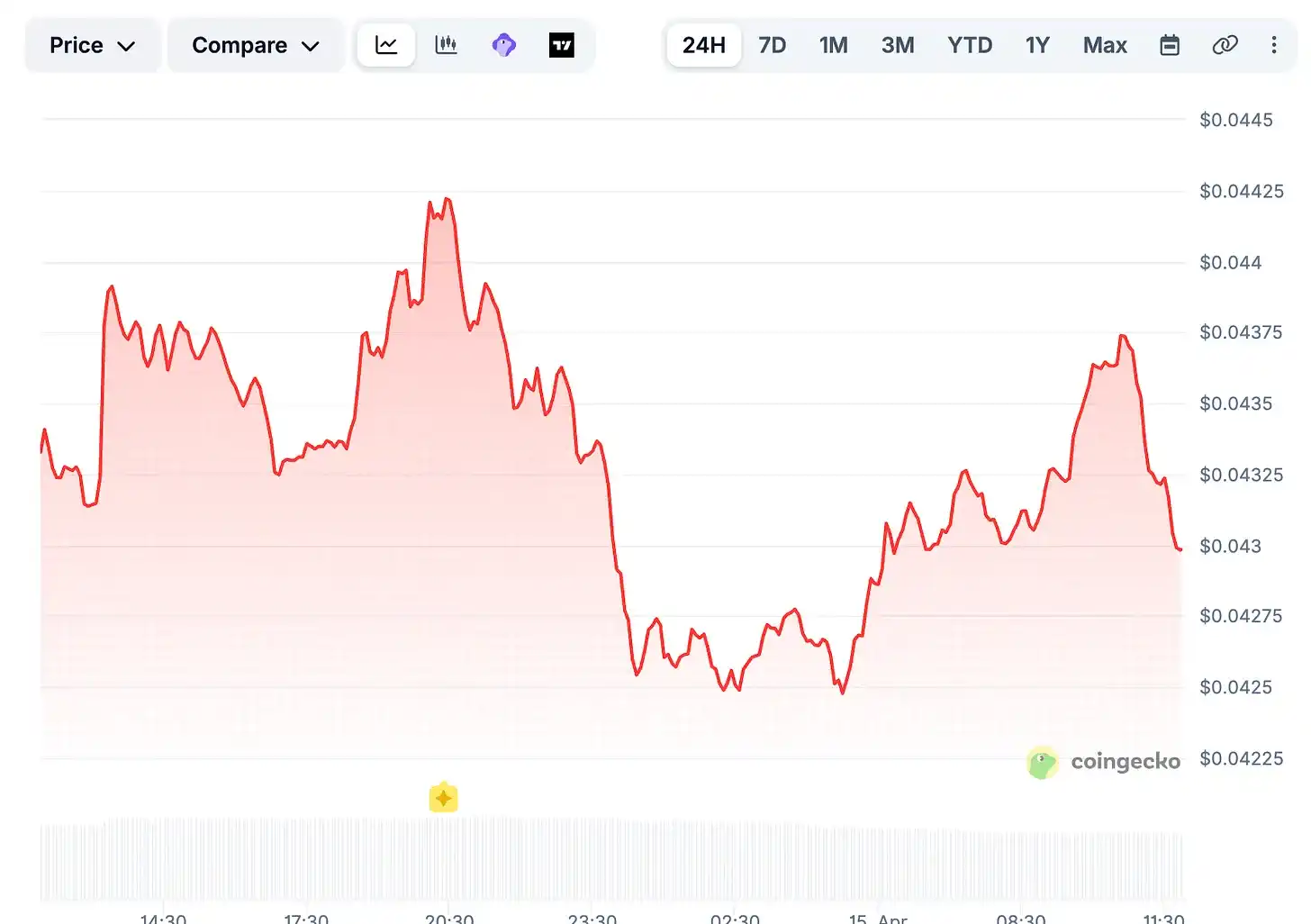
The PYTH token hit an all-time high of $1.20 in March 2024 and is currently trading around $0.046, down about 96% from its peak. The obvious reason: using Pyth's data does not require holding or buying PYTH. The network can grow significantly while the token remains range-bound, a known problem that Pyth's reserve plan is attempting to address, allocating a portion of protocol revenue for open market buybacks of PYTH.
The End of the Tollbooth

Getting data from the generating institution to the desk of the person who needs it requires hardware, proprietary networks, sales relationships, and ongoing support. Bloomberg solved all of this and charged accordingly. Data producers had no alternative distribution mechanism, so they sold their data to middlemen, who kept the profits. Blockchain eliminates that specific friction. Not the analysis, not the workflow, not the keyboard. Just the part where someone had to move data from one place to another and charge for the privilege.

But Bloomberg sells workflow. The terminal, the keyboard, the messaging system, the analysis, the support team. Traders build entire careers around it. Pyth sells none of that. It's the data layer that protocols plug into. The only overlapping part is the underlying data itself, and that part just moved.

This matters because if Fidelity publishes its ETF valuations on-chain, any developer anywhere can read that data without negotiating a license agreement, without paying $32,000 a year, without waiting for a supplier to standardize the format. Data becomes programmable infrastructure rather than a proprietary product. Institutions retain control over what they publish and keep the attribution. The middleman's job—moving data from source to user—becomes unnecessary.

These six institutions are choosing Pyth as a primary distribution channel, which is a different category of commitment than a pilot. Pilots get turned off when the advocate changes jobs. Primary distribution channels become operational dependencies.

Tokenized bonds, tokenized stocks, tokenized everything. Most of these are months or years away from meaningful scale. But the raw material that makes real-world asset products possible in DeFi is now available without contracts, without terminals, without two-year minimum commitments.

Michael Bloomberg spent months handing out free coffee in the halls of Merrill Lynch because the data he needed was locked inside institutions that had no reason to give it to him. He built an entire business on that friction.

The tollbooths won't disappear overnight. Every monopoly in data distribution ends the same way. Not with a fight, not with laws, not with a revolution. Mostly, someone somewhere asks why they are paying for something they already have.


Crypto di tendenza

Domande pertinenti

QWhat is the core innovation that Pyth introduces to challenge Bloomberg's data monopoly?

APyth enables financial institutions to publish market data directly on-chain, allowing any developer to access it freely without contracts, fees, or proprietary hardware, replacing the centralized data distribution model with a permissionless, blockchain-based infrastructure.

QWhich six major institutions have started publishing data directly on-chain via Pyth's new data marketplace?

AThe six institutions are Euronext, Fidelity, Tradeweb, OTC Markets Group, Singapore Exchange Foreign Exchange, and Exchange Data International.

QWhy is high-quality, real-time data critical for the tokenization of real-world assets (RWA) in DeFi?

AAccurate, institutional-grade data is essential for pricing and trading tokenized assets like bonds or stocks reliably in DeFi protocols. Without real-time data from credible sources, building scalable and trustworthy financial products for traditional assets on-chain is impossible.

QHow does Pyth's approach to oracle data differ from Chainlink's model?

APyth sources data directly from institutional traders and exchanges (e.g., Jane Street) who are active market participants, ensuring data comes from the source. Chainlink aggregates data from multiple third-party sources and relies on a decentralized node network to submit prices on-chain.

QWhat challenges does the PYTH token face despite the growth of the Pyth network?

AThe PYTH token has declined significantly in value because using Pyth's data does not require holding or purchasing the token. Protocol usage can grow without directly impacting token demand, though Pyth's reserve plan aims to address this by allocating protocol revenue for token buybacks.

Letture associate

Base Under Pressure

**Title: The Pressure Mounts for Base** Base, the Ethereum Layer 2 scaling solution backed by Coinbase, is facing significant pressure and public scrutiny from its leadership following the launch of Robinhood Chain. Base co-founder Jesse Pollak recently acknowledged strategic missteps, admitting that the chain's past focus on social and creator tokens (e.g., through Farcaster, Zora) failed to deliver sustainable adoption. He has refocused on core infrastructure, handing leadership of the Base App back to Coinbase's Cobie. While Base remains a top L2 contender alongside OP Mainnet and Arbitrum, and boasts the highest TVL (nearly $12B), its weaknesses are being highlighted by the new competitor. Key criticisms include its slow progress on decentralization. Base has faced issues with its single sequencer causing block production halts, and L2BEAT is reportedly considering downgrading its decentralization rating from Stage 1 to Stage 0. This contrasts sharply with the rapid initial success of Robinhood Chain, whose DEX quickly entered the top five by volume. The leadership styles of the parent companies are also being compared: Robinhood's CEO actively engages with new projects, while a recent incident where Coinbase's Brian Armstrong briefly changed his profile picture—sparking and then crashing a related meme token—drew community ire and mockery. Pollak stated Base is working with Coinbase on tokenized stocks backed 1:1 by real equity, differentiating it from Robinhood's derivatives model. However, the article argues that Base's most urgent task is to address its long-standing technical and trust issues. With more traditional finance players likely to emulate Robinhood's path, Base must use this competitive pressure to solidify its position as long-term financial infrastructure.

Foresight News10 min fa

Base Under Pressure

Foresight News10 min fa

White House Concession Removes Ethical Hurdle, Clarity Act Races Against Final Window Before Recess?

On July 21st, industry sources reported that the Trump administration has agreed to include an ethics provision in the "Clarity Act" (Digital Asset Market Clarity Act of 2025). This concession addresses the long-standing conflict-of-interest concerns regarding government officials and the crypto industry, potentially removing the final major obstacle to the bill's progress. Additionally, Patrick Witt, the executive director of the White House's Digital Asset Advisory Committee, confirmed he will remain in his role to help finalize the bill, alleviating previous concerns about his potential departure. The Clarity Act aims to establish a unified federal regulatory framework for the U.S. digital asset market. Its core objective is to resolve regulatory ambiguity by defining different types of digital assets (digital commodities, investment contract assets, and permitted payment stablecoins) and clarifying the respective oversight roles of the SEC and CFTC. This would end the long-running jurisdictional dispute between the two agencies and provide clearer compliance paths for the industry. With the ethics issue moving toward resolution, the most urgent challenge now is time. The U.S. Congress is set to begin its August recess in mid-August, leaving only a few working weeks to finalize the text and advance the bill through the Senate. Industry advocates, like the Blockchain Association's Kristin Smith, stress that this is a critical moment. If negotiations conclude successfully in the coming weeks, the Clarity Act could pass a key hurdle before the recess; otherwise, it may face significant delays. If enacted, the Clarity Act could mark a historic turning point in crypto regulation. By providing a clearer and more predictable legal framework, it aims to reduce uncertainty for businesses, developers, and traditional financial institutions looking to enter the digital asset space, potentially setting a global benchmark for market structure regulation.

Odaily星球日报16 min fa

White House Concession Removes Ethical Hurdle, Clarity Act Races Against Final Window Before Recess?

Odaily星球日报16 min fa

AI Era, Industrial Revolution, and Future Civilization Interview — Zhang Dingwen: The Future Does Not Belong to Chasers

"AI Era, Industrial Revolution and Future Civilization: An Interview with Zhang Dingwen – The Future Does Not Belong to Those Who Chase" In this interview, entrepreneur Zhang Dingwen reflects on his entrepreneurial journey and philosophy, moving beyond discussions of financing or success to emphasize understanding the "era" itself. He argues that true entrepreneurs should not chase short-term trends ("winds"), but position themselves in the direction of long-term technological and societal evolution. Zhang shares key lessons from his early days, including the realization that user value does not automatically translate to commercial value. For him, the core of entrepreneurship is not building a company but constantly upgrading one's own "cognition" – the ability to interpret information, ask the right questions, and understand the underlying "causes" behind business outcomes, not just the effects. His thinking has evolved from a focus on creating good products to a strategic focus on building "entrances" – platforms that naturally connect users to digital services. He sees smart wearables, like watches, not merely as hardware but as potential future gateways combining technological, financial, social, and even fashion attributes to create sustained user relationships and ecosystems. Ultimately, Zhang's vision transcends individual products or companies. He discusses business competition in three stages: product, platform, and finally, "civilization" – where the greatest companies influence how society operates by defining new rules and ways of life. He believes the mission of a truly great enterprise is to solve problems of its time, build enduring trust, and contribute lasting value, leaving behind not just wealth but a positive impact on how the world works. The future, he concludes, belongs not to the fastest, but to those with the correct long-term direction and a commitment to continuous learning and evolution.

marsbit27 min fa

AI Era, Industrial Revolution, and Future Civilization Interview — Zhang Dingwen: The Future Does Not Belong to Chasers

marsbit27 min fa

Cryptocurrency & Stock Market Barometer丨Strategy Cash Reserves Increase to $3.23 Billion, Halting BTC Purchases; Vanguard and Other Asset Managers Increase Holdings in Strategy Stock (July 21)

Market Overview & Warnings: The article warns of high volatility in South Korean stocks and continued dependence on U.S. stocks on geopolitics. Chinese A-shares remain under pressure. It advises against using leverage in current equity markets. For crypto-linked stocks, most have limited growth except Robinhood, with caution advised. U.S. Stock Market: Bearish bets on U.S. stocks, particularly targeting AI-related companies, have reached record highs since 2010, signaling deep skepticism about the sustainability of the AI-driven rally. Tech and chip stocks led a market decline, with the Philadelphia Semiconductor Index potentially entering a bear market. Increased expectations for Federal Reserve interest rate hikes and geopolitical tensions contributed to the negative sentiment. Bitcoin Treasury Company Updates: * Strategy: Increased its cash reserves to $3.23 billion and paused Bitcoin purchases. Several major asset managers, including Vanguard Group and Capital Group, increased their holdings of Strategy (MSTR) stock. * Global corporate Bitcoin buying slowed significantly to just $1.33 million last week. * Other notable activity: Strive purchased 21 BTC; ORANGE JUICE raised $40 million for Bitcoin acquisitions; Bitcoin Japan Corp. raised $60 million, allocating $4.08 million for its first BTC purchase. Other Crypto Treasury Holdings: * Ethereum: BitMine increased its ETH holdings to 5.78 million, nearing its 5% of supply goal. Its total crypto assets, cash, and securities are valued at $11.5 billion. * Solana: No significant corporate treasury activity reported. * Altcoins: HypeStrat made no adjustments to its treasury; its mNAV ratio fell to a long-term low. (Note: This summary is for informational purposes only and does not constitute investment advice.)

marsbit28 min fa

Cryptocurrency & Stock Market Barometer丨Strategy Cash Reserves Increase to $3.23 Billion, Halting BTC Purchases; Vanguard and Other Asset Managers Increase Holdings in Strategy Stock (July 21)

marsbit28 min fa

Trading

Spot

Articoli Popolari

Cosa è $S$

Comprendere SPERO: Una Panoramica Completa Introduzione a SPERO Mentre il panorama dell'innovazione continua a evolversi, l'emergere delle tecnologie web3 e dei progetti di criptovaluta gioca un ruolo fondamentale nel plasmare il futuro digitale. Un progetto che ha attirato l'attenzione in questo campo dinamico è SPERO, denotato come SPERO,$$s$. Questo articolo mira a raccogliere e presentare informazioni dettagliate su SPERO, per aiutare gli appassionati e gli investitori a comprendere le sue basi, obiettivi e innovazioni nei domini web3 e crypto. Che cos'è SPERO,$$s$? SPERO,$$s$ è un progetto unico all'interno dello spazio crypto che cerca di sfruttare i principi della decentralizzazione e della tecnologia blockchain per creare un ecosistema che promuove l'impegno, l'utilità e l'inclusione finanziaria. Il progetto è progettato per facilitare interazioni peer-to-peer in modi nuovi, fornendo agli utenti soluzioni e servizi finanziari innovativi. Al suo interno, SPERO,$$s$ mira a responsabilizzare gli individui fornendo strumenti e piattaforme che migliorano l'esperienza dell'utente nello spazio delle criptovalute. Questo include la possibilità di metodi di transazione più flessibili, la promozione di iniziative guidate dalla comunità e la creazione di percorsi per opportunità finanziarie attraverso applicazioni decentralizzate (dApps). La visione sottostante di SPERO,$$s$ ruota attorno all'inclusività, cercando di colmare le lacune all'interno della finanza tradizionale mentre sfrutta i vantaggi della tecnologia blockchain. Chi è il Creatore di SPERO,$$s$? L'identità del creatore di SPERO,$$s$ rimane piuttosto oscura, poiché ci sono risorse pubblicamente disponibili limitate che forniscono informazioni dettagliate sul suo fondatore o fondatori. Questa mancanza di trasparenza può derivare dall'impegno del progetto per la decentralizzazione—un ethos che molti progetti web3 condividono, dando priorità ai contributi collettivi rispetto al riconoscimento individuale. Centrando le discussioni attorno alla comunità e ai suoi obiettivi collettivi, SPERO,$$s$ incarna l'essenza dell'empowerment senza mettere in evidenza individui specifici. Pertanto, comprendere l'etica e la missione di SPERO rimane più importante che identificare un creatore singolo. Chi sono gli Investitori di SPERO,$$s$? SPERO,$$s$ è supportato da una varietà di investitori che vanno dai capitalisti di rischio agli investitori angelici dedicati a promuovere l'innovazione nel settore crypto. Il focus di questi investitori generalmente si allinea con la missione di SPERO—dando priorità a progetti che promettono avanzamenti tecnologici sociali, inclusività finanziaria e governance decentralizzata. Queste fondazioni di investitori sono tipicamente interessate a progetti che non solo offrono prodotti innovativi, ma contribuiscono anche positivamente alla comunità blockchain e ai suoi ecosistemi. Il supporto di questi investitori rafforza SPERO,$$s$ come un concorrente degno di nota nel dominio in rapida evoluzione dei progetti crypto. Come Funziona SPERO,$$s$? SPERO,$$s$ impiega un framework multifunzionale che lo distingue dai progetti di criptovaluta convenzionali. Ecco alcune delle caratteristiche chiave che sottolineano la sua unicità e innovazione: Governance Decentralizzata: SPERO,$$s$ integra modelli di governance decentralizzati, responsabilizzando gli utenti a partecipare attivamente ai processi decisionali riguardanti il futuro del progetto. Questo approccio favorisce un senso di proprietà e responsabilità tra i membri della comunità. Utilità del Token: SPERO,$$s$ utilizza il proprio token di criptovaluta, progettato per servire varie funzioni all'interno dell'ecosistema. Questi token abilitano transazioni, premi e la facilitazione dei servizi offerti sulla piattaforma, migliorando l'impegno e l'utilità complessivi. Architettura Stratificata: L'architettura tecnica di SPERO,$$s$ supporta la modularità e la scalabilità, consentendo un'integrazione fluida di funzionalità e applicazioni aggiuntive man mano che il progetto evolve. Questa adattabilità è fondamentale per mantenere la rilevanza nel panorama crypto in continua evoluzione. Coinvolgimento della Comunità: Il progetto enfatizza iniziative guidate dalla comunità, impiegando meccanismi che incentivano la collaborazione e il feedback. Nutrendo una comunità forte, SPERO,$$s$ può affrontare meglio le esigenze degli utenti e adattarsi alle tendenze di mercato. Focus sull'Inclusione: Offrendo basse commissioni di transazione e interfacce user-friendly, SPERO,$$s$ mira ad attrarre una base utenti diversificata, inclusi individui che potrebbero non aver precedentemente interagito nello spazio crypto. Questo impegno per l'inclusione si allinea con la sua missione generale di empowerment attraverso l'accessibilità. Cronologia di SPERO,$$s$ Comprendere la storia di un progetto fornisce preziose intuizioni sulla sua traiettoria di sviluppo e sui traguardi. Di seguito è riportata una cronologia suggerita che mappa eventi significativi nell'evoluzione di SPERO,$$s$: Fase di Concettualizzazione e Ideazione: Le idee iniziali che formano la base di SPERO,$$s$ sono state concepite, allineandosi strettamente con i principi di decentralizzazione e focus sulla comunità all'interno dell'industria blockchain. Lancio del Whitepaper del Progetto: Dopo la fase concettuale, è stato rilasciato un whitepaper completo che dettaglia la visione, gli obiettivi e l'infrastruttura tecnologica di SPERO,$$s$ per suscitare interesse e feedback dalla comunità. Costruzione della Comunità e Prime Interazioni: Sono stati effettuati sforzi attivi di outreach per costruire una comunità di early adopters e potenziali investitori, facilitando discussioni attorno agli obiettivi del progetto e ottenendo supporto. Evento di Generazione del Token: SPERO,$$s$ ha condotto un evento di generazione del token (TGE) per distribuire i propri token nativi ai primi sostenitori e stabilire una liquidità iniziale all'interno dell'ecosistema. Lancio della Prima dApp: La prima applicazione decentralizzata (dApp) associata a SPERO,$$s$ è stata attivata, consentendo agli utenti di interagire con le funzionalità principali della piattaforma. Sviluppo Continuo e Partnership: Aggiornamenti e miglioramenti continui alle offerte del progetto, inclusi partnership strategiche con altri attori nello spazio blockchain, hanno plasmato SPERO,$$s$ in un concorrente competitivo e in evoluzione nel mercato crypto. Conclusione SPERO,$$s$ rappresenta una testimonianza del potenziale del web3 e delle criptovalute di rivoluzionare i sistemi finanziari e responsabilizzare gli individui. Con un impegno per la governance decentralizzata, il coinvolgimento della comunità e funzionalità progettate in modo innovativo, apre la strada verso un panorama finanziario più inclusivo. Come per qualsiasi investimento nello spazio crypto in rapida evoluzione, si incoraggiano potenziali investitori e utenti a ricercare approfonditamente e a impegnarsi in modo riflessivo con gli sviluppi in corso all'interno di SPERO,$$s$. Il progetto mostra lo spirito innovativo dell'industria crypto, invitando a ulteriori esplorazioni delle sue innumerevoli possibilità. Mentre il percorso di SPERO,$$s$ è ancora in fase di sviluppo, i suoi principi fondamentali potrebbero effettivamente influenzare il futuro di come interagiamo con la tecnologia, la finanza e tra di noi in ecosistemi digitali interconnessi.

129 Totale visualizzazioniPubblicato il 2024.12.17Aggiornato il 2024.12.17

Cosa è $S$

Cosa è AGENT S

Agent S: Il Futuro dell'Interazione Autonoma in Web3 Introduzione Nel panorama in continua evoluzione di Web3 e criptovalute, le innovazioni stanno costantemente ridefinendo il modo in cui gli individui interagiscono con le piattaforme digitali. Uno di questi progetti pionieristici, Agent S, promette di rivoluzionare l'interazione uomo-computer attraverso il suo framework agentico aperto. Aprendo la strada a interazioni autonome, Agent S mira a semplificare compiti complessi, offrendo applicazioni trasformative nell'intelligenza artificiale (AI). Questa esplorazione dettagliata approfondirà le complessità del progetto, le sue caratteristiche uniche e le implicazioni per il dominio delle criptovalute. Cos'è Agent S? Agent S si presenta come un innovativo framework agentico aperto, progettato specificamente per affrontare tre sfide fondamentali nell'automazione dei compiti informatici: Acquisizione di Conoscenze Specifiche del Dominio: Il framework apprende in modo intelligente da varie fonti di conoscenza esterne ed esperienze interne. Questo approccio duale gli consente di costruire un ricco repository di conoscenze specifiche del dominio, migliorando le sue prestazioni nell'esecuzione dei compiti. Pianificazione su Lungo Orizzonte di Compiti: Agent S impiega una pianificazione gerarchica potenziata dall'esperienza, un approccio strategico che facilita la suddivisione e l'esecuzione efficiente di compiti complessi. Questa caratteristica migliora significativamente la sua capacità di gestire più sottocompiti in modo efficiente ed efficace. Gestione di Interfacce Dinamiche e Non Uniformi: Il progetto introduce l'Interfaccia Agente-Computer (ACI), una soluzione innovativa che migliora l'interazione tra agenti e utenti. Utilizzando Modelli Linguistici Multimodali di Grandi Dimensioni (MLLM), Agent S può navigare e manipolare senza sforzo diverse interfacce grafiche utente. Attraverso queste caratteristiche pionieristiche, Agent S fornisce un framework robusto che affronta le complessità coinvolte nell'automazione dell'interazione umana con le macchine, preparando il terreno per innumerevoli applicazioni nell'AI e oltre. Chi è il Creatore di Agent S? Sebbene il concetto di Agent S sia fondamentalmente innovativo, informazioni specifiche sul suo creatore rimangono elusive. Il creatore è attualmente sconosciuto, il che evidenzia sia la fase embrionale del progetto sia la scelta strategica di mantenere i membri fondatori sotto anonimato. Indipendentemente dall'anonimato, l'attenzione rimane sulle capacità e sul potenziale del framework. Chi sono gli Investitori di Agent S? Poiché Agent S è relativamente nuovo nell'ecosistema crittografico, informazioni dettagliate riguardanti i suoi investitori e sostenitori finanziari non sono documentate esplicitamente. La mancanza di approfondimenti pubblicamente disponibili sulle fondazioni di investimento o sulle organizzazioni che supportano il progetto solleva interrogativi sulla sua struttura di finanziamento e sulla roadmap di sviluppo. Comprendere il supporto è cruciale per valutare la sostenibilità del progetto e il suo potenziale impatto sul mercato. Come Funziona Agent S? Al centro di Agent S si trova una tecnologia all'avanguardia che gli consente di funzionare efficacemente in contesti diversi. Il suo modello operativo è costruito attorno a diverse caratteristiche chiave: Interazione Uomo-Computer Simile a Quella Umana: Il framework offre una pianificazione AI avanzata, cercando di rendere le interazioni con i computer più intuitive. Mimando il comportamento umano nell'esecuzione dei compiti, promette di elevare le esperienze degli utenti. Memoria Narrativa: Utilizzata per sfruttare esperienze di alto livello, Agent S utilizza la memoria narrativa per tenere traccia delle storie dei compiti, migliorando così i suoi processi decisionali. Memoria Episodica: Questa caratteristica fornisce agli utenti una guida passo-passo, consentendo al framework di offrire supporto contestuale mentre i compiti si sviluppano. Supporto per OpenACI: Con la capacità di funzionare localmente, Agent S consente agli utenti di mantenere il controllo sulle proprie interazioni e flussi di lavoro, allineandosi con l'etica decentralizzata di Web3. Facile Integrazione con API Esterne: La sua versatilità e compatibilità con varie piattaforme AI garantiscono che Agent S possa adattarsi senza problemi agli ecosistemi tecnologici esistenti, rendendolo una scelta attraente per sviluppatori e organizzazioni. Queste funzionalità contribuiscono collettivamente alla posizione unica di Agent S all'interno dello spazio crittografico, poiché automatizza compiti complessi e multi-fase con un intervento umano minimo. Man mano che il progetto evolve, le sue potenziali applicazioni in Web3 potrebbero ridefinire il modo in cui si svolgono le interazioni digitali. Cronologia di Agent S Lo sviluppo e le tappe di Agent S possono essere riassunti in una cronologia che evidenzia i suoi eventi significativi: 27 Settembre 2024: Il concetto di Agent S è stato lanciato in un documento di ricerca completo intitolato “Un Framework Agentico Aperto che Usa i Computer Come un Umano”, mostrando le basi per il progetto. 10 Ottobre 2024: Il documento di ricerca è stato reso pubblicamente disponibile su arXiv, offrendo un'esplorazione approfondita del framework e della sua valutazione delle prestazioni basata sul benchmark OSWorld. 12 Ottobre 2024: È stata rilasciata una presentazione video, fornendo un'idea visiva delle capacità e delle caratteristiche di Agent S, coinvolgendo ulteriormente potenziali utenti e investitori. Questi indicatori nella cronologia non solo illustrano i progressi di Agent S, ma indicano anche il suo impegno per la trasparenza e il coinvolgimento della comunità. Punti Chiave su Agent S Man mano che il framework Agent S continua a evolversi, diversi attributi chiave si distinguono, sottolineando la sua natura innovativa e il potenziale: Framework Innovativo: Progettato per fornire un uso intuitivo dei computer simile all'interazione umana, Agent S porta un approccio nuovo all'automazione dei compiti. Interazione Autonoma: La capacità di interagire autonomamente con i computer attraverso GUI segna un passo avanti verso soluzioni informatiche più intelligenti ed efficienti. Automazione di Compiti Complessi: Con la sua metodologia robusta, può automatizzare compiti complessi e multi-fase, rendendo i processi più veloci e meno soggetti a errori. Miglioramento Continuo: I meccanismi di apprendimento consentono ad Agent S di migliorare dalle esperienze passate, migliorando continuamente le sue prestazioni e la sua efficacia. Versatilità: La sua adattabilità attraverso diversi ambienti operativi come OSWorld e WindowsAgentArena garantisce che possa servire un'ampia gamma di applicazioni. Man mano che Agent S si posiziona nel panorama di Web3 e delle criptovalute, il suo potenziale per migliorare le capacità di interazione e automatizzare i processi segna un significativo avanzamento nelle tecnologie AI. Attraverso il suo framework innovativo, Agent S esemplifica il futuro delle interazioni digitali, promettendo un'esperienza più fluida ed efficiente per gli utenti in vari settori. Conclusione Agent S rappresenta un audace passo avanti nell'unione tra AI e Web3, con la capacità di ridefinire il modo in cui interagiamo con la tecnologia. Sebbene sia ancora nelle sue fasi iniziali, le possibilità per la sua applicazione sono vaste e coinvolgenti. Attraverso il suo framework completo che affronta sfide critiche, Agent S mira a portare le interazioni autonome al centro dell'esperienza digitale. Man mano che ci addentriamo nei regni delle criptovalute e della decentralizzazione, progetti come Agent S giocheranno senza dubbio un ruolo cruciale nel plasmare il futuro della tecnologia e della collaborazione uomo-computer.

583 Totale visualizzazioniPubblicato il 2025.01.14Aggiornato il 2025.01.14

Cosa è AGENT S

Come comprare S

Benvenuto in HTX.com! Abbiamo reso l'acquisto di Sonic (S) semplice e conveniente. Segui la nostra guida passo passo per intraprendere il tuo viaggio nel mondo delle criptovalute.Step 1: Crea il tuo Account HTXUsa la tua email o numero di telefono per registrarti il tuo account gratuito su HTX. Vivi un'esperienza facile e sblocca tutte le funzionalità,Crea il mio accountStep 2: Vai in Acquista crypto e seleziona il tuo metodo di pagamentoCarta di credito/debito: utilizza la tua Visa o Mastercard per acquistare immediatamente SonicS.Bilancio: Usa i fondi dal bilancio del tuo account HTX per fare trading senza problemi.Terze parti: abbiamo aggiunto metodi di pagamento molto utilizzati come Google Pay e Apple Pay per maggiore comodità.P2P: Fai trading direttamente con altri utenti HTX.Over-the-Counter (OTC): Offriamo servizi su misura e tassi di cambio competitivi per i trader.Step 3: Conserva Sonic (S)Dopo aver acquistato Sonic (S), conserva nel tuo account HTX. In alternativa, puoi inviare tramite trasferimento blockchain o scambiare per altre criptovalute.Step 4: Scambia Sonic (S)Scambia facilmente Sonic (S) nel mercato spot di HTX. Accedi al tuo account, seleziona la tua coppia di trading, esegui le tue operazioni e monitora in tempo reale. Offriamo un'esperienza user-friendly sia per chi ha appena iniziato che per i trader più esperti.

1.1k Totale visualizzazioniPubblicato il 2025.01.15Aggiornato il 2026.06.02

Come comprare S

Discussioni

Benvenuto nella Community HTX. Qui puoi rimanere informato sugli ultimi sviluppi della piattaforma e accedere ad approfondimenti esperti sul mercato. Le opinioni degli utenti sul prezzo di S S sono presentate come di seguito.

活动图片