Blockchain Association Rejects Proposal To Widen Stablecoin Yield Restrictions

bitcoinistPubblicato 2025-12-21Pubblicato ultima volta 2025-12-21

Introduzione

The Blockchain Association, along with over 125 crypto and fintech groups, is urging Senate Banking leaders to oppose efforts to expand a ban on stablecoin yields beyond what is explicitly stated in the GENIUS Act. The law prohibits stablecoin issuers from paying yields directly to holders but allows third-party platforms to offer rewards. The association argues that broadening the ban would harm competition and innovation, favoring larger financial firms. In contrast, banking groups, led by the American Bankers Association, are pushing for the ban to extend to partners and affiliates, warning that stablecoin rewards could circumvent the law and drain trillions from traditional bank deposits. The debate centers on consumer protection, financial stability, and the future competitive landscape of digital payments. Senate Banking staff are reviewing both sides as they consider potential legislative clarifications.

The Blockchain Association led a broad industry push this week, asking Senate Banking leaders to resist efforts that would widen a ban on stablecoin yields beyond what Congress wrote into law.

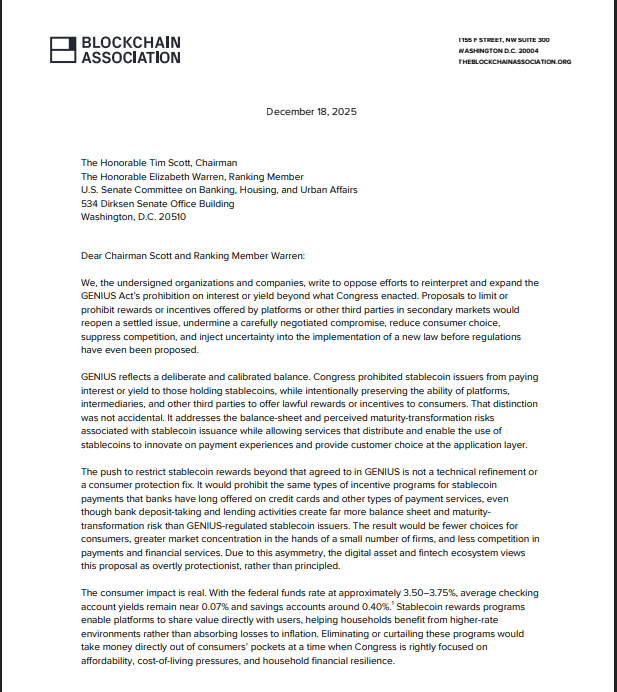
According to the association, the letter was signed by more than 125 crypto and fintech groups and companies and was sent to lawmakers to warn against reinterpreting the new rules in a way that would also bar exchanges and apps from offering rewards tied to stablecoin holdings.

Preserving Platforms’ Ability To Offer Rewards

The coalition’s argument rests on the text of the GENIUS Act, which was signed into law earlier this year by US President Donald Trump and explicitly bars permitted stablecoin issuers from paying interest or yield directly to holders.

Reports have disclosed that the statute nevertheless leaves room for third-party platforms to provide incentives, a distinction industry groups say is intentional and important for competition.

The letter pushes back against attempts to bar crypto platforms from offering yield to customers. Source: The Blockchain Association
Banks Call For Closing A Loophole

Banking groups have pushed back hard. A coalition led by the American Bankers Association and other banking trade groups asked Congress to clarify that the prohibition should extend to partners and affiliates, arguing that third-party rewards could circumvent the law and drain deposits from traditional banks.

According to recent coverage, Treasury analyses cited by bank advocates estimate that stablecoins could, in some scenarios, pull over $6 trillion from bank deposits — a figure that has become central to the banks’ case for tightening the rules.

What Industry Leaders Say

Industry spokespeople say expanding the ban would chill new services that rely on stablecoins and would tilt the market toward larger, incumbent financial firms that already control many payment rails.

BTCUSD currently trading at $88,063. Chart: TradingView

Based on reports, the Blockchain Association and partner groups contend that changing the law’s interpretation now would reopen negotiations the GENIUS Act resolved and would sow regulatory confusion before agencies finish writing implementing rules.

Competition And Consumer Choice At Stake

Supporters of stronger limits say the aim is consumer protection — to stop stablecoin arrangements from becoming de-facto interest accounts that could undermine the banking system and reduce loans to households and businesses.

Other observers point out the issue could also shape which firms win in payments going forward, since restrictions on rewards would affect the commercial incentives of exchanges and fintechs.

Next Steps In Washington

Senate Banking staff are weighing letters from both sides as they consider potential fixes or clarifying language during upcoming hearings.

Regulators who must implement the GENIUS Act have been urged to issue rules that prevent evasion of the ban, and lawmakers may face pressure to either leave the law as written or to craft narrow changes aimed at banks’ concerns.

Featured image from Unsplash, chart from TradingView

Domande pertinenti

QWhat is the main action taken by the Blockchain Association this week?

AThe Blockchain Association led a broad industry push by sending a letter to Senate Banking leaders, asking them to resist efforts to widen a ban on stablecoin yields beyond the text of the GENIUS Act.

QAccording to the coalition's argument, what does the GENIUS Act explicitly prohibit?

AThe GENIUS Act explicitly bars permitted stablecoin issuers from paying interest or yield directly to holders.

QWhy are banking groups, like the American Bankers Association, pushing for a broader interpretation of the ban?

ABanking groups argue that third-party rewards could circumvent the law and drain deposits from traditional banks, with estimates suggesting stablecoins could pull over $6 trillion from bank deposits in some scenarios.

QWhat is the potential market impact if the ban on stablecoin yields is expanded to third parties, according to industry spokespeople?

AIndustry spokespeople say expanding the ban would chill new services that rely on stablecoins and would tilt the market toward larger, incumbent financial firms that already control many payment rails.

QWhat are the next steps for Senate Banking staff regarding this issue?

ASenate Banking staff are weighing letters from both sides as they consider potential fixes or clarifying language during upcoming hearings.

Letture associate

Bitcoin Withdrawals Continue: 8 Years of Storage in a Coldcard Cold Wallet Ended in Zero

Coldcard Hardware Wallet Hacked: Losses Mount Due to Vulnerable Seed Generation A critical vulnerability in Coldcard hardware wallets has led to a continued wave of fund thefts. According to Galaxy Research, the total stolen has reached 1,367.05 BTC (approx. $88.6 million) from 4,585 addresses, a significant increase from the initial 594.5 BTC reported on July 30, 2026. Most of the stolen funds remain on the attackers' addresses. The issue is not with the current firmware, which Coinkite has updated, but with seed phrases generated on vulnerable devices between March 2021 and the release of fixed firmware versions. Due to a programmer error, devices switched from using a hardware random number generator to the software-based Yasmarang generator, which was initialized with publicly accessible data like the chip's serial number. This made the seed phrases predictable through offline brute-force attacks, meaning wallets remain at risk until funds are moved to a new wallet generated with the patched firmware. Affected devices include Mk2/Mk3 with firmware 4.0.1–4.1.9 (and up to 5.0.3), Mk4/Mk5 up to version 5.6.0, and Q models up to 1.5.0Q. The only exceptions are seeds created with a high-entropy method like at least 50 independent dice rolls or a strong unique BIP-39 passphrase. All other owners must generate a new seed on the fixed firmware and transfer their assets. A case highlighting the human impact involves a 39-year-old long-term investor who lost 2 BTC (approx. $130,000) in minutes. He had accumulated the Bitcoin over eight years through physical labor, viewing it as a financial lifeline and a retirement plan in a country suffering from hyperinflation. His story underscores that even conservative "buy and hold in cold storage" strategies can be compromised by such underlying technical flaws. From a technical perspective, this incident echoes historical failures where weak random number generators undermined cryptographic security, challenging the assumption that offline storage is automatically foolproof.

cryptonews.ru24 min fa

Bitcoin Withdrawals Continue: 8 Years of Storage in a Coldcard Cold Wallet Ended in Zero

cryptonews.ru24 min fa

Trading

Spot
活动图片





