Blockchain and no-code tools challenge AWS' dominance: Crypto exec

cointelegraphPubblicato 2025-12-20Pubblicato ultima volta 2025-12-20

Introduzione

The rise of AI-powered no-code tools and blockchain technology is challenging Amazon Web Services' dominance in cloud computing, according to Lomesh Dutta of the Dfinity Foundation. These tools democratize app creation and enable AI-driven, continuously updated user experiences without relying on centralized servers. Blockchain provides a secure, tamper-resistant infrastructure that operates without constant human intervention. Despite promoting decentralization, many crypto and Web3 projects still depend on AWS, as seen in multiple 2025 outages that disrupted major platforms like Binance, Coinbase, and MetaMask. Industry executives argue that true decentralization must extend beyond the ledger to infrastructure to avoid reliance on centralized providers.

The rise of AI-powered no-code tools that allow users to create applications through linguistic prompts rather than computer code, decentralized through blockchain technology, will challenge Amazon Web Services’ (AWS) dominance of the cloud computing market.

No-code tools will democratize access to app creation and custom-tailored user experiences that will require constant updates and maintenance from AI, Lomesh Dutta, vice president of growth at the Dfinity Foundation, a non-profit organization that guides development of the Internet Computer Protocol (ICP) ecosystem, told Cointelegraph.

This rise of user-created applications eliminates the need for centrally managed software solutions stored on centralized servers.

AWS continues to dominate the cloud-computing market in 2025. Source: Statista

“When applications are continuously generated and evolved by AI, you need infrastructure that is secure, tamper-resistant, and able to stay online without constant human intervention,” he said. Lomesh added:

“Decentralized blockchain networks introduced a revolutionary computing paradigm: by eliminating central points of control, they enable the creation of secure, reliable, and fault-tolerant software.”

A significant portion of crypto companies and Web3 projects rely on centralized AWS infrastructure to power their consumer-facing applications and websites, Internet Computer founder Dominic Williams told Cointelegraph.

Related: Cloudflare outage shows why crypto needs end-to-end decentralization

AWS outages rock the crypto industry in 2025

Several AWS outages occurred in 2025, impacting multiple crypto platforms and exchanges using AWS servers and data centers to host their applications.

The first outage occurred in April, causing disruptions to centralized crypto exchanges, including Binance, KuCoin and MEXC. At the time, Binance temporarily paused withdrawals until normal service was restored.

AWS experienced another outage in October, causing disruptions in crypto exchange Coinbase’s mobile application, with users reporting login problems, slowdowns and withdrawal issues.
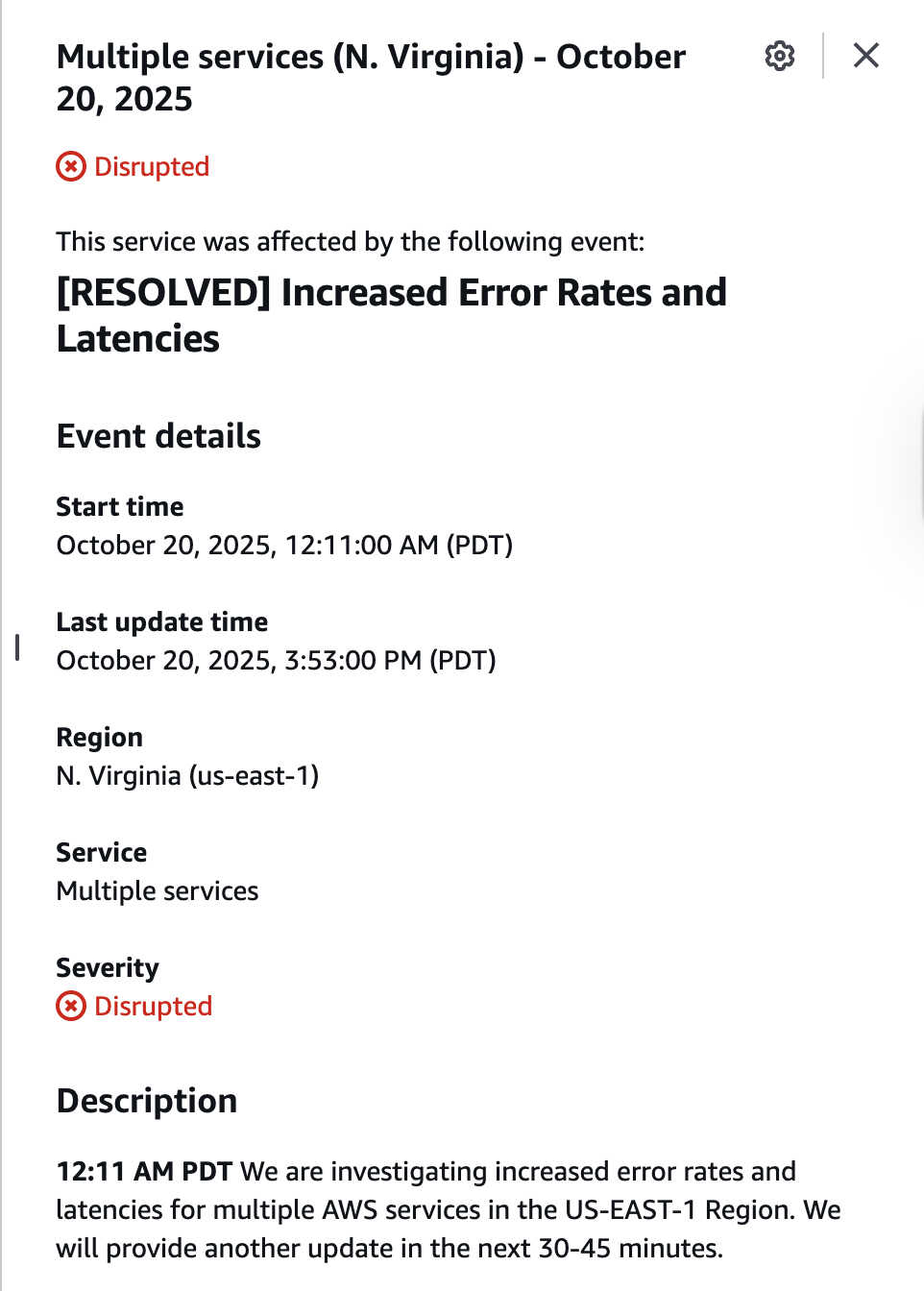
AWS reports an outage on October 20. Source: AWS Health Dashboard

Other financial applications were impacted by the outage, including the mixed-asset brokerage platform Robinhood and Web3 wallet MetaMask.

The October AWS outage lasted for about 15 hours and underscored the level of reliance crypto and Web3 projects, which market themselves as decentralized alternatives, have on centralized cloud infrastructure providers.

Crypto’s reliance on centralized infrastructure has drawn criticism from several crypto industry executives, including Jamie Elkaleh, chief marketing officer at crypto wallet company Bitget Wallet, and Carlos Lei, co-founder of decentralized physical infrastructure network (DePIN) marketplace Uplink.

“Decentralization has succeeded at the ledger layer but not yet at the infrastructure layer,” Elkaleh told Cointelegraph in October.

Magazine: Meet the onchain crypto detectives fighting crime better than the cops

Domande pertinenti

QAccording to the article, how will no-code tools and blockchain technology challenge AWS' dominance in cloud computing?

ANo-code tools democratize app creation through AI-powered linguistic interfaces, while blockchain provides decentralized, secure, and tamper-resistant infrastructure that eliminates reliance on centralized servers and reduces need for constant human maintenance.

QWhat specific problems did AWS outages cause for crypto platforms in 2025 as mentioned in the article?

AAWS outages in April and October 2025 caused disruptions including Binance pausing withdrawals, Coinbase experiencing login problems and withdrawal issues, and affecting platforms like KuCoin, MEXC, Robinhood, and MetaMask.

QWhat criticism did crypto executives have regarding the industry's infrastructure according to the article?

AExecutives like Jamie Elkaleh criticized that 'decentralization has succeeded at the ledger layer but not yet at the infrastructure layer,' highlighting the contradiction between Web3's decentralized ideals and its reliance on centralized cloud providers like AWS.

QWhat advantages does Lomesh Dutta attribute to decentralized blockchain networks for AI-generated applications?

AHe stated decentralized blockchain networks provide 'a revolutionary computing paradigm' by eliminating central points of control, enabling the creation of secure, reliable, and fault-tolerant software that can stay online without constant human intervention.

QWhich major companies and projects were mentioned as being affected by the AWS outages in the article?

AThe affected entities included crypto exchanges Binance, KuCoin, MEXC, and Coinbase; mixed-asset brokerage Robinhood; and Web3 wallet MetaMask.

Letture associate

Dialogue with ViaBTC CEO Yang Haipo: Is the Essence of Blockchain a Libertarian Experiment?

"ViaBTC CEO Yang Haipo: Blockchain as a Hardcore Libertarian Experiment" In a deep-dive interview, ViaBTC CEO Yang Haipo reframes the essence of blockchain, arguing it is not merely a new technology or infrastructure but a hardcore libertarian experiment. This experiment, born from the 2008 financial crisis and decades of cypherpunk ideology, tests a fundamental question: to what extent can freedom and self-organization exist without centralized trust? The discussion highlights the experiment's verified outcomes. On one hand, it has proven its core value of censorship resistance, providing critical financial lifelines for entities like WikiLeaks and individuals in hyperinflationary or sanctioned countries via tools like stablecoins. However, Yang points out a key paradox: the most successful product, USDT, is itself a centralized compromise, showing users prioritize a less-controlled pipeline over pure decentralization. On the other hand, the experiment has exposed the severe costs of this freedom—a "dark forest" without safeguards. Events like the collapses of LUNA, Celsius, and FTX, resulting in massive wealth destruction and prison sentences for founders, underscore the system's fragility and the inherent risks of an unregulated environment. Yang observes that despite decentralized protocols, human nature inevitably recreates centralized power structures, speculative frenzies, and narrative-driven cycles (from ICOs to Meme coins), where emotion and belonging often trump technological substance. Looking forward, he believes blockchain's future is significant but niche. Its real value lies in serving specific, real-world needs for financial sovereignty and bypassing traditional controls, not as a universal infrastructure replacing all centralized systems. For the average participant, Yang's crucial advice is to cultivate independent judgment. True freedom is not holding a crypto wallet, but possessing a mind resilient to groupthink and narrative hype in a high-risk, often irrational market.

marsbit11 min fa

Dialogue with ViaBTC CEO Yang Haipo: Is the Essence of Blockchain a Libertarian Experiment?

marsbit11 min fa

North Korean Hackers Loot $500 Million in a Single Month, Becoming the Top Threat to Crypto Security

North Korean hackers, particularly the notorious Lazarus Group and its subgroup TraderTraitor, have stolen over $500 million from cryptocurrency DeFi platforms in less than three weeks, bringing their total theft for the year to over $700 million. Recent major attacks on Drift Protocol and KelpDAO, resulting in losses of approximately $286 million and $290 million respectively, highlight a strategic shift: instead of targeting core smart contracts, attackers are now exploiting vulnerabilities in peripheral infrastructure. For instance, the KelpDAO attack involved compromising downstream RPC infrastructure used by LayerZero's decentralized validation network (DVN), allowing manipulation without breaching core cryptography. This sophisticated approach mirrors advanced corporate cyber-espionage. Additionally, North Korea has systematically infiltrated the global crypto workforce, with an estimated 100 operatives using fake identities to gain employment at blockchain companies, enabling long-term access to sensitive systems and facilitating large-scale thefts. According to Chainalysis, North Korean-linked hackers stole a record $2 billion in 2025, accounting for 60% of all global crypto theft that year. Their total historical crypto theft has reached $6.75 billion. Post-theft, they employ specialized money laundering methods, heavily relying on Chinese OTC brokers and cross-chain mixing services rather than standard decentralized exchanges. Security experts, while acknowledging the increased sophistication, emphasize that many attacks still exploit fundamental weaknesses like poor access controls and centralized operational risks. Strengthening private key management, limiting privileged access, and enhancing coordination among exchanges, analysts, and law enforcement immediately after an attack are critical to improving defense and fund recovery chances. The industry's challenge now extends beyond secure smart contracts to safeguarding operational security at the infrastructure level.

marsbit1 h fa

North Korean Hackers Loot $500 Million in a Single Month, Becoming the Top Threat to Crypto Security

marsbit1 h fa

Trading

Spot
Futures
活动图片