‘Block and find out’ – White House warns Coinbase on CLARITY Act fallout

ambcryptoPubblicato 2026-03-28Pubblicato ultima volta 2026-03-28

Introduzione

The White House issued a veiled warning to Coinbase over its opposition to the CLARITY Act, suggesting a future Democratic administration could impose harsher regulations on stablecoin yields, DeFi, and crypto overall. This marks a shift from earlier statements downplaying the exchange's stance. Coinbase confirmed it is working on a counterproposal to preserve stablecoin rewards, drawing both support and criticism. Broader industry concerns include weakened DeFi developer protections and the exclusion of Bitcoin from tax exemptions, which only apply to stablecoins. Despite the standoff, Coinbase anticipates the bill could be resolved and passed by early May.

The latest CLARITY Act standoff has now devolved into subtle threats between the White House and Coinbase.

In a social media post on the 28th of March, Patrick Witt, the executive director of the President’s Council on Digital Assets, issued a veiled warning that seemed aimed at a recent Coinbase holdout.
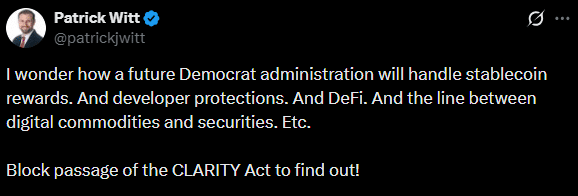
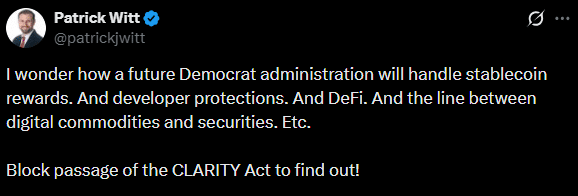
Source: X/Witt

According to Witt, the future Democratic administration will likely treat stablecoin yield, DeFi, and overall crypto way worse than the current compromise in the CLARITY Act draft. The Trump crypto advisor dared Coinbase to block the bill and find out Democrats’ plans.

This was a complete U-turn from an earlier White House statement that downplayed Coinbase’s alleged opposition to the new stablecoin restrictions.

But the stalemate is now public, and the crypto exchange confirmed it. In a separate statement, David Duong, Coinbase’s head of global investment research, said the industry was “working on a coordinated counterproposal” to “preserve sustainable stablecoin rewards.”

Some supported Coinbase’s fight for stablecoin yield. But critics wondered when the exchange’s CEO became a “crypto industry CEO” and a de facto spokesperson, decrying that he was holding the entire sector hostage.

However, the contentions on the latest CLARITY Act draft go beyond stablecoin rewards.

Developer protections and Bitcoin tax exemption concerns

Industry’s policy chiefs also raised concerns about the draft rules’ treatment of DeFi developer protections and the crypto double taxation issue.

For his part, Jake Chervinsky, CEO of Hyperliquid Policy Center, said the draft rules undermine developer protections and cautioned,

Those sections must be fixed, or the bill doesn’t work for DeFi. If the bill doesn’t work for DeFi, it doesn’t work at all.

However, Senator Cynthia Lummis assured that there was bipartisan support to include changes that protect developers.
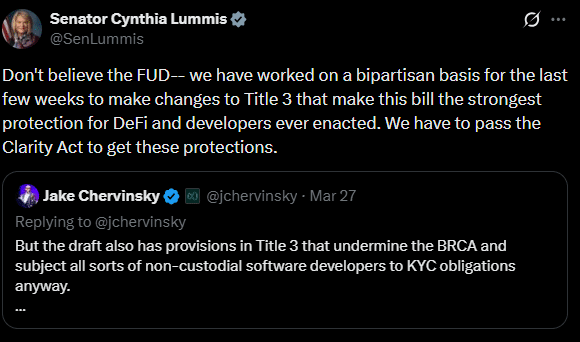
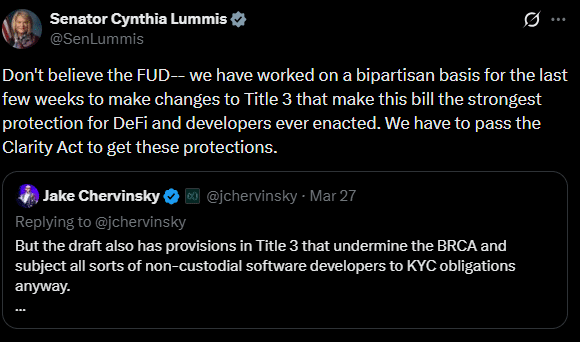
Source: X/Lummis

Separately, legal experts had issues with a new draft proposal that only offered a tax exemption for stablecoin transfers, but not BTC. Again, Coinbase was blamed for blocking the BTC tax exemption.

Notably, the proposal fixed the double taxation of crypto staking but not Bitcoin mining. This elicited a strong opposition from the advocacy group Bitcoin Policy Institute (BPI). BPI added,

Today’s new draft leaves the double taxation on Bitcoin mining in place and only provides relief to staking. We need a strong community push back to show that this language sets America and Bitcoin back.

Coinbase eyes May for final bill passage

That said, Coinbase’s Duong projected that the stablecoin yield issue could be resolved in the next three weeks.

According to him, a Senate Banking markup could then happen in H2 April with a potential final passage of the bill in early May if “floor time allows.”


Final Summary

  • White House warned Coinbase of the dire future consequences if it blocks the CLARITY Act again.
  • The exchange sought a new stablecoin yield deal and expected the bill could be passed in May.

Crypto di tendenza

Domande pertinenti

QWhat was the White House's warning to Coinbase regarding the CLARITY Act?

AThe White House, through Patrick Witt, issued a veiled warning that a future Democratic administration would likely treat stablecoin yield, DeFi, and crypto much worse than the current compromise in the CLARITY Act draft if Coinbase blocks the bill.

QWhat specific issue is Coinbase seeking to address with a coordinated counterproposal?

ACoinbase is working on a coordinated counterproposal to 'preserve sustainable stablecoin rewards' in response to the new stablecoin restrictions in the CLARITY Act draft.

QBeyond stablecoins, what other major concerns did industry experts raise about the CLARITY Act draft?

AIndustry experts raised concerns about the draft's undermining of DeFi developer protections and its failure to provide a tax exemption for Bitcoin, only offering one for stablecoin transfers and fixing double taxation for staking but not for Bitcoin mining.

QWhat was the projected timeline for the bill's passage according to Coinbase's David Duong?

ADavid Duong projected that the stablecoin yield issue could be resolved in three weeks, with a Senate Banking markup in the second half of April and a potential final passage of the bill in early May.

QWhich advocacy group strongly opposed the draft's treatment of Bitcoin mining taxation?

AThe Bitcoin Policy Institute (BPI) strongly opposed the draft, stating it leaves the double taxation on Bitcoin mining in place and only provides relief to staking, which sets America and Bitcoin back.

Letture associate

Dan Koe: The Counterintuitive Truth—You Don't Need to Remember Everything You Read

Dan Koe: The Counterintuitive Truth — You Don't Need to Remember Everything You Read The central idea is that deliberately trying to remember information is often misguided. True learning isn't about memorizing facts but about having important knowledge surface naturally when needed through use. Most forgetting is normal, not a failure. The article reframes learning using a control theory framework—a four-step feedback loop: having a clear Goal, accurately Sensing your current state, Comparing the gap, and Acting to close it. Most learning stalls because people only do step 2 (blind input) without a goal to create the necessary "error signal" for focused action. The most effective method is to start with output, not input. Begin a meaningful personal project first, and learn only what's necessary to complete it. This project-driven, "just-in-time" learning ensures knowledge is contextual and retained. The concept of a "Second Brain" often fails because it becomes a digital graveyard—over-collected and under-utilized. The goal should be building a "Second Subconscious"—a dynamic system that proactively surfaces relevant ideas during creation, not a static storage vault. Tools like Obsidian+Claude or Eden can help by automating organization and enabling semantic search, but their value depends on linking knowledge to active projects. Ultimately, what matters is not what you store, but what you filter and internalize. Focus on ideas that shape your worldview, use projects as filters, and transform collected material through writing and sharing. AI should be used to reduce friction in research and editing, not to formulate your core views. In conclusion, remembering is a byproduct, not the goal. Knowledge that sticks comes from pursuing personal goals, applying it in real projects, and digesting it through creation. The tools are merely aids; the crucial step is to start doing meaningful work and let the necessary knowledge find you.

marsbit7 min fa

Dan Koe: The Counterintuitive Truth—You Don't Need to Remember Everything You Read

marsbit7 min fa

A New Era: The Fundamental Transformation of China's Entrepreneurs

A profound generational shift is underway among Chinese entrepreneurs. The wealth and influence once dominated by real estate and internet giants is now being claimed by a new wave of founders driving breakthroughs in AI, semiconductors, and robotics. This change is vividly reflected in 2026's wealth rankings. Figures like Zhang Yiming (ByteDance), Liang Wenfeng (DeepSeek), Chen Tianshi (Cambricon), and Wang Xingxing (Unitree Robotics) are ascending. Their wealth stems not from traditional business models but from market expectations for future technological competitiveness, with AI, chips, and smart hardware becoming the primary engines of wealth creation. Their common trait is a foundational focus on technology, often starting from the laboratory rather than a business plan. Examples include Chen Tianshi's decade-long push in AI chips, Liang Wenfeng's core algorithmic innovations at DeepSeek with a compact team, and Zhu Yiming's "no salary until profitable" 9-year journey to build Changxin Memory into a global DRAM player. This transition marks a fundamental shift in China's economic imperative: from commercial expansion and learning to indigenous innovation and deep industrial capability. While the previous generation built the foundational market and infrastructure, this new cohort is tasked with achieving global leadership in core technologies, moving China from "keeping pace" to pioneering original, breakthrough innovations that are industrialized at scale. The baton is being passed to those competing on the world stage through technological originality.

marsbit7 min fa

A New Era: The Fundamental Transformation of China's Entrepreneurs

marsbit7 min fa

Once-Popular Web3 Enters Wave of Layoffs

The once-hot Web3 industry is experiencing a severe wave of layoffs. While many companies attribute job cuts to AI-driven restructuring, the primary reason is often financial pressure. The Web3 sector, at the intersection of tech and finance, has been hit particularly hard. Employees at major cryptocurrency exchanges report sudden, impersonal layoffs—often with system access revoked overnight—and minimal or no severance. Common tactics include setting impossible performance targets or terminating employees for minor policy violations. The working atmosphere has become toxic, marked by intense monitoring, excessive meetings, and management obsessed with control and internal politics rather than product innovation. The industry's core business model is collapsing. Exchange revenue from trading fees and listing charges has plummeted due to a decline in quality projects and retail investor exodus. Events like the massive forced liquidation on October 10th further shattered confidence. Competition from on-chain derivatives platforms and prediction markets is intensifying the downturn. As layoffs continue, displaced workers struggle to find new opportunities. Many transition to the AI sector, but face significant bias from traditional finance and even some AI firms, which view crypto industry experience with suspicion. The current downturn appears more structural than cyclical, driven by unsustainable practices, internal strife, and a failure to innovate, raising questions about the industry's future trajectory.

marsbit1 h fa

Once-Popular Web3 Enters Wave of Layoffs

marsbit1 h fa

Trading

Spot

Articoli Popolari

Come comprare HOUSE

Benvenuto in HTX.com! Abbiamo reso l'acquisto di Housecoin (HOUSE) semplice e conveniente. Segui la nostra guida passo passo per intraprendere il tuo viaggio nel mondo delle criptovalute.Step 1: Crea il tuo Account HTXUsa la tua email o numero di telefono per registrarti il tuo account gratuito su HTX. Vivi un'esperienza facile e sblocca tutte le funzionalità,Crea il mio accountStep 2: Vai in Acquista crypto e seleziona il tuo metodo di pagamentoCarta di credito/debito: utilizza la tua Visa o Mastercard per acquistare immediatamente HousecoinHOUSE.Bilancio: Usa i fondi dal bilancio del tuo account HTX per fare trading senza problemi.Terze parti: abbiamo aggiunto metodi di pagamento molto utilizzati come Google Pay e Apple Pay per maggiore comodità.P2P: Fai trading direttamente con altri utenti HTX.Over-the-Counter (OTC): Offriamo servizi su misura e tassi di cambio competitivi per i trader.Step 3: Conserva Housecoin (HOUSE)Dopo aver acquistato Housecoin (HOUSE), conserva nel tuo account HTX. In alternativa, puoi inviare tramite trasferimento blockchain o scambiare per altre criptovalute.Step 4: Scambia Housecoin (HOUSE)Scambia facilmente Housecoin (HOUSE) nel mercato spot di HTX. Accedi al tuo account, seleziona la tua coppia di trading, esegui le tue operazioni e monitora in tempo reale. Offriamo un'esperienza user-friendly sia per chi ha appena iniziato che per i trader più esperti.

389 Totale visualizzazioniPubblicato il 2025.04.27Aggiornato il 2026.06.02

Come comprare HOUSE

Discussioni

Benvenuto nella Community HTX. Qui puoi rimanere informato sugli ultimi sviluppi della piattaforma e accedere ad approfondimenti esperti sul mercato. Le opinioni degli utenti sul prezzo di HOUSE HOUSE sono presentate come di seguito.

活动图片