BlackRock files for listing staked Ether ETF

cointelegraphPubblicato 2025-12-08Pubblicato ultima volta 2025-12-08

Introduzione

BlackRock, a major US asset management firm, has filed an application with the SEC to list a staked Ethereum ETF, named the iShares Staked Ethereum Trust. The proposed ETF, intended for trading on Nasdaq under the ticker ETHB, would be among the first investment vehicles tied to staked cryptocurrencies. This filing follows the company's previous crypto offerings, including its successful spot Bitcoin ETF. While the SEC has been cautious about approving crypto staking funds since greenlighting spot Ether ETFs in 2024, other firms like Grayscale and Bitwise have also launched similar staking products. The article also notes the evolving stance of BlackRock's CEO, Larry Fink, who has shifted from earlier skeptical comments on crypto to supporting such offerings.

US-based asset management company BlackRock has applied to list and trade shares of an investment vehicle tied to staked Ether, following its offering of other cryptocurrency products.

In a Friday filing with the US Securities and Exchange Commission, BlackRock filed a Form S-1 registration statement for its iShares Staked Ethereum Trust exchange-traded fund. The filing is part of the SEC’s process for companies to list investment vehicles such as ETFs, but does not guarantee approval.
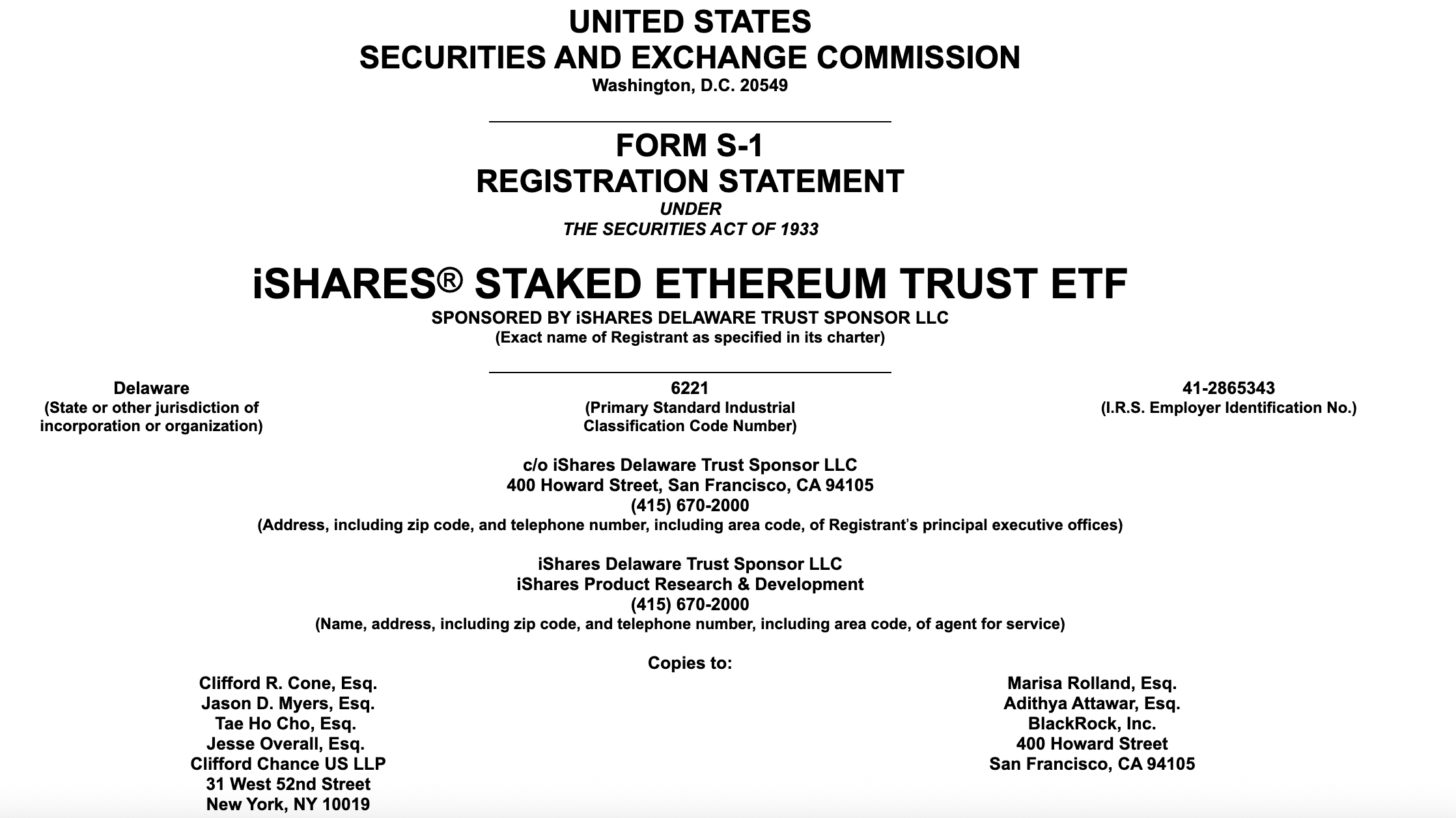
BlackRock staked Ether ETF filing on Friday. Source: SEC

Shares of the staked Ether (ETH) fund, which BlackRock intends to list and trade on the Nasdaq exchange under the ticker ETHB, could be one of the first offerings tied to staked cryptocurrencies. Grayscale Investments added staking functionality to its previously approved spot ETH and mini ETH trusts in October.

The regulator has not greenlighted many crypto staking funds since initially approving spot Ether ETFs in May 2024. However, Canary Capital made a similar SEC filing for a staked Injective (INJ) product in July, and Grayscale and Bitwise launched separate staking products tied to Solana (SOL) in October.

BlackRock manages the largest spot Bitcoin (BTC) exchange-traded fund, the iShares Bitcoin Trust ETF, which is listed under the ticker symbol IBIT.

Related: Spot Ether ETF staking could ‘dramatically reshape the market’

Has BlackRock’s CEO softened on crypto?

Larry Fink, who co-founded BlackRock in 1988, said before Bitcoin’s 2017 bull run that the cryptocurrency “shows you how much demand for money laundering there is in the world.”

In the years since, and as the US digital asset market grew in volume and usage, the CEO has made more bullish remarks on crypto investments, including by supporting BlackRock’s launch of a spot Bitcoin ETF and others.

In The New York Times’ DealBook Summit last week, Fink said he had had a “big shift” in his opinions of crypto, but still referred to BTC as an “asset of fear.”

Magazine: XRP’s ‘now or never’ moment, Kalshi taps Solana: Hodler’s Digest, Nov. 30 – Dec. 6

Letture associate

The 20% Threshold Audit: Which of the Top 20 Cryptocurrencies Will Perish Under the CLARITY Act?

**Audit of the Top 20: Which Cryptocurrencies Will the CLARITY Act Kill?** Scheduled for a final push in December 2025, the U.S. CLARITY Act introduces a critical 20% threshold. If any single entity or affiliated party controls more than 20% of a network's token supply or validation power, the asset is classified as a "digital security" under the SEC's strict jurisdiction. If it remains below, it is a "digital commodity" under the more lenient CFTC. An audit of the top 20 cryptocurrencies reveals a stark divide: **The Safe Haven (Digital Commodities):** * **Bitcoin (BTC):** 0% control. The gold standard of decentralization. * **Ethereum (ETH):** <1% control. Highly dispersed validators and foundation holdings. * **Dogecoin (DOGE) & Litecoin (LTC):** Near 0% control. Their simple, early PoW issuance is now a major compliance advantage. **The Red Zone (At High Risk):** * **XRP:** High risk. Ripple's massive escrowed holdings could be deemed "entity-controlled." * **BNB:** High risk. Strong association with Binance exchange and its controlled burn mechanism. * **TON:** High risk. Historically concentrated supply from early mining. * **Sui & Aptos:** Extreme risk. Classic "VC coins" with teams, investors, and foundations holding over 50%. * **Layer 2 Tokens (e.g., ARB, OP):** Medium-High risk. Their DAO treasuries often hold 30-40+% of supply, which could be viewed as a single entity. **The Grey Zone:** * **Solana (SOL):** Its status is unclear. FTX's collapse dispersed supply, but the foundation and VC holdings remain a focus for regulators. The 360-day grace period will trigger a market reckoning. Projects may desperately airdrop or burn tokens to dilute control, accept a security" label and face liquidity death on major exchanges, or be preemptively delisted. The outcome will be a "gentrification" of crypto, splitting the market into compliant, institutional "digital commodities" and a shadowy world of illiquid "digital securities." Investors must now scrutinize token distribution or risk being locked out of liquidity.

marsbit30 min fa

The 20% Threshold Audit: Which of the Top 20 Cryptocurrencies Will Perish Under the CLARITY Act?

marsbit30 min fa

Trading

Spot
Futures
活动图片