Bitwise Plants Its Flag In ETF Staking With Chorus One Buyout

bitcoinistPubblicato 2026-02-26Pubblicato ultima volta 2026-02-26

Introduzione

Crypto asset manager Bitwise has acquired staking infrastructure firm Chorus One, which manages over $2.2 billion in assets across dozens of blockchain networks. The deal brings 50 employees into Bitwise's onchain division and expands its staking services to more than 30 proof-of-stake networks, including Solana, Avalanche, and Sui. While financial terms were undisclosed, the acquisition positions Bitwise to capitalize on staking as a key growth opportunity, especially as the SEC warms to crypto investment products like ETFs that may offer staking rewards. Bitwise, which already manages $15 billion in assets and runs over 40 investment products, including its Bitcoin and Ethereum ETFs, continues to expand beyond its core ETF offerings.

Crypto asset manager Bitwise just made one of its boldest moves yet. The company has acquired Chorus One, a staking infrastructure firm that manages more than $2.2 billion in assets across dozens of blockchain networks. The deal brings 50 Chorus One employees into Bitwise’s growing onchain division, where several billion dollars in crypto assets are already being staked by clients.

Financial Terms Undisclosed

Chorus One has been in the staking business since 2018. Over those years, it built a client base that includes family offices, large funds, exchanges, high-net-worth individuals, and custodians — the kind of institutional relationships that take years to earn. Its founder and CEO, Brian Crain, will stay on in an advisory role as the rest of the team folds into Bitwise Onchain Solutions.
Image: Bitwise Asset Management

Reports say the financial terms of the deal were not made public. Bitwise did not disclose how much it paid.

What is clear, though, is what the company gets out of it. The acquisition extends Bitwise’s staking reach across more than 30 proof-of-stake networks — among them Solana, Avalanche, Sui, Aptos, Hyperliquid, Monad, and Tezos. That is a wide net, and it signals the company is not thinking just about Ethereum.

BTCUSD now trading at $65,247. Chart: TradingView

Staking, for those unfamiliar, works like this: holders of certain crypto tokens lock them up on a blockchain to help keep the network running. In return, they earn rewards — typically somewhere between 2% and 10% a year, on top of any gains from the token itself.

Why The Timing Matters

The US Securities and Exchange Commission has been warming up to a wider range of crypto investment products. That shift has opened the door for new types of exchange-traded funds, including ones that could one day offer staking rewards to ordinary investors. Bitwise appears to be positioning itself for exactly that possibility.
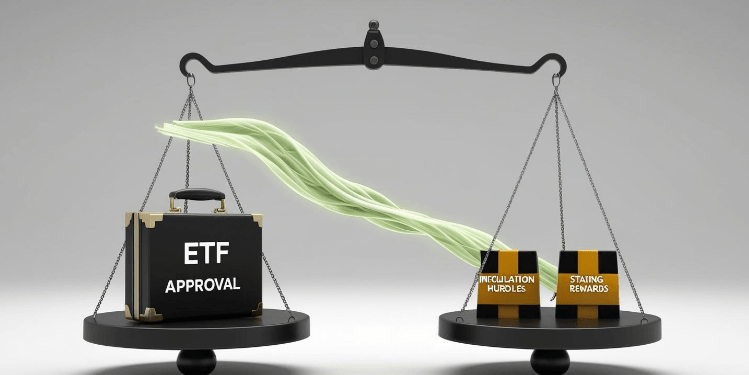
Image: OSL

Bitwise CEO Hunter Horsley described staking as “one of the most compelling growth opportunities” the firm sees for its clients. The company already runs more than 40 investment products and oversees roughly $15 billion in assets under management. Its flagship offerings include the Bitwise Bitcoin ETF and the Bitwise Ethereum ETF, which have pulled in over $2 billion and $387 million in flows respectively since launching in 2024.

Room To Grow

With nearly 200 employees now spread across the world, Bitwise has been steadily building out beyond its core ETF lineup. Reports note that its other products include ETFs tied to Solana, XRP, Chainlink, and even Dogecoin. The Chorus One deal adds staking muscle to that already broad product shelf.

Featured image from Gemini, chart from TradingView

Crypto di tendenza

Domande pertinenti

QWhat is the significance of Bitwise's acquisition of Chorus One?

AThe acquisition of Chorus One is a significant move for Bitwise as it expands the company's staking capabilities across more than 30 proof-of-stake blockchain networks, bringing in over $2.2 billion in staked assets and 50 experienced employees to bolster its onchain division.

QWhat types of clients did Chorus One serve prior to the acquisition?

AChorus One's client base included family offices, large funds, exchanges, high-net-worth individuals, and custodians, representing a range of institutional relationships built since 2018.

QHow does staking work in the context of cryptocurrency, according to the article?

AStaking involves holders of certain crypto tokens locking them up on a blockchain to help maintain network operations. In return, they earn rewards, typically between 2% and 10% annually, in addition to any appreciation in the token's value.

QWhy is the timing of this acquisition particularly important for Bitwise?

AThe timing is crucial because the US Securities and Exchange Commission is becoming more open to a wider range of crypto investment products, potentially including exchange-traded funds (ETFs) that offer staking rewards. Bitwise is positioning itself to capitalize on this future opportunity.

QWhat are some of Bitwise's flagship investment products mentioned in the article?

ABitwise's flagship offerings include the Bitwise Bitcoin ETF and the Bitwise Ethereum ETF, which have attracted over $2 billion and $387 million in flows, respectively, since their launch in 2024. The company also has ETFs tied to Solana, XRP, Chainlink, and Dogecoin.

Letture associate

Global Market Share Survey: Japanese Firms Lead in Semiconductor Materials

Global Market Share Survey: Japanese Firms Lead in Semiconductor Materials According to the 2025 "Major Goods and Services Market Share Survey" by Nikkei, Japanese companies maintain strong positions in semiconductor-related materials. In silicon wafers, Shin-Etsu Chemical ranks first with a 26.3% share, followed by SUMCO at 17.8%. Together, they hold 44.1% of the market, widening their lead over competitors from Taiwan, Germany, and South Korea. In photoresists, Tokyo Ohka Kogyo, JSR, and Shin-Etsu Chemical occupy the top three spots, with a combined share of 60.5%. Despite their strength in materials, Japanese firms have a weaker presence in core semiconductor segments like DRAM and NAND flash memory, where South Korean and U.S. companies dominate. For instance, SK Hynix and Samsung lead in DRAM, while China’s CXMT doubled its share to 6% in 2025. The semiconductor market is projected to grow rapidly, with WSTS forecasting a 90% increase to $1.5112 trillion by 2026. Major players like Samsung, SK Hynix, and Micron are making massive investments to expand capacity. To maintain their edge in materials, Japanese companies must similarly commit to large-scale, risk-taking investments. In contrast, Japan’s automotive sector shows stagnation. Toyota remains the global leader but with only a slight share increase to 12.3%, while Japanese brands are absent from the top five in the EV market. In shipbuilding, Imabari Shipbuilding rose to third place globally with a 7.2% share, benefiting from large container ship deliveries. However, Chinese and South Korean firms dominate the sector, holding the top two positions. Japan aims to revitalize its shipbuilding industry through government and corporate efforts, targeting a near doubling of output by 2035. Addressing labor shortages and adopting advanced technologies like physical AI will be critical for competitiveness.

marsbit16 min fa

Global Market Share Survey: Japanese Firms Lead in Semiconductor Materials

marsbit16 min fa

STRC Major De-pegging's First Financial Report, How Will Strategy Repair Its Capital Flywheel?

Bitcoin treasury company Strategy released its Q2 2026 earnings report on July 31. Despite a 6.9% year-over-year revenue increase to $122 million, the company recorded a net loss of $8.22 billion, largely due to $8.32 billion in unrealized losses from Bitcoin price fluctuations. As of quarter-end, Strategy holds 843,775 BTC with an average cost of $75,000 per coin, and Bitcoin per share increased. The report highlights a critical shift in Strategy's capital model following the de-pegging of its key financing tool, STRC (Strategic Coin), which fell below its $100 target. Management's top priority is restoring STRC to its target value, aiming for a recovery by September 8. They rule out discounted STRC issuances and plan to maintain its dividend yield at 12%, instead focusing on bolstering its $3.75 billion cash reserve. Strategy has moved from a one-way "buy-and-hold" Bitcoin strategy to active capital management. This new approach, part of its "Digital Credit Capital Framework," involves flexibly managing its balance sheet across four elements: BTC, USD cash, common stock (MSTR), and digital credit securities like STRC. This allows for BTC monetization (having sold $218.4 million in BTC so far), strategic repurchases of discounted securities, and debt optimization, as seen with a $1.5 billion convertible bond buyback. The company's future hinges on two key tests: successfully re-pegging STRC to restore market confidence in its digital credit system, and a long-term recovery in Bitcoin's price to ultimately support its growth thesis.

marsbit1 h fa

STRC Major De-pegging's First Financial Report, How Will Strategy Repair Its Capital Flywheel?

marsbit1 h fa

STRC's First Financial Report Post-Depegging, How is Strategy Restoring the Capital Flywheel?

On July 31, 2026, Bitcoin treasury company Strategy released its Q2 financial report. Despite a 6.9% year-over-year increase in revenue to $122 million, the company recorded a substantial net loss of $8.22 billion, primarily due to $8.32 billion in unrealized losses from Bitcoin holdings. While Strategy's core Bitcoin strategy remains intact—its holdings grew 11% to 843,775 BTC—the company is undergoing a fundamental shift in its capital model. Following the de-pegging of its key financing tool, the STRCoin (STRC), from its $100 target in May, Strategy has pivoted from a one-directional "raise funds, buy Bitcoin" cycle to a more dynamic, multi-asset capital management approach. A key part of this new framework is the "Monetization Program," through which Strategy has sold approximately $218.4 million worth of BTC to bolster liquidity. The company's top priority is repairing STRC's peg, committing not to issue discounted shares until it returns to its target range. It has initiated a $1 billion buyback program for discounted digital credit securities, having repurchased $28.9 million face value of STRC so far. Management aims to restore the peg around September 8, 2026. Strategy now actively manages a matrix of assets: Bitcoin (for accumulation or strategic sales), USD cash reserves (now at $3.75 billion), common stock (MSTR), and digital credit securities like STRC. This allows for tactical moves like repurchasing discounted debt or equity to capture value. The future success of Strategy's "capital flywheel" hinges on two factors: the short-term ability to successfully re-peg STRC to restore market confidence in its digital credit system, and the long-term price trajectory of Bitcoin, upon which its entire investment thesis ultimately depends.

Odaily星球日报1 h fa

STRC's First Financial Report Post-Depegging, How is Strategy Restoring the Capital Flywheel?

Odaily星球日报1 h fa

Trading

Spot

Articoli Popolari

Come comprare ONE

Benvenuto in HTX.com! Abbiamo reso l'acquisto di Harmony (ONE) semplice e conveniente. Segui la nostra guida passo passo per intraprendere il tuo viaggio nel mondo delle criptovalute.Step 1: Crea il tuo Account HTXUsa la tua email o numero di telefono per registrarti il tuo account gratuito su HTX. Vivi un'esperienza facile e sblocca tutte le funzionalità,Crea il mio accountStep 2: Vai in Acquista crypto e seleziona il tuo metodo di pagamentoCarta di credito/debito: utilizza la tua Visa o Mastercard per acquistare immediatamente HarmonyONE.Bilancio: Usa i fondi dal bilancio del tuo account HTX per fare trading senza problemi.Terze parti: abbiamo aggiunto metodi di pagamento molto utilizzati come Google Pay e Apple Pay per maggiore comodità.P2P: Fai trading direttamente con altri utenti HTX.Over-the-Counter (OTC): Offriamo servizi su misura e tassi di cambio competitivi per i trader.Step 3: Conserva Harmony (ONE)Dopo aver acquistato Harmony (ONE), conserva nel tuo account HTX. In alternativa, puoi inviare tramite trasferimento blockchain o scambiare per altre criptovalute.Step 4: Scambia Harmony (ONE)Scambia facilmente Harmony (ONE) nel mercato spot di HTX. Accedi al tuo account, seleziona la tua coppia di trading, esegui le tue operazioni e monitora in tempo reale. Offriamo un'esperienza user-friendly sia per chi ha appena iniziato che per i trader più esperti.

368 Totale visualizzazioniPubblicato il 2024.12.12Aggiornato il 2026.06.02

Come comprare ONE

Discussioni

Benvenuto nella Community HTX. Qui puoi rimanere informato sugli ultimi sviluppi della piattaforma e accedere ad approfondimenti esperti sul mercato. Le opinioni degli utenti sul prezzo di ONE ONE sono presentate come di seguito.

活动图片