Bittensor: Should TAO bulls buy now or wait for a pullback below $300?

ambcryptoPubblicato 2026-03-28Pubblicato ultima volta 2026-03-28

Introduzione

Bittensor (TAO) has demonstrated notable strength by maintaining its position above the critical $300 support level, even as major cryptocurrencies like Bitcoin and Ethereum faced selling pressure. The recent move above $302.4 confirmed a bullish structural shift on the 3-day chart, supported by new highs in the On-Balance Volume (OBV) indicator. This resilience is attributed to growing demand for decentralized AI infrastructure. Analysts suggest that a pullback toward the $286–$305 zone could offer a strategic buying opportunity, with potential upward targets at $405–$450. The 4-hour chart reinforces this bullish outlook, showing steady buying pressure and a constructive price structure. However, a drop below $261 would invalidate this optimistic setup. Traders are advised to consider entering within the $286–$319 range, anticipating further gains in the near term.

Bittensor [TAO] continued to trade above the psychological $300 level. While the market leaders Bitcoin [BTC] and Ethereum [ETH] faced strong selling pressure over the past week and were forced to register losses, TAO continued to trend higher.

The $300 was therefore an important support level that swing traders should keep an eye on. Is the sustained uptrend another buying opportunity for TAO traders, or should they take profits and expect a deep retracement next?

The bullish TAO swing structure confirms the trend direction
Source: TAO/USDT on TradingView

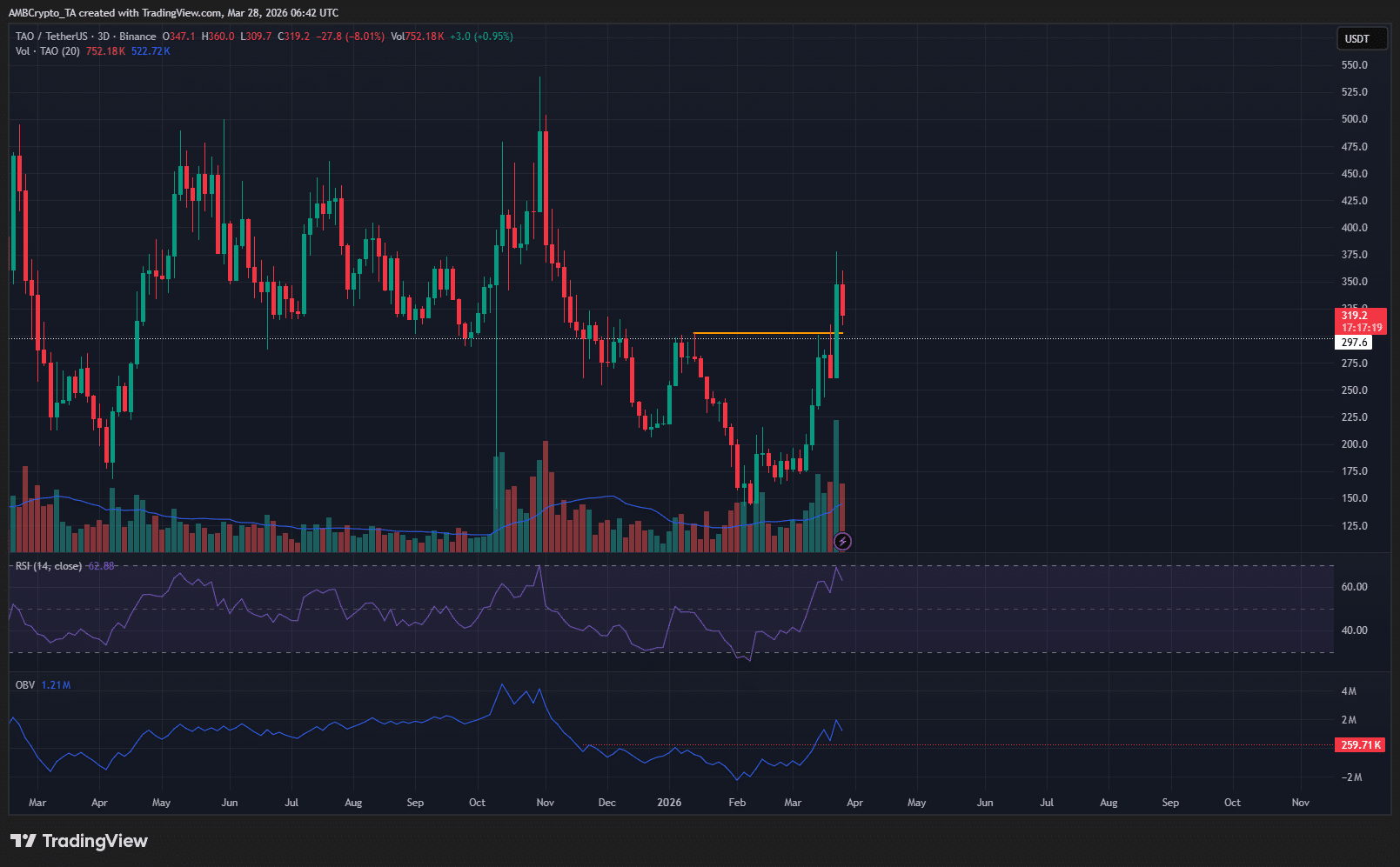
The move above $302.4 last week represented a bullish swing structural shift for TAO on the 3-day chart. At the same time, the OBV was making new local highs, and a psychological round number resistance had been overcome.

These developments were remarkable, especially as Bitcoin and many altcoins were forced to go lower or trade sideways. The demand for decentralized AI infrastructure likely explained the AI token’s relative strength.

A pullback toward $300 would be a buying opportunity for Bittensor traders and investors. Their next targets would be $450-$500.

Why traders should buy now
Source: TAO/USDT on TradingView

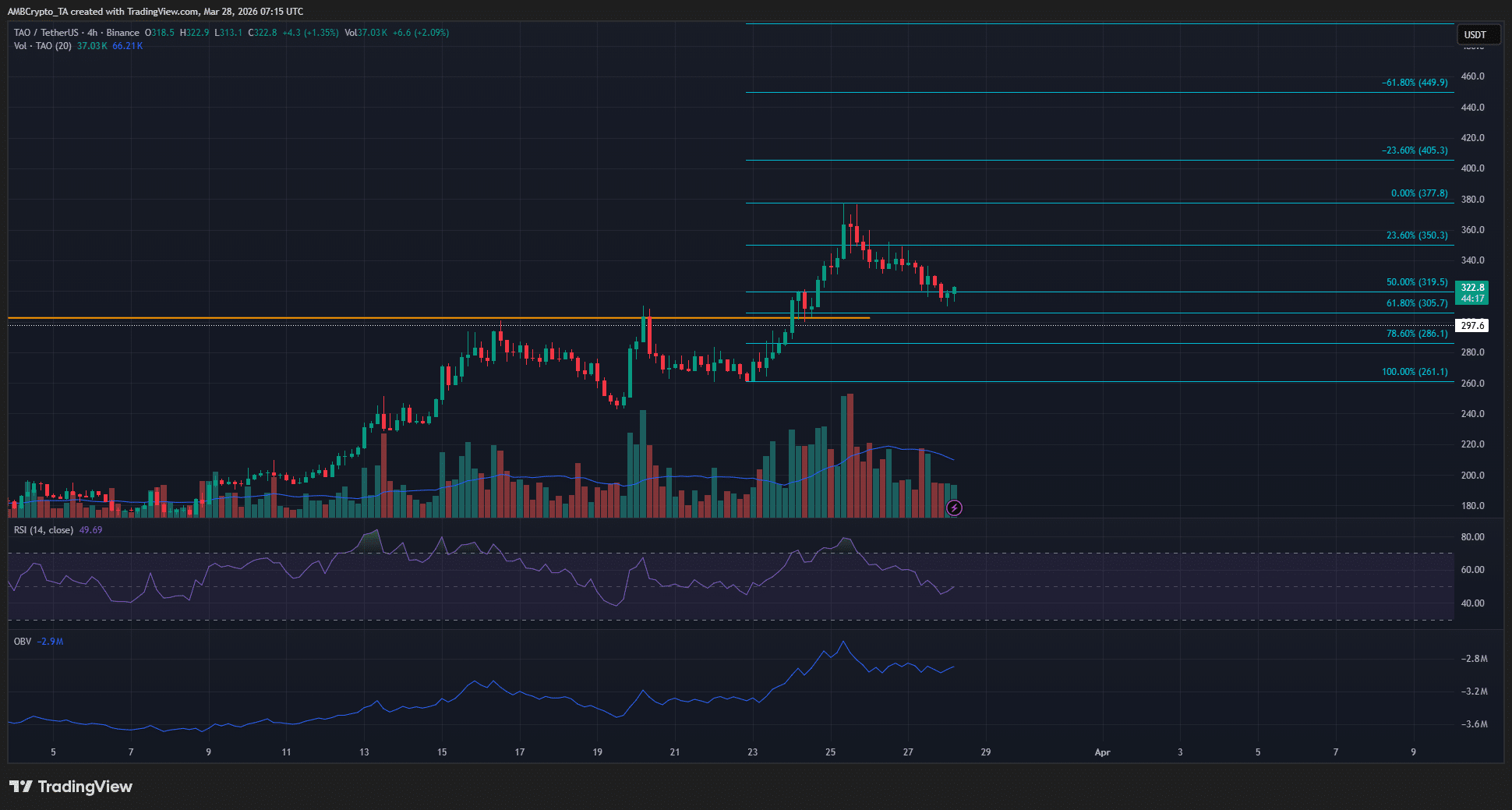
The 4-hour chart was quite encouraging. In this timeframe, the price structure was firmly bullish. The technical indicators also supported the upward momentum and reflected steady buying pressure on the altcoin.

The Fibonacci retracement levels (cyan) showed that a retracement was underway. The $286-$305 pocket would be the ideal buying zone, but it is unclear if we will get this dip.

Traders can look to buy anywhere within the $286-$319 area, as many traders and analysts also consider the 50% retracement as a key support in an uptrend. In either scenario, the $405 and $449 levels would be the next targets.

A drop below the $261.1 mark will shift the H4 structure bearishly and invalidate the bullish setup laid out above.


Final Summary

  • Bittensor continued to trade above the $300 level despite the crypto market correction over the past two days.
  • This show of relative strength could see another uptrend next week, with $409 and $450 being the next targets.


Domande pertinenti

QWhat is the key psychological support level for Bittensor (TAO) mentioned in the article?

AThe key psychological support level for Bittensor (TAO) is $300.

QWhat did the move above $302.4 represent for TAO on the 3-day chart?

AThe move above $302.4 represented a bullish swing structural shift for TAO on the 3-day chart.

QAccording to the article, what is the ideal buying zone for TAO on the 4-hour chart?

AThe ideal buying zone for TAO on the 4-hour chart is the $286-$305 price pocket.

QWhat price level would invalidate the bullish setup and shift the H4 structure bearishly?

AA drop below the $261.1 mark would invalidate the bullish setup and shift the H4 structure bearishly.

QWhat are the next major price targets for TAO if the uptrend continues?

AThe next major price targets for TAO are the $405, $409, $449, and $450 levels.

Letture associate

Lowering Expectations for BTC's Next Bull Market

The author, Alex Xu, explains his decision to significantly reduce his Bitcoin holdings (from full to ~30% of his portfolio) during the current bull cycle, citing a lowered long-term outlook for BTC's price appreciation in the next cycle. He outlines six key reasons for this reduced expectation: 1. **Diminished Growth Drivers:** The narrative of exponential user adoption has largely played out with institutional ETF adoption. The next major growth phase—adoption by sovereign national reserves or central banks—seems unlikely in the near future. 2. **Personal Opportunity Cost:** More attractive investment opportunities have emerged in other assets, such as undervalued companies. 3. **Industry-Wide Contraction:** The broader crypto industry is struggling, with most Web3 business models (SocialFi, GameFi, DePIN) failing. This overall萧条 (depression) reduces the fundamental demand and consensus for Bitcoin. 4. **Strain on Major Buyer:** MicroStrategy, a major corporate buyer of BTC, faces rising financing expenses for its debt, which could slow its purchasing rate and create significant marginal pressure on the market. 5. **Increased Competition from Gold:** The emergence of "tokenized gold" has closed the functional gap (portability, divisibility) between physical gold and Bitcoin, offering a strong competitor in the non-sovereign store-of-value space. 6. **Security Budget Concerns:** The block reward halving continues to exacerbate the long-standing issue of funding Bitcoin's network security, with new fee source explorations like Ordinals and L2s largely failing. The author's decision to hold a significant (though reduced) position reflects a cautious, not bearish, outlook. He remains open to increasing his exposure if the fundamental reasons for his skepticism change or if new positive catalysts emerge.

marsbit4 min fa

Lowering Expectations for BTC's Next Bull Market

marsbit4 min fa

Can Iran 'Control' the Strait of Hormuz?

Iran has announced a comprehensive plan to assert control over the strategic Strait of Hormuz, a critical global oil shipping chokepoint. The proposed measures include requiring all vessels to obtain Iranian permission for passage, imposing fees for security, environmental protection, and navigation management—preferably paid in Iranian rials—and absolutely banning Israeli ships. Vessels from countries deemed hostile by Iran’s top security bodies may also be barred. Analysts suggest Iran’s motives are multifaceted: increasing pressure on the U.S. and Israel by leveraging control over oil transit to influence global prices and inflation; creating a new revenue stream, potentially exceeding $7.7 billion annually, to counter Western sanctions and support postwar reconstruction; and using transit permissions as bargaining chips in future negotiations, notably with the U.S. However, the plan faces significant practical and diplomatic challenges. Enforcing comprehensive interception and fee collection in the busy waterway, patrolled by international military forces, would be difficult. The U.S. has already countering with a blockade of Iranian ports and threats to intercept any ship paying fees, potentially strangling Iran’s oil exports and fee revenue. Broad international opposition, led by European and Gulf states, and legal controversies further complicate implementation. The proposal may ultimately serve more as a negotiating tactic than a feasible policy, with its execution remaining highly uncertain.

marsbit1 h fa

Can Iran 'Control' the Strait of Hormuz?

marsbit1 h fa

Trading

Spot
Futures
活动图片