Bittensor jumps 28% as Anthropic restrictions fuel TAO’s $300 test

ambcryptoPubblicato 2026-06-15Pubblicato ultima volta 2026-06-15

Introduzione

Bittensor (TAO) surged 28% weekly, recovering from key support near $180.9 as buyers gained momentum. The price broke through resistance and the 20-day SMA, reaching ~$267.4 with strong volume and improving technical indicators like RSI and MACD. The rally was fueled in part by news that Anthropic restricted access to some AI models for foreign nationals, highlighting a weakness in centralized AI and boosting demand for decentralized AI projects like Bittensor. Attention now turns to the $280-$300.6 resistance zone. Maintaining support above the $244.7-$255 range is crucial for the bullish structure; losing it could lead to a retracement toward $210-$220. The sustainability of the move depends on continued demand beyond the initial headline-driven boost.

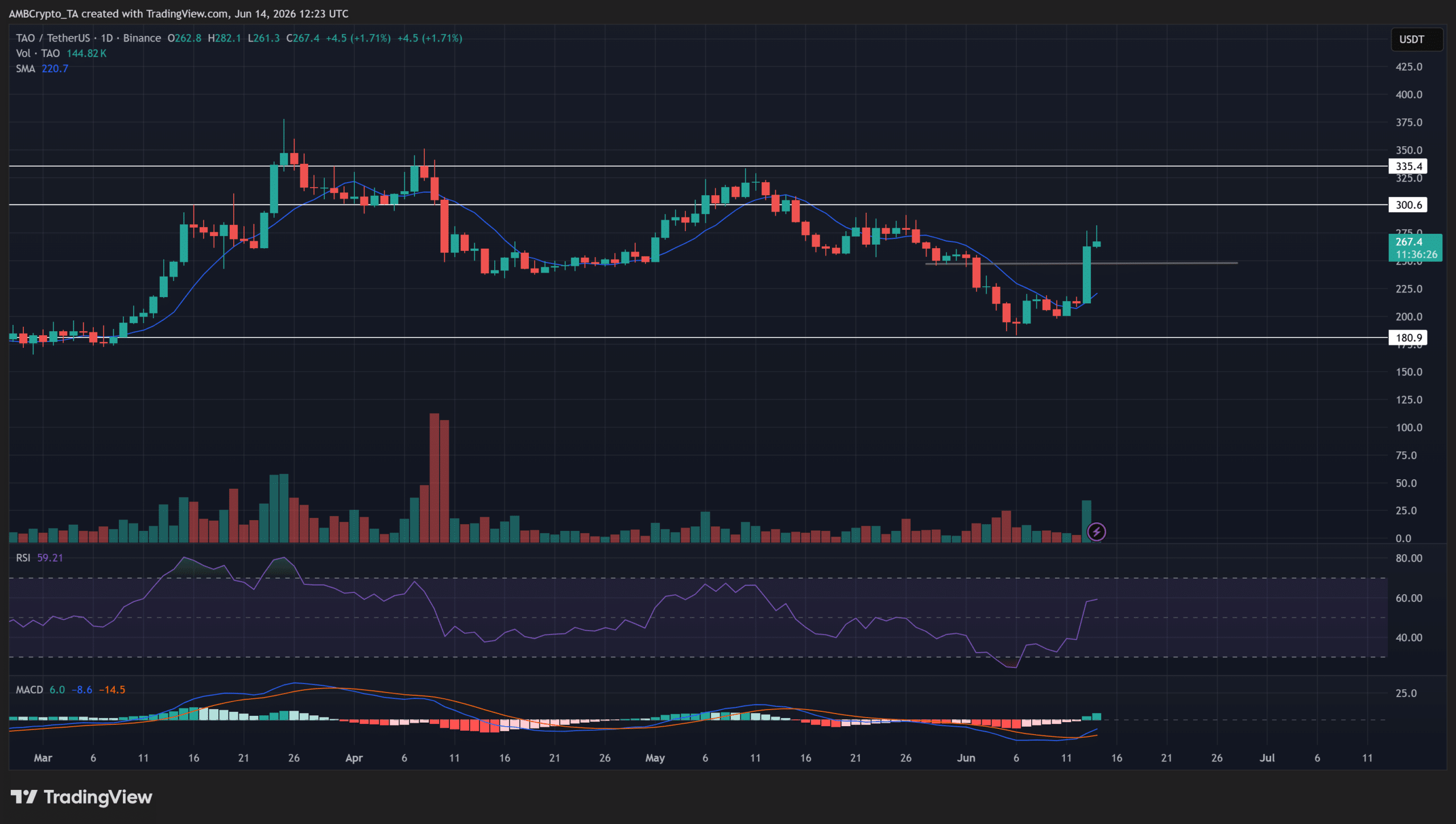
Bittensor [TAO] gained 9% in the last 24 hours, extending its weekly gain to 28% as buyers continued rebuilding momentum. The recovery began near the key $180.9 support zone.

There, repeated selling attempts failed to generate fresh downside pressure.

As sellers lost control, buyers gradually absorbed available supply and stabilized price action. This transition was followed by a brief consolidation phase, which suggested accumulation rather than continued distribution.
Source: TAO/USDT on TradingView

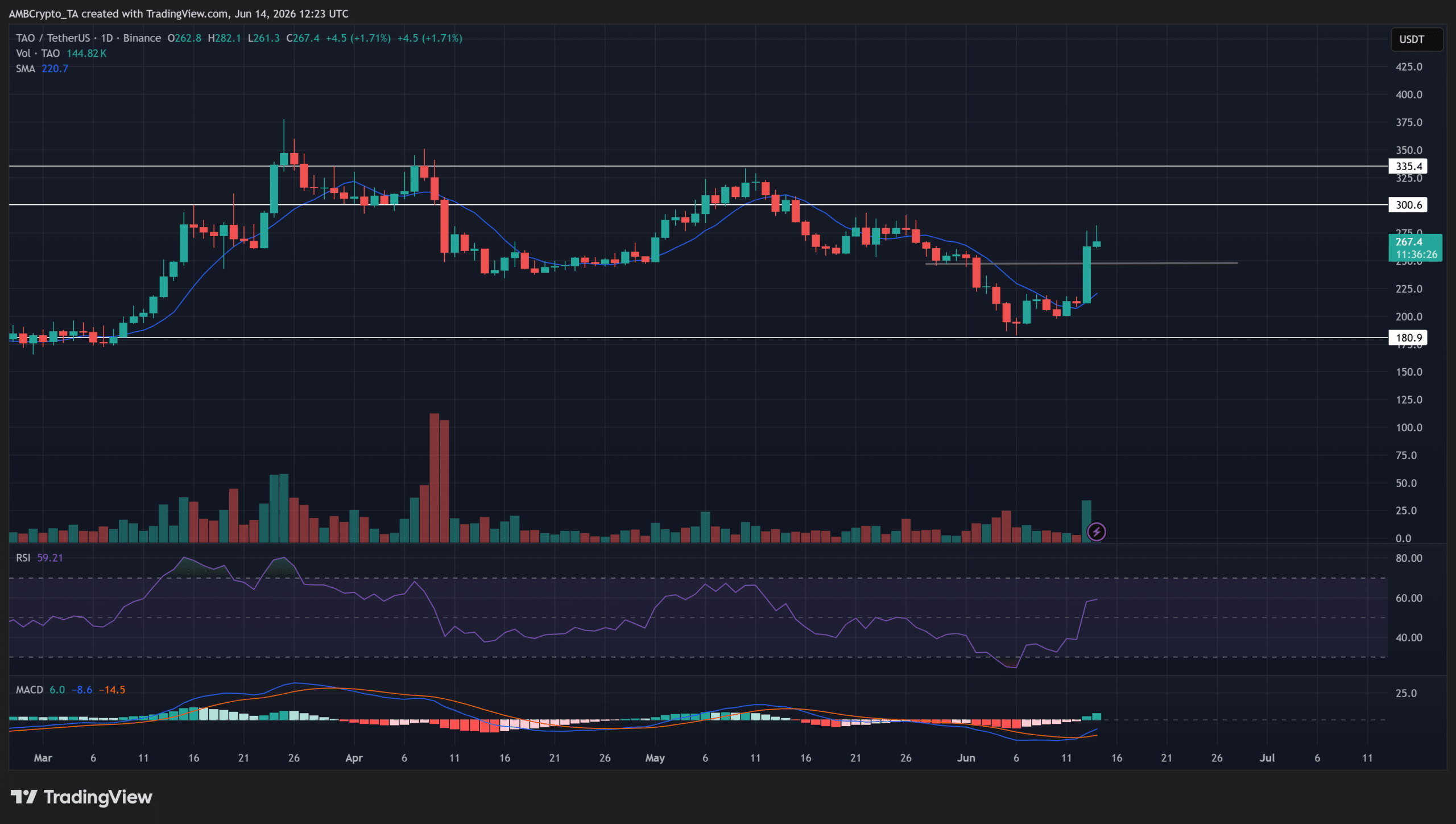
Momentum then accelerated sharply, lifting TAO from roughly $215 to $267.4 within two sessions. In the process, price reclaimed the 20-day SMA at $220.70 and pushed through a resistance area that had limited advances for weeks.

Volume expanded aggressively during the breakout, producing its strongest positive reading in nearly two months.

Meanwhile, RSI climbed to 59.2 from below 40, while MACD continued strengthening. Attention now turns to the $280-$300.6 region, where buyers and sellers will likely contest the recovery’s strength.

Anthropic’s move fuels TAO demand

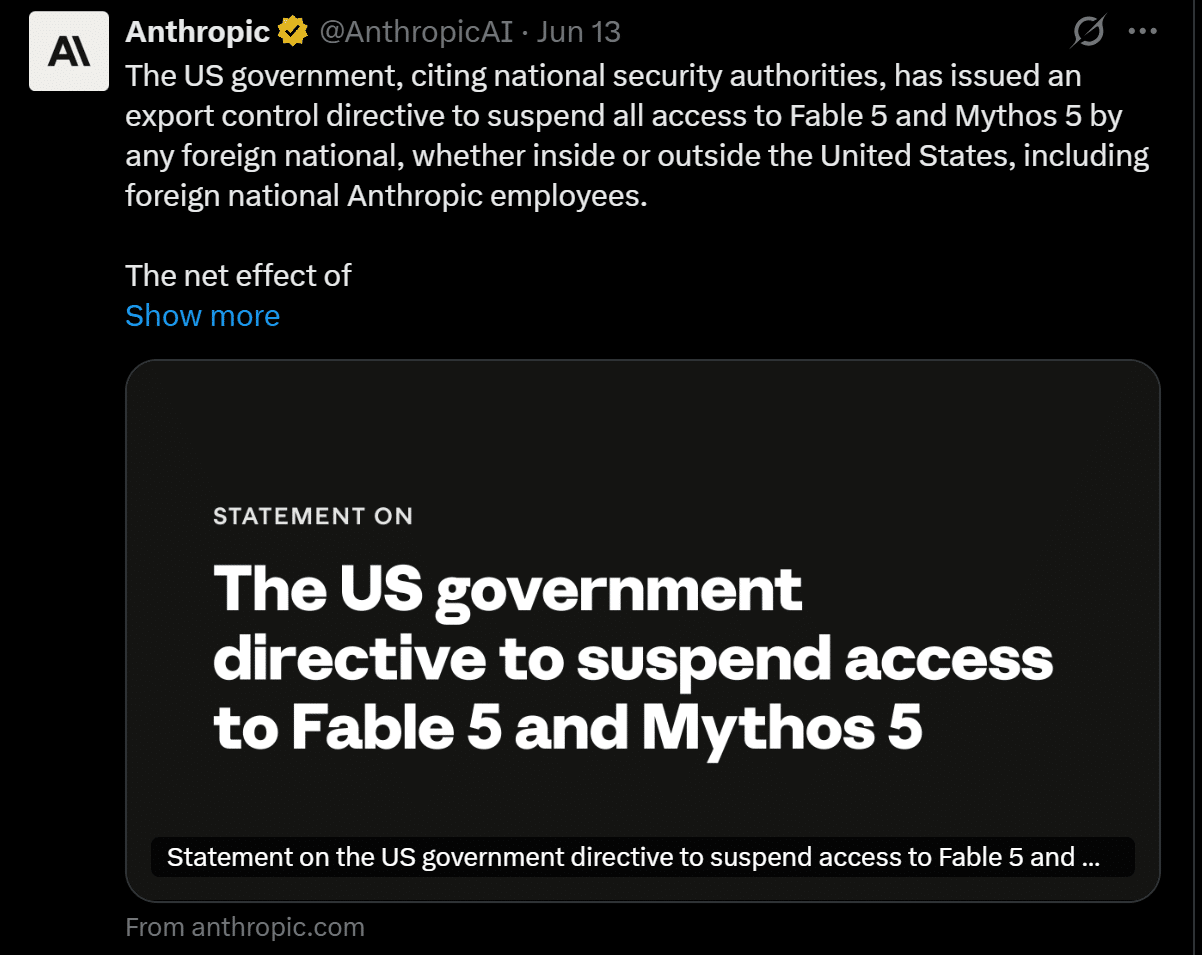
Bittensor’s rally did not emerge in isolation. Anthropic announced that access to Fable 5 and Mythos 5 would be suspended for foreign nationals following a U.S. government directive. The decision immediately highlighted a key weakness of centralized AI systems.
Source: X

Access could be restricted by regulation, regardless of demand. That narrative quickly spilled into crypto markets. As a result, traders rotated toward decentralized AI projects, helping TAO extend its advance toward the $272-$279 range.

Volume climbed above $560 million, reinforcing the strength of the move. This reaction suggests buyers were responding to more than technical momentum alone.

However, the durability of the rally now depends on whether demand continues after the headline impact fades.

Can bulls force a break above $300?

TAO’s sharp rebound has shifted attention toward whether buyers can maintain control above newly reclaimed levels. After rallying from the $182.5 liquidity sweep to $292.2, the price encountered resistance near a key May supply zone and began pulling back.
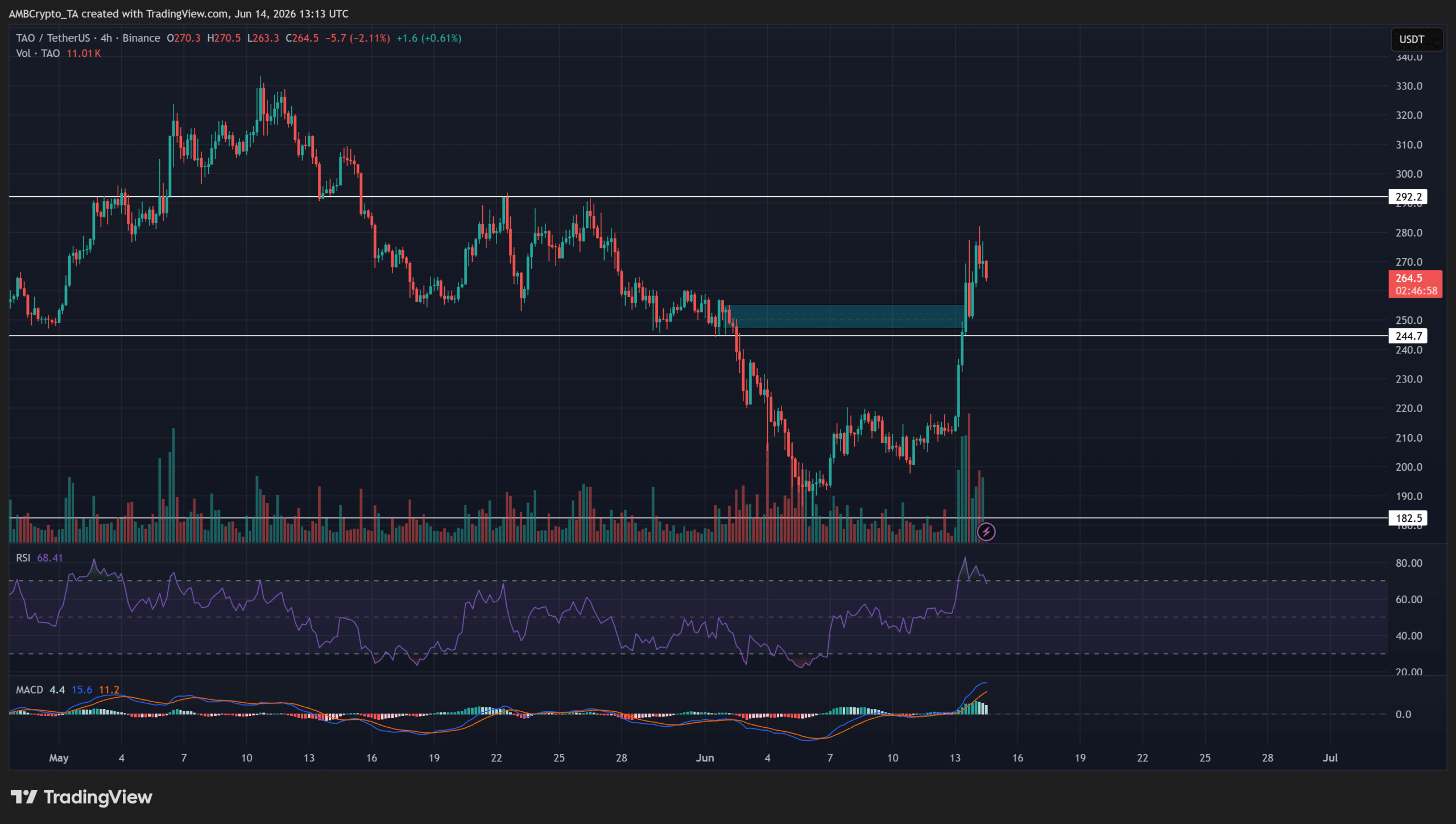
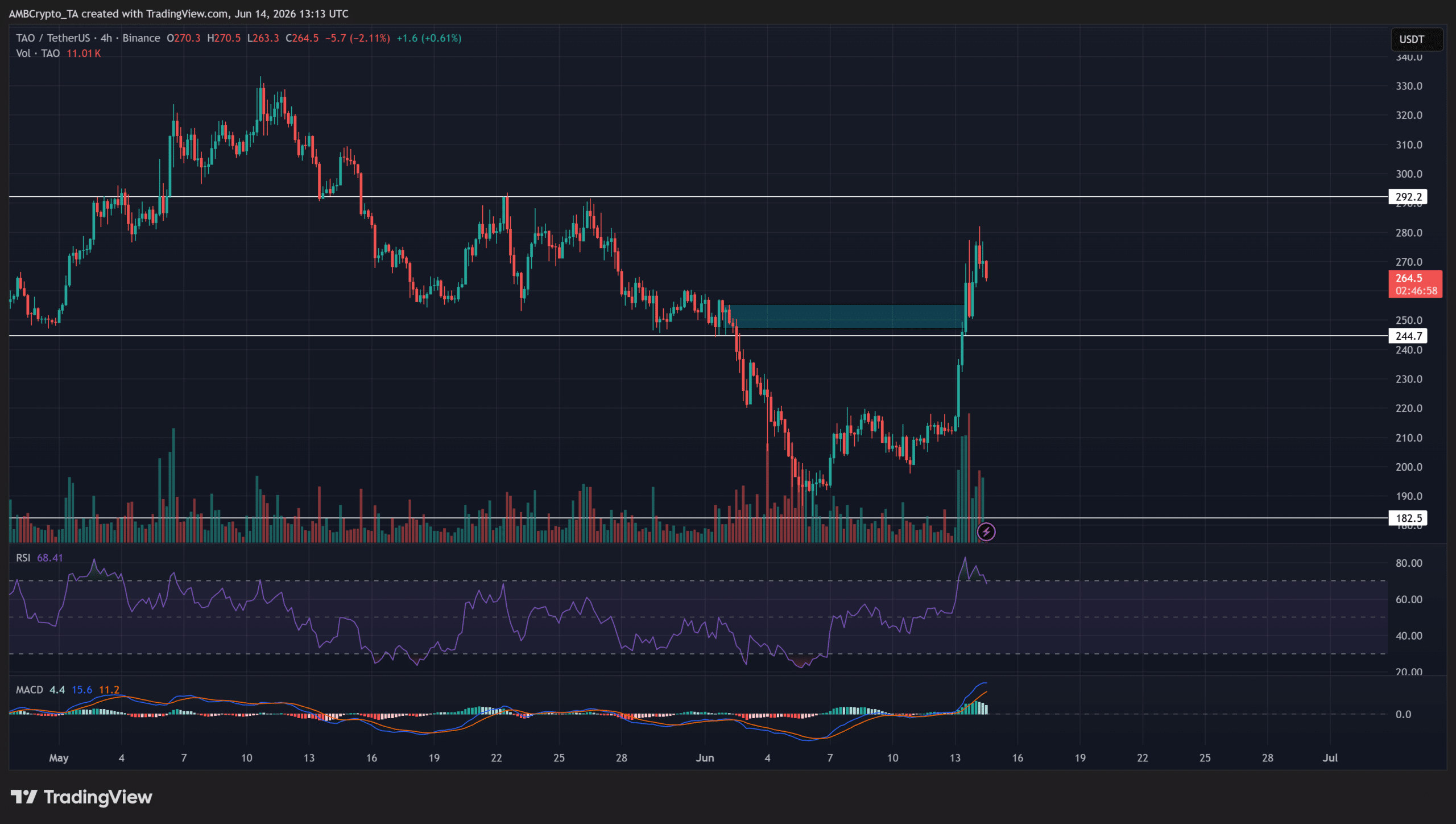
Source: TAO/USDT on TradingView

That reaction places the former $244.7-$255 consolidation range in focus. The area previously acted as resistance before the breakout and now serves as the market’s most important support zone.

Holding above it would preserve the recovery structure and keep $300 within reach. Losing it would expose TAO to a deeper retracement toward $210-$220 support.


Final Summary

  • Bittensor [TAO] reclaimed key resistance levels as rising volume and AI-driven demand strengthened the recovery structure.
  • TAO now faces a decisive $300 test, with support holding critical to preserving recent gains.

Domande pertinenti

QWhat was the main catalyst for Bittensor's (TAO) recent 28% price rally, according to the article?

AThe main catalyst was an announcement from Anthropic restricting access to its AI models (Fable 5 and Mythos 5) for foreign nationals. This highlighted a weakness in centralized AI systems and drove demand towards decentralized AI projects like Bittensor, fueling TAO's price surge.

QFrom which key support level did TAO's recovery begin, and to what level did it initially rally?

ATAO's recovery began near the key $180.9 support zone. Momentum then accelerated sharply, lifting the price from roughly $215 to $267.4 within two trading sessions.

QWhat is the critical support zone that TAO must hold to maintain its recovery structure and keep the $300 price target in reach?

AThe critical support zone is the former consolidation range of $244.7 to $255. This area previously acted as resistance before the breakout and is now the most important support zone. Holding above it is necessary to preserve the recovery structure.

QHow did technical indicators like RSI and volume behave during TAO's price breakout?

ADuring the breakout, the Relative Strength Index (RSI) climbed from below 40 to 59.2, indicating strengthening momentum. Volume also expanded aggressively, producing its strongest positive reading in nearly two months, reinforcing the strength of the move.

QWhat factor does the article suggest will determine the durability of TAO's rally beyond the initial headline impact?

AThe durability of the rally depends on whether demand for TAO continues after the initial impact of the Anthropic news headline fades. Sustained demand is needed to maintain the upward momentum.

Letture associate

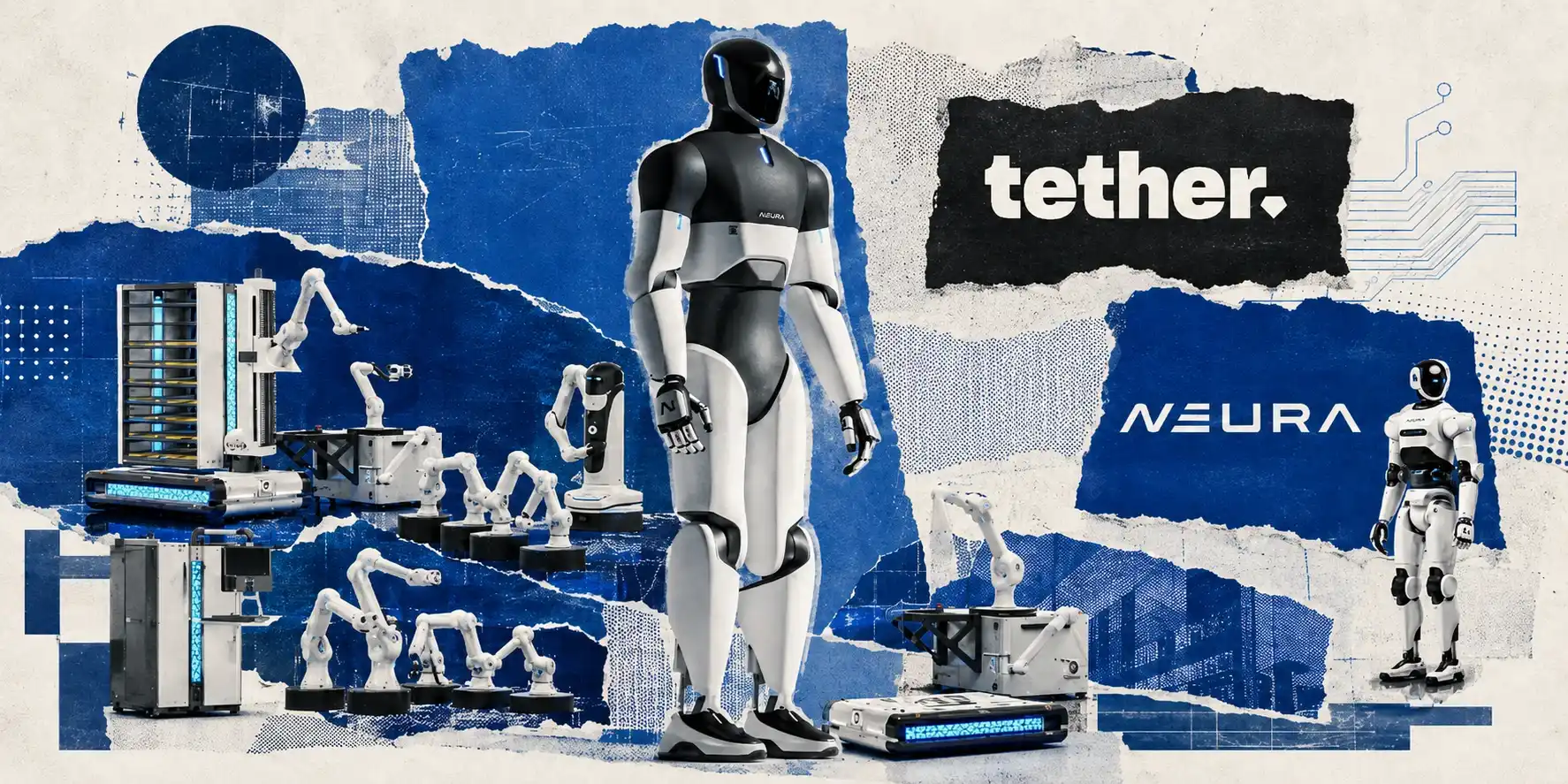
Do Robots Also Need Encrypted Wallets? Stablecoin Giant Tether Bets on German Company NEURA Robotics

Do Robots Need Crypto Wallets? Stablecoin Giant Tether Bets on German Firm NEURA Robotics German robotics company NEURA Robotics has secured up to $1.4 billion in what is claimed to be the largest-ever funding round in the full-stack robotics industry, valuing the company at $7 billion. The Series C round attracted major investors like Tether, Qualcomm, Amazon, NVIDIA, Bosch, and the European Investment Bank. NEURA, founded in 2019, initially focused on AI-powered collaborative robots (cobots) for industrial automation, later expanding to autonomous mobile robots, service robots, and humanoid robots. Its core strategy is evolving from a hardware manufacturer to the operator of "Neuraverse," a platform designed to enable different robots to share learned experiences and data, creating network effects. A key, crypto-focused aspect of this investment is Tether's involvement. Tether plans to integrate its open-source Wallet Development Kit (WDK) into NEURA's robot platforms. This would embed self-custody wallet functionality, allowing robots to autonomously handle payments and settlements for tasks under pre-set rules—envisioning use cases in logistics or Robotics-as-a-Service (RaaS) models. This move could position stablecoins and crypto wallets as potential "machine payment infrastructure." Additionally, the partnership will see Tether's QVAC (QuantumVerse Automatic Computer) edge-AI framework tested and deployed within Neuraverse. This aims to enable low-latency, offline-capable AI decision-making directly on robots, reducing reliance on cloud computing for critical, time-sensitive operations. The investment underscores Tether's broader ambition to expand beyond being just a stablecoin issuer into AI, energy, and digital infrastructure, with NEURA's robotics network serving as a testbed for merging crypto-based financial layers with edge-based intelligence for the future of automation.

marsbit14 min fa

Do Robots Also Need Encrypted Wallets? Stablecoin Giant Tether Bets on German Company NEURA Robotics

marsbit14 min fa

AMD Launches Compact AI Host, Directly Challenging NVIDIA DGX Spark

In June 2026, AMD announced the Ryzen AI Halo, a compact AI developer desktop to rival NVIDIA's DGX Spark. Both feature 128GB unified memory for running 200B+ parameter models locally. Priced from $2,949 to $3,999, AMD undercuts NVIDIA's $3,999+ DGX Spark. The core divergence lies in architecture and philosophy. Ryzen AI Halo uses an x86-based Ryzen AI Max+ 395 APU (CPU+GPU+NPU), runs standard Windows/Linux, and emphasizes general-purpose PC flexibility. DGX Spark uses an ARM-based Grace Blackwell Superchip, runs a custom DGX OS, and includes a high-speed ConnectX-7 NIC for cluster prototyping, anchoring it to NVIDIA's full-stack CUDA ecosystem. AMD's ROCm software has improved, with simpler installation and support for major frameworks, but still lags behind CUDA's 17-year maturity in community support and cutting-edge library availability. AMD's broader strategy focuses on becoming a viable second-source supplier. Key moves include acquiring design capabilities via ZT Systems (while outsourcing manufacturing) and securing two major 6GW GPU supply deals with OpenAI and Meta in late 2025/early 2026. These contracts validate AMD's role in diversifying the AI supply chain, rather than outright beating NVIDIA. NVIDIA counters with a tightly integrated stack from desktop (DGX Spark) to data center, emphasizing seamless scalability and enterprise software subscriptions (AI Enterprise). In summary, Ryzen AI Halo represents AMD's pragmatic path: offering a cost-effective, open-ecosystem alternative for developers wary of vendor lock-in, while its large data center contracts aim to capture share from customers seeking a second GPU supplier. The choice boils down to a familiar, flexible PC environment with potential software gaps (AMD) versus a premium, optimized, but locked-in ecosystem (NVIDIA).

marsbit15 min fa

AMD Launches Compact AI Host, Directly Challenging NVIDIA DGX Spark

marsbit15 min fa

Sharplink CEO: One Million Ethereum Developers, Who Can Compete?

Etherean Ecosystem: One Million Developers and a Formidable Moat The Ethereum network has surpassed a significant milestone: over one million unique lifetime developers, with approximately 232,000 active in the past year. This vast and growing talent pool is Ethereum's core advantage, far more critical than transient metrics like speed or transaction fees. The central question is not which blockchain is fastest, but where the best builders choose to build long-term. Ethereum's answer lies in a decade-long accumulation of infrastructure, standards, tools, liquidity, and collaborative culture that is exceptionally difficult to replicate. It has become the default operating system for programmable finance. This massive developer base is actively working on complex, high-risk challenges that deepen Ethereum's strategic moat: * **Glamsterdam Upgrade (2026):** Focused on core protocol scalability (ePBS, parallel execution) while preserving core values like credible neutrality. * **Synchronous Composability:** Aims to make numerous Rollups interoperate like a single chain, directly addressing fragmentation concerns. * **Quantum Resistance:** Ethereum leads mainstream ecosystems in coordinated preparation for post-quantum cryptography, with a targeted migration plan around 2029. This developer advantage is self-reinforcing, fueled by: * **Deep Composability:** Applications interact like interoperable financial Lego bricks via shared standards (e.g., EVM, Solidity). * **Credible Neutrality:** Secured by over 900,000 validators, making it trusted by major institutions. * **Modularity:** Rollups (Base, Arbitrium, etc.) expand, rather than fracture, the ecosystem into a tightly connected modular internet economy. * **Culture:** Attracts top-tier researchers and standard-setters who guide the entire industry. In essence, while other chains generate activity, Ethereum is consolidating as the trusted, long-term coordination layer for internet-native finance. Its future is being built now by the architects of the next-generation financial infrastructure.

Odaily星球日报1 h fa

Sharplink CEO: One Million Ethereum Developers, Who Can Compete?

Odaily星球日报1 h fa

Ethereum Reaches the Milestone of One Million Developers, Sharplink CEO Delves Deep into Ethereum's Future Possibilities

Ethereum Surpasses One Million Developers Milestone: A Look at Its Unshakeable Dominance and Future Joseph Chalom, CEO of Sharplink, reflects on his recent Asia trip where he engaged deeply with Ethereum developers and ecosystem leaders. The most striking takeaway was not just the industry's vibrancy, but the rigorous, long-term vision of local builders. This context brings to life a pivotal statistic: Ethereum has now surpassed one million cumulative developers (1,012,824), with approximately 232,000 remaining active in the past year—a talent pool unmatched by any other crypto ecosystem. The critical question isn't which blockchain is fastest, but where top developers choose to build long-term. Ethereum's answer is unequivocal. Its decade-long lead stems from a unique convergence of technology, institutional culture, economic systems, and composability, cementing its role as the foundational operating system for programmable finance. This massive developer base is tackling the industry's hardest problems, continuously strengthening Ethereum's moat. Key initiatives include: * **The Glamsterdam Upgrade (planned 2026):** Introducing ePBS and Block-level Access Lists for parallel execution and higher throughput while preserving core values like credible neutrality and fair MEV distribution. * **Synchronous Composability:** Projects are working to enable atomic transactions across dozens of Rollups, making them function as one unified chain and eliminating ecosystem fragmentation. * **Post-Quantum Security:** Ethereum is far ahead in preparing for quantum computing threats, with a dedicated foundation working group and testnets targeting a full migration by ~2029—a crucial factor for institutional adoption. Beyond developers, Ethereum's core network effects are its unparalleled composability and unified standards (like EVM and Solidity), which create a powerful flywheel: more developers → better tools → greater liquidity → more institutional participation. Its other decisive advantages include credible neutrality (over 900k validators), a secure modular architecture with interconnected Rollups, and a deeply entrenched culture shaped by top-tier researchers. Ultimately, there's a vast difference between generating short-term activity and becoming the trusted, long-term coordination layer for global native finance. Major institutions prioritize security, trust, and liquidity—areas where Ethereum holds dominant mindshare. The industry's trajectory shows resources consolidating around unified standards, deep liquidity, and developer consensus. After meeting the builders in Seoul and Hong Kong, Chalom is more convinced than ever: Ethereum's unshakeable future is being built right now.

Foresight News1 h fa

Ethereum Reaches the Milestone of One Million Developers, Sharplink CEO Delves Deep into Ethereum's Future Possibilities

Foresight News1 h fa

Saylor's Latest Long Read: Bitcoin is Not Money, It's Digital Capital, and Money is Built Upon It

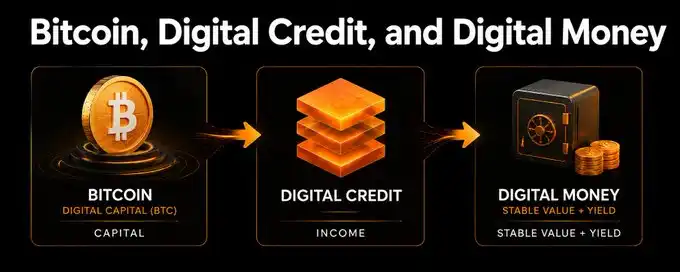
Michael Saylor presents his "Digital Asset Stack" theory, positioning Bitcoin as the foundational layer of digital capital. He argues Bitcoin itself should remain unchanged—no staking, inflation, or protocol alterations. Instead, a five-layer financial architecture should be built atop it: Digital Capital (BTC), Digital Credit (e.g., yield instruments like STRC), Digital Currency (stable, yield-bearing instruments pegged to fiat), Digital Yield (leveraged/structured products), and Digital Equity (e.g., MSTR stock, absorbing residual volatility). Saylor asserts this stack transforms Bitcoin's high-volatility, high-energy capital into tailored products: stable currencies for payments/savings, yield instruments for income seekers, and equity for growth investors. This approach meets diverse needs—corporate treasuries, banks, retirees, emerging market users—without compromising Bitcoin's core properties (scarcity, decentralization). The "killer use case" is rebuilding global money, credit, and capital markets on Bitcoin, bridging the fiat world with a superior digital asset foundation. The system leverages traditional finance principles (risk layering, structured products) while using Bitcoin as the ultimate collateral. This expands Bitcoin's utility, drives adoption, and offers a better monetary experience: digital, yield-bearing, stable-value tools for everyday use.

marsbit1 h fa

Saylor's Latest Long Read: Bitcoin is Not Money, It's Digital Capital, and Money is Built Upon It

marsbit1 h fa

Trading

Spot
Futures

Articoli Popolari

Come comprare GAIN

Benvenuto in HTX.com! Abbiamo reso l'acquisto di GriffinAI (GAIN) semplice e conveniente. Segui la nostra guida passo passo per intraprendere il tuo viaggio nel mondo delle criptovalute.Step 1: Crea il tuo Account HTXUsa la tua email o numero di telefono per registrarti il tuo account gratuito su HTX. Vivi un'esperienza facile e sblocca tutte le funzionalità,Crea il mio accountStep 2: Vai in Acquista crypto e seleziona il tuo metodo di pagamentoCarta di credito/debito: utilizza la tua Visa o Mastercard per acquistare immediatamente GriffinAIGAIN.Bilancio: Usa i fondi dal bilancio del tuo account HTX per fare trading senza problemi.Terze parti: abbiamo aggiunto metodi di pagamento molto utilizzati come Google Pay e Apple Pay per maggiore comodità.P2P: Fai trading direttamente con altri utenti HTX.Over-the-Counter (OTC): Offriamo servizi su misura e tassi di cambio competitivi per i trader.Step 3: Conserva GriffinAI (GAIN)Dopo aver acquistato GriffinAI (GAIN), conserva nel tuo account HTX. In alternativa, puoi inviare tramite trasferimento blockchain o scambiare per altre criptovalute.Step 4: Scambia GriffinAI (GAIN)Scambia facilmente GriffinAI (GAIN) nel mercato spot di HTX. Accedi al tuo account, seleziona la tua coppia di trading, esegui le tue operazioni e monitora in tempo reale. Offriamo un'esperienza user-friendly sia per chi ha appena iniziato che per i trader più esperti.

325 Totale visualizzazioniPubblicato il 2025.09.24Aggiornato il 2026.06.02

Come comprare GAIN

Discussioni

Benvenuto nella Community HTX. Qui puoi rimanere informato sugli ultimi sviluppi della piattaforma e accedere ad approfondimenti esperti sul mercato. Le opinioni degli utenti sul prezzo di GAIN GAIN sono presentate come di seguito.

活动图片