BitMine joins NYSE ‘Big Board’ with expanded $4B buyback plan

ambcryptoPubblicato 2026-04-10Pubblicato ultima volta 2026-04-10

Introduzione

BitMine Immersion Technologies achieved a major milestone by uplisting from NYSE American to the prestigious New York Stock Exchange (NYSE), enhancing its visibility and trading potential. The company also announced a significant expansion of its share buyback program, increasing it from $1 billion to $4 billion, positioning it among the top 10 corporate buyback initiatives. This strategy aims to repurchase shares if they trade below intrinsic value relative to its ETH holdings. Additionally, BitMine reported holding 4.8 million ETH, nearing its 6 million ETH target, and plans to stake its entire ETH stash on its MAVAN platform, potentially generating $300 million annually in staking rewards. Despite these developments, its stock (BMNR) declined 2% to $21.29, with a year-to-date loss of 22%.

BitMine Immersion Technologies hit a major milestone on Wall Street today, marking a big start to Q2.

On Thursday, the firm was uplisted to the New York Stock Exchange (NYSE) from the ‘smaller’ NYSE American. In a statement, Tom Lee, Chairman of the world’s largest Ethereum treasury said that being uplisted to the “big board” is a “major milestone.” He added,

“The NYSE is the most prestigious venerable stock exchange with a storied history.”

This could increase the firm’s visibility and, by extension, its trading volume.

Additionally, the firm’s board approved the overhaul of its share buyback from 2025’s $1 billion to $4 billion. Commenting on the massive buyback cash, Lee claimed,

Bitmine’s expanded $4 billion buyback reflects our commitment to shareholders. There may be a time in the future when Bitmine shares are trading below intrinsic value, and the Company wants to be in a position to accretively retire common shares.

This means that the firm could actively begin its share buyback if the mNAV (market-to-Net Asset Value) falls below 1. In other words, when its share trades at a discount to its ETH holdings, then the buyback will be initiated.

The $4B program ranked BitMine among the top 10 firms with the largest corporate buybacks.

BitMine’s holdings hit 4.8M ETH

Separately, the firm reported that it now holds 4.8 million ETH and was 79% done with its target of holding 6 million ETH or the ‘5% Alchemy.’ In the past week alone, it bought 40K ETH.

Unlike Strategy, which currently holds BTC for pure price appreciation and to extend the same volatility to MSTR, BitMine eyes a steady annual revenue.

The firm recently launched a MAVAN staking platform and plans to stake its entire ETH stash on it. Thanks to current staking rewards, BitMine could earn $300 million annually. In fact, the MAVAN platform won’t stop at ETH, with planned expansion to target other Proof-of-Stake (PoS) chains like Solana.

Meanwhile, BitMine’s stock, BMNR, slipped by 2% and closed the Thursday market session at $21.29 after the bullish update. On a year-to-date (YTD) basis, BMNR and ETH have posted nearly similar losses of 22% and 26%, respectively.
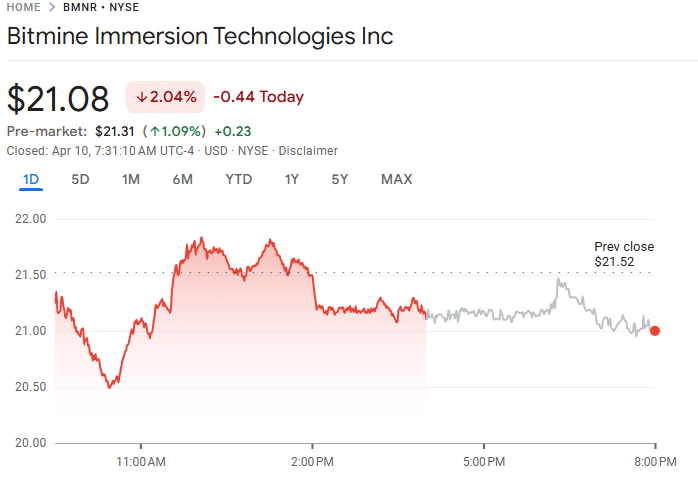
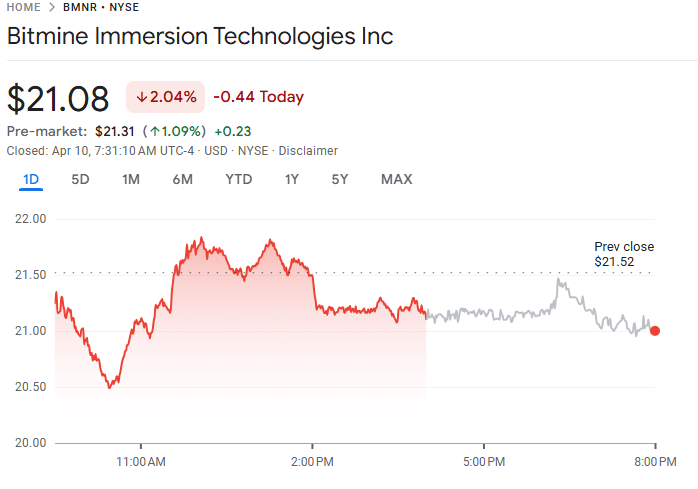
Source: Google Finance

Final Summary

  • BitMine was uplisted to the NYSE, an upgrade from the prior NYSE American, offering it an extra visibility to Wall Street investors seeking indirect exposure to ETH.
  • Treasury firm now holds 4.8 million ETH and is about 20% away from hitting its goal of holding 6 million ETH.


Letture associate

L2 'Recalibration': When L1 Becomes Its Own Rollup, What Is Ethereum's Endgame?

The article discusses the evolving relationship between Ethereum's Layer 1 (L1) and Layer 2 (L2) solutions, moving beyond the initial "L2 for scaling" model. As Ethereum L1 itself scales (increasing Gas Limit, statelessness, zkEVM), the unique value proposition of L2s shifts from merely providing cheap execution to offering differentiated features like application-specific optimization, privacy, and flexible governance. The piece explores three key themes: 1. **L2's New Role:** L2s are transitioning from a pure scaling technology to a spectrum of execution environments with varying degrees of security inheritance from Ethereum L1. 2. **Interoperability as State Trust:** Solving L2 fragmentation is less about cross-chain bridges and more about enabling faster, trust-minimized state verification between environments. This involves initiatives like faster L1 finality, intent-based architectures (Open Intents Framework), and native account abstraction. 3. **Blurring Layers:** With the potential integration of zk-proofs into L1 validation (making L1 akin to its own "Rollup") and the concept of "Native Rollups," the rigid boundary between L1 and L2 may fade. The future could be a unified system with multiple execution domains (for DeFi, gaming, privacy, etc.) sharing a common security, settlement, and state framework. In conclusion, Ethereum's goal is not to abandon L2s or re-centralize everything on L1, but to re-integrate the fragmented user experience—liquidity, accounts, applications—while preserving the scaling benefits of a multi-environment ecosystem. The endgame is a cohesive "one chain" feeling for users, powered by diverse but securely interconnected execution layers.

marsbit37 min fa

L2 'Recalibration': When L1 Becomes Its Own Rollup, What Is Ethereum's Endgame?

marsbit37 min fa

Trading

Spot
活动图片