BitMine joins NYSE ‘Big Board’ with expanded $4B buyback plan

ambcryptoPubblicato 2026-04-10Pubblicato ultima volta 2026-04-10

Introduzione

BitMine Immersion Technologies achieved a major milestone by uplisting from NYSE American to the prestigious New York Stock Exchange (NYSE), enhancing its visibility and trading potential. The company also announced a significant expansion of its share buyback program, increasing it from $1 billion to $4 billion, positioning it among the top 10 corporate buyback initiatives. This strategy aims to repurchase shares if they trade below intrinsic value relative to its ETH holdings. Additionally, BitMine reported holding 4.8 million ETH, nearing its 6 million ETH target, and plans to stake its entire ETH stash on its MAVAN platform, potentially generating $300 million annually in staking rewards. Despite these developments, its stock (BMNR) declined 2% to $21.29, with a year-to-date loss of 22%.

BitMine Immersion Technologies hit a major milestone on Wall Street today, marking a big start to Q2.

On Thursday, the firm was uplisted to the New York Stock Exchange (NYSE) from the ‘smaller’ NYSE American. In a statement, Tom Lee, Chairman of the world’s largest Ethereum treasury said that being uplisted to the “big board” is a “major milestone.” He added,

“The NYSE is the most prestigious venerable stock exchange with a storied history.”

This could increase the firm’s visibility and, by extension, its trading volume.

Additionally, the firm’s board approved the overhaul of its share buyback from 2025’s $1 billion to $4 billion. Commenting on the massive buyback cash, Lee claimed,

Bitmine’s expanded $4 billion buyback reflects our commitment to shareholders. There may be a time in the future when Bitmine shares are trading below intrinsic value, and the Company wants to be in a position to accretively retire common shares.

This means that the firm could actively begin its share buyback if the mNAV (market-to-Net Asset Value) falls below 1. In other words, when its share trades at a discount to its ETH holdings, then the buyback will be initiated.

The $4B program ranked BitMine among the top 10 firms with the largest corporate buybacks.

BitMine’s holdings hit 4.8M ETH

Separately, the firm reported that it now holds 4.8 million ETH and was 79% done with its target of holding 6 million ETH or the ‘5% Alchemy.’ In the past week alone, it bought 40K ETH.

Unlike Strategy, which currently holds BTC for pure price appreciation and to extend the same volatility to MSTR, BitMine eyes a steady annual revenue.

The firm recently launched a MAVAN staking platform and plans to stake its entire ETH stash on it. Thanks to current staking rewards, BitMine could earn $300 million annually. In fact, the MAVAN platform won’t stop at ETH, with planned expansion to target other Proof-of-Stake (PoS) chains like Solana.

Meanwhile, BitMine’s stock, BMNR, slipped by 2% and closed the Thursday market session at $21.29 after the bullish update. On a year-to-date (YTD) basis, BMNR and ETH have posted nearly similar losses of 22% and 26%, respectively.
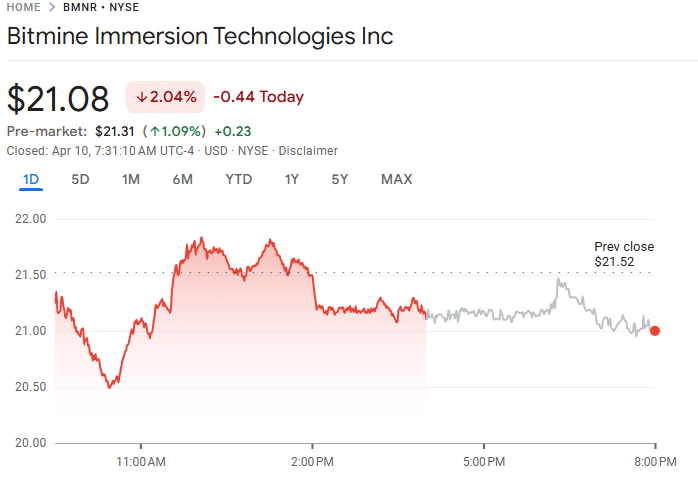
Source: Google Finance

Final Summary

  • BitMine was uplisted to the NYSE, an upgrade from the prior NYSE American, offering it an extra visibility to Wall Street investors seeking indirect exposure to ETH.
  • Treasury firm now holds 4.8 million ETH and is about 20% away from hitting its goal of holding 6 million ETH.


Letture associate

Bitcoin Withdrawals Continue: 8 Years of Storage in a Coldcard Cold Wallet Ended in Zero

Coldcard Hardware Wallet Hacked: Losses Mount Due to Vulnerable Seed Generation A critical vulnerability in Coldcard hardware wallets has led to a continued wave of fund thefts. According to Galaxy Research, the total stolen has reached 1,367.05 BTC (approx. $88.6 million) from 4,585 addresses, a significant increase from the initial 594.5 BTC reported on July 30, 2026. Most of the stolen funds remain on the attackers' addresses. The issue is not with the current firmware, which Coinkite has updated, but with seed phrases generated on vulnerable devices between March 2021 and the release of fixed firmware versions. Due to a programmer error, devices switched from using a hardware random number generator to the software-based Yasmarang generator, which was initialized with publicly accessible data like the chip's serial number. This made the seed phrases predictable through offline brute-force attacks, meaning wallets remain at risk until funds are moved to a new wallet generated with the patched firmware. Affected devices include Mk2/Mk3 with firmware 4.0.1–4.1.9 (and up to 5.0.3), Mk4/Mk5 up to version 5.6.0, and Q models up to 1.5.0Q. The only exceptions are seeds created with a high-entropy method like at least 50 independent dice rolls or a strong unique BIP-39 passphrase. All other owners must generate a new seed on the fixed firmware and transfer their assets. A case highlighting the human impact involves a 39-year-old long-term investor who lost 2 BTC (approx. $130,000) in minutes. He had accumulated the Bitcoin over eight years through physical labor, viewing it as a financial lifeline and a retirement plan in a country suffering from hyperinflation. His story underscores that even conservative "buy and hold in cold storage" strategies can be compromised by such underlying technical flaws. From a technical perspective, this incident echoes historical failures where weak random number generators undermined cryptographic security, challenging the assumption that offline storage is automatically foolproof.

cryptonews.ru32 min fa

Bitcoin Withdrawals Continue: 8 Years of Storage in a Coldcard Cold Wallet Ended in Zero

cryptonews.ru32 min fa

Trading

Spot
活动图片



