BitMine enters Ethereum staking race with new MAVAN platform – Details

ambcryptoPubblicato 2026-03-27Pubblicato ultima volta 2026-03-27

Introduzione

BitMine Immersion Technologies, the world's largest Ethereum treasury firm, has launched a new ETH staking platform called MAVAN (Made in America Validator Network) with the goal of becoming the leading staking provider. The company has already staked 3.14 million ETH worth over $6.8 billion and holds a total of 4.6 million ETH, representing 3.8% of the total supply. It aims to control 5% of the circulating supply and generate $300 million in annual yield. While staking all its ETH would make it the second-largest platform, surpassing Binance, it would still need an additional 5 million ETH to overtake current leader Lido, which holds nearly 9 million staked ETH. BitMine also plans to expand into other proof-of-stake networks and blockchain infrastructure in the future.

Bitmine Immersion Technologies, the world’s largest Ethereum treasury firm, now aims to replace Lido as the top ETH staking platform. On Wednesday, the firm unveiled its ETH staking platform dubbed MAVAN (an acronym for Made in America Validator Network).

The firm reported that it has already staked 3,142, 643 ETH as of Tuesday, 24 March, translating to over $6.8B worth of staked ETH based on current market prices. In the past week alone, BitMine staked 101.7K ETH, worth $219M.

At the time of writing, BitMine held a total of 4.6 million ETH or 3.8% of the total supply. It aims to control 5% of the circulating supply.

It also bought an additional 50K ETH earlier on Thursday, bringing its weekly buys to over 117K ETH. This meant the remaining unstaked ETH was over 1.5 million ETH. This too will be staked in the coming weeks, the firm said.

BitMine’s aggressive bet on ETH staking

The end goal is to become the top staking platform for institutions with the potential to generate $300M annually at the current 2.83% 7-day BMNR yield. Tom Lee, the chairman of the firm, added,

Because Bitmine is the largest owner of Ethereum in the world, shortly after launch, MAVAN will be the largest Ethereum staking platform in the world.

Highlighting MAVAN and Bitmine’s long-term staking strategy, Lee continued,

We plan to expand across additional proof-of-stake (PoS)networks and critical blockchain infrastructure over time, and through 2026, we’ll grow our efforts in areas such as on-chain vaults, post-quantum client development, and more.

In other words, other PoS chains like SOL, BNB, Tron [TRX], and others could fall in BitMine’s staking orbit.

However, the update could shake up the broader ETH staking ecosystem, which is currently facing stiff competition amid growing appetite for low-risk institutional staking.

In fact, Lido, the top leader in the segment, confirmed that the ongoing structural shift was partly responsible for its 23% annual revenue fall in 2025. Although its market share also shrank, it was still leading in the segment with nearly 9 million staked ETH.

Alas, with BitMine now eyeing its position, will it defend its top spot? Well, that depends on whether Lido’s staking outflows continue in the next few months.

As it stands, even if BitMine stakes its entire 4.6 million ETH stash, that would make it the second-largest staking platform, surpassing Binance. However, it would still need an extra 5 million ETH to dislodge Lido from the top seat.
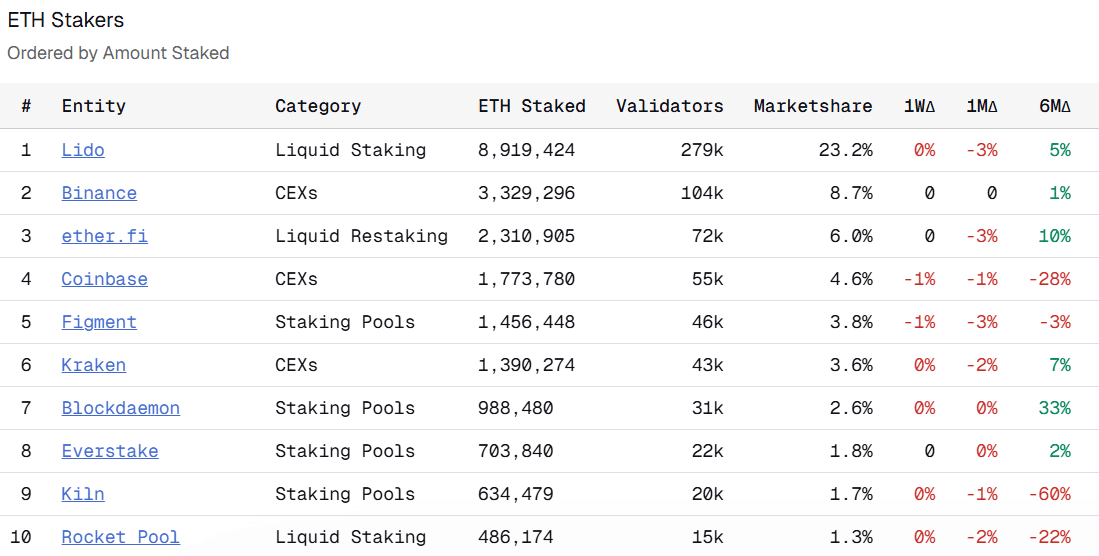
Source: Dune

Final Summary

  • BitMine unveiled the MAVAN staking platform and plans to stake the whole of its 4.6 million ETH stash to get $300M in annual yield revenue.
  • However, it will need over 5 million ETH to displace Lido as the top staking platform.

Domande pertinenti

QWhat is the name of the new ETH staking platform launched by BitMine and what does the acronym stand for?

AThe new ETH staking platform is called MAVAN, which stands for Made in America Validator Network.

QHow much Ethereum (ETH) has BitMine already staked as of March 24th, and what is its total ETH holding?

AAs of March 24th, BitMine has staked 3,142,643 ETH. The company's total ETH holding is 4.6 million.

QWhat is BitMine's stated end goal for its staking platform in terms of annual revenue and current yield?

ABitMine's end goal is to generate $300 million in annual revenue at the current 2.83% 7-day BMNR yield.

QWho is the current leader in the ETH staking segment and how much ETH do they have staked?

ALido is the current leader in the ETH staking segment with nearly 9 million staked ETH.

QBesides Ethereum, what other types of networks does BitMine plan to expand into, according to Chairman Tom Lee?

AAccording to Tom Lee, BitMine plans to expand across additional proof-of-stake (PoS) networks, such as SOL, BNB, and Tron [TRX], as well as critical blockchain infrastructure.

Letture associate

a16z: AI's 'Amnesia', Can Continuous Learning Cure It?

The article "a16z: AI's 'Amnesia' – Can Continual Learning Cure It?" explores the limitations of current large language models (LLMs), which, like the protagonist in the film *Memento*, are trapped in a perpetual present—unable to form new memories after training. While methods like in-context learning (ICL), retrieval-augmented generation (RAG), and external scaffolding (e.g., chat history, prompts) provide temporary solutions, they fail to enable true internalization of new knowledge. The authors argue that compression—the core of learning during training—is halted at deployment, preventing models from generalizing, discovering novel solutions (e.g., mathematical proofs), or handling adversarial scenarios. The piece introduces *continual learning* as a critical research direction to address this, categorizing approaches into three paths: 1. **Context**: Scaling external memory via longer context windows, multi-agent systems, and smarter retrieval. 2. **Modules**: Using pluggable adapters or external memory layers for specialization without full retraining. 3. **Weights**: Enabling parameter updates through sparse training, test-time training, meta-learning, distillation, and reinforcement learning from feedback. Challenges include catastrophic forgetting, safety risks, and auditability, but overcoming these could unlock models that learn iteratively from experience. The conclusion emphasizes that while context-based methods are effective, true breakthroughs require models to compress new information into weights post-deployment, moving from mere retrieval to genuine learning.

marsbit2 h fa

a16z: AI's 'Amnesia', Can Continuous Learning Cure It?

marsbit2 h fa

Can a Hair Dryer Earn $34,000? Deciphering the Reflexivity Paradox in Prediction Markets

An individual manipulated a weather sensor at Paris Charles de Gaulle Airport with a portable heat source, causing a Polymarket weather market to settle at 22°C and earning $34,000. This incident highlights a fundamental issue in prediction markets: when a market aims to reflect reality, it also incentivizes participants to influence that reality. Prediction markets operate on two layers: platform rules (what outcome counts as a win) and data sources (what actually happened). While most focus on rules, the real vulnerability lies in the data source. If reality is recorded through a specific source, influencing that source directly affects market settlement. The article categorizes markets by their vulnerability: 1. **Single-point physical data sources** (e.g., weather stations): Easily manipulated through physical interference. 2. **Insider information markets** (e.g., MrBeast video details): Insiders like team members use non-public information to trade. Kalshi fined a剪辑师 $20,000 for insider trading. 3. **Actor-manipulated markets** (e.g., Andrew Tate’s tweet counts): The subject of the market can control the outcome. Evidence suggests Tate’sociated accounts coordinated to profit. 4. **Individual-action markets** (e.g., WNBA disruptions): A single person can execute an event to profit from their pre-placed bets. Kalshi and Polymarket handle these issues differently. Kalshi enforces strict KYC, publicly penalizes insider trading, and reports to regulators. Polymarket, with its anonymous wallet-based system, has historically been more permissive, arguing that insider information improves market accuracy. However, it cooperated with authorities in the "Van Dyke case," where a user traded on classified government information. The core paradox is reflexivity: prediction markets are designed to discover truth, but their financial incentives can distort reality. The more valuable a prediction becomes, the more likely participants are to influence the event itself. The market ceases to be a mirror of reality and instead shapes it.

marsbit3 h fa

Can a Hair Dryer Earn $34,000? Deciphering the Reflexivity Paradox in Prediction Markets

marsbit3 h fa

Trading

Spot
Futures
活动图片





