Bitcoin's Pursuit of a Monetary Standard

marsbitPubblicato 2026-02-04Pubblicato ultima volta 2026-02-04

Introduzione

The article "Bitcoin's Pursuit of a Monetary Standard" by Thejaswini M A, based on a reading of Saifedean Ammous' "The Bitcoin Standard," explores the concept of money as a technology for transferring value across time, space, and scale. It emphasizes "salability" and introduces the critical idea of "hardness"—money whose supply is difficult to increase. The author reviews historical examples of money, such as Yap's Rai Stones, African Aggry beads, and wampum, which all lost value when their supply was easily expanded by new technology or trade. Precious metals, particularly gold, emerged as superior due to their scarcity and high stock-to-flow ratio. The critique then shifts to government-issued fiat currency, arguing it represents an unbacked, easily inflated system that erodes savings and leads to economic instability. While acknowledging the book's persuasive framework and its effective use of historical anecdotes, the author remains unconvinced by its one-sided, Austrian economics-influenced narrative that blames fiat for modern societal ills. The key takeaway is a new perspective on evaluating any asset: to critically ask how easily new units can be created and to be wary of anyone who can print money faster than one can earn it.

Written by: Thejaswini M A

Compiled by: Block unicorn

I've always wanted to slowly study "The Bitcoin Standard"—read it from start to finish and see how it affects my thinking. It often appears in the background of many Bitcoin discussions, revered as a foundational work. People would say, "As Saifedean explained..." and then you realize that everything they're referencing is based on a meme or a cover screenshot.
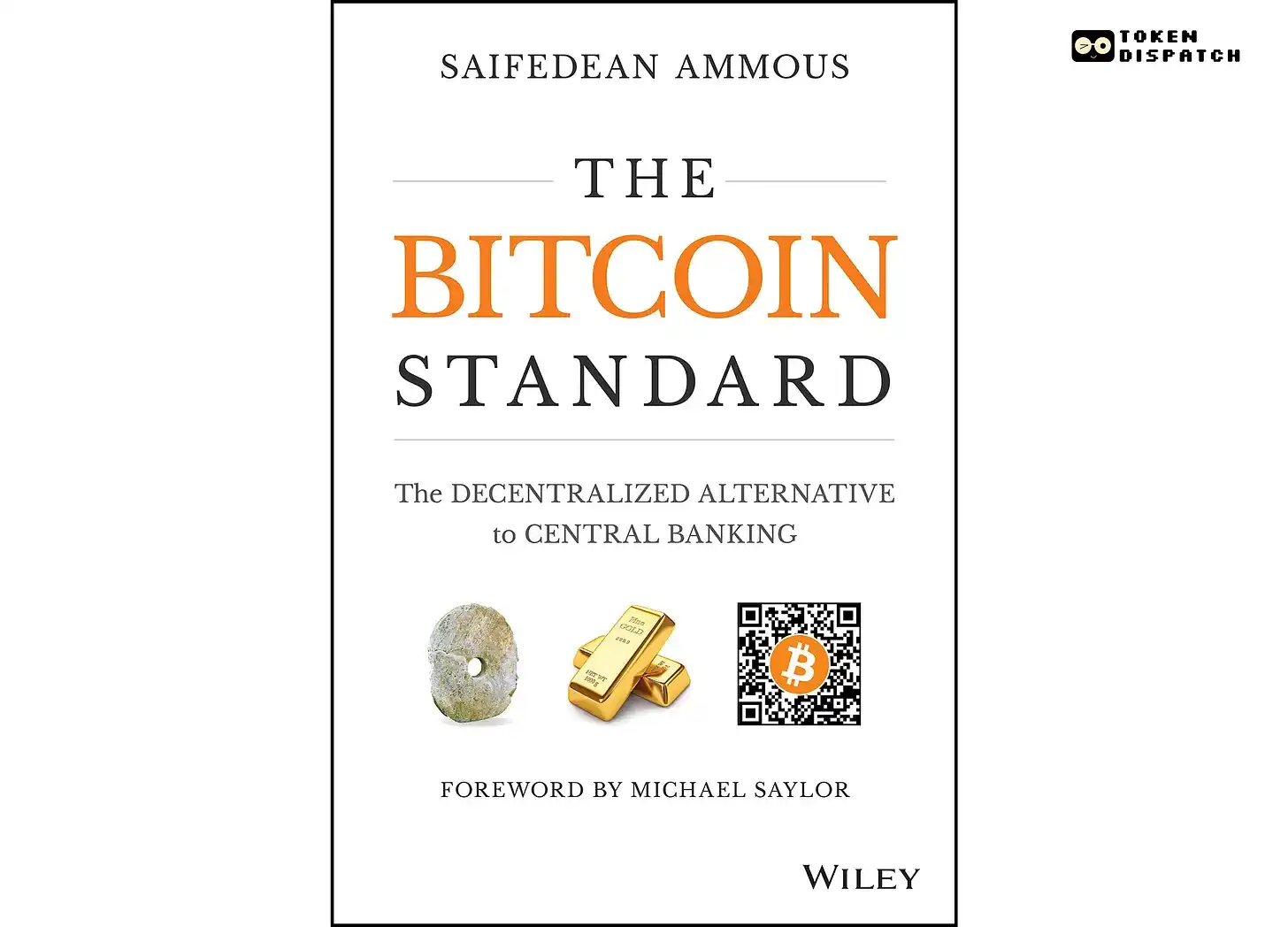
So, I will read this book in its entirety, divided into three parts. This is the first part.

We are still in the early chapters and haven't reached the later sections that fully critique fiat money for ruining everything from architecture to waistlines. For now, Saifedean Ammous is laying the groundwork, trying to convince you that money is a technology, that some forms of money are "harder" than others, and that history is essentially a process of continuous selection, with the harder options ultimately prevailing. If he can make you understand this, Bitcoin will then emerge as the "hardest money to date," and you'll feel it's inevitable.

I'm not entirely convinced yet, but I must admit it's a tricky framework.

The book begins by stripping money of its romanticized veneer, revealing its core essence. It is not a "social contract," nor a "product of the state," but simply a tool for transferring value across time and space, something people don't need to think too much about every day.

Ammous repeatedly emphasizes the concept of "Salability." A good monetary asset should be easily sold anytime, anywhere, without significant loss. To be salable, it must meet three conditions: across space—so you can carry it with you and use it to exchange for what you need; across time—so it doesn't rot or collapse in value; and across scale—so it can be used for any purpose, from a cup of tea to a house, without needing a calculator or a large bag of change.
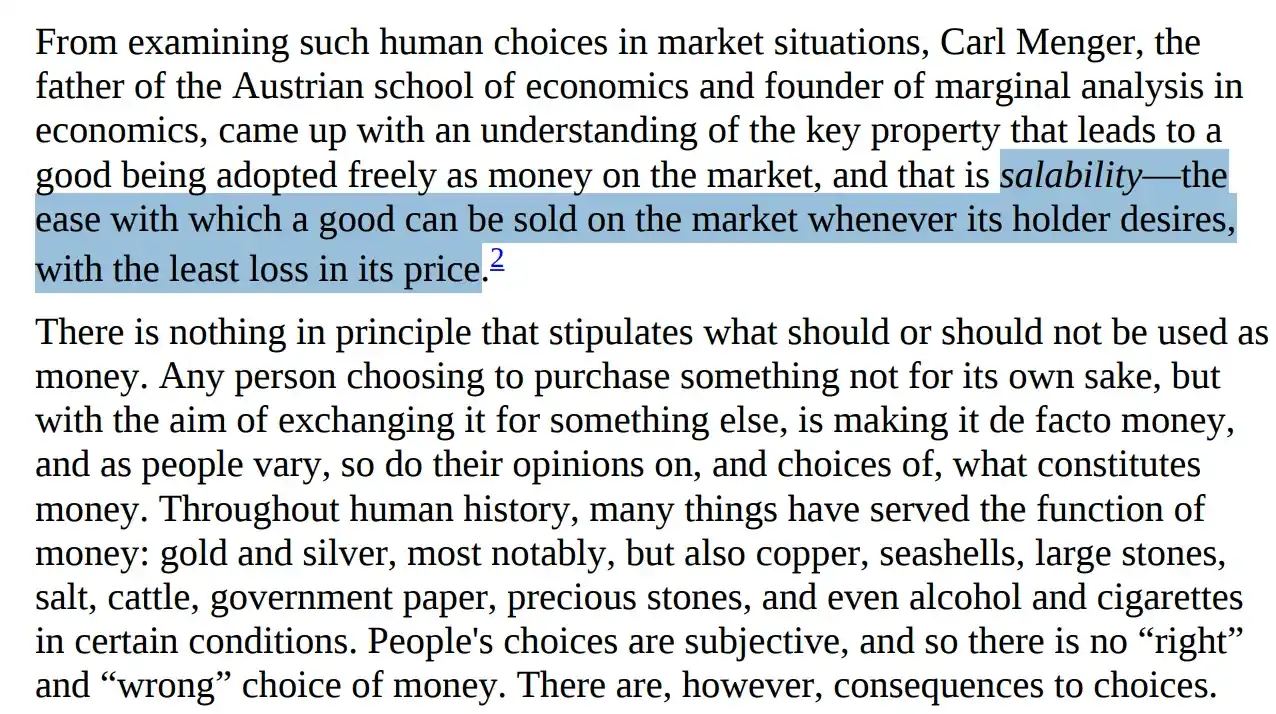
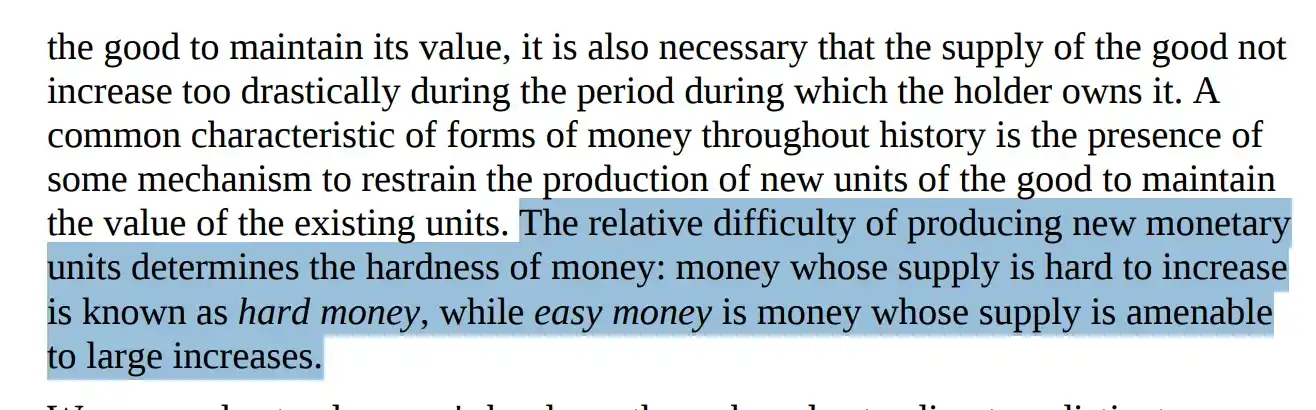
Next, the book's truly decisive word appears: hardness. Hard money is money whose supply is difficult to increase. Soft money is easy to print. This is the essence. The core logic is simple: Why would you store your life's work in something that others can easily create?
You can feel the influence of the Austrian School of Economics in every sentence, but once you strip away the ideology, the book leaves you with a very useful question: If I invest my savings in X, how easy is it for others to earn more X?

Once you view your life through this lens—whether it's rupees, dollars, stablecoins, Bitcoin, or any other monetary combination—it's hard to ignore.

After setting up this framework, the book takes you on a tour of a small "Museum of Broken Money."

The first exhibit is Yap Island and its Rai Stones. These huge circular limestone discs, some weighing up to four tons, were quarried from other islands and arduously transported to Yap. Ammous writes that this worked surprisingly well for centuries. The stones were bulky and difficult to move or steal. Everyone in the village knew which stone belonged to whom. Payment was made by announcing the change of ownership to the community. The stones were "easily salable anywhere on the island" because they were known everywhere on the island; they also stood the test of time because the cost of obtaining new stones was so high that the existing stock was always far greater than the new supply that could be produced in a given period... The stock-to-flow ratio of Rai stones was very high."

Then, technology arrived.

In 1871, an Irish-American captain named David O'Keefe was shipwrecked on Yap Island. After recovering, he left and later returned with a large ship and explosives, realizing he could quarry Rai stones in large quantities using modern tools. The villagers were divided. The chief deemed his stones "too easy" to produce, banned their quarrying, and insisted that only traditional stones counted. Others disagreed and began quarrying the newly discovered stones. Conflict ensued. The stones' use as money gradually faded. Today, they are mostly used for ceremonial purposes.

It's a neat, perhaps overly neat, parable. But it makes a point: once a monetary commodity loses its hardness (once someone can produce it cheaply and in large quantities), those who once held it end up subsidizing later arrivals.

Beads and shells followed the same pattern. West Africa's Aggry Beads were valuable because they were scarce and time-consuming to make. Later, European merchants began importing them in large quantities from glass factories. Ammous describes how this importation "slowly but surely" turned them from "hard money" into "cheap money," "undermining their salability and causing the purchasing power of these beads in the hands of African owners to decline over time, ultimately impoverishing them as their wealth was transferred to the Europeans, who could now easily obtain the beads."
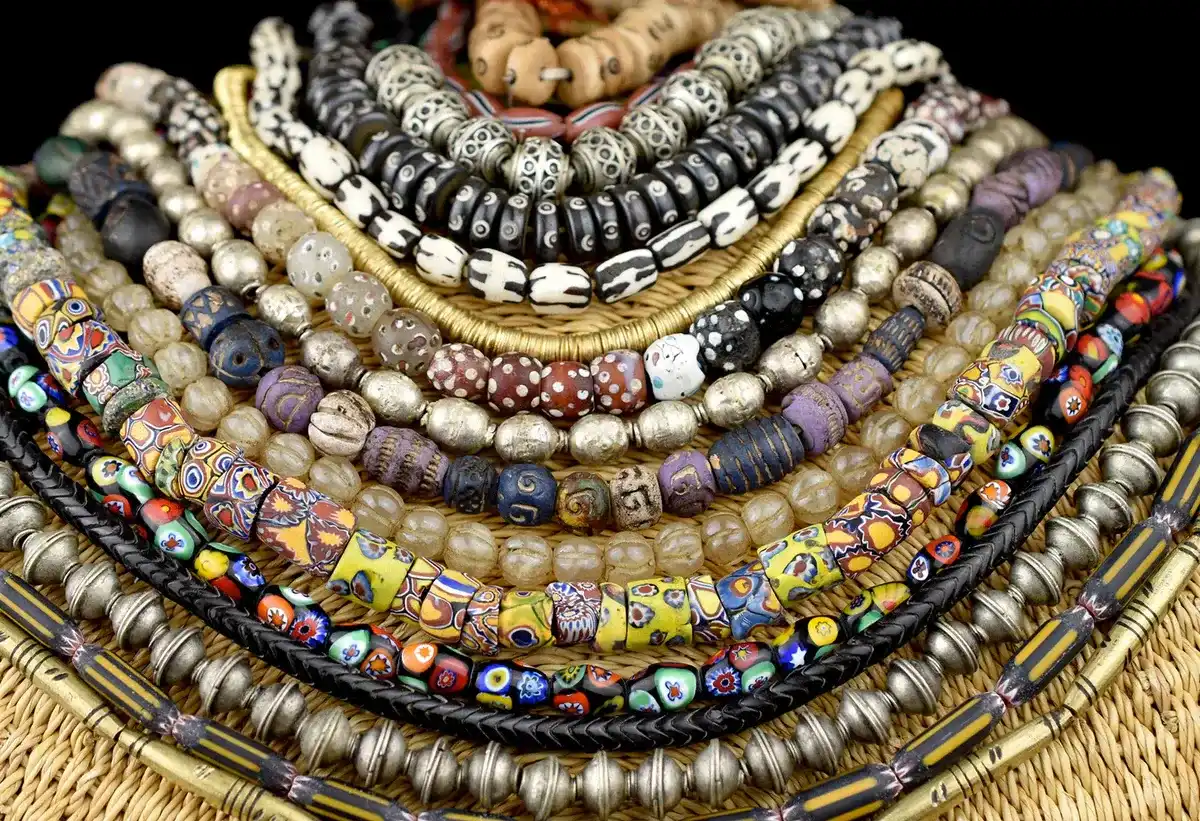
Cowrie shells and wampum experienced similar trajectories. They were initially scarce hard money, difficult to obtain, with high stock-to-flow ratios. Later, with the advent of industrial ships, "their supply expanded dramatically, causing their value to decline and their salability to be lost over time." and by 1661, they had lost their status as legal tender.

You'll find stories of cattle, salt, tally sticks, and cigarettes in prisoner-of-war camps. Each story does the same thing: trains your intuition to feel that if the supply of new units can suddenly be greatly increased at very low cost, then the stock held by savers is essentially making a donation.

You could criticize these historical narratives as being too tidy. There's little mention of violence, politics, or culture in these small stories. Everyone acts like a hyper-rational economic actor with perfect memory. But as a means of making you suspicious of easily printed money, it works.

After you're thoroughly horrified by shells and beads, metals emerge as the mature solution.

Metals solved many salability problems. They didn't spoil like grain. They were more portable than巨石. They could be minted into uniform coins, making pricing and accounting easier. Over time, gold and silver ultimately prevailed because they were the most resistant to inflation. The annual mining output only increased the existing stock by a small fraction, so no single miner could devalue everyone's savings.

Thus began the long era of metallic money, and later, gold-backed paper money. The book doesn't dwell too much on these details. Its purpose is to make you feel that once humans discovered gold, they found a near-perfect money: portable, durable, divisible, and most importantly, expensive to produce.

You'll later see how this sets the stage for Bitcoin's emergence. If you fully accept the notion that "given the physical and metallurgical conditions of the time, gold was the best substance we could make," then "Bitcoin is digital gold with even greater hardness" sounds logical.

What interests me is that in this section, gold is portrayed less as a mystical object and more as a clever workaround to physical limitations. If you imagine ancient societies as constantly trying to answer the question, "How do we preserve the fruits of a harvest or a voyage in a form that can be passed down to future generations?" then gold is a relatively clever, albeit imperfect, yet reasonable answer.

This framework also benefits Bitcoin. It is no longer "magic internet money," but rather "another attempt to solve the same problem with new tools."

The book hasn't reached that point yet, but you can feel the runway being laid.

Then, government money enters the scene as the villain.

So far, monetary collapses have stemmed from external factors. New technology emerged, breaking the rigidity of the monetary system, leaving savers with nothing. Now, the villain comes from within: governments and central banks have the legal authority to print money without any scarce commodity to back it.

In this narrative, fiat money is the product of governments realizing they could completely separate monetary symbols from real assets. The monetary unit was retained, but the constraints were removed. Governments told people their paper money had value because the law said so, because taxes had to be paid with it, not because it was backed by any physical asset.
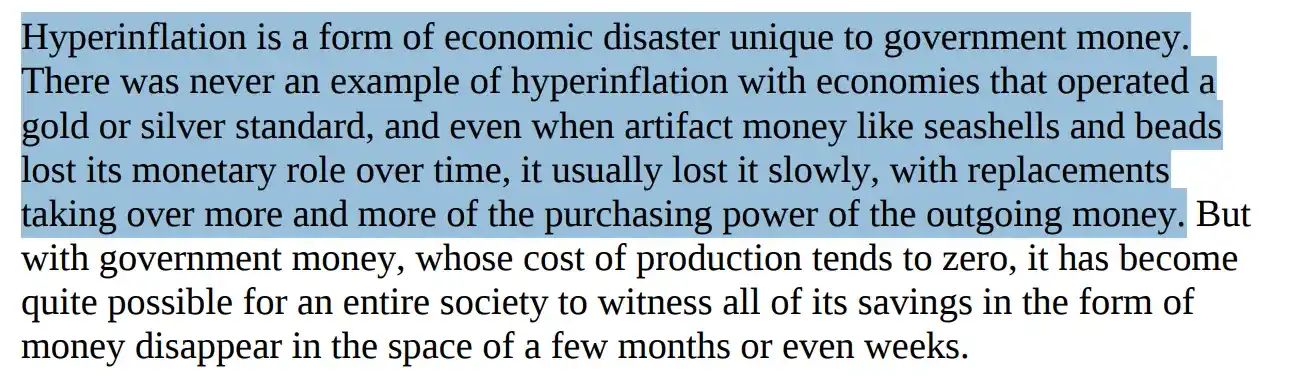
Under a gold or silver standard, money could be devalued or debased, but you didn't get Zimbabwe-style collapses where wages became worthless within months. But under a fiat system, this can happen. And some governments have indeed done it repeatedly.

Ammous spends considerable time explaining the social consequences of this phenomenon. To survive, people are forced to sell capital, and productive activity is eroded. Long-term contracts break down because no one trusts them. Political extremism thrives amidst anger and chaos. Weimar Germany is a prime example. Monetary collapse is just the precursor to worse things.

It's not wrong that most fiat currencies depreciate against physical goods over the long term. This is somewhat by design of the monetary system.

Where my mind starts to push back against the book is not the facts themselves, but its framing. Almost all the ills of modern society are blamed on the fiat monetary system. Central banks are portrayed almost entirely as tools that secretly tax savers to subsidize borrowers. Any benefits of having a flexible lender of last resort are downplayed as "but they will abuse it," which has some truth, but it's not the only question society must answer.

Even if you don't like central banks, the idea that "the entire twentieth century was a mistake from the moment we abandoned the full metal standard" feels a bit extreme.

What impressed me

So, beyond adding more quotable classics to the timeline, what practical impact did Part One actually have on me?

Strangely, it didn't make me more convinced about Bitcoin. It just clarified a question I hadn't asked carefully enough before.

I rarely look at my money the way Ammous does. I consider risk and returns, volatility, how much time I'm willing to put into crypto versus boring things. I don't systematically sit down and scrutinize who can print how much of each crypto I handle and under what rules.

Then I saw a Bloomberg chart showing the S&P 500 not priced in dollars, but in gold. It's so unfair. Priced in gold, the US stock market is back to where it was over a decade ago, in the post-global financial crisis era. All those dollar-denominated all-time highs, all the post-pandemic frenzy, are just noise on a flat line.
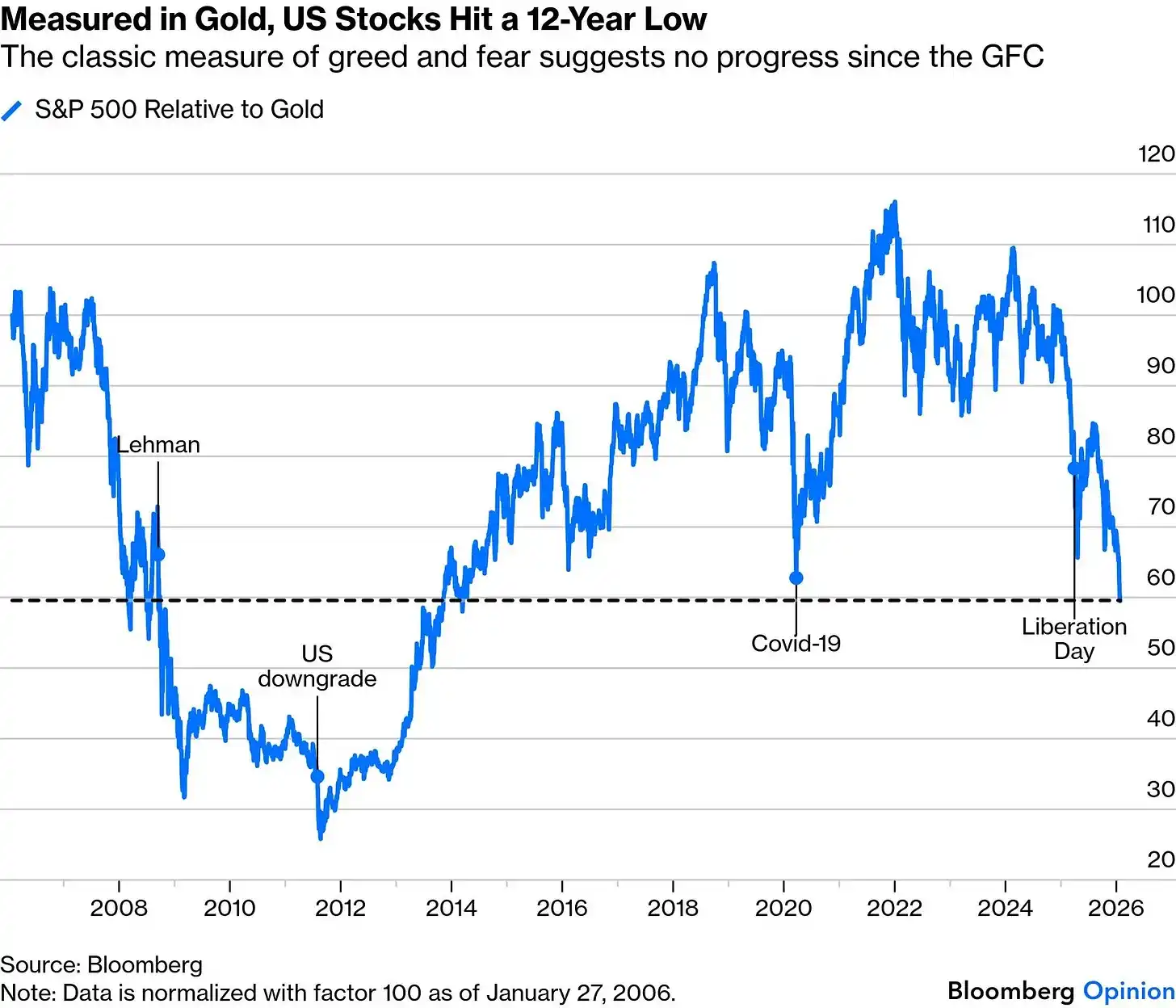
Once you understand this, it's hard to ignore the simple truth Ammous has been hammering home: performance is always "performance relative to what?" If your base unit is slowly depreciating, even if your index hits new highs, your performance in harder units might still be stagnant.

I realize the book leaves out a lot. It barely seriously discusses credit as a social tool, nor does it mention that states don't just destroy money; they also create the legal and military environments that allow markets to flourish. It doesn't delve into the idea that some groups might sacrifice some economic strength for greater resilience to shocks. Everything revolves around one core: are the savers' interests being diluted?

Maybe that's the point. It's a polemic, not a textbook. But I don't want to pretend it's the whole truth.

For now, I'm happy to treat it as a perspective, not a creed. Whenever I see a central bank's balance sheet, a new secondary bond issuance plan, or some "stable yield" product promising 18% returns in dollars, a Saifedean-esque voice echoes in my ear: How hard is this money really? And how many O'Keefes are already in the water with dynamite?

For now, I just want to remember this: money stores our future choices. Choose your monetary unit carefully, and be wary of anyone who can print more than you earn.


Domande pertinenti

QWhat is the core concept of 'hard money' as described in the book 'The Bitcoin Standard'?

AHard money refers to a form of currency that is difficult to increase in supply, making it resistant to inflation and devaluation. It contrasts with 'soft money,' which can be easily created or printed.

QHow did the introduction of modern technology disrupt the Rai Stone monetary system on Yap Island?

AModern technology, such as ships and explosives brought by David O'Keefe, made it easier to mine and transport Rai Stones. This led to an oversupply, devaluing the existing stones and ultimately causing the collapse of their use as money.

QWhat is 'salability' in the context of money, and what are its three dimensions?

ASalability refers to the ease with which a monetary asset can be sold without significant loss. Its three dimensions are: across space (portability), across time (durability and resistance to decay), and across scale (divisibility for transactions of any size).

QWhy does the author argue that fiat money is problematic compared to commodity-based money like gold?

AFiat money is problematic because it can be easily printed by governments and central banks without any backing by scarce commodities. This leads to devaluation, loss of purchasing power, and economic instability, as seen in historical hyperinflation episodes like Weimar Germany.

QWhat historical examples does the book use to illustrate the downfall of previously 'hard' currencies?

AThe book uses examples like Rai Stones on Yap Island, Aggry beads in West Africa, and wampum shells, which were initially scarce and hard to produce but lost their value when technological advances or industrial methods made them easy to mass-produce.

Letture associate

Will the Fed Still Cut Interest Rates? Tonight's Data Is Crucial

The core debate surrounding the Federal Reserve's potential interest rate cuts is intensifying amid geopolitical conflict and rebounding inflation. The key question is whether high energy prices will cause persistent inflation or weaken consumer demand enough to force the Fed to cut rates. Citigroup presents a bullish case for cuts, arguing that oil supply disruptions from the Strait of Hormuz are temporary and will not lead to lasting inflationary pressure. They point to receding bond yields and oil prices as evidence the market is pricing in a short-lived shock. Citi's data also shows tightening financial conditions, a stabilizing labor market, and healthy tax returns, supporting their view that the path to lower rates remains open. Conversely, Deutsche Bank offers a starkly contrasting, more hawkish outlook. They argue the Fed's current policy is already neutral and expect rates to remain unchanged indefinitely. Their view is based on stalled disinflation progress and a shift toward more hawkish rhetoric from key Fed officials like Waller, who cited risks from prolonged Middle East conflict and tariffs. Other officials, including Williams and Hammack, signaled rates would likely stay on hold for a "considerable time." The market pricing has shifted dramatically, now forecasting zero cuts in 2026. The imminent release of the March retail sales "control group" data is highlighted as a critical test. This metric, which excludes gas station sales, will reveal if high gasoline prices are eroding consumer spending in other areas. A weak reading could support the case for imminent rate cuts, while a strong one would bolster the argument for the Fed to hold steady. This data is pivotal for determining the near-term policy path.

marsbitAdesso

Will the Fed Still Cut Interest Rates? Tonight's Data Is Crucial

marsbitAdesso

The Second Half of Macro Influencer Fu Peng's Career

Fu Peng, a prominent Chinese macroeconomist and former chief economist of Northeast Securities, has joined Hong Kong-based digital asset management firm Bitfire Group (formerly New Huo Group) as its chief economist. This move, announced in April 2026, triggered an 11% surge in Bitfire's stock price. Fu, known for his accessible macroeconomic commentary and large social media following, will focus on integrating digital assets into global asset allocation frameworks, particularly combining FICC (fixed income, currencies, and commodities) with cryptocurrencies for institutional clients. His career includes roles at Lehman Brothers and Solomon International, with significant influence gained through public communication. However, in late 2024, Fu faced temporary social media bans after a controversial private speech at HSBC on China's economic challenges, though he denied regulatory sanctions. He later left Northeast Securities citing health reasons. Bitfire, a licensed virtual asset manager serving high-net-worth clients, seeks to build trust and attract traditional capital through Fu’s expertise and credibility. The partnership represents a strategic shift for both: Fu enters the crypto sector after a traditional finance peak, while Bitfire aims to leverage his macro framework for institutional adoption. Outcomes remain uncertain regarding capital inflows and compatibility within corporate structure.

marsbit1 h fa

The Second Half of Macro Influencer Fu Peng's Career

marsbit1 h fa

Trading

Spot
Futures

Articoli Popolari

Cosa è BITCOIN

Comprendere HarryPotterObamaSonic10Inu (ERC-20) e la sua posizione nel mondo delle criptovalute Negli ultimi anni, il mercato delle criptovalute ha assistito a un aumento della popolarità delle meme coin, catturando l'interesse non solo dei trader, ma anche di coloro che cercano coinvolgimento comunitario e valore di intrattenimento. Tra questi token unici c'è HarryPotterObamaSonic10Inu (ERC-20), un progetto intrigante che mescola riferimenti culturali nel tessuto delle criptovalute. Questo articolo esplora gli aspetti chiave di HarryPotterObamaSonic10Inu, analizzando i suoi meccanismi, l'etica guidata dalla comunità e il suo coinvolgimento con il panorama crittografico più ampio. Che cos'è HarryPotterObamaSonic10Inu (ERC-20)? Come suggerisce il suo nome, HarryPotterObamaSonic10Inu è una meme coin costruita sulla blockchain di Ethereum, classificata secondo lo standard ERC-20. A differenza delle criptovalute tradizionali che possono enfatizzare l'utilità pratica o il potenziale investimento, questo token prospera grazie al valore di intrattenimento e alla forza della sua comunità. Il progetto mira a creare un ambiente in cui gli utenti coinvolti possono riunirsi, condividere idee e partecipare ad attività ispirate a diversi fenomeni culturali. Una caratteristica notevole di HarryPotterObamaSonic10Inu è la zero tassa sulle transazioni. Questo elemento allettante tende a incoraggiare il trading e il coinvolgimento della comunità, privo di costi aggiuntivi che possono scoraggiare i trader di piccole dimensioni. L'offerta totale della moneta è fissata a un miliardo di token, un numero che segna la sua intenzione di mantenere una circolazione sostanziale all'interno della comunità. Creatore di HarryPotterObamaSonic10Inu (ERC-20) Le origini di HarryPotterObamaSonic10Inu sono avvolte in un certo mistero; i dettagli sul creatore rimangono sconosciuti. Lo sviluppo di questo token non presenta un team identificabile o un piano esplicito, cosa non rara nel settore delle meme coin. Invece, il progetto è emerso organicamente, con il suo progresso fortemente dipendente dall'entusiasmo e dalla partecipazione della sua comunità. Investitori di HarryPotterObamaSonic10Inu (ERC-20) Per quanto riguarda investimenti esterni e finanziamenti, HarryPotterObamaSonic10Inu rimane ambiguo. Il token non elenca alcuna fondazione di investimento conosciuta o un sostegno organizzativo significativo. Invece, la linfa vitale del progetto è la sua comunità di base, che informa la sua crescita e sostenibilità attraverso azioni collettive e coinvolgimento nello spazio crittografico. Come funziona HarryPotterObamaSonic10Inu (ERC-20)? In quanto meme coin, HarryPotterObamaSonic10Inu opera principalmente al di fuori delle strutture tradizionali che governano spesso il valore degli asset. Ci sono diversi aspetti distintivi che definiscono il funzionamento del progetto: Transazioni senza tasse: Senza costi fiscali sulle transazioni, gli utenti possono comprare e vendere liberamente il token senza preoccuparsi di costi nascosti. Coinvolgimento della comunità: Il progetto prospera sull'interazione della comunità, sfruttando le piattaforme social per creare entusiasmo e facilitare il coinvolgimento. Discussioni, condivisione di contenuti e coinvolgimento sono elementi cruciali che aiutano ad espandere la sua portata e a favorire la lealtà tra i sostenitori. Nessuna utilità pratica: Va notato che HarryPotterObamaSonic10Inu non offre un'utilità concreta all'interno dell'ecosistema finanziario. Piuttosto, è classificato come un token principalmente per attività di intrattenimento e comunitarie. Riferimento culturale: Il token incorpora astutamente elementi della cultura pop per attirare interesse, collegandosi a appassionati di meme e seguaci delle criptovalute. HarryPotterObamaSonic10Inu esemplifica come le meme coin operino in modo diverso rispetto ai progetti di criptovalute più tradizionali, entrando nel mercato come costrutti sociali innovativi piuttosto che come asset utilitari. Cronologia di HarryPotterObamaSonic10Inu (ERC-20) La storia di HarryPotterObamaSonic10Inu è segnata da diversi traguardi notevoli: Creazione: Il token è emerso da un meme virale, catturando l'immaginazione di molti appassionati di criptovalute. Le date di creazione specifiche non sono disponibili, sottolineando la sua crescita organica. Inserimento negli scambi: HarryPotterObamaSonic10Inu ha fatto il suo ingresso in vari scambi, consentendo un accesso e un trading più facili da parte della comunità. Iniziative di coinvolgimento della comunità: Attività in corso volte a migliorare l'interazione della comunità, comprese gare, campagne sui social media e generazione di contenuti da parte di fan e sostenitori. Piani di espansione futura: La tabella di marcia del progetto include il lancio di una collezione NFT, merchandising e un sito di eCommerce relativo ai suoi temi culturali, coinvolgendo ulteriormente la comunità e cercando di aggiungere più dimensioni al suo ecosistema. Punti chiave su HarryPotterObamaSonic10Inu (ERC-20) Natura guidata dalla comunità: Il progetto dà priorità al contributo collettivo e alla creatività, garantendo che il coinvolgimento degli utenti sia al centro del suo sviluppo. Classificazione come meme coin: Rappresenta l'epitome delle criptovalute basate sull'intrattenimento, distinguendosi dai veicoli d'investimento tradizionali. Nessuna affiliazione diretta con Bitcoin: Nonostante la somiglianza nel nome del ticker, HarryPotterObamaSonic10Inu è distintivo e non ha alcuna relazione con Bitcoin o altre criptovalute consolidate. Focus sulla collaborazione: HarryPotterObamaSonic10Inu è progettato per creare uno spazio per la collaborazione e la condivisione di storie tra i suoi detentori, fornendo un canale per la creatività e il legame comunitario. Prospettive future: L'ambizione di espandersi oltre il suo presupposto iniziale verso NFT e merchandising delinea un percorso per il progetto per potenzialmente entrare in strade più mainstream all'interno della cultura digitale. Poiché le meme coin continuano a catturare l'immaginazione della comunità crittografica, HarryPotterObamaSonic10Inu (ERC-20) si distingue per i suoi legami culturali e il suo approccio centrato sulla comunità. Anche se potrebbe non adattarsi al modello tipico di un token orientato all'utilità, la sua essenza risiede nella gioia e nella camaraderia coltivate tra i suoi sostenitori, evidenziando la natura in evoluzione delle criptovalute in un'epoca sempre più digitale. Con la continuazione dello sviluppo del progetto, sarà importante osservare come le dinamiche della comunità influenzano la sua traiettoria nel panorama in continuo cambiamento della tecnologia blockchain.

1.1k Totale visualizzazioniPubblicato il 2024.04.01Aggiornato il 2024.12.03

Cosa è BITCOIN

Come comprare BTC

Benvenuto in HTX.com! Abbiamo reso l'acquisto di Bitcoin (BTC) semplice e conveniente. Segui la nostra guida passo passo per intraprendere il tuo viaggio nel mondo delle criptovalute.Step 1: Crea il tuo Account HTXUsa la tua email o numero di telefono per registrarti il tuo account gratuito su HTX. Vivi un'esperienza facile e sblocca tutte le funzionalità,Crea il mio accountStep 2: Vai in Acquista crypto e seleziona il tuo metodo di pagamentoCarta di credito/debito: utilizza la tua Visa o Mastercard per acquistare immediatamente BitcoinBTC.Bilancio: Usa i fondi dal bilancio del tuo account HTX per fare trading senza problemi.Terze parti: abbiamo aggiunto metodi di pagamento molto utilizzati come Google Pay e Apple Pay per maggiore comodità.P2P: Fai trading direttamente con altri utenti HTX.Over-the-Counter (OTC): Offriamo servizi su misura e tassi di cambio competitivi per i trader.Step 3: Conserva Bitcoin (BTC)Dopo aver acquistato Bitcoin (BTC), conserva nel tuo account HTX. In alternativa, puoi inviare tramite trasferimento blockchain o scambiare per altre criptovalute.Step 4: Scambia Bitcoin (BTC)Scambia facilmente Bitcoin (BTC) nel mercato spot di HTX. Accedi al tuo account, seleziona la tua coppia di trading, esegui le tue operazioni e monitora in tempo reale. Offriamo un'esperienza user-friendly sia per chi ha appena iniziato che per i trader più esperti.

3.5k Totale visualizzazioniPubblicato il 2024.12.12Aggiornato il 2025.03.21

Come comprare BTC

Cosa è $BITCOIN

ORO DIGITALE ($BITCOIN): Un'Analisi Completa Introduzione all'ORO DIGITALE ($BITCOIN) L'ORO DIGITALE ($BITCOIN) è un progetto basato su blockchain che opera sulla rete Solana, con l'obiettivo di combinare le caratteristiche dei metalli preziosi tradizionali con l'innovazione delle tecnologie decentralizzate. Sebbene condivida un nome con Bitcoin, spesso definito “oro digitale” a causa della sua percezione come riserva di valore, l'ORO DIGITALE è un token separato progettato per creare un ecosistema unico all'interno del panorama Web3. Il suo obiettivo è posizionarsi come un asset digitale alternativo valido, anche se i dettagli riguardanti le sue applicazioni e funzionalità sono ancora in fase di sviluppo. Cos'è l'ORO DIGITALE ($BITCOIN)? L'ORO DIGITALE ($BITCOIN) è un token di criptovaluta esplicitamente progettato per l'uso sulla blockchain di Solana. A differenza di Bitcoin, che fornisce un ruolo di stoccaggio di valore ampiamente riconosciuto, questo token sembra concentrarsi su applicazioni e caratteristiche più ampie. Aspetti notevoli includono: Infrastruttura Blockchain: Il token è costruito sulla blockchain di Solana, nota per la sua capacità di gestire transazioni ad alta velocità e a basso costo. Dinamiche di Offerta: L'ORO DIGITALE ha un'offerta massima fissata a 100 quadrilioni di token (100P $BITCOIN), sebbene i dettagli riguardanti la sua offerta circolante siano attualmente non divulgati. Utilità: Sebbene le funzionalità precise non siano esplicitamente delineate, ci sono indicazioni che il token potrebbe essere utilizzato per varie applicazioni, potenzialmente coinvolgendo applicazioni decentralizzate (dApp) o strategie di tokenizzazione degli asset. Chi è il Creatore dell'ORO DIGITALE ($BITCOIN)? Attualmente, l'identità dei creatori e del team di sviluppo dietro l'ORO DIGITALE ($BITCOIN) rimane sconosciuta. Questa situazione è tipica tra molti progetti innovativi nel settore blockchain, in particolare quelli allineati con la finanza decentralizzata e i fenomeni delle meme coin. Sebbene tale anonimato possa favorire una cultura guidata dalla comunità, intensifica le preoccupazioni riguardo alla governance e alla responsabilità. Chi sono gli Investitori dell'ORO DIGITALE ($BITCOIN)? Le informazioni disponibili indicano che l'ORO DIGITALE ($BITCOIN) non ha alcun sostenitore istituzionale noto o investimenti di venture capital prominenti. Il progetto sembra operare su un modello peer-to-peer incentrato sul supporto e sull'adozione della comunità piuttosto che su percorsi di finanziamento tradizionali. La sua attività e liquidità si trovano principalmente su exchange decentralizzati (DEX), come PumpSwap, piuttosto che su piattaforme di trading centralizzate consolidate, evidenziando ulteriormente il suo approccio di base. Come Funziona l'ORO DIGITALE ($BITCOIN) Le meccaniche operative dell'ORO DIGITALE ($BITCOIN) possono essere elaborate in base al suo design blockchain e alle caratteristiche della rete: Meccanismo di Consenso: Sfruttando il proof-of-history (PoH) unico di Solana combinato con un modello di proof-of-stake (PoS), il progetto garantisce una validazione efficiente delle transazioni contribuendo all'alta performance della rete. Tokenomics: Sebbene meccanismi deflazionistici specifici non siano stati dettagliati ampiamente, l'ampia offerta massima di token implica che potrebbe soddisfare microtransazioni o casi d'uso di nicchia che devono ancora essere definiti. Interoperabilità: Esiste il potenziale per l'integrazione con l'ecosistema più ampio di Solana, inclusi vari piattaforme di finanza decentralizzata (DeFi). Tuttavia, i dettagli riguardanti integrazioni specifiche rimangono non specificati. Cronologia degli Eventi Chiave Ecco una cronologia che evidenzia traguardi significativi riguardanti l'ORO DIGITALE ($BITCOIN): 2023: Il dispiegamento iniziale del token avviene sulla blockchain di Solana, contrassegnato dal suo indirizzo di contratto. 2024: L'ORO DIGITALE guadagna visibilità poiché diventa disponibile per il trading su exchange decentralizzati come PumpSwap, consentendo agli utenti di scambiarlo contro SOL. 2025: Il progetto assiste a un'attività di trading sporadica e a un potenziale interesse per impegni guidati dalla comunità, sebbene non siano state documentate partnership significative o avanzamenti tecnici fino ad ora. Analisi Critica Punti di Forza Scalabilità: L'infrastruttura sottostante di Solana supporta alti volumi di transazioni, il che potrebbe migliorare l'utilità di $BITCOIN in vari scenari di transazione. Accessibilità: Il potenziale basso prezzo di trading per token potrebbe attrarre investitori al dettaglio, facilitando una partecipazione più ampia grazie a opportunità di proprietà frazionata. Rischi Mancanza di Trasparenza: L'assenza di sostenitori, sviluppatori o di un processo di audit pubblicamente noti potrebbe generare scetticismo riguardo alla sostenibilità e all'affidabilità del progetto. Volatilità del Mercato: L'attività di trading è fortemente dipendente dal comportamento speculativo, il che può comportare una significativa volatilità dei prezzi e incertezze per gli investitori. Conclusione L'ORO DIGITALE ($BITCOIN) emerge come un progetto intrigante ma ambiguo all'interno dell'evolvente ecosistema di Solana. Sebbene tenti di sfruttare la narrativa dell'“oro digitale”, la sua partenza dal ruolo consolidato di Bitcoin come riserva di valore sottolinea la necessità di una chiara differenziazione della sua utilità e struttura di governance. L'accettazione e l'adozione future dipenderanno probabilmente dall'affrontare l'attuale opacità e dalla definizione più esplicita delle sue strategie operative ed economiche. Nota: Questo rapporto comprende informazioni sintetizzate disponibili a ottobre 2023, e potrebbero essersi verificati sviluppi oltre il periodo di ricerca.

99 Totale visualizzazioniPubblicato il 2025.05.13Aggiornato il 2025.05.13

Cosa è $BITCOIN

Discussioni

Benvenuto nella Community HTX. Qui puoi rimanere informato sugli ultimi sviluppi della piattaforma e accedere ad approfondimenti esperti sul mercato. Le opinioni degli utenti sul prezzo di BTC BTC sono presentate come di seguito.

活动图片