Bitcoiners push for quantum-resistant BIP-360 upgrade as debate heats up

cointelegraphPubblicato 2025-12-18Pubblicato ultima volta 2025-12-18

Introduzione

A group of Bitcoin advocates and fund managers is urging the network to accelerate the adoption of quantum-resistant cryptography, citing BIP-360 as a potential solution. Proponents like Charles Edwards of Capriole warn that a significant portion of Bitcoin could be vulnerable to quantum attacks within years and argue for a migration deadline by 2028. However, critics including Adam Back of Blockstream dismiss these concerns as premature, stating quantum threats are “decades away” and emphasizing that Bitcoin doesn’t rely on encryption vulnerable to near-term quantum breaks. Debate continues as Taproot adoption declines, possibly reflecting user anxiety, while alternative quantum-resistant signature schemes like hash-based proposals from Blockstream Research gain attention.

A small but growing group of Bitcoin advocates and crypto fund managers is urging the network to accelerate work on quantum-resistant signatures, arguing that the perception of a future “quantum threat” could become a market risk long before it becomes a practical one.

Some supporters are pointing to a draft Bitcoin Improvement Proposal known as BIP-360, which would introduce a post-quantum signature option for Bitcoin addresses that could be vulnerable to future advances in quantum computing.

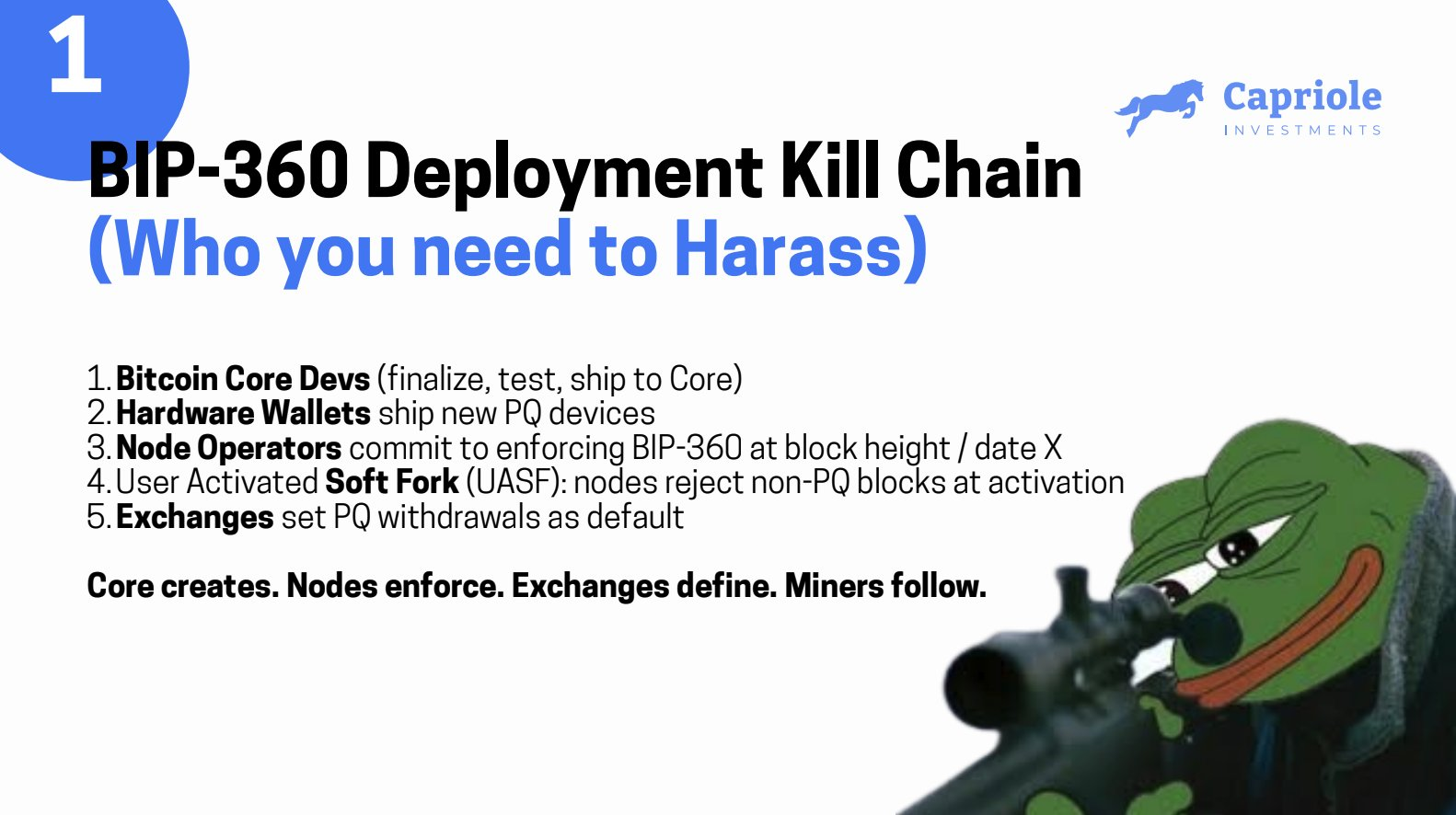
The implementation must be finalized and deployed in 2026, said Charles Edwards, the founder of quantitative Bitcoin (BTC) and digital asset fund Capriole.

However, the implementation of the new standard would require wider consensus among hardware wallet providers, node operators and cryptocurrency exchanges, added Capriole in a Thursday X post. Around “20-30% of Bitcoin will be taken by a quantum hacker in the next few years,” Edwards said. “I believe we should burn all coins that do not migrate to BIP-360 by 2028.”
Source: Charles Edwards

Related: Bitcoin treasuries stall in Q4, but largest holders keep stacking sats

However, other industry watchers see quantum computing as a short-term risk for Bitcoin’s price.

“Pro-tip for quantum FUD promoters. Bitcoin does not use encryption. Get your basics right, or it’s a tell,” wrote Adam Back, co-founder and CEO of Blockstream, and the inventor of Hashcash, in a Thursday X post, adding that the quantum computing threat is still “decades away.”

Samson Mow, the CEO of Bitcoin technology company Jan3, also mocked the idea of early quantum computing threatening the Bitcoin network.

“Quantum computing can’t even factor 21, yet people are panic selling because they think it will kill Bitcoin,” wrote Mow in a Wednesday X post.

Related: Bitcoin investor loses retirement fund in AI-fueled romance scam

Taproot questions and competing proposals

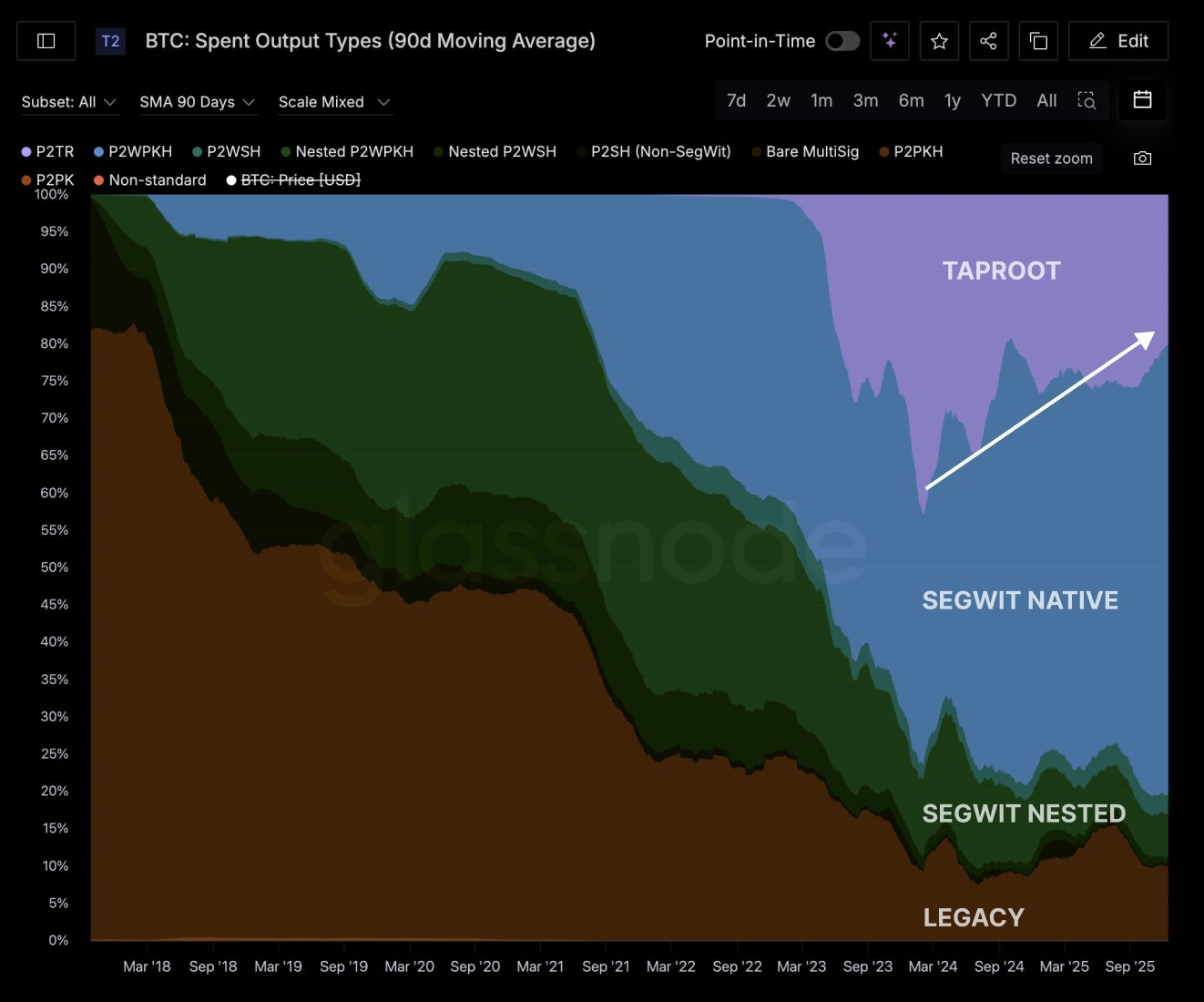
Bitcoin’s latest Taproot format, which is perceived as quantum vulnerable, is declining in usage, from 42% of transactions in 2024 to just 20%, signaling that users may be worried about Bitcoin's quantum threat.
Source: Willy Woo

“I’ve NEVER seen the latest format losing adoption before. Taproot is Quantum Vulnerable, while older SegWit and Legacy are not,” wrote Bitcoin analyst Willy Woo, in a Wednesday X post.

Bitcoin’s Taproot update is the most important upgrade the cryptocurrency has experienced since 2017, when Segregated Witness (SegWit) was activated. Taproot aimed to upgrade the privacy and efficiency of the Bitcoin network.

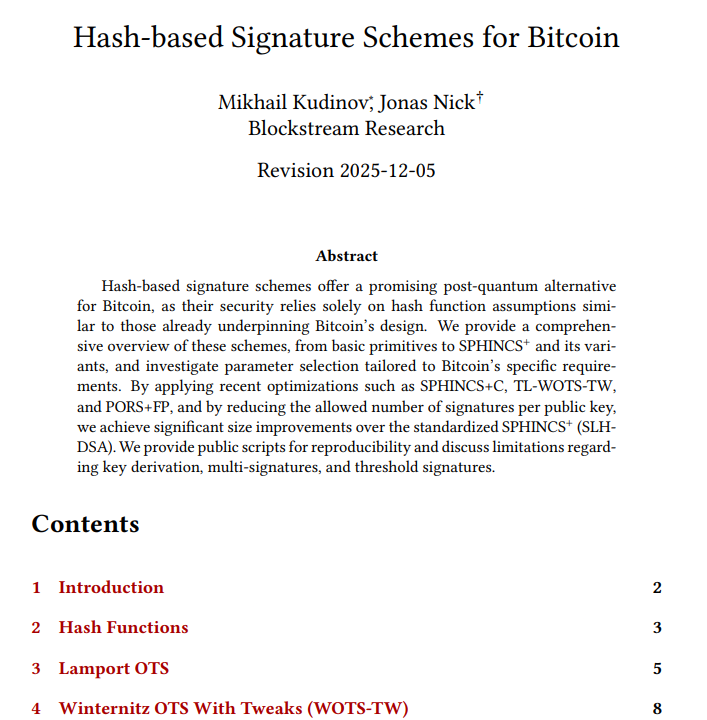
Meanwhile, Back, one of the leading cryptographers, proposed a new hash-based signature scheme as a promising post-quantum alternative for Bitcoin, where security would rely solely on hash function assumptions similar to the ones currently used in the Bitcoin network’s design.
Hash-based signature schemes for Bitcoin, research paper. Source: Blockstream Research

Hash-based signature schemes like ECDSA and Schnorr signatures “offer a promising path for securing Bitcoin in a post-quantum world,” according to the paper released by Back’s Blockstream Research on Dec. 5.

The Elliptic Curve Digital Signature Algorithm (ECDSA) uses elliptic-curve cryptography to verify the authenticity and integrity of a message. Schnorr signatures are another signature scheme praised for enhancing privacy and reducing data size, due to their ability to combine multiple signatures into one.

Magazine: Bitcoin vs. the quantum computer threat — Timeline and solutions (2025–2035)

Domande pertinenti

QWhat is the main purpose of the proposed BIP-360 upgrade for Bitcoin?

AThe main purpose of the proposed BIP-360 upgrade is to introduce a post-quantum signature option for Bitcoin addresses, making them resistant to potential future attacks from advanced quantum computers.

QAccording to Charles Edwards, by when must the quantum-resistant implementation be deployed, and what is his proposal for non-migrated coins?

ACharles Edwards stated that the implementation must be finalized and deployed by 2026, and he proposed that all coins not migrated to BIP-360 by 2028 should be burned.

QWhy is Bitcoin's Taproot format considered a decline in usage significant, as noted by Willy Woo?

AThe decline in Taproot usage, from 42% of transactions in 2024 to just 20%, is significant because it is the first time a newer Bitcoin format has lost adoption. This signals that users may be concerned about Taproot's vulnerability to quantum threats, unlike older SegWit and Legacy formats.

QWhat alternative post-quantum solution did Adam Back and Blockstream Research propose for Bitcoin?

AAdam Back and Blockstream Research proposed a new hash-based signature scheme as a post-quantum alternative. This scheme's security relies solely on hash function assumptions, similar to those already used in Bitcoin's design, with ECDSA and Schnorr signatures being highlighted as promising paths.

QWhat are the differing views on the immediacy of the quantum computing threat to Bitcoin, as presented in the article?

AThe article presents differing views: Charles Edwards and others see it as a near-term market risk, urging immediate action. In contrast, Adam Back and Samson Mow consider the quantum threat to be decades away or currently insignificant, with Mow mocking the idea that quantum computing, which 'can't even factor 21,' is a reason for panic selling.

Letture associate

It Took Me a Year to See the Bitter Truth About Agent Payments

After a year building infrastructure for the Agent economy, engaging with major players like Stripe, Visa, and Coinbase, the author shares a sobering analysis of the current state of Agent payments. The core finding is a stark lack of genuine, immediate demand across most envisioned use cases. The article breaks down four key market segments: 1. **Agent-to-Merchant (Consumer Shopping):** For most product categories (e.g., clothing, electronics), conversational AI shopping is a step backwards from visual e-commerce interfaces. While agents excel at understanding needs, they can't replace side-by-side product comparison. Real merchant interest is defensive "Agent Engine Optimization," not driven by current customer demand. Potential exists for high-frequency, low-decision purchases (like food delivery) or navigating complex store UIs, but these require massive B2C distribution channels dominated by giants like Amazon. 2. **Agent-to-API (Developer Services):** Developers already have subscriptions and billing relationships for APIs (compute, data). Prepaid balances solve micro-payment issues for low transaction volumes. A deeper structural problem is that major SaaS vendors' business models rely on enterprise contracts, resisting granular pay-per-call pricing. While protocols like MPP and x402 serve the long tail of niche services, this market is small and developers are historically low-willingness-to-pay. 3. **Agent-to-Agent:** This remains largely theoretical with minimal transaction volume. While it represents a long-term bet on a fundamentally new transaction infrastructure (sub-second, micro-penny to million-dollar, multi-party settlements), it does not constitute a present market. 4. **Agent-to-Finance:** This is the only category with existing, paying demand. Integrating AI into financial workflows (trading, portfolio management) is a natural evolution and enables new capabilities like autonomous rebalancing. However, competition favors established, regulated institutions. The "real problem" is not moving money between agents, but the broader challenge of **coordination**—orchestrating work between agents and humans, verifying outcomes, and settling results. Payment is just one component of settlement, which is itself part of coordination. Companies that solve the coordination layer will subsume payment, not the other way around. While well-funded incumbents build defensively for a long-term future, startups must find where the market is today—which, for the author's team, lies outside these four categories in an area of real, growing, and underserved activity.

marsbit6 min fa

It Took Me a Year to See the Bitter Truth About Agent Payments

marsbit6 min fa

It Took Me a Year to See the Hard Truth About Agent Payments

**Title: It Took Me a Year to See the Hard Truth About Agent Payments** Over the past year, I've worked on infrastructure for the Agent economy, engaging with major players like Stripe, Visa, Coinbase, and numerous startups. The findings reveal a stark reality: genuine, widespread demand for Agent-based payments does not yet exist. **Key Observations:** * **Agent-to-Merchant (Shopping):** The user experience for AI shopping often falls short, especially for visual product discovery. While AI excels at understanding needs, conversational interfaces can't yet replace browsing and comparing multiple products visually. Current merchant interest is largely defensive ("Agent Engine Optimization") for a future that hasn't arrived. High-frequency, low-friction purchases (like food delivery) are potential fits, but lack open APIs and face high AI inference costs. Simpler, more affordable, or cross-language interactions for complex UIs are a niche opportunity but require massive consumer distribution to scale. * **Agent-to-API (Developer Tools):** Developer payment needs for APIs (computing, data, models) are already met through subscriptions and prepaid credits. The core challenge is not payment friction but supplier economics: most large SaaS providers prefer enterprise contracts over micropayments for API calls. Protocols like MPP and x402 suit the long-tail of smaller services but cater to a developer market historically reluctant to pay for these tools. Major infrastructure needs at the top of the stack are already being addressed. * **Agent-to-Agent (Machine Commerce):** This is a long-term vision with almost no current transaction volume. While a future with high-speed, high-frequency, multi-party machine-to-machine transactions would require novel infrastructure, it remains theoretical. The market is not here yet. * **Agent-to-Finance:** This is the only category with clear, present demand. Financial professionals and DeFi users already pay for tools, and AI augmentation is a natural evolution. Autonomous AI agents can enable entirely new financial strategies. However, competition is fierce from established, regulated incumbents who can more easily layer AI onto their existing products. **The Core Insight:** Companies, especially giants with long time horizons, are building defensively for a potential future of mass machine commerce. For them, early investment is a low-cost hedge. For startups, the current market reality is different. The primary challenge isn't just moving money between agents (payments). The larger, unsolved problem is **orchestration** – coordinating work between agents and humans, verifying outcomes, and then settling. Payment is just a part of settlement, which is just a part of orchestration. Companies that solve the orchestration problem will subsume payments, not the other way around. After a year of building, we see the real, growing, and underserved market opportunity lies in this broader domain of orchestration.

链捕手29 min fa

It Took Me a Year to See the Hard Truth About Agent Payments

链捕手29 min fa

Claude Opus 4.8 Finds a $4.5 Billion Bug: The AI Era is Mass-Producing Hackers

A researcher discovered a critical "infinite mint" vulnerability in the Zcash cryptocurrency's Orchard protocol using Claude Opus 4.8, leading to a swift fix but also a 50% market drop, erasing billions in value. This incident highlights a new era where powerful, accessible AI models are dramatically lowering the barrier to finding software vulnerabilities. Previously, the security community feared specialized models like Claude Mythos Preview, capable of finding decades-old zero-day exploits. The Zcash case, however, involved a publicly available, general-purpose model. This shift makes advanced security auditing—and attack capabilities—accessible to far more people, not just experts. The mass democratization of vulnerability discovery brings a dual challenge: a flood of low-quality, AI-generated false reports that overwhelm maintainers, and the real, rapid uncovering of deep, dangerous bugs. Open-source projects, often understaffed and unfunded, are particularly vulnerable to this "attention DDoS." The article cites examples like curl shutting down its bug bounty program due to the unsustainable workload. Our perceived digital safety has often been luck, relying on the high cost and effort required to find deeply hidden flaws in complex systems, as seen with historical vulnerabilities like Heartbleed or Baron Samedit. AI changes this cost structure, effectively "mass-producing flashlights" to illuminate every corner of our codebase. While large companies operate extensive security chains involving external white-hat hackers and massive defensive operations, the global cybersecurity workforce faces a severe shortage, especially of experienced personnel capable of analyzing complex threats and coordinating fixes. The core dilemma emerges: AI makes *finding* bugs cheap and scalable, but *fixing* them remains a slow, expensive, and human-intensive process. The article concludes that AI won't destroy the internet but acts as a bright light, revealing that our digital existence is not inherently secure but is precariously maintained by ongoing human effort. The true cost in the AI era may not be discovery, but whether there will be enough people left willing and able to do the hard work of repair.

marsbit1 h fa

Claude Opus 4.8 Finds a $4.5 Billion Bug: The AI Era is Mass-Producing Hackers

marsbit1 h fa

Codex Goal Mode Usage Guide: How to Make AI Continuously Pursue a Specific Objective

"Codex Goal Mode: How to Make AI Work Continuously Toward a Specific Goal" OpenAI's Codex "goal mode" (/goal) transforms the AI from a reactive code assistant into a proactive execution agent capable of working autonomously for hours or even days to achieve a defined objective. To maximize its effectiveness, follow these key principles: 1. **Define Clear, Verifiable Exit Criteria:** The goal prompt should be a concise, measurable success condition, not a lengthy specification. Use quantifiable metrics like "reduce build time by 30%" or "achieve 100% test parity." 2. **Provide Initial Guidance and Tools:** Direct Codex toward likely problem areas and specify available tools (e.g., browsers, testing environments) to prevent it from exploring unproductive paths. 3. **Enable Progress Measurement:** Equip Codex with ways to track advancement, such as creating comparison tools for visual tasks or evaluation sets, ensuring it can gauge its own progress. 4. **Use a Realistic Execution Environment:** For tasks like performance optimization, provide access to environments that closely mimic production (e.g., similar configs, databases) to yield valid results. 5. **Be Cautious with Visual Goals:** Avoid vague "pixel-perfect" instructions. Instead, supplement visual references with functional checklists or design system specifications to prevent Codex from obsessing over minor details. 6. **Implement Progress Tracking:** For long-running tasks, have Codex commit code to draft PRs, update progress documents, or send Slack updates to maintain visibility into its work. 7. **Review and Consolidate Results:** Once the goal is met, instruct Codex to review its work, clean up ineffective experimental code, and reflect on what strategies succeeded or failed. Ultimately, using goal mode shifts the developer's role from writing prompts to managing a persistent engineering agent—defining objectives, establishing metrics, configuring environments, and conducting final reviews.

marsbit2 h fa

Codex Goal Mode Usage Guide: How to Make AI Continuously Pursue a Specific Objective

marsbit2 h fa

Trading

Spot
Futures

Articoli Popolari

Come comprare PUSH

Benvenuto in HTX.com! Abbiamo reso l'acquisto di Push Protocol (PUSH) semplice e conveniente. Segui la nostra guida passo passo per intraprendere il tuo viaggio nel mondo delle criptovalute.Step 1: Crea il tuo Account HTXUsa la tua email o numero di telefono per registrarti il tuo account gratuito su HTX. Vivi un'esperienza facile e sblocca tutte le funzionalità,Crea il mio accountStep 2: Vai in Acquista crypto e seleziona il tuo metodo di pagamentoCarta di credito/debito: utilizza la tua Visa o Mastercard per acquistare immediatamente Push ProtocolPUSH.Bilancio: Usa i fondi dal bilancio del tuo account HTX per fare trading senza problemi.Terze parti: abbiamo aggiunto metodi di pagamento molto utilizzati come Google Pay e Apple Pay per maggiore comodità.P2P: Fai trading direttamente con altri utenti HTX.Over-the-Counter (OTC): Offriamo servizi su misura e tassi di cambio competitivi per i trader.Step 3: Conserva Push Protocol (PUSH)Dopo aver acquistato Push Protocol (PUSH), conserva nel tuo account HTX. In alternativa, puoi inviare tramite trasferimento blockchain o scambiare per altre criptovalute.Step 4: Scambia Push Protocol (PUSH)Scambia facilmente Push Protocol (PUSH) nel mercato spot di HTX. Accedi al tuo account, seleziona la tua coppia di trading, esegui le tue operazioni e monitora in tempo reale. Offriamo un'esperienza user-friendly sia per chi ha appena iniziato che per i trader più esperti.

533 Totale visualizzazioniPubblicato il 2024.12.13Aggiornato il 2026.06.02

Come comprare PUSH

Discussioni

Benvenuto nella Community HTX. Qui puoi rimanere informato sugli ultimi sviluppi della piattaforma e accedere ad approfondimenti esperti sul mercato. Le opinioni degli utenti sul prezzo di PUSH PUSH sono presentate come di seguito.

活动图片