Bitcoin whale count tops 20K – Is a BTC supply crunch ahead?

ambcryptoPubblicato 2026-03-20Pubblicato ultima volta 2026-03-20

Introduzione

Bitcoin (BTC) price declined toward $70,000, down 20.2%, but large holders continued accumulating, with wallets holding ≥100 BTC increasing by 753 to over 20,000. This reflects strategic buying during weakness, as strong hands absorb supply from weaker participants. Meanwhile, exchange balances decreased by about 5,500 BTC over 30 days, indicating coins are moving to custodial wallets. ETF inflows, totaling over $56.64 billion, reinforce this trend, with BlackRock’s IBIT holding nearly 765,000 BTC. The alignment of whale accumulation and institutional demand is tightening liquid supply, reducing sell-side pressure, and increasing the likelihood of a supply squeeze and potential upward price movement once demand strengthens.

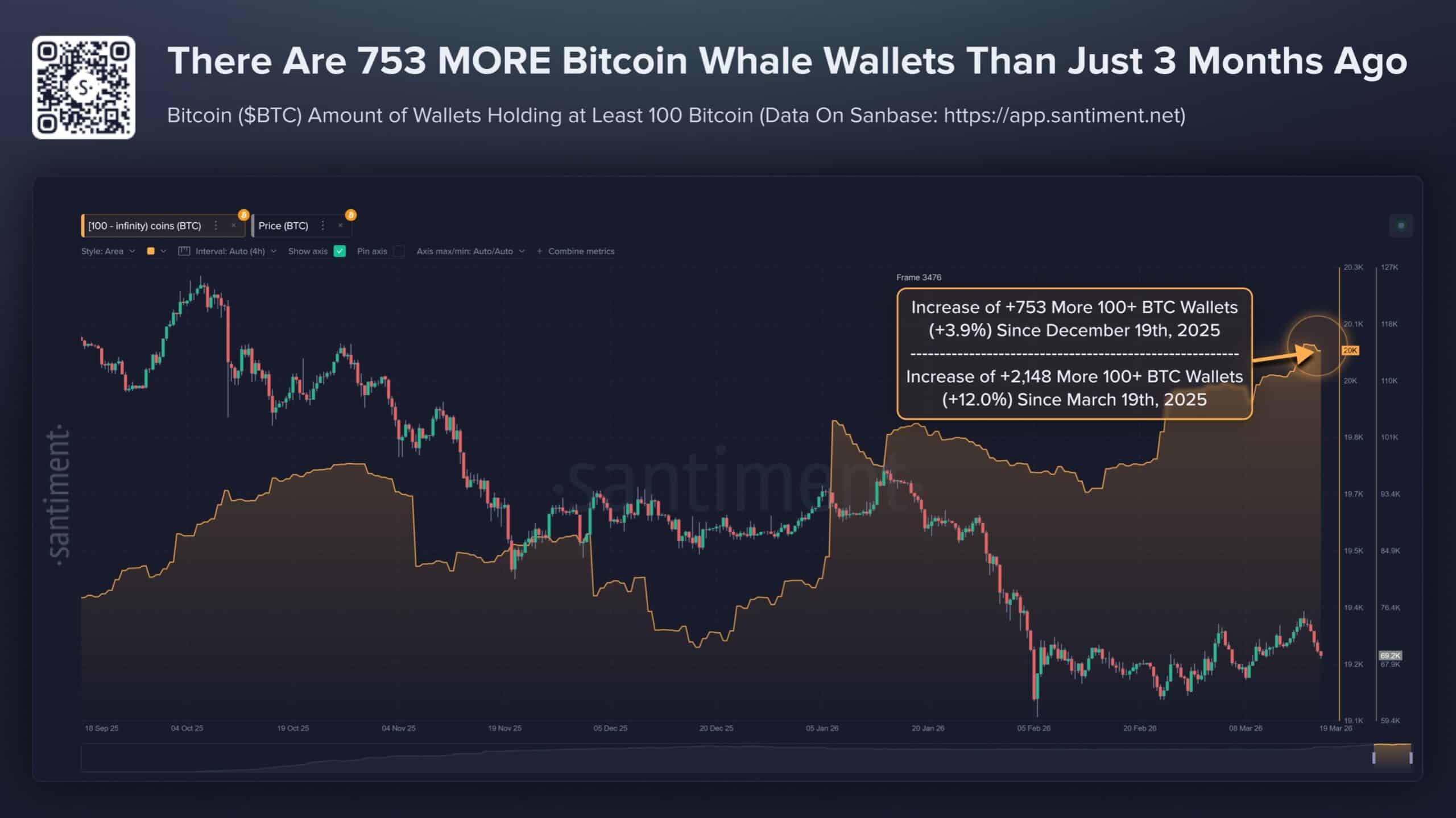
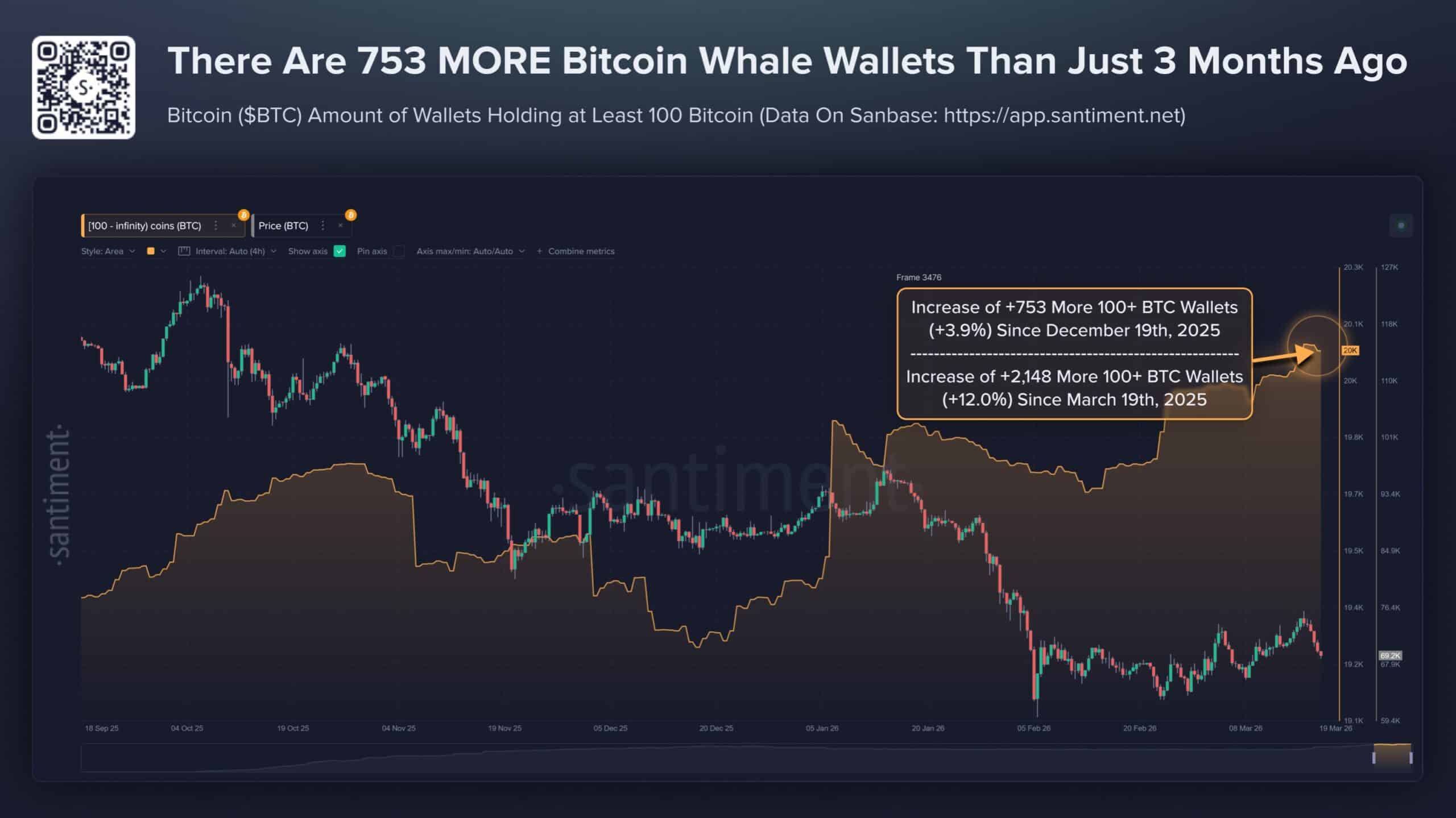
Bitcoin [BTC] declined towards $70,000 at press time, losing 20.2%, yet large holder behavior shifted upward, forming a clear divergence. As price prints lower highs through January and February, ≥100 BTC wallets rise to 20,087–20,102, adding 753 addresses.

This steady expansion during weakness shows strategic accumulation, as strong hands absorb supply released by weaker participants. As selling pressure slows, price begins stabilizing, while wallet growth remains elevated, reinforcing underlying demand.
Source: Santiment

At press time, the 100–1,000 cohort reached 18,073 wallets holding 5.193 million BTC, while addresses holding over 1,000 BTC controlled 7.14 million. As older supply stays inactive and new entities enter, liquid supply tightens, reducing downside volatility while increasing the probability of a supply squeeze that can drive a sharp upward repricing once demand returns.

Bitcoin supply tightens as ETF and whale demand align

As Bitcoin’s supply tightens under whale accumulation, ETF flows began reinforcing the same structural shift rather than offsetting it. Cumulative inflows surpassed $56.64 billion, or 713,880 BTC, while AUM nears $96.76 billion, reflecting sustained institutional entry.

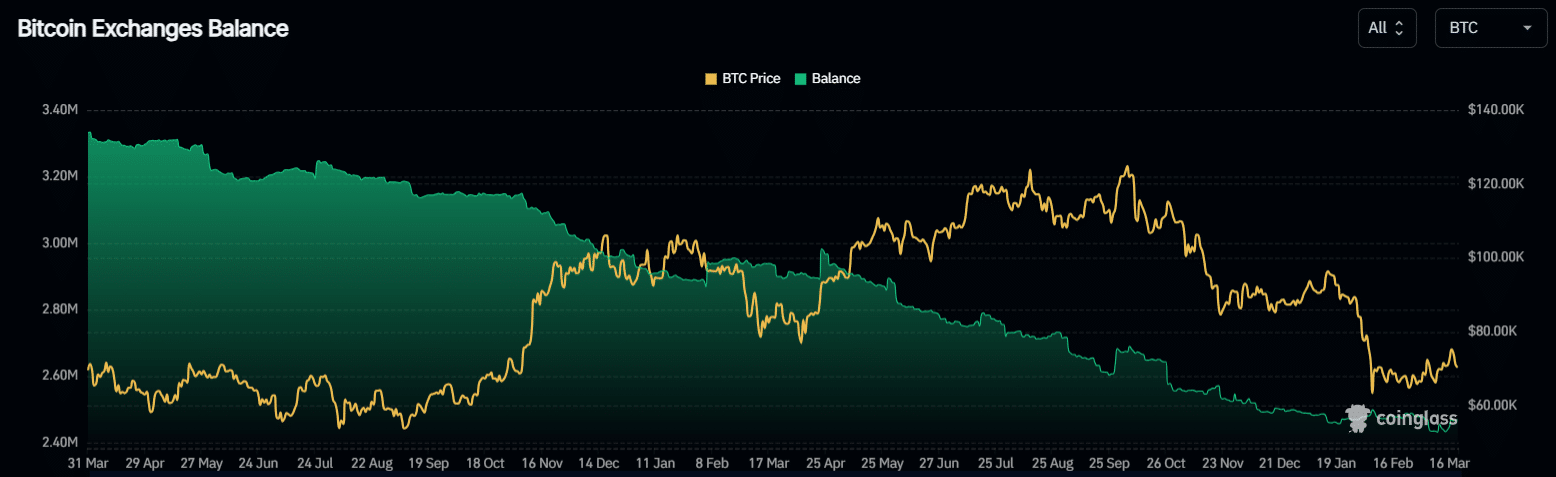
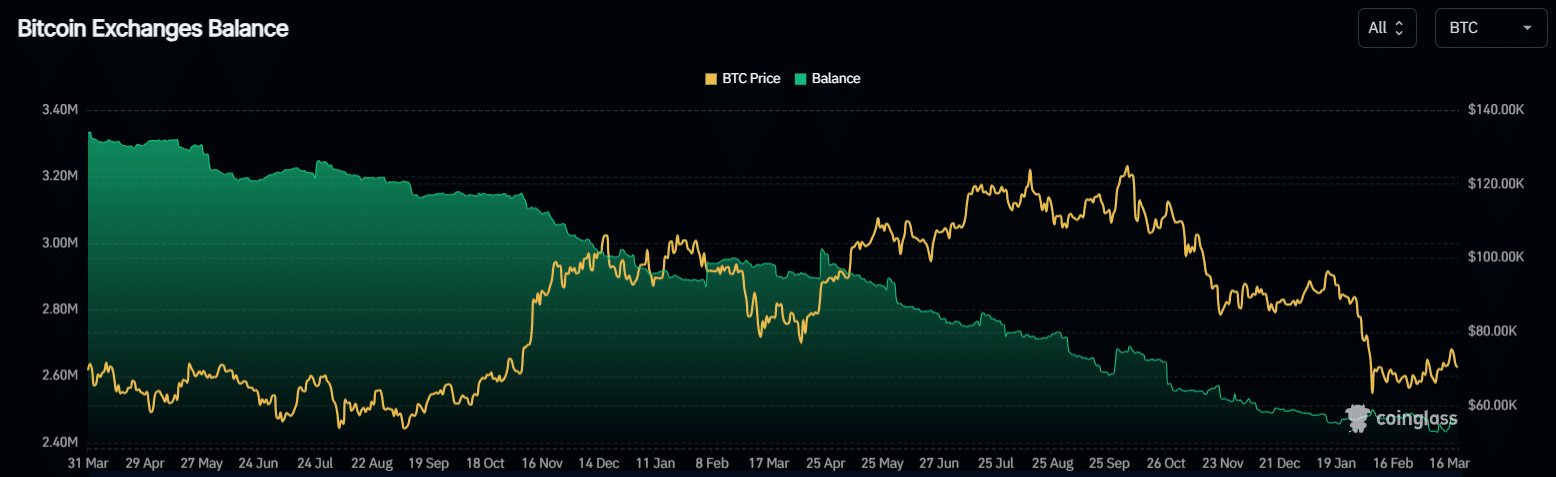
Although short-term flows fluctuate, including a -$90.20 million session, creations remain, indicating fresh demand rather than internal rotation. As this demand builds, Exchange Balances held near 2.47 million BTC, at press time but trended lower by about 5,500 BTC over 30 days, showing coins steadily leaving liquid venues.
Source: CoinGlass

As buy-side pressure persists through positive spot CVD, both ETF flows and whale behavior align, absorbing available supply. This alignment reduces market slack, limits sell-side depth, and increases the likelihood of a demand-driven breakout as liquidity conditions tighten further.


ETF inflows map directly to Bitcoin supply drain

As ETF inflows expand, they translate directly into on-chain accumulation, strengthening the link between institutional demand and spot supply. BlackRock’s IBIT approaches 765,000 BTC, while FBTC holds around 187,000 BTC, lifting total custodial balances sharply.

As coins exit exchanges, they move into custodian wallets, tightening liquid supply. With ETF additions of 45,700 BTC aligning with platform outflows, capital flow remains efficient. This flow confirms real absorption, reducing available liquidity and reinforcing Bitcoin’s supply-driven market structure.


Final Summary

  • Bitcoin [BTC] shows coordinated whale accumulation and ETF-driven demand, tightening liquid supply as exchange reserves decline and custodial balances rise steadily.
  • Bitcoin faces reduced sell-side pressure and deepening supply constraints, increasing the likelihood of a demand-led breakout as liquidity conditions continue tightening.

Domande pertinenti

QHow many Bitcoin whale addresses (≥100 BTC) were added during the recent decline, and what does this indicate?

A753 new whale addresses (≥100 BTC) were added, bringing the total to 20,087–20,102. This indicates strategic accumulation by large holders during price weakness, as they absorb supply sold by weaker participants.

QWhat is the significance of the alignment between ETF inflows and whale accumulation?

AThe alignment between ETF inflows (over $56.64 billion cumulative) and whale accumulation reinforces structural supply tightening. Both mechanisms absorb available Bitcoin from the market, reducing liquid supply and increasing the probability of a demand-driven price surge.

QHow much Bitcoin is held by the 100–1,000 BTC cohort and addresses with over 1,000 BTC?

AThe 100–1,000 BTC cohort holds 5.193 million BTC, while addresses with over 1,000 BTC control 7.14 million BTC. Combined, these large holders significantly reduce liquid supply, contributing to potential supply constraints.

QWhat trend is observed in Bitcoin exchange balances, and what does it imply?

AExchange balances decreased by approximately 5,500 BTC over 30 days, trending lower to around 2.47 million BTC. This implies coins are steadily moving off liquid trading venues into custodial or long-term storage, tightening available supply and reducing sell-side pressure.

QHow do ETF inflows directly impact Bitcoin's on-chain supply?

AETF inflows (e.g., BlackRock’s IBIT holding 765,000 BTC and Fidelity’s FBTC holding 187,000 BTC) directly drain Bitcoin from exchanges into custodian wallets. This process reduces liquid supply, confirms real demand absorption, and reinforces a supply-driven market structure prone to volatility spikes.

Letture associate

The Verdict in Choi Tae-won's Divorce Case: Revealing the Inheritance Undercurrent Behind SK Hynix's Trillion-Won Empire

SK Group Chairman Chey Tae-won's high-profile divorce case, involving a record 1.38 trillion won settlement, has drawn attention to the succession plans for Korea's second-largest conglomerate, especially its crown jewel, SK hynix. Unlike traditional chaebol scripts centered on the eldest son, Chey's three children from his marriage to former President Roh Tae-woo's daughter, Roh Soh-yeong, are carving distinct, non-traditional paths. Eldest daughter Chey Yun-jung (b. 1989) is seen as the most evident successor. With a scientific and consulting background, she holds executive roles at SK bioscience and SK Inc.'s growth support department, focusing on future strategy and biopharma. Her marriage is to an AI infrastructure entrepreneur, not a traditional business alliance. Second daughter Chey Min-jung (b. 1991) took a unique route, voluntarily serving as a South Korean naval officer, including an anti-piracy deployment. She later worked on policy and strategy for SK hynix in Washington D.C. before co-founding an AI-driven healthcare startup. She married a former U.S. Marine Corps officer, connecting her to U.S. defense and policy circles—networks crucial for a global semiconductor giant. The only son, Chey In-geun (b. 1995), who studied physics like his father, worked briefly at SK E&S before joining McKinsey. Despite fitting the traditional "heir" profile as the eldest son, he remains silent and holds no public position or shares in SK, suggesting the old succession playbook is obsolete. As SK hynix's valuation soars, becoming a geopolitical asset in the AI era, the heirs' legitimacy is no longer automatic. They must prove themselves in fields like AI biotech, global policy, and strategic consulting. Their marriages also reflect new elite networks in tech and defense, not old political alliances. Their inheritance is the complex challenge of navigating a globalized, tech-driven world, not just a corporate throne.

marsbit3 h fa

The Verdict in Choi Tae-won's Divorce Case: Revealing the Inheritance Undercurrent Behind SK Hynix's Trillion-Won Empire

marsbit3 h fa

From OpenSea to OpenRouter: Is Alex Atallah Repeating His 'Exit at the Peak' Playbook?

From OpenSea to OpenRouter: Is Alex Atallah Repeating His "Exit at the Peak" Playbook? According to the Wall Street Journal, payments giant Stripe is in talks to acquire the AI model aggregation platform OpenRouter in a potential deal valuing the company near $100 billion. This would mark founder Alex Atallah's second creation of a company reaching a $100 billion valuation, following his co-founding of NFT marketplace OpenSea. OpenRouter, founded just over three years ago, has grown rapidly by acting as a unified gateway for developers to access over 400 AI models. It currently has about 10 million users and processes over 200 trillion tokens monthly. While the platform's annualized revenue is around $50 million, its valuation has skyrocketed from $1.3 billion in March 2026. The potential acquisition by Stripe, a company OpenRouter's founder once likened it to, represents a major expansion into AI infrastructure for the payments leader. This move echoes Atallah's previous timing with OpenSea, where he departed before the NFT market's significant downturn. For OpenRouter, selling now may be strategic. Despite its scale, its business model—charging a 5-5.5% fee on AI inference calls—faces pressure from competition, open-source models, and potential price wars among model providers, limiting its profitability narrative for an IPO. A key asset for potential acquirers like Stripe is OpenRouter's vast repository of real-world AI usage data, which offers unique insights into model performance and developer preferences that are difficult to replicate. Whether this potential deal signifies a new valuation benchmark for AI infrastructure or another market peak signal remains to be seen.

链捕手3 h fa

From OpenSea to OpenRouter: Is Alex Atallah Repeating His 'Exit at the Peak' Playbook?

链捕手3 h fa

Trading

Spot
活动图片




