Bitcoin whale count tops 20K – Is a BTC supply crunch ahead?

ambcryptoPubblicato 2026-03-20Pubblicato ultima volta 2026-03-20

Introduzione

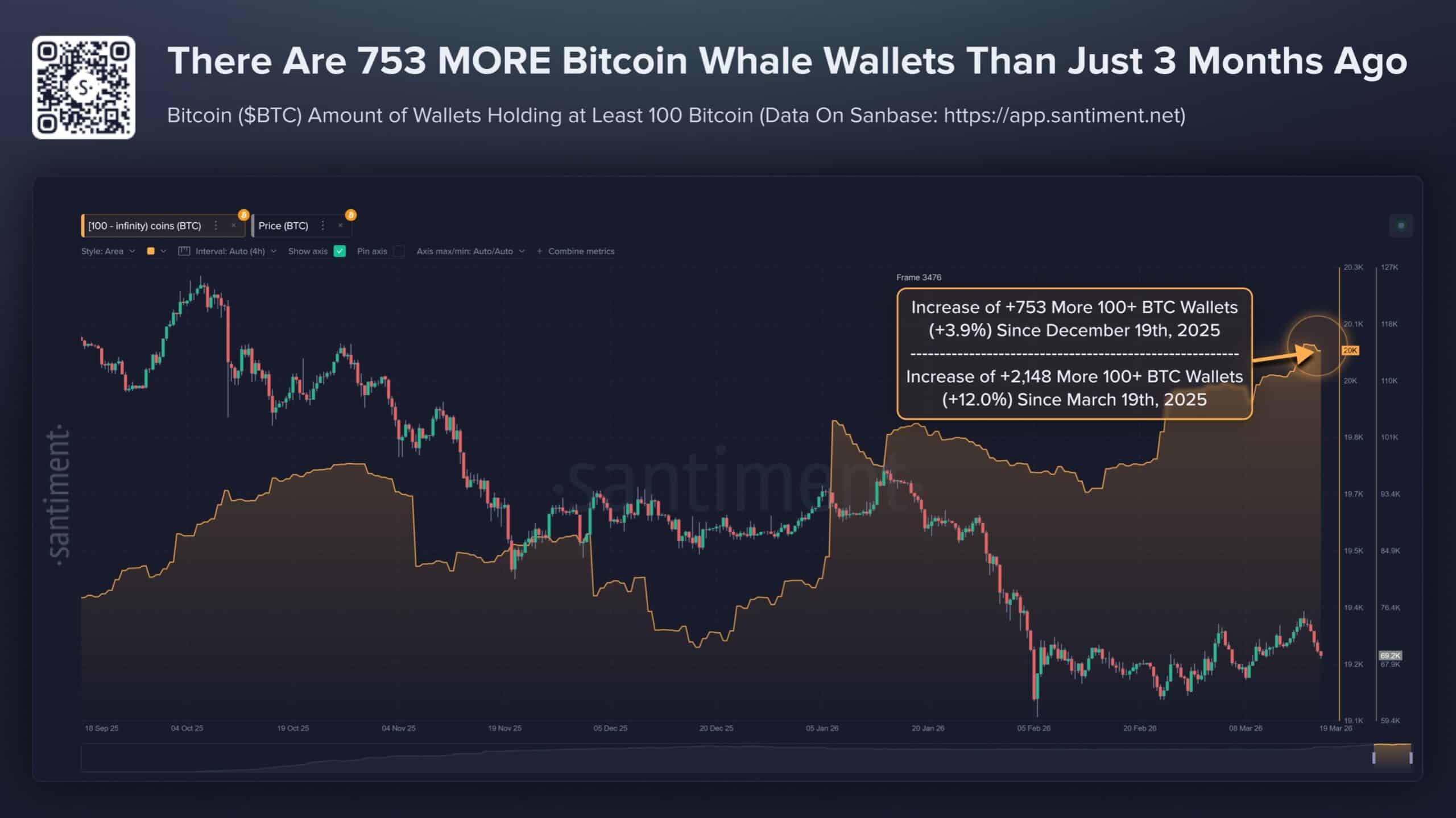
Bitcoin (BTC) price declined toward $70,000, down 20.2%, but large holders continued accumulating, with wallets holding ≥100 BTC increasing by 753 to over 20,000. This reflects strategic buying during weakness, as strong hands absorb supply from weaker participants. Meanwhile, exchange balances decreased by about 5,500 BTC over 30 days, indicating coins are moving to custodial wallets. ETF inflows, totaling over $56.64 billion, reinforce this trend, with BlackRock’s IBIT holding nearly 765,000 BTC. The alignment of whale accumulation and institutional demand is tightening liquid supply, reducing sell-side pressure, and increasing the likelihood of a supply squeeze and potential upward price movement once demand strengthens.

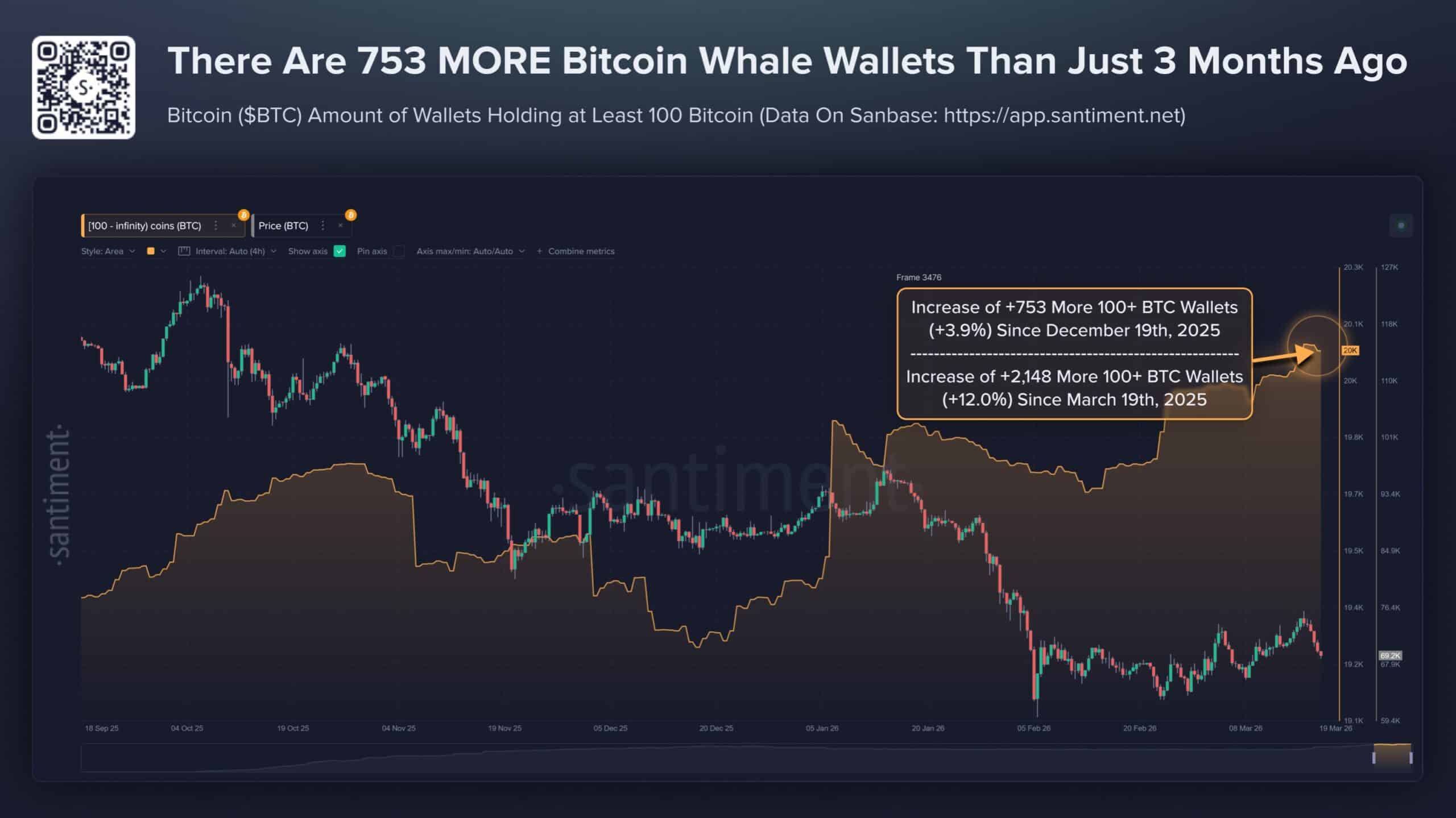
Bitcoin [BTC] declined towards $70,000 at press time, losing 20.2%, yet large holder behavior shifted upward, forming a clear divergence. As price prints lower highs through January and February, ≥100 BTC wallets rise to 20,087–20,102, adding 753 addresses.

This steady expansion during weakness shows strategic accumulation, as strong hands absorb supply released by weaker participants. As selling pressure slows, price begins stabilizing, while wallet growth remains elevated, reinforcing underlying demand.
Source: Santiment

At press time, the 100–1,000 cohort reached 18,073 wallets holding 5.193 million BTC, while addresses holding over 1,000 BTC controlled 7.14 million. As older supply stays inactive and new entities enter, liquid supply tightens, reducing downside volatility while increasing the probability of a supply squeeze that can drive a sharp upward repricing once demand returns.

Bitcoin supply tightens as ETF and whale demand align

As Bitcoin’s supply tightens under whale accumulation, ETF flows began reinforcing the same structural shift rather than offsetting it. Cumulative inflows surpassed $56.64 billion, or 713,880 BTC, while AUM nears $96.76 billion, reflecting sustained institutional entry.

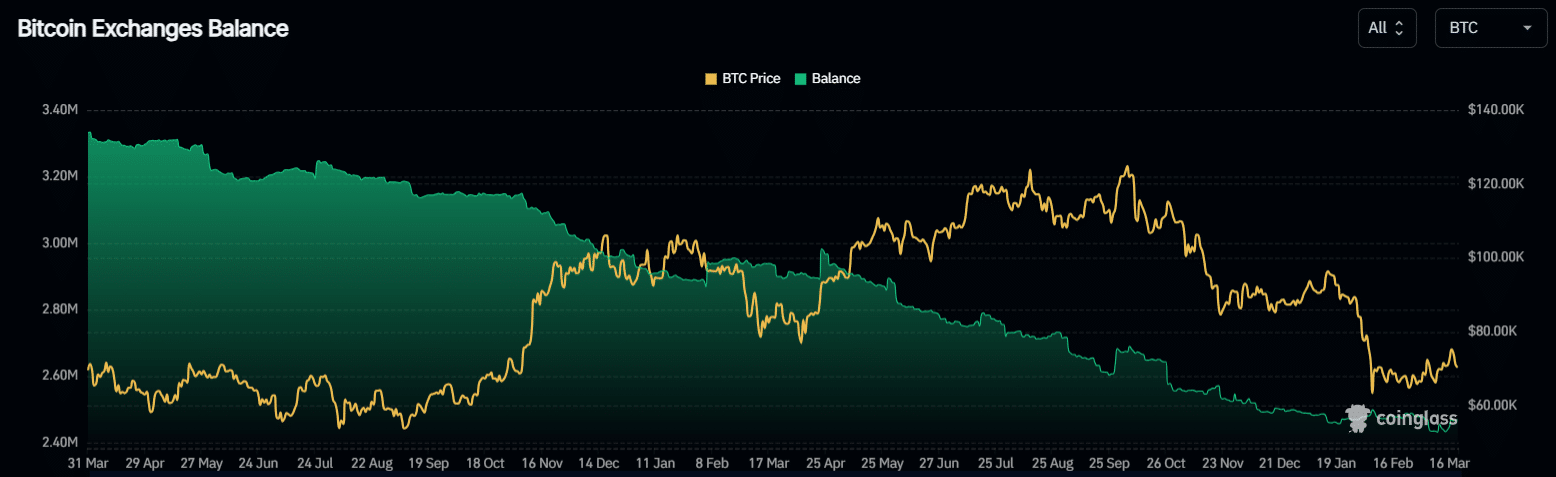
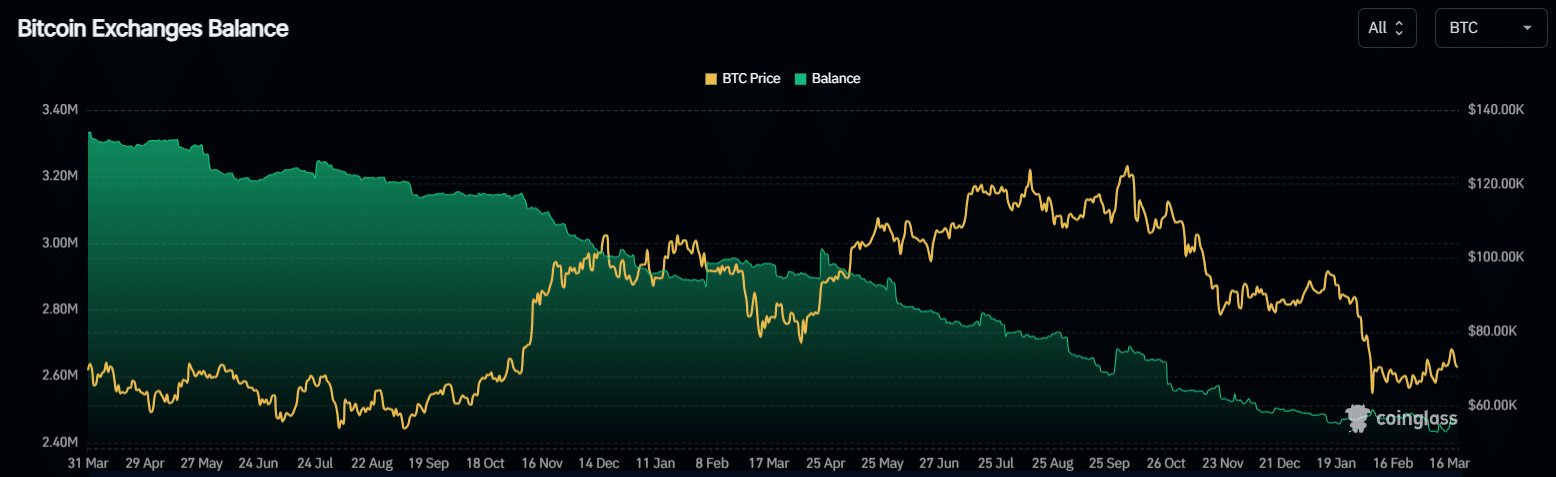
Although short-term flows fluctuate, including a -$90.20 million session, creations remain, indicating fresh demand rather than internal rotation. As this demand builds, Exchange Balances held near 2.47 million BTC, at press time but trended lower by about 5,500 BTC over 30 days, showing coins steadily leaving liquid venues.
Source: CoinGlass

As buy-side pressure persists through positive spot CVD, both ETF flows and whale behavior align, absorbing available supply. This alignment reduces market slack, limits sell-side depth, and increases the likelihood of a demand-driven breakout as liquidity conditions tighten further.


ETF inflows map directly to Bitcoin supply drain

As ETF inflows expand, they translate directly into on-chain accumulation, strengthening the link between institutional demand and spot supply. BlackRock’s IBIT approaches 765,000 BTC, while FBTC holds around 187,000 BTC, lifting total custodial balances sharply.

As coins exit exchanges, they move into custodian wallets, tightening liquid supply. With ETF additions of 45,700 BTC aligning with platform outflows, capital flow remains efficient. This flow confirms real absorption, reducing available liquidity and reinforcing Bitcoin’s supply-driven market structure.


Final Summary

  • Bitcoin [BTC] shows coordinated whale accumulation and ETF-driven demand, tightening liquid supply as exchange reserves decline and custodial balances rise steadily.
  • Bitcoin faces reduced sell-side pressure and deepening supply constraints, increasing the likelihood of a demand-led breakout as liquidity conditions continue tightening.

Domande pertinenti

QHow many Bitcoin whale addresses (≥100 BTC) were added during the recent decline, and what does this indicate?

A753 new whale addresses (≥100 BTC) were added, bringing the total to 20,087–20,102. This indicates strategic accumulation by large holders during price weakness, as they absorb supply sold by weaker participants.

QWhat is the significance of the alignment between ETF inflows and whale accumulation?

AThe alignment between ETF inflows (over $56.64 billion cumulative) and whale accumulation reinforces structural supply tightening. Both mechanisms absorb available Bitcoin from the market, reducing liquid supply and increasing the probability of a demand-driven price surge.

QHow much Bitcoin is held by the 100–1,000 BTC cohort and addresses with over 1,000 BTC?

AThe 100–1,000 BTC cohort holds 5.193 million BTC, while addresses with over 1,000 BTC control 7.14 million BTC. Combined, these large holders significantly reduce liquid supply, contributing to potential supply constraints.

QWhat trend is observed in Bitcoin exchange balances, and what does it imply?

AExchange balances decreased by approximately 5,500 BTC over 30 days, trending lower to around 2.47 million BTC. This implies coins are steadily moving off liquid trading venues into custodial or long-term storage, tightening available supply and reducing sell-side pressure.

QHow do ETF inflows directly impact Bitcoin's on-chain supply?

AETF inflows (e.g., BlackRock’s IBIT holding 765,000 BTC and Fidelity’s FBTC holding 187,000 BTC) directly drain Bitcoin from exchanges into custodian wallets. This process reduces liquid supply, confirms real demand absorption, and reinforces a supply-driven market structure prone to volatility spikes.

Letture associate

Anthropic Starts Poaching Scientists? $27K Weekly Onsite Stipend to Fix Claude's Expert-Level Errors

Anthropic has launched a new STEM Fellow program, offering $3,800 per week for a three-month, in-person residency in San Francisco. The role targets experts from science, technology, engineering, and mathematics (STEM) fields—machine learning experience is helpful but not required. Instead, Anthropic values scientific judgment and a willingness to learn quickly. Fellows will work with Claude models and internal tools under the guidance of an Anthropic researcher. Example projects include a materials scientist identifying errors in Claude’s reasoning or a climate scientist integrating atmospheric modeling software with Claude. The goal is to have experts "tell Claude where it's wrong" and improve its scientific capabilities. This initiative is part of Anthropic’s broader strategy to strengthen its scientific ecosystem, following earlier programs like the AI Safety Fellows and AI for Science programs. The company acknowledges that current AI models, while powerful, still produce high-confidence errors and lack end-to-end research autonomy. The program aims to embed domain expertise directly into model development, turning scientists into "high-level reviewers" for AI. Anthropic CEO Dario Amodei has previously emphasized AI’s potential to accelerate scientific breakthroughs, particularly in biology and healthcare. The company believes that the next phase of AI competition will depend not on scaling parameters, but on integrating human expertise to refine model accuracy and reliability.

marsbit26 min fa

Anthropic Starts Poaching Scientists? $27K Weekly Onsite Stipend to Fix Claude's Expert-Level Errors

marsbit26 min fa

On the Eve of X Money's Launch, Musk Dismantles the Referee First

"X Money Launches After Dismantling Regulator: Musk's 9-Day Power Play" In February 2025, a team from the "Department of Government Efficiency" (DOGE), led by Elon Musk, entered the Consumer Financial Protection Bureau (CFPB) headquarters. Shortly after, the CFPB was effectively dismantled—its funding frozen, activities suspended, and nearly 90% of staff laid off. This move came just nine days after X announced a partnership with Visa and as X Money prepared to launch. The article contrasts this with the decade-long regulatory battles faced by companies like Coinbase and PayPal. Coinbase spent over $75 million in political contributions and endured a major SEC lawsuit to operate legally. PayPal complied with strict state and federal rules for its stablecoin PYUSD, including 100% reserve requirements and monthly audits. However, Musk’s approach was different. After the CFPB introduced a rule placing large digital payment apps under federal oversight, Musk tweeted "Delete CFPB." Within months, the rule was revoked by Congress. Meanwhile, DOGE operatives gained "god-tier" access to CFPB databases, potentially obtaining sensitive competitive information from rivals like Apple, Google, and PayPal. The article also highlights a "suspicious exemption clause" in the GENIUS Act, which allows private companies like X to issue stablecoins with fewer restrictions. Senator Elizabeth Warren questioned whether Musk, who was a senior presidential advisor during the Act’s drafting, influenced this clause. X Money offers a 6% APY on deposits, despite FDIC warnings that stablecoin users are not insured. As X Money launches to 600 million monthly users, the article questions the fairness of a system where Musk can bypass regulations that others spent years and millions to comply with. The dismantling of the CFPB and the alleged regulatory advantages raise concerns about the future of equitable rule-making in the U.S. financial system.

marsbit35 min fa

On the Eve of X Money's Launch, Musk Dismantles the Referee First

marsbit35 min fa

Trading

Spot
Futures
活动图片