Bitcoin Treasury Companies That Promised Never to Sell Are Now Selling. Why?

marsbitPubblicato 2026-05-08Pubblicato ultima volta 2026-05-08

Introduzione

The narrative of "never selling" Bitcoin treasuries is unraveling as major holders pivot to using BTC as a liquidity tool. MicroStrategy has formally integrated selling Bitcoin into its financial framework, stating it will sell when beneficial—for instance, to pay dividends if its mNAV ratio falls below 1.22x. CEO Michael Saylor outlined a model where selling BTC is preferable to equity issuance under certain conditions, based on quantified thresholds like a 2.3% annual Bitcoin appreciation break-even. Similarly, Marathon Digital (MARA) sold 15,133 BTC to repay convertible debt, framing it as "balance sheet optimization." Sequans Communications has sold Bitcoin for two consecutive quarters to service maturing convertible bonds, using its BTC holdings as collateral and operational liquidity amidst revenue declines. The shift redefines these companies from pure "belief-based reserves" to leveraged treasuries where capital management decisions—driven by debt obligations, financing costs, and shareholder returns—can override holding dogma. The future path hinges on Bitcoin's price: a bull market above $112,000 would ease financing pressure and absorb tactical sales, while a drop toward $50,000–$58,000 could force more defensive selling to meet liabilities, potentially creating a downward spiral of selling pressure and price declines. Investors must now price in debt maturities, collateral calls, and specific financial triggers alongside Bitcoin exposure.

Author: Gino Matos, CryptoSlate

Compiled by: TechFlow

TechFlow Introduction: Strategy has publicly stated it may sell Bitcoin to pay dividends, MARA sold 15,000 BTC to repay debt, and Sequans used Bitcoin to pay off convertible bonds for two consecutive quarters. The "never sell" narrative of Bitcoin treasuries is collapsing, as these companies transform Bitcoin from a "belief reserve" into a "liquidity tool." When falling prices trigger more selling, and selling further depresses prices, a spiral begins.

Saylor Softens His Stance: Selling Can Be More Cost-Effective Than Issuing Shares

During Strategy's earnings call on May 5, CEO Phong Le stated directly: "We will sell Bitcoin when it is beneficial for the company." Saylor added: Strategy might sell some Bitcoin to pay dividends, "to let the market get used to this idea."

As of May 3, Strategy holds 818,334 BTC, a 22% increase year-to-date, with a market value of $64.14 billion.

This call officially established one thing: BTC selling behavior has been formally incorporated into the company's financial toolkit, backed by a quantitative framework.

Management drew a line—when the mNAV (market cap/net asset value) falls below 1.22 times, selling Bitcoin to pay dividends enhances per-share value more than issuing common stock. According to Saylor's calculation: as long as Bitcoin's annualized appreciation exceeds 2.3%, Strategy's existing Bitcoin reserves can pay dividends "forever"; even if Bitcoin appreciation is zero, the reserves are sufficient for 43 years.
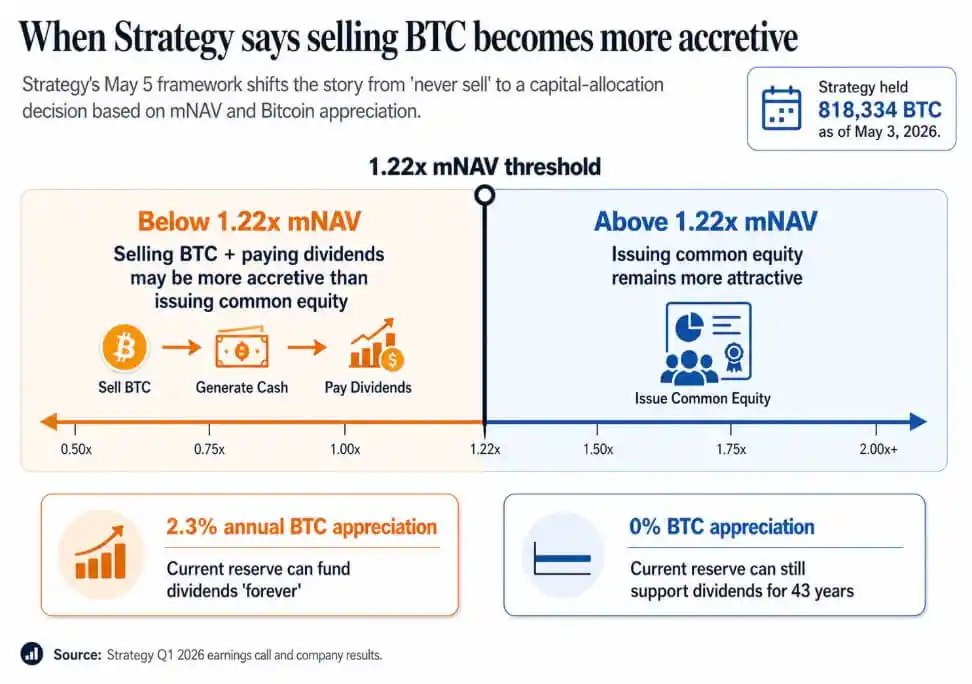
Caption: Illustration of Strategy's 1.22x mNAV threshold—when mNAV falls below this line, selling Bitcoin for dividends is more beneficial to shareholders than issuing stock.

The slogan "never sell" has given way to a model: buy when it enhances value, issue shares when it enhances value, issue preferred shares when it enhances value, and sell Bitcoin when it enhances value. These companies are essentially leveraged treasuries + credit vehicles.

Investors who bought these stocks initially purchased a Bitcoin proxy built on scarcity and a promise of permanent holding. The 1.22x mNAV threshold and the 2.3% break-even appreciation rate represent a more honest version, and a more complex one.

When Bitcoin Becomes Working Capital

Sequans' Q1 report is more straightforward. Revenue fell 24.8% year-over-year to $6.1 million, with an operating loss of $50.5 million. The net realized loss from selling Bitcoin in Q1 was $11.7 million, with proceeds mainly used to repay convertible bonds and repurchase ADS.

As of March 31, Sequans held 1,514 BTC, of which 1,217 BTC served as collateral for $66.2 million in convertible bonds. By April 30, holdings decreased to 1,114 BTC, with 817 BTC securing $35.9 million in debt (due June 1).

This mirrors the operation from November 2025—when Sequans sold 970 BTC, redeeming 50% of its convertible bonds, reducing debt from $189 million to $94.5 million.

For two consecutive quarters, the same pattern: declining revenue, maturing debt, Bitcoin becoming operational working capital. The BTC used as collateral was locked into debt obligations long before any active selling decision.

Sequans is not in the same league as Strategy—its underlying business is weaker, and its treasury position is more fragile. When Bitcoin must be used to repay debt, the logic of "inventory management" takes over.

MARA did the same in March, on a larger scale—selling 15,133 BTC, cashing out approximately $1.1 billion to repurchase convertible notes, slashing 30% of its convertible bond balance at once, and locking in a spread gain of about $88.1 million.

MARA framed this move as "balance sheet optimization," driven by debt structure and financing conditions. This establishes a precedent: BTC selling can be a capital allocation decision independent of Bitcoin belief. The real question is—under what conditions is selling the highest-return choice?

The Bull-Bear Fork: Financing Conditions Determine Everything

If Bitcoin rebounds to Citi's 12-month base case target of $112,000 or the bull case target of $165,000, the equity premium of treasury companies will expand, the window for share issuance will reopen, and large new purchases will be sufficient to absorb tactical BTC sales.

Strategy's 1.22x mNAV threshold would become a technical detail. Companies like Sequans, facing debt pressure during Bitcoin's weak periods, could also resolve their debt issues and enter the next cycle with unrestricted BTC.

If Bitcoin falls toward Citi's adverse scenario of $58,000 (Standard Chartered has hinted at a further drop to $50,000), companies trading near or below NAV will lose the value-enhancing effect of issuing shares.

In such a scenario, dividend obligations on preferred shares accumulate, and BTC selling transitions from capital management to balance sheet defense. Sequans' model could spread to all treasury companies with "thin-margin operations + BTC-collateralized borrowing"—selling Bitcoin to repay debt, shrinking collateral, and reducing free float becoming the only option.

At that point, corporate Bitcoin buying becomes a vicious cycle: falling prices trigger more selling, and more selling depresses prices.
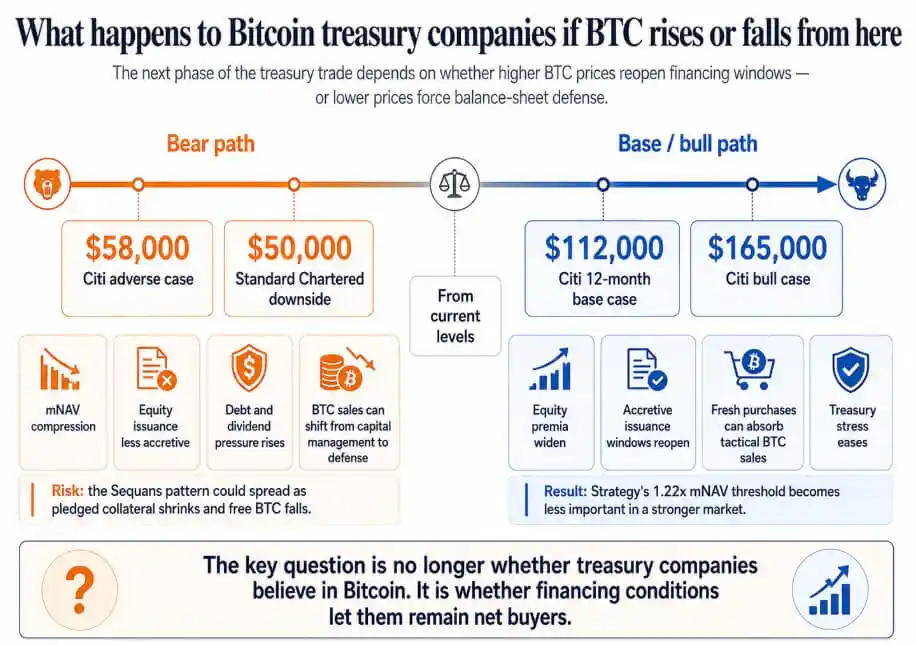
Caption: Two paths for Bitcoin treasury companies—under a bear market scenario ($50,000-$58,000), they face balance sheet pressure; under a bull market scenario (above $112,000), financing pressure eases.

The corporate Bitcoin treasury trade was built on the promise of "permanent holding," which led investors to price these companies as Bitcoin proxies. Once selling becomes an openly acknowledged tool in the model, investors must factor debt maturities, collateral requirements, dividend obligations, and the mNAV level at which management would choose to sell Bitcoin rather than issue shares into their pricing.

Saylor's 2.3% annualized break-even and 1.22x mNAV threshold are more honest. In the next phase of the Bitcoin treasury trade, the weight of financing conditions will not be lower than that of Bitcoin belief.


Domande pertinenti

QWhy are Bitcoin treasury companies like Strategy and MARA starting to sell their BTC holdings after previously promoting a 'never sell' narrative?

AThese companies are shifting their strategy from viewing Bitcoin solely as a 'faith-based reserve' to a 'liquidity tool.' The change is driven by financial models and practical needs. For instance, Strategy has established a quantitative framework, stating that selling BTC for dividends becomes more beneficial to shareholders when its mNAV (market cap to net asset value) falls below a 1.22x threshold. Meanwhile, companies like MARA and Sequans have sold BTC to repay convertible debt, viewing it as a strategic move for capital allocation and 'balance sheet optimization' rather than a departure from belief.

QWhat is the '1.22x mNAV threshold' mentioned in the article for Strategy, and what does it signify?

AThe 1.22x mNAV threshold is a financial model established by Strategy. It signifies the point at which the company deems it more value-accretive for shareholders to sell Bitcoin to pay dividends rather than issuing new common shares. When Strategy's market capitalization divided by its net asset value (predominantly the value of its BTC holdings) falls below this 1.22 multiple, the model suggests selling BTC is the superior financial tool for distributing value, officially incorporating BTC sales into its corporate financial toolkit.

QHow is Sequans Communications using its Bitcoin holdings differently from a company like Strategy?

ASequans is using its Bitcoin holdings primarily as a source of operational liquidity to service debt obligations, unlike Strategy's strategic model for shareholder returns. Faced with declining revenue, significant operating losses, and maturing convertible bonds, Sequans has been forced to sell BTC in consecutive quarters to repay these debts. A substantial portion of its BTC is also held as collateral for its loans, meaning sales are often driven by debt covenants and repayment needs rather than optional capital management, highlighting a more financially pressured and fragile treasury position.

QAccording to the article, what are the potential market scenarios for Bitcoin price and their impact on treasury companies?

AThe article outlines two divergent scenarios based on Bitcoin's price movement: 1) Bull Case (e.g., $112,000 or $165,000): Equity premiums for treasury companies would expand, reopening equity issuance windows. New, large BTC purchases could easily offset any tactical sales, and financial pressures (like Sequans's debt) would ease. 2) Bear Case (e.g., $50,000 - $58,000): Companies trading near or below NAV would lose the ability to issue accretive equity. BTC sales would transition from capital management to balance sheet defense, potentially creating a downward spiral where price declines trigger more forced selling, which further depresses the price.

QWhat key factor does the article suggest will become as important as 'Bitcoin belief' in the next phase of corporate Bitcoin treasury strategy?

AThe article suggests that 'funding conditions' will become a factor with weight equal to or greater than 'Bitcoin belief' in the next phase. Investors must now price in practical elements like debt maturity dates, collateral requirements, dividend obligations, and specific financial thresholds (like Strategy's mNAV model) that dictate when a company might sell BTC. The commitment has shifted from an ideological 'never sell' to a complex financial calculus where liquidity needs, debt management, and shareholder value optimization are paramount.

Letture associate

KOL's Perspective: Why Is SOL Set to Rise from This Point?

**Summary: Why SOL is Positioned for Growth at This Level** The article argues that SOL is poised for an upward move from its current price point, citing several key factors. Primarily, SOL has just broken out of a 4-month consolidation phase. This breakout signals a return of risk appetite to the broader crypto market, as SOL is seen as a key indicator of overall crypto health. The token's ownership has reportedly shifted from short-term traders and tourists to long-term accumulators, leading to low volume. Any meaningful increase in trading activity could thus trigger significant upward momentum. Fundamental strengths include strong institutional adoption, integration with DeFi and RWAs (Real-World Assets), and the potential benefits from the Clarity Act. Despite its high volatility—having dropped 70% from its all-time high but still up 12x from its bear market low—SOL is highlighted as one of the few tokens from the last cycle to reach new highs. It boasts a robust ecosystem of applications, users, and protocols. Future catalysts include the expected influx of AI developers following the Miami Accelerate conference, which focused on AI on Solana. Furthermore, Solana is positioned as the premier chain for memecoin activity, a trend expected to continue and drive network usage and fees. The article concludes that recent price action reflects a healthy transfer to long-term holders, setting the stage for growth.

marsbit8 min fa

KOL's Perspective: Why Is SOL Set to Rise from This Point?

marsbit8 min fa

Those Pre-Bitcoin PoW Protocols Have Recently Been Reimplemented

This article details a recent surge in replicating pre-Bitcoin Proof-of-Work (PoW) protocols, specifically focusing on Hal Finney's 2004 RPOW (Reusable Proofs of Work). Within five days in May 2026, multiple independent builders in the Bitcoin/cypherpunk community launched projects inspired by this early electronic cash proposal. The initiative began with Fred Krueger's `rpow2.com`, a centralized but auditable system that replaced RPOW's original IBM 4758 hardware with Ed25519 signatures. Initially a faithful replica, it later adopted Bitcoin-like features (21M supply cap, difficulty adjustment) and a controversial 5.24% founder allocation. This sparked rapid forks, including `rpow4.com` which incorporated full Bitcoin parameters, a prediction market (`rpowmarket.com`), and a DEX (`rpow2swap.com`). Concurrently, Mike In Space created a prototype of Wei Dai's 1998 b-money proposal (`b-money.replit.app`), pushing the historical exploration even further back. The article contrasts these centralized, server-dependent experiments with Bitcoin's core innovation of decentralized, trustless consensus. It also highlights a parallel development: the `HASH` project on Ethereum, which uses smart contract hooks to enable a purely fair-launch, browser-mineable PoW token with 0% allocations to team or VCs. The collective activity is framed as a meme-driven, educational exploration of cypherpunk history rather than a serious financial movement, with all projects heavily disclaiming any investment value.

marsbit13 min fa

Those Pre-Bitcoin PoW Protocols Have Recently Been Reimplemented

marsbit13 min fa

South Korean Exchanges 'Battle' Regulators, Challenging the Boundaries of Enforcement and Legislation

South Korea's cryptocurrency industry is engaged in a rare, direct confrontation with regulators. The Financial Intelligence Unit (FIU), the primary anti-money laundering (AML) watchdog, has recently imposed heavy penalties on major exchanges like Upbit and Bithumb for alleged violations involving unregistered overseas VASPs and AML procedures. However, exchanges are now actively challenging these actions in court and through industry associations. In a significant shift, the Seoul Administrative Court ruled in favor of Upbit's operator, Dunamu, overturning part of an FIU-ordered business suspension. The court found the FIU's penalty criteria and justification insufficiently clear. Similarly, the court suspended the enforcement of a six-month business suspension against Bithumb pending a final ruling, citing potential irreversible harm to the exchange. Beyond legal battles, the industry is contesting proposed legislative amendments. The Digital Asset eXchange Alliance (DAXA) strongly opposes a draft rule that would mandate Suspicious Transaction Reports (STRs) for all crypto transfers over 10 million KRW (~$6,800). DAXA argues this "poison pill" clause violates legal principles and would overwhelm the STR system, increasing reports from 63,000 to an estimated 5.45 million annually for major exchanges, thereby crippling effective AML monitoring. This conflict highlights a structural tension in South Korea's crypto governance: comprehensive digital asset laws are still developing, while regulators rely heavily on AML enforcement. The industry's move from passive compliance to active legal and legislative challenges signifies a new phase, pressing for clearer rules and more proportionate enforcement. While short-term disputes may intensify, this clash could ultimately lead to a more mature and sustainable regulatory framework for South Korea's vibrant crypto market.

marsbit1 h fa

South Korean Exchanges 'Battle' Regulators, Challenging the Boundaries of Enforcement and Legislation

marsbit1 h fa

After 50x Storage Surge, Justin Sun Always Looks to the Next Decade

Sun Yuchen, known for his controversial stunts like a $30 million lunch with Warren Buffett (canceled due to a kidney stone) and eating a $6.2 million duct-taped banana, is often overshadowed by a significant fact: his decade-long track record of spotting major investment trends. In 2016, he famously advised young people to invest in Bitcoin, Nvidia, Tesla, and Tencent instead of buying property. A hypothetical $20,000 investment in Nvidia and Tesla from that list would now be worth over 50 million RMB. His latest major call was on November 6, 2025, predicting a "50x storage opportunity" tied to the AI boom, which materialized with Sandisk's stock surging nearly 50-fold by 2026. Looking ahead, Sun now focuses on the next frontier: Physical AI. He identifies four key areas: 1. **Embodied AI/Robotics**: He sees this reaching its "iPhone moment," with companies like UBTech and Galaxy General leading in commercialization. 2. **Drones**: Viewed as the first commercially viable form of Physical AI, revolutionizing sectors from warfare (e.g., AeroVironment's Switchblade) to logistics. 3. **Spatial Computing**: Beyond VR, it's about AI understanding physical space, a foundational technology for robotics and autonomous systems, exemplified by Apple's Vision Pro. 4. **Space Exploration**: After a 2025 suborbital flight with Blue Origin, Sun advocates for space as the ultimate frontier, discussing blockchain's potential role in space asset management and data transactions. His investment philosophy involves betting on entire, inevitable trends rather than single companies. For robotics, he sees Tesla (the body/manufacturer) and Nvidia (the brain/AI platform) as complementary plays. In defense drones, he highlights companies making tanks obsolete (AeroVironment) and those augmenting fighter jets (Kratos). For space, he participated in Blue Origin's flight and anticipates SpaceX's potential IPO to redefine the sector's valuation. Sun Yuchen's vision frames the next two decades not as a revolution in information flow (like the internet), but in the fundamental operation of the physical world through AI-powered robots, autonomous systems, and spatial intelligence, ultimately extending human and AI activity into space. While many still focus on conventional assets, he continues to look toward the next technological horizon.

marsbit2 h fa

After 50x Storage Surge, Justin Sun Always Looks to the Next Decade

marsbit2 h fa

Trading

Spot
Futures
活动图片




