Bitcoin Speculative Activity Cooling Fast: IFP Shows Steep Slide

bitcoinistPubblicato 2025-12-17Pubblicato ultima volta 2025-12-17

Introduzione

The Bitcoin Inter-exchange Flow Pulse (IFP), an on-chain metric tracking BTC flows between spot and derivatives exchanges, has been in a steep decline since the start of 2025, signaling rapidly cooling speculative activity. A falling IFP suggests traders are reducing risk appetite by moving fewer coins to derivatives platforms. This recent accelerated downtrend, which began after a brief uptrend in late 2024, has historically signaled bearish conditions and is now accompanied by a period of declining price. Despite the IFP's bearish signal, Bitcoin treasury companies have continued to increase their holdings even as the asset's price fell from its all-time high above $126,000. At the time of writing, Bitcoin is trading around $87,500, down over 7% in the past week.

On-chain data shows the Bitcoin Inter-exchange Flow Pulse (IFP) has rapidly been going down recently, a sign of cooling derivatives interest.

Bitcoin IFP Has Witnessed A Plunge Recently

In a new post on X, CryptoQuant community analyst Maartunn has talked about the trajectory that the Bitcoin IFP has been following recently. The IFP refers to an on-chain indicator that measures the BTC flows taking place between spot and derivatives exchanges.

When the value of this metric is going up, it means investors are ramping up transactions to derivatives platforms. Such a trend can be a sign that demand for speculation is on the rise.

On the other hand, the indicator witnessing a decline implies fewer coins are traveling from spot exchanges to derivatives ones. This kind of trend can suggest traders are lowering their appetite for risk.

Now, here is the chart shared by Maartunn that shows the trend in the Bitcoin IFP and its 90-day moving average (MA) over the past decade:
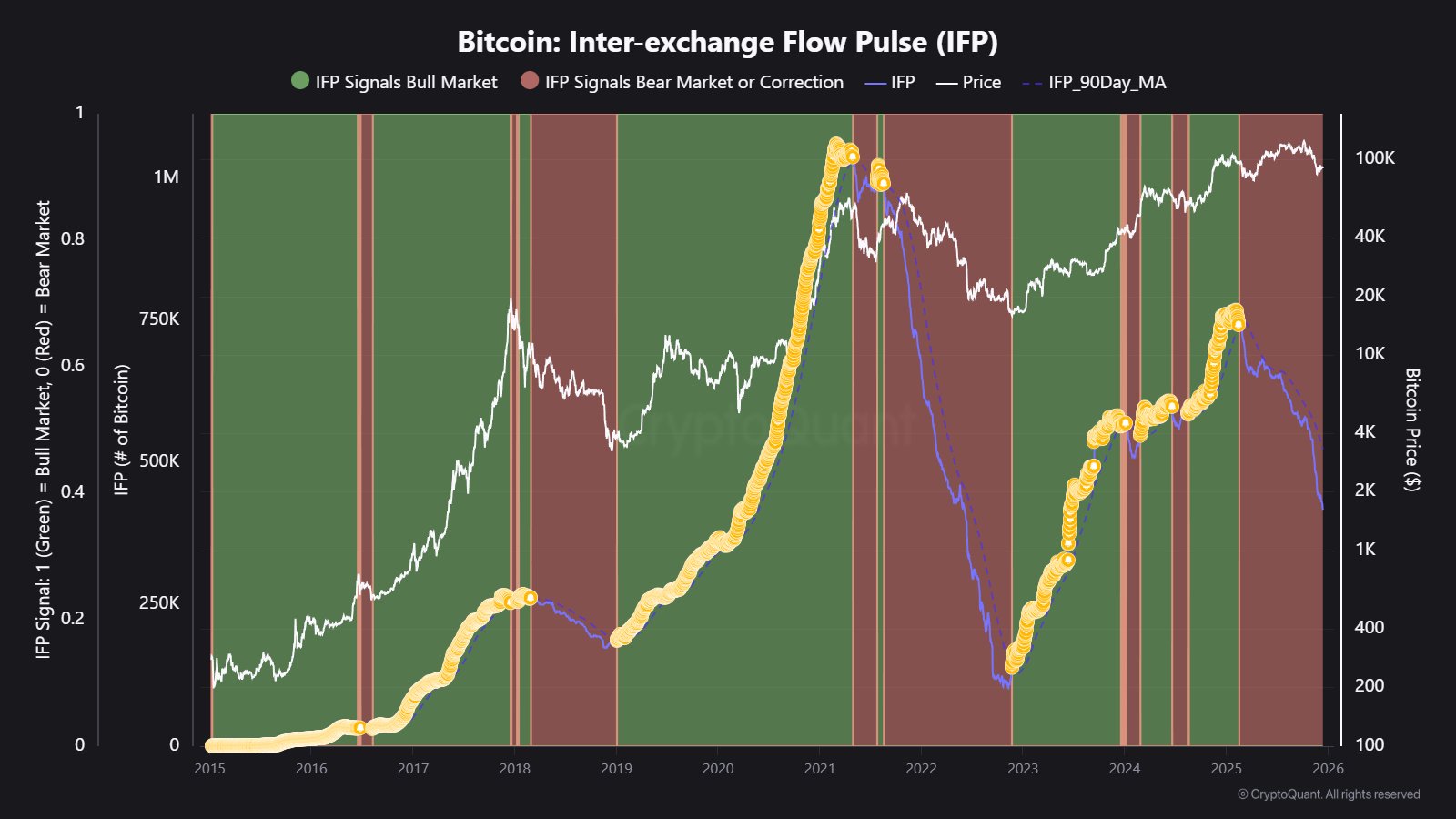
Looks like the value of the indicator has been on the way down since a while now | Source: @JA_Maartun on X

As is visible in the above graph, the Bitcoin IFP was witnessing an uptrend in the last few months of 2024, but with the start of this year, a reversal in the indicator occurred. The switch to a downtrend meant that its value slipped below the 90-day MA, something that has historically signaled bearish conditions.

Over the course of 2025, the IFP has continued its downward trajectory, but lately, the decline has accelerated, indicating that derivatives interest is cooling off fast.

Two cycles ago, the IFP sliding below its 90-day MA led into the 2018 bear market. In the 2021 bull market, the bear signal on the IFP was initially followed by the second half of that bull run, but then the 2022 bear market took over as the metric failed to recover.

A similar trend has been witnessed this year as well, with Bitcoin exploring new all-time highs (ATHs) despite the IFP suggesting bearish conditions. The recent acceleration in the indicator’s downtrend, however, has been accompanied by a bearish period in the asset’s price. Only time will tell whether this is a repeat of the pattern from the last cycle, or if risk appetite will make a comeback among investors and the IFP will reverse course.

In some other news, the Bitcoin treasury companies have seen their holdings go up recently, despite the drawdown that the market has faced, as pointed out by Glassnode co-founder Rafael in an X post.
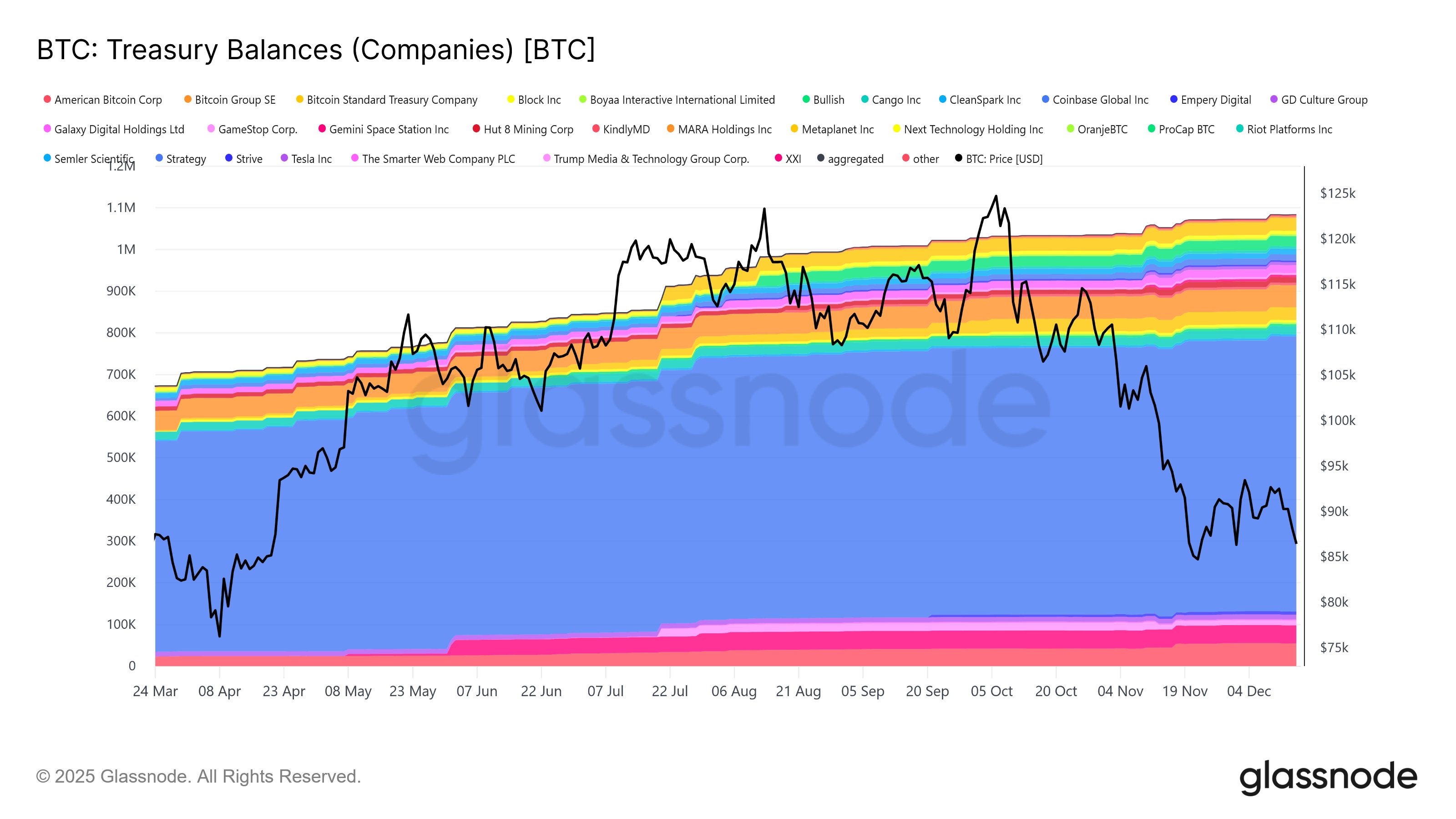
The trend in the holdings of the BTC treasury companies | Source: @n3ocortex on X

From the chart, it’s apparent that since Bitcoin started declining from its ATH above $126,000, the treasury companies have still continued a net upward trajectory. “Not seeing much of the alleged forced selling here despite some equities trading below mNAV,” noted Rafael.

BTC Price

At the time of writing, Bitcoin is trading around $87,500, down over 7% in the last week.

The price of the coin seems to have been facing bearish winds | Source: BTCUSDT on TradingView

Letture associate

The Brutal Reckoning of the Public Chain Market in 2025: The Thriving Casino, The Fake Ghost Town, and VC's Harvesting Scheme

Crypto Public Chains Face a Reality Check: A Grim Settlement in 2025 The crypto market, often perceived as a lens of soaring market caps and futuristic promises, reveals a starkly different reality when analyzed through on-chain fee data. A deep dive into DeFiLlama’s “Fees by Chain” metrics exposes a severe structural issue: the public chain ecosystem is dominated by profit concentration, while the long tail languishes in zombification. Notable examples highlight this disparity. Algorand, a chain backed by Turing Award-winning cryptography, recorded a meager $17 in daily protocol revenue despite a billion-dollar valuation. Similarly, Cardano, a top-ten asset by market cap, generates only around $6,000 in daily fees, indicating a lack of substantial economic activity beyond basic transfers. In contrast, the chains capturing real value are those serving clear, immediate demands. Tron leads with $1.24 million in daily fees, powered primarily by its role as a low-cost payment rail for USDT transfers. Solana follows with nearly $600,000, driven largely by its vibrant on-chain casino of meme coin trading and speculation. Base, backed by Coinbase’s distribution power, has also emerged as a serious contender. These cases underscore that proven, fee-generating business models in crypto are currently limited to payments, high-frequency speculation, and Ethereum’s role as a settlement layer. The analysis further reveals the failure of the VC-driven model. Newer chains like Sui, Sei, and Starknet, which launched with massive funding and high Fully Diluted Valuations (FDV), show alarmingly low daily fees—often in the low thousands or even hundreds of dollars. Their typical lifecycle involves attracting airdrop farmers with incentives, followed by a collapse in organic activity once subsidies end. This reflects a critical issue of “block space inflation”: too many chains have been built, without a proportional growth in killer applications that demand that capacity. The market is at an inflection point. Investors are shifting from valuing narratives to scrutinizing fundamentals. The new imperative is to identify chains that generate genuine, fee-based revenue from organic user demand—not those sustained by speculation, subsidies, or empty promises. This necessary清算 (settlement) in valuation may be painful, but it is essential for the industry's long-term health. The era of paying for dreams is giving way to an era of paying for proven utility.

marsbit28 min fa

The Brutal Reckoning of the Public Chain Market in 2025: The Thriving Casino, The Fake Ghost Town, and VC's Harvesting Scheme

marsbit28 min fa

Trading

Spot
Futures

Discussioni

Benvenuto nella Community HTX. Qui puoi rimanere informato sugli ultimi sviluppi della piattaforma e accedere ad approfondimenti esperti sul mercato. Le opinioni degli utenti sul prezzo di BTC BTC sono presentate come di seguito.

活动图片