Bitcoin Recovery Fails To Lift Market Sentiment From Extreme Fear

bitcoinistPubblicato 2026-04-17Pubblicato ultima volta 2026-04-17

Introduzione

Despite Bitcoin's recent recovery to around $74,800, the overall market sentiment remains in "extreme fear," according to the Crypto Fear & Greed Index. The index, which measures investor sentiment based on factors like volatility, social media, and trading volume, is at a value of 23, just inside the extreme fear zone. This marks a continued period of bearish sentiment since late 2025. Although Bitcoin's rally provided a brief uplift in mid-March, the current price movement has not been enough to shift market psychology into a more positive or greedy territory. For sentiment to improve, a sustained bullish momentum may be required.

Data shows the crypto Fear & Greed Index is still inside the extreme fear territory despite the recovery that Bitcoin and other coins have made.

Bitcoin Fear & Greed Index Is Still Pointing At ‘Extreme Fear’

The “Fear & Greed Index” is an indicator created by Alternative that tells us about the average sentiment present among traders in the Bitcoin and wider cryptocurrency markets. The index takes into account for the data of the following five factors to determine the investor mentality: trading volume, market cap dominance, volatility, social media sentiment, and Google Trends.

To represent the market sentiment, the metric makes use of a numerical scale running from zero to hundred. All values on this scale that lie below 47 correspond to a net sentiment of fear, while those above 53 suggest the dominance of greed among investors. Naturally, the values lying between these two cutoffs imply a neutral mentality.

Besides these three main zones, there are also two ‘extreme’ regions called the extreme fear (25 and under) and extreme greed (above 75). Historically, these two have held significance for the market as they have been where major tops and bottoms have tended to form.

The relationship between prices and sentiment has been an inverse one, however, with tops appearing during extreme greed and bottoms alongside extreme fear.

Recently, the crypto sector has been stuck in the latter of the two, as the below chart shows.
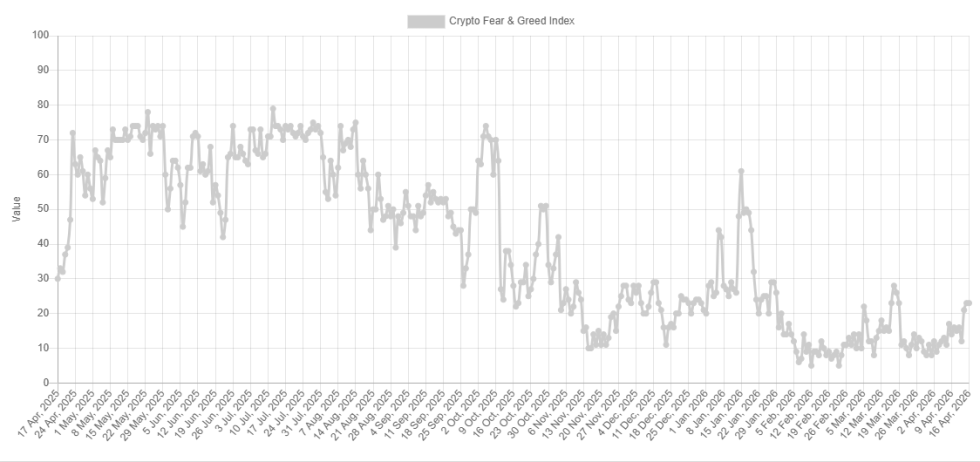
How the Fear & Greed Index has changed over the past year | Source: Alternative

The long stay in the extreme fear zone has been a consequence of the bearish action that Bitcoin and other assets have faced since Q4 2025. In mid-March, BTC’s recovery to $75,000 meant that the market saw a temporary respite from rock-bottom sentiment, with the Fear & Greed Index surging to a peak of 28. After the BTC rally fizzled out, however, the sentiment also cooled back deep into the extreme fear zone again.

From the above chart, it’s apparent that in the last few days, the metric has again made some recovery. The uplift in sentiment is due to BTC’s rally toward the $76,000 mark. Unlike the surge from mid-March, though, this one hasn’t yet been able to take the Fear & Greed Index out of the extreme fear region.

As is visible in the meter, the indicator is sitting at a value of 23 right now, which is just inside the extreme fear boundary.
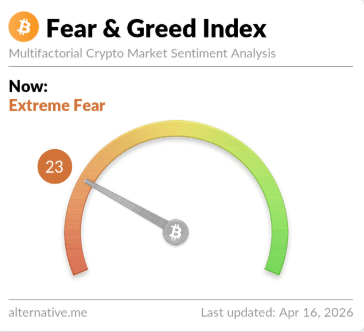
The latest value of the Fear & Greed Index | Source: Alternative

It’s possible that if bull momentum continues in the coming days, the Fear & Greed Index will escape the extreme fear zone. But for now, it seems that the market isn’t convinced about the price rally.

BTC Price

At the time of writing, Bitcoin is floating around $74,800, up nearly 5% in the last seven days.

The price of the coin seems to have been moving sideways since its upward move earlier in the week | Source: BTCUSDT on TradingView


Domande pertinenti

QWhat is the Bitcoin Fear & Greed Index and what does it measure?

AThe Bitcoin Fear & Greed Index is an indicator created by Alternative that measures the average sentiment among traders in the Bitcoin and wider cryptocurrency markets. It uses a numerical scale from 0 to 100, taking into account five factors: trading volume, market cap dominance, volatility, social media sentiment, and Google Trends.

QWhat value on the Fear & Greed Index represents 'extreme fear' and what is its historical significance?

AValues of 25 and below on the Fear & Greed Index represent 'extreme fear.' Historically, this zone has been significant for the market as major bottoms have tended to form during periods of extreme fear.

QDespite Bitcoin's recent price recovery, what is the current reading of the Fear & Greed Index?

ADespite Bitcoin's recent rally toward $76,000, the Fear & Greed Index is currently sitting at a value of 23, which is still inside the extreme fear territory.

QWhat was the peak value the Fear & Greed Index reached during Bitcoin's mid-March recovery to $75,000?

ADuring Bitcoin's mid-March recovery to $75,000, the Fear & Greed Index surged to a peak of 28, providing a temporary respite from the rock-bottom sentiment.

QWhat is the inverse relationship between market sentiment and Bitcoin prices mentioned in the article?

AThe article states that the relationship between prices and sentiment has been inverse, with major tops in the market tending to form during periods of extreme greed, while major bottoms have typically occurred alongside extreme fear.

Letture associate

Within Strategy's Framework, STRC's Dividend Yield Remains at 12% as Share Price Stays Below Par Value

Michael Saylor, Executive Chairman of Strategy (MSTR), confirmed that the dividend rate for its STRC perpetual preferred shares will remain at 12.00% through August 2026. The rate has increased from 9% at its July 2025 launch to the current high via a "ratchet" mechanism, which permanently raises the rate by 0.5% whenever the share price falls below $95. This mechanism is intended to push the price back toward its $100 par value and support Strategy's "at-the-market" (ATM) program for issuing new shares to fund Bitcoin purchases. However, the mechanism has not worked as intended. STRC shares closed at $89.46 on July 31, remaining about 10-11% below par value despite the record-high dividend. Competition from rival Strive's higher-yielding SATA securities has pressured demand. The persistent discount has forced Strategy to suspend new STRC issuances via its ATM program, limiting this funding channel for Bitcoin acquisitions. STRC's struggles reflect Bitcoin's own volatility, as the preferred shares historically move in tandem. Analysts have warned the ratchet structure carries long-term, one-way risk. A law firm is investigating Strategy's ability to maintain dividend payments if Bitcoin's price stays low. Retail investors own roughly 83% of outstanding STRC shares, a group seen as prone to panic selling during downturns. In response, Strategy has established financial reserves, including a liquidity cushion covering about 26 months of dividend/interest obligations, and a $2 billion share buyback program alongside a Bitcoin monetization framework, though the company emphasized it is not obligated to sell any Bitcoin.

cryptonews.ru26 min fa

Within Strategy's Framework, STRC's Dividend Yield Remains at 12% as Share Price Stays Below Par Value

cryptonews.ru26 min fa

Analyst: Bitcoin's Price Will Drop to $60k in August, Then Rebound to $70k

Financial analyst Andrey Poroshin has provided a new forecast for Bitcoin's price dynamics in August. Poroshin, an analyst at the Bitbanker exchange, expects the cryptocurrency market to experience a downturn this month, with prices retesting the $60,000 level due to a lack of supportive macroeconomic catalysts. He noted that the recent US Federal Reserve decision to hold interest rates did not significantly impact the market, while inflation remains above the 2% target. Poroshin stated that Bitcoin is ending July under pressure from moderate volatility and a lack of new macroeconomic stimuli, leading to continued market caution. According to his base scenario, Bitcoin will drop to a range of $60,000 to $62,000 before recovering to $70,000. He pointed out that even $70,000 remains below the cost of mining in the US, which has prompted some miners to shift towards AI data center operations. Poroshin cited the winding down of BitMEX's operations as a potential catalyst for a price rebound, suggesting the exit of weaker players often coincides with market reversals and reduced short-term selling pressure. He believes Bitcoin is currently less susceptible to geopolitical shocks, such as the Iran-US conflict, and does not expect significant market changes in August related to the pending CLARITY Act. Looking ahead, Poroshin forecasts that September will bring more active price fluctuations driven by potential Fed rate decisions and possible discussions or approval of the CLARITY Act.

cryptonews.ru26 min fa

Analyst: Bitcoin's Price Will Drop to $60k in August, Then Rebound to $70k

cryptonews.ru26 min fa

Trading

Spot
活动图片




