Bitcoin Price Bottom Could Be Around $40,000, On-Chain Data Shows

bitcoinistPubblicato 2026-02-22Pubblicato ultima volta 2026-02-22

Introduzione

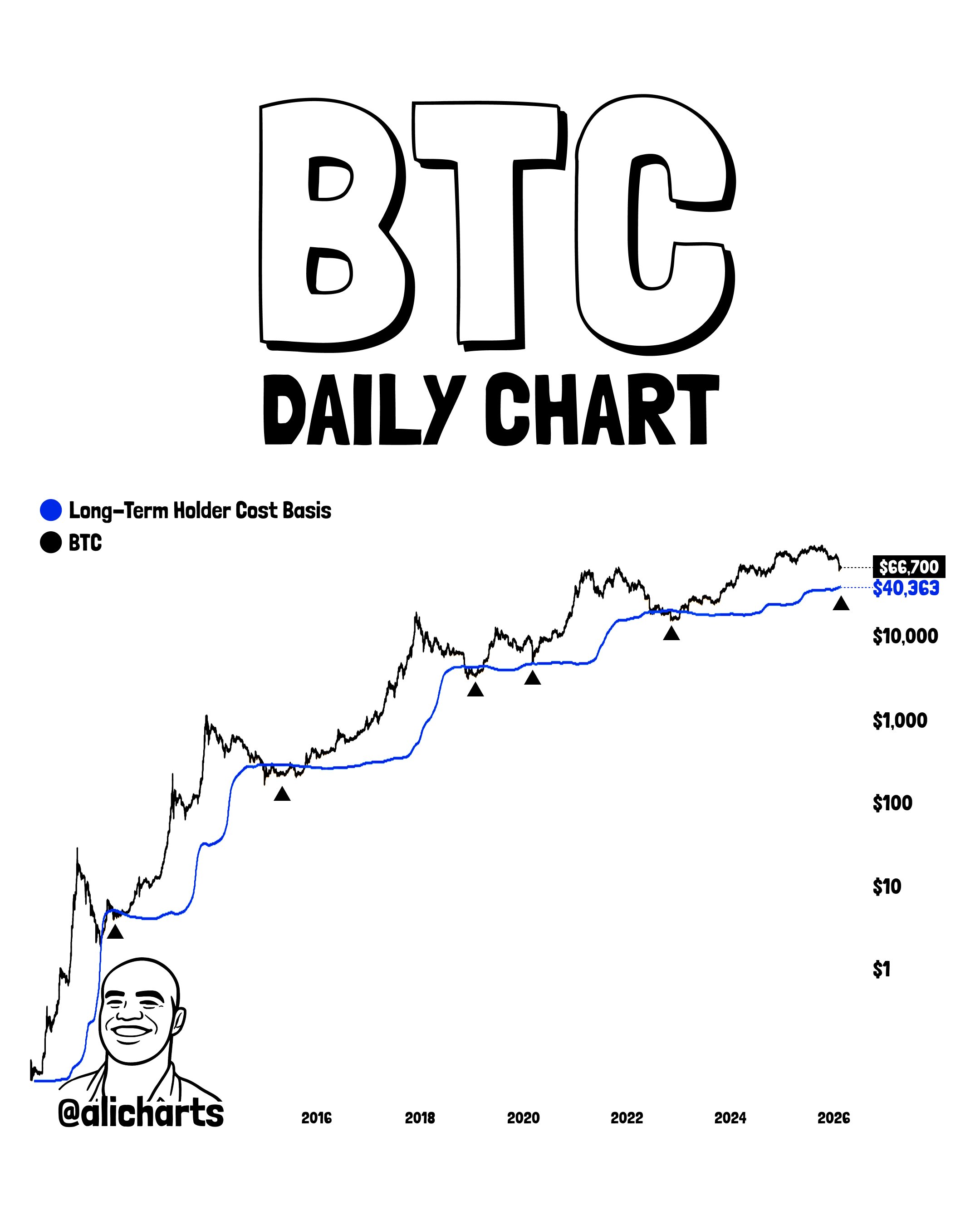
Based on on-chain data analysis by Ali Martinez, the Bitcoin price bottom in the current bear market could be around $40,000. This projection hinges on the cost basis of long-term holders (LTH), investors who have held their coins for over 155 days. Historically, this level acts as a strong support during downturns, as these investors are less likely to sell and often increase their buying when the price approaches their average acquisition cost, which is currently approximately $40,363. If selling pressure does not overwhelm this renewed buying activity, this cost basis could mark the market bottom. Currently, Bitcoin is trading near $68,330, down over 45% from its all-time high.

The biggest question so far in the bear phase has been when and where the Bitcoin price will bounce back. According to the latest on-chain data, there might be a fresh answer as to where the price bottom will be in the current bear market.

Here’s Why $40,000 Could Be Pivotal To The Bear Market

In a recent post on the X platform, crypto analyst Ali Martinez identified the $40,000 level as a potential bottom for the Bitcoin price in the current market phase. This projection is based on the cost basis of an old investor cohort known as the long-term holders (LTH)

For context, the cost basis of long-term holders refers to the average price at which Bitcoin investors (who have held their coins for 155 days or more) acquired their coins. This price level is often relevant because long-term investors are often referred to as diamond hands, who are less likely to sell during periods of downside volatility.

Moreover, the LTH cost basis tends to act as the ultimate support level during bear markets, as most long-term investors are usually still in profit even in the thick of the bear market. Hence, when the Bitcoin price falls to this support, the long-term holders double down on their positions.
Source: @ali_charts on X

This renewed buying activity by the long-term holders would prop up the price of the premier cryptocurrency above their cost basis, as observed in the chart above. According to the highlighted data, the LTH cost basis is currently around $40,363, about 40% from the current price point.

If the Bitcoin price were to face further downside pressure and approach this cost basis, there is a likelihood it would receive support from the long-term investors’ increased reaccumulation. Hence, this cost basis could become the bottom for the current bear market.

On the flip side, the Bitcoin market could face an even deeper correction if the selling pressure overwhelms the long-term holders’ reaccumulation spree.

Bitcoin Price Overview

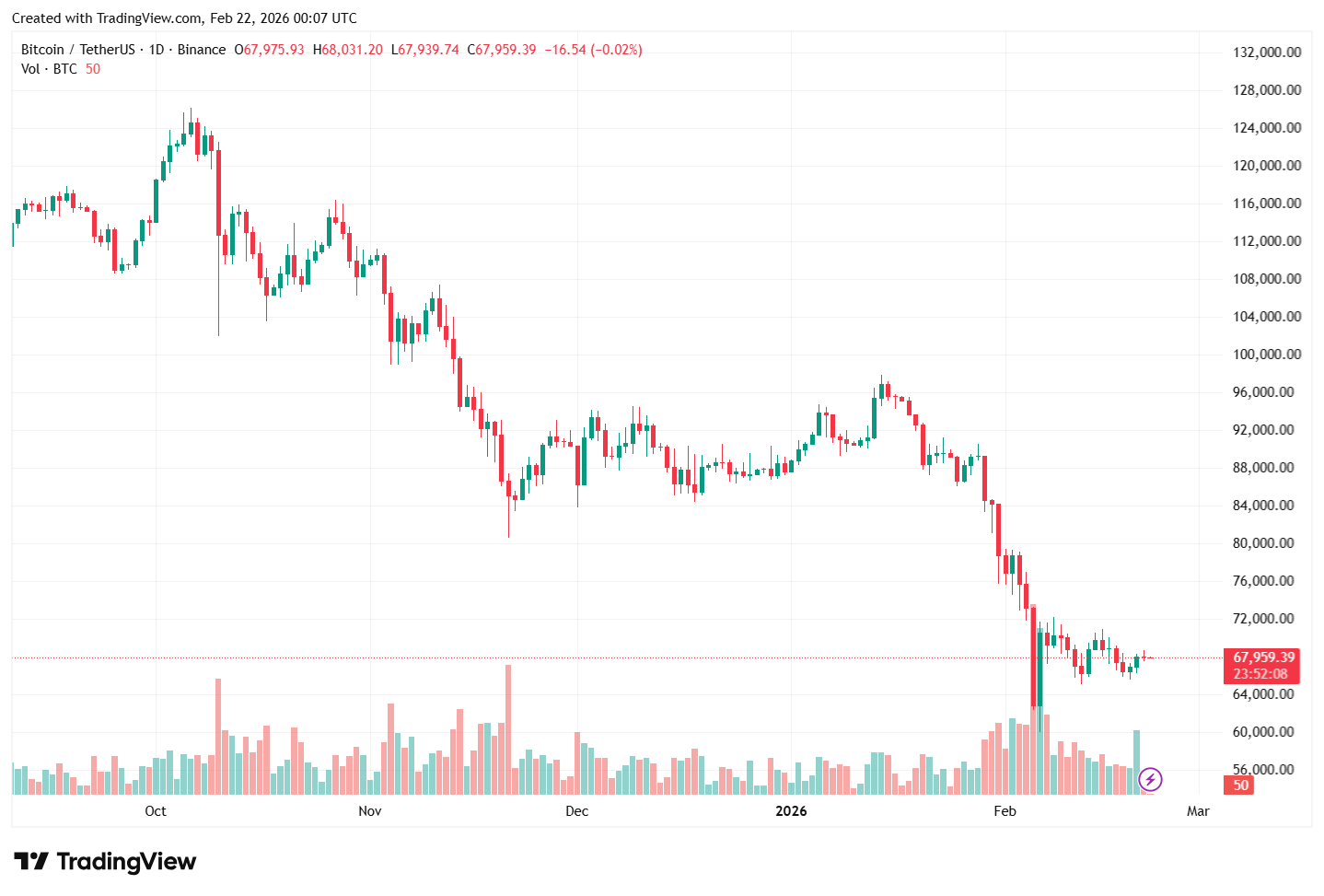
As of this writing, the price of BTC stands at around $68,330, reflecting a nearly 1% increase in the past 24 hours. However, this mild single-day action does little to correct the over 2% price decline witnessed by the premier cryptocurrency over the past week. According to data from CoinGecko, the Bitcoin price is currently down from its all-time high by more than 45%.
The price of BTC on the daily timeframe | Source: BTCUSDT chart on TradingView


Domande pertinenti

QWhat is the on-chain data suggesting about the potential price bottom for Bitcoin in the current bear market?

AThe on-chain data suggests that the price bottom for Bitcoin could be around $40,000, based on the cost basis of long-term holders.

QWho are the 'long-term holders' (LTH) mentioned in the analysis, and why is their cost basis significant?

ALong-term holders are investors who have held their Bitcoin for 155 days or more. Their cost basis is significant because it often acts as a strong support level during bear markets, as these investors are less likely to sell and may even buy more when the price approaches their average purchase price.

QWhat is the specific cost basis for long-term holders that is cited as a potential support level?

AThe specific cost basis for long-term holders is currently around $40,363.

QWhat could happen if the selling pressure in the market overpowers the buying activity of long-term holders?

AIf the selling pressure overwhelms the long-term holders' reaccumulation, the Bitcoin market could experience an even deeper correction beyond the $40,000 support level.

QWhat was the price of Bitcoin and its performance at the time of writing, according to the article?

AAt the time of writing, the price of Bitcoin was around $68,330, reflecting a nearly 1% increase in the past 24 hours, but it was still down over 2% for the week and more than 45% from its all-time high.

Letture associate

The Verdict in Choi Tae-won's Divorce Case: Revealing the Inheritance Undercurrent Behind SK Hynix's Trillion-Won Empire

SK Group Chairman Chey Tae-won's high-profile divorce case, involving a record 1.38 trillion won settlement, has drawn attention to the succession plans for Korea's second-largest conglomerate, especially its crown jewel, SK hynix. Unlike traditional chaebol scripts centered on the eldest son, Chey's three children from his marriage to former President Roh Tae-woo's daughter, Roh Soh-yeong, are carving distinct, non-traditional paths. Eldest daughter Chey Yun-jung (b. 1989) is seen as the most evident successor. With a scientific and consulting background, she holds executive roles at SK bioscience and SK Inc.'s growth support department, focusing on future strategy and biopharma. Her marriage is to an AI infrastructure entrepreneur, not a traditional business alliance. Second daughter Chey Min-jung (b. 1991) took a unique route, voluntarily serving as a South Korean naval officer, including an anti-piracy deployment. She later worked on policy and strategy for SK hynix in Washington D.C. before co-founding an AI-driven healthcare startup. She married a former U.S. Marine Corps officer, connecting her to U.S. defense and policy circles—networks crucial for a global semiconductor giant. The only son, Chey In-geun (b. 1995), who studied physics like his father, worked briefly at SK E&S before joining McKinsey. Despite fitting the traditional "heir" profile as the eldest son, he remains silent and holds no public position or shares in SK, suggesting the old succession playbook is obsolete. As SK hynix's valuation soars, becoming a geopolitical asset in the AI era, the heirs' legitimacy is no longer automatic. They must prove themselves in fields like AI biotech, global policy, and strategic consulting. Their marriages also reflect new elite networks in tech and defense, not old political alliances. Their inheritance is the complex challenge of navigating a globalized, tech-driven world, not just a corporate throne.

marsbitIeri 09:06

The Verdict in Choi Tae-won's Divorce Case: Revealing the Inheritance Undercurrent Behind SK Hynix's Trillion-Won Empire

marsbitIeri 09:06

From OpenSea to OpenRouter: Is Alex Atallah Repeating His 'Exit at the Peak' Playbook?

From OpenSea to OpenRouter: Is Alex Atallah Repeating His "Exit at the Peak" Playbook? According to the Wall Street Journal, payments giant Stripe is in talks to acquire the AI model aggregation platform OpenRouter in a potential deal valuing the company near $100 billion. This would mark founder Alex Atallah's second creation of a company reaching a $100 billion valuation, following his co-founding of NFT marketplace OpenSea. OpenRouter, founded just over three years ago, has grown rapidly by acting as a unified gateway for developers to access over 400 AI models. It currently has about 10 million users and processes over 200 trillion tokens monthly. While the platform's annualized revenue is around $50 million, its valuation has skyrocketed from $1.3 billion in March 2026. The potential acquisition by Stripe, a company OpenRouter's founder once likened it to, represents a major expansion into AI infrastructure for the payments leader. This move echoes Atallah's previous timing with OpenSea, where he departed before the NFT market's significant downturn. For OpenRouter, selling now may be strategic. Despite its scale, its business model—charging a 5-5.5% fee on AI inference calls—faces pressure from competition, open-source models, and potential price wars among model providers, limiting its profitability narrative for an IPO. A key asset for potential acquirers like Stripe is OpenRouter's vast repository of real-world AI usage data, which offers unique insights into model performance and developer preferences that are difficult to replicate. Whether this potential deal signifies a new valuation benchmark for AI infrastructure or another market peak signal remains to be seen.

链捕手Ieri 08:42

From OpenSea to OpenRouter: Is Alex Atallah Repeating His 'Exit at the Peak' Playbook?

链捕手Ieri 08:42

Trading

Spot
活动图片




