Bitcoin is About to Choose a Direction, How to Respond Flexibly | Invited Analysis

Odaily星球日报Pubblicato 2025-12-29Pubblicato ultima volta 2025-12-29

Introduzione

Odaily featured market analyst Conaldo provides a weekly trading report on Bitcoin (BTC). Last week, the strategy of shorting within the defined resistance zone of $89,500–$91,000 was successfully performed twice, yielding a total return of 3.62%. The core view that the market would experience wide-range volatility was validated, with price action accurately testing the identified support and resistance levels. From a technical perspective, BTC has been in a confirmed medium-term bearish trend since its historic high on October 6th, with a maximum drawdown of approximately 36% over 82 days. However, multiple technical indicators suggest the market is approaching oversold conditions historically associated with bottoms. Since November 22nd, price has consolidated in a low-range, indicating a balance between bullish and bearish forces and a buildup of energy for a directional breakout. A key possibility is presented: if the market is dominated by major players, a strategic move for bears could be to break down below the critical psychological level of $80,000. This would flush out remaining long positions via panic selling, potentially forming a final bottom before a powerful technical rebound. **This Week's Outlook (Dec 29 - Jan 4):** The market is expected to oscillate with a bearish bias, with the core area to watch being **$86,000–$86,500**. * A break below could lead to a test of the **$83,500–$84,500** support zone. * Holding above could extend the current **$86,50...

Odaily Invited Market Analyst Conaldo, Master of Financial Statistics from Columbia University, USA, focused on quantitative trading of US stocks during university and gradually expanded to digital assets such as Bitcoin, constructing a systematic quantitative trading model and risk control system through practical experience; possesses keen data insight into market fluctuations and is committed to continuous development in the professional trading field, pursuing stable returns; will delve into BTC technical, macro, and capital changes weekly, review and showcase practical strategies, and preview major upcoming events for reference.
Trading Weekly Report Core Summary:

  • Strategy Execution (Short-term) Effectiveness Verification: Last week's trading strictly followed the established strategy, successfully completing two operations, achieving a cumulative return of 3.62%.
  • Core View (Short-term) Verification: Our core view proposed last week that "the market will show wide-range fluctuations" has been perfectly verified by the market movement. The defined core observation range of $89,500~$91,000 and the support zone below of $86,500~$87,500 were repeatedly tested. Particularly key, last week's high of $90,598 was only $402 away from the upper edge of our core zone ($91,000); the mid-week pullback low ($86,400) was only $100 away from the lower edge of the support zone ($86,500), and the accuracy of the point prediction has been fully confirmed by the market.
  • From a macro technical perspective, Bitcoin has been correcting for 82 days since hitting its all-time high of $126,200 on October 6, with a maximum decline of about 36%, confirming a medium-term bearish trend. However, observing multiple technical indicators, it has now reached a low area, and both the time and space of the correction are gradually approaching historical common oversold conditions. Since November 22, the price has continued to consolidate in a low range, showing that the forces of long and short are relatively balanced, and the momentum for a directional breakout is accumulating. Although the market's "calls for a rise" are gradually increasing, we believe that, excluding interference from sudden news, there is still one key possibility for the subsequent trend: if the market is dominated by main funds, a better strategy for the bears might be to break down first, piercing the key psychological barrier of $80,000, using panic to clean up the remaining long positions, thus completing the final bottoming. After that, funds can顺势 achieve a "short covering rally," quickly pulling the price away from the cost area, and then start a relatively strong technical rebound. It must be emphasized that the above trend is only a deduction based on market behavior logic, not an inevitable path. No matter how the market evolves, remember: "The market is always right." Before the direction, maintaining observation and flexible response remains the key at this stage.

I. Review of Last Week's Trading Results: (12.22~12.28)

1. Short-term Trading Review (No Leverage):

First Trade (Profit 2.27%): Based on the "rebound to core pressure zone encounters resistance and goes short" pattern. When the price冲击 the $89,500~$91,000 zone and encountered resistance,叠加 the spread trading model simultaneously issued a top signal, a 30% short position was established, and finally profit was taken when the price fell near the support zone.

Second Trade (Profit 1.35%): The trading logic is the same as above. When the price冲击 the $89,500~$91,000 zone and encountered resistance,叠加 two models issued共振 signals, successfully completing this trade.

2. Last Week's Trend Prediction and Operation Strategy Review:

The前瞻 analysis last week clearly stated: It is expected that the market will mainly present a wide-range fluctuation pattern. The core observation range is $89,500~$91,000, and the outcome of the struggle in this area will determine the short-term direction. The following is the strategy review and analysis.

1. Market Trend Prediction Review:

• Core Pressure Level: First pressure looks at the $89,500~$91,000 zone; second pressure looks at the $93,000~$94,500 zone.

• Core Support Level: First support looks at the $86,500~$87,500 zone; second support looks at the $83,500~$84,500 zone.

2. Operation Strategy Review:

• Medium-term Strategy: Maintain a medium-term position of about 65% (short positions).

• Short-term Strategy: Last week we initially drafted A/B two sets of short-term operation plans. Combined with the actual market movement, we finally used Plan B as the core strategy and executed it.

(Plan B: Rebound verification, the $89,500~$91,000 core zone has been effectively broken below)

• Open Position: When encountering resistance signals during the rebound verification process, a 30% short position can be established.

• Risk Control: Stop loss set above $92,000.

• Close Position: When the price探 to the $83,500~$84,500 zone shows resistance, consider partially or fully closing the position to take profit.

II. Technical Analysis: Bitcoin Medium-term Trend Judgment

Combining last week's market operation, the author will use a multi-dimensional analysis model to conduct an in-depth analysis of the evolution of Bitcoin's internal structure and trend.

Bitcoin Weekly K-line Chart: (Momentum Quantitative Model + Sentiment Quantitative Model)
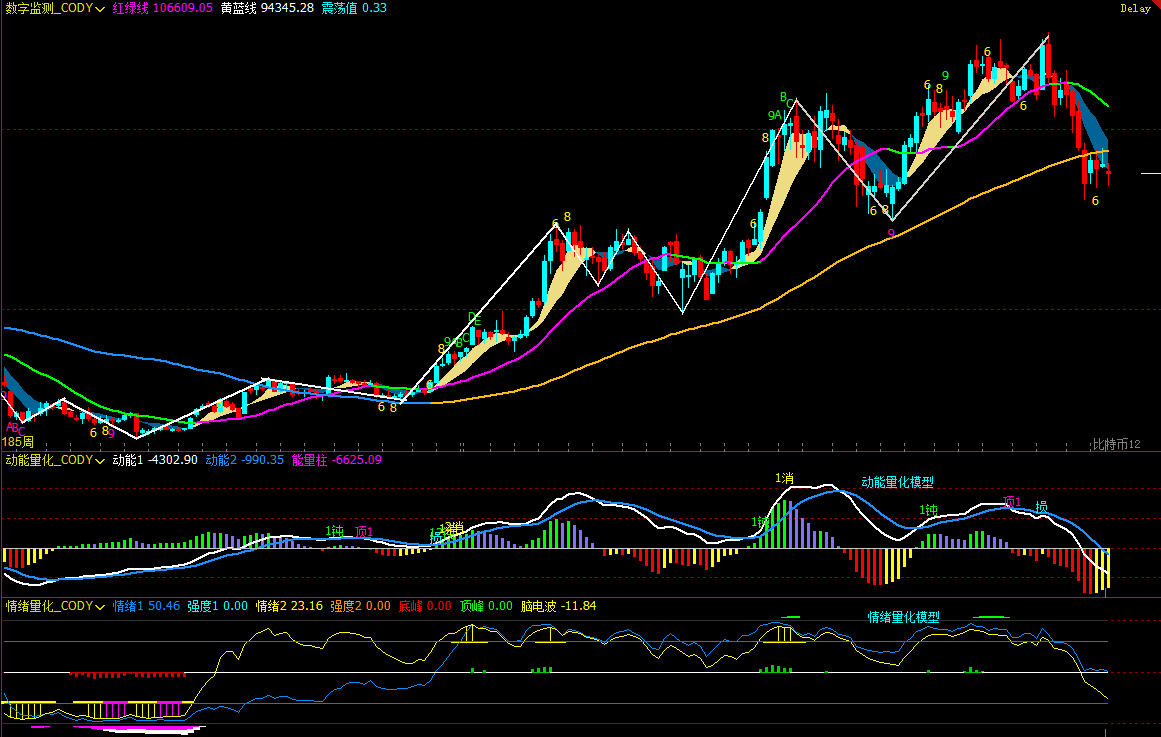
Figure 2

1. As shown in (Figure 2), analysis from the weekly chart:

Momentum Quantitative Model: After last week's adjustment, the two momentum indicator lines are still running below the zero axis, and the negative energy柱 is gradually shortening. This indicates that although the weekly chart has entered a bear market, the bearish momentum has not been fully released.

Momentum Quantitative Model Predicts: Price decline index: High

Sentiment Quantitative Model: Blue sentiment line value 49.74, intensity zero; yellow sentiment line value 19.99 (close to the low threshold), intensity zero, peak value is 0.

Sentiment Quantitative Model Predicts: Price pressure and support index: Neutral

Digital Monitoring Model: The price has broken below the bull-bear (yellow-blue line) dividing line for 6 weeks; short-term bottom digital signal (above 9) has not yet appeared.

The above data预示: Bitcoin's weekly chart has established a bearish trend, be wary of subsequent release of bearish forces.

Bitcoin Daily K-line Chart:
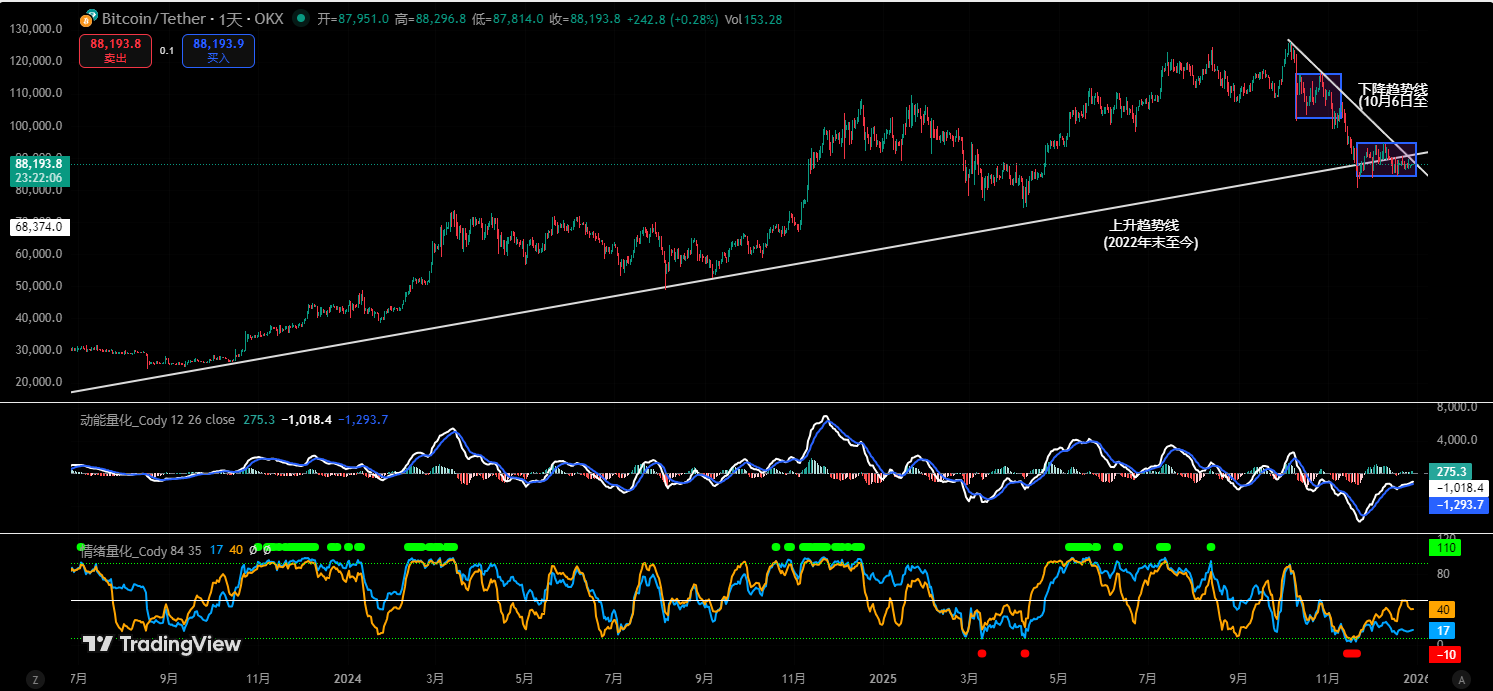
Figure 3

2. As shown in (Figure 3), analysis from the daily chart:

Momentum Quantitative Model: In last week's movement, the two momentum lines were almost粘合 together, slowly rising below the zero axis and gradually approaching the zero axis. Affected by the holiday, daily trading volume continued to萎缩, and the positive energy柱 change was not obvious.

Momentum Quantitative Model Predicts: Buying momentum is weak, the energy柱 has contracted to a "starry" state, indicating a temporary balance between long and short forces.

Sentiment Quantitative Model: After last week's daily close, the blue sentiment line value is 16 (close to the low threshold), intensity zero; yellow sentiment line value is 40, intensity zero.

Sentiment Quantitative Model Predicts: Pressure and support index: Neutral

The above data提示: The daily level is in a bear market, and the short-term market is about to choose a direction.

III. This Week's Bitcoin Market Prediction: (12.29~01.04)

1. It is highly likely that the market will mainly fluctuate and探底 this week, with the core observation range at $86,000~$86,500.

If effectively broken below: The price may continue to探底, testing the support zone below of $83,500~$84,500.

If effectively站稳: The market may延续 the current $86,500~$91,000 range fluctuation pattern.

2. Core Pressure Levels:

• First Pressure Zone: $89,500~$91,000 zone

• Second Pressure Zone: $93,000~$94,500 zone

• Important Pressure Zone: Near $97,000

3. Core Support Levels:

• First Support Level: $86,000~$86,500 zone

• Second Support Level: $83,500~$84,500 zone

• Important Support Level: Near $80,000.

IV. This Week's Bitcoin Operation Strategy (Excluding Sudden News Impact): (12.29~01.04)

1. Medium-term Strategy: Maintain a medium-term position of about 65% (short positions).

2. Short-term Strategy: Use 30% of the position, set stop loss points, and look for "spread" opportunities based on support and pressure levels. (Using 30 minutes as the operation cycle).

3. Focus on observing the struggle between long and short双方 over the $86,000~$86,500 zone. To cope with market evolution, we have drafted A/B two sets of short-term operation plans:

Plan A: If effectively站稳 the $86,000~$86,500 zone:

• Open Position: When the price rebounds to the $89,500~$91,000 zone and shows resistance signals, a 30% short position can be established.

• Risk Control: Short stop loss set above $92,500.

• Close Position: When the price falls to the $86,000~$86,500 zone and shows stabilization signals, close all short positions to take profit.

Plan B: If effectively broken below the $86,000~$86,500 zone:

• Open Position: If the price effectively breaks below, a 30% short position can be established.

• Risk Control: Stop loss set above $88,000.

• Close Position: When the price探 to the $83,500~$84,500 zone shows stabilization signals, gradually close the position to take profit.

V. Special Notes:​​

1. When opening a position: Immediately set the initial stop loss level.

2. When profit reaches 1%: Move the stop loss to the opening cost price (breakeven point), ensuring principal safety.

3. When profit reaches 2%​​: Move the stop loss to the position of 1% profit.

4. Continuous Tracking: Thereafter, for every additional 1% profit the price makes, move the stop loss level同步 by 1%, dynamically protecting and locking in existing profits.

(Note: The above 1% profit trigger threshold can be flexibly adjusted by investors according to their own risk preference and标的 volatility.)

VI. This Week's Key Events前瞻: (12.29~01.04)

1. Fed Meeting Minutes Release "Real Divergence" Signal

Wednesday 03:00, the Fed will release the latest monetary policy meeting minutes. Compared to the interest rate decision itself, the minutes are more critical regarding the degree of divergence among internal members on the "timing, magnitude, and persistence of rate cuts."

If the minutes show increased confidence among officials in the decline of inflation and discuss an earlier or faster easing path, it will strengthen market expectations of "falling real interest rates," constituting a medium-term positive for Bitcoin; conversely, if the minutes emphasize concerns about inflation recurring or financial conditions easing too quickly, it may阶段性 lift the dollar and US bond yields, forming emotional suppression on BTC.

For Bitcoin, this is not a short-term directional signal, but an important node affecting the medium-term fund pricing anchor.

2. Initial Jobless Claims: Thermometer of Liquidity Expectations

Wednesday 21:30, the US will announce the initial jobless claims for the week ending December 27.

The market now pays more attention to "whether the labor market is showing structural cooling" rather than fluctuations in a single data point.

If initial claims持续 above trend levels, it will further verify the economic cooling logic, strengthening market expectations for the continuation of宽松 policies, which is beneficial for the valuation repair of non-yielding assets like Bitcoin; if the data falls again, it may strengthen the judgment that "the economy is still resilient," which is not conducive to the expansion of risk appetite for BTC in the short term.

The impact of this indicator on Bitcoin is mainly reflected in interest rate expectations rather than fundamentals itself.

3. Final Manufacturing PMI Verifies Real Economy Direction

Friday 22:45, the US December S&P Global Manufacturing PMI final value is announced.

As a leading indicator, the PMI will help the market judge whether "soft landing" is still on track.

If the final value confirms that manufacturing is stabilizing or even improving, the overall sentiment of risk assets is expected to be maintained, with limited systematic pressure on BTC; if the PMI is revised down again, it may trigger repricing of economic downturn, short-term bearish for risk assets, but medium to long term may instead strengthen expectations for monetary easing.

Financial markets are changing rapidly, all market analysis and trading strategies need to be dynamically adjusted. All views, analysis models, and operation strategies involved in this article are derived from personal technical analysis, for personal trading log use only, and do not constitute any investment advice or operation basis. The market has risks, investment needs caution, DYOR.


Domande pertinenti

QWhat is the analyst's core short-term view on the Bitcoin market as presented in the article?

AThe analyst's core short-term view is that the market is in a state of wide-range consolidation and is about to choose a direction. They emphasize the possibility that major funds might drive a downward break below the $80,000 psychological level to flush out remaining long positions before a potential technical rebound.

QWhat were the key support and resistance levels identified for Bitcoin in the previous week's analysis?

AThe key resistance levels were the first zone at $89,500~$91,000 and the second zone at $93,000~$94,500. The key support levels were the first zone at $86,500~$87,500 and the second zone at $83,500~$84,500.

QAccording to the technical analysis, what is the current state of Bitcoin's medium-term trend based on the weekly chart?

AThe weekly chart analysis confirms that Bitcoin has established a medium-term bearish trend. The momentum量化 model shows indicators below the zero line with negative energy columns shortening, indicating bearish momentum has not been fully released. The sentiment量化 model shows neutral pressure and support indices.

QWhat are the two main short-term trading strategies (Plan A and Plan B) proposed for the upcoming week?

APlan A: If the price holds effectively above the $86,000~$86,500 area, open a 30% short position when the price rebounds to the $89,500~$91,000 resistance zone and shows a rejection signal. Stop loss is set above $92,500. Plan B: If the price effectively breaks below the $86,000~$86,500 area, open a 30% short position. Stop loss is set above $88,000. Take profit when the price falls to the $83,500~$84,500 support zone and shows signs of stabilization.

QWhat key macroeconomic events are highlighted as important for Bitcoin's price movement in the coming week?

AThe key events are: 1. The release of the FOMC Meeting Minutes on Wednesday at 03:00, which could signal internal Fed分歧 on rate cuts. 2. The Weekly Initial Jobless Claims data on Wednesday at 21:30, which acts as a thermometer for liquidity expectations. 3. The S&P Global Manufacturing PMI Final reading on Friday at 22:45, which validates the direction of the real economy.

Letture associate

The Value Distribution of Stablecoins

**Summary: The Value Distribution of Stablecoins** The article argues that stablecoins are evolving from mere trading tools into broader channels for dollar access. It divides the stablecoin ecosystem into four layers to analyze how value is distributed: 1. **Issuance Layer:** Mints stablecoins, holds reserve assets, and captures the spread between reserve yield and user costs (e.g., Tether, Circle). This layer currently earns the largest profit margin. 2. **Infrastructure Layer:** Connects stablecoins to the traditional financial system, handling fiat on/off-ramps, banking integration, compliance (KYC/AML), and asset management (e.g., Bridge, BVNK). This is the "unglamorous" but critical work, building the essential bridges between crypto and real-world finance. 3. **Acquiring/Distribution Layer:** Integrates stablecoins into merchant systems, manages payment flows, and provides enterprise financial software (e.g., Stripe, Coinbase). They act as the access point for businesses. 4. **Application Layer:** The end-users and businesses that ultimately use stablecoins for payments, settlements, or as a store of value. They benefit from convenience but have little pricing power. The core thesis is that while the issuance layer currently dominates profits, the often-overlooked **infrastructure layer holds significant long-term potential**. The real challenge and barrier to mass adoption is not the on-chain transfer of stablecoins (which is simple), but the complex "last mile" integration into existing business workflows, banking systems, and regulatory frameworks across different countries. Companies in this layer are currently in a "land grab" phase, investing heavily to build networks, secure bank partnerships, and establish compliance pathways. While their position is currently pressured by the profitable issuers above and distribution platforms below, the article suggests that if stablecoins become a default financial rail for businesses, the infrastructure providers who have done the hard work of integration will ultimately gain strong pricing power and become entrenched, essential players.

marsbit1 h fa

The Value Distribution of Stablecoins

marsbit1 h fa

The Value Distribution of Stablecoins

The Value Distribution of Stablecoins The article argues that stablecoins are evolving from a mere trading tool into a broad "dollar channel." It analyzes the industry's value chain through four layers: 1. **Issuance Layer (e.g., Tether, Circle):** The top layer that mints stablecoins, holds reserve assets, and captures the thickest interest rate spread. 2. **Infrastructure Layer (e.g., Bridge, BVNK):** Connects stablecoins to the traditional financial system, handling critical but complex "dirty work" like fiat on/off-ramps, banking integration, compliance (KYC/AML), and cross-border settlement. 3. **Acquiring/Distribution Layer (e.g., Stripe, Coinbase):** Embeds stablecoins into merchant systems, manages payment flows, and integrates with enterprise software. 4. **Application Layer:** End-users and businesses that ultimately use stablecoins for payments, settlement, or storing value. The author posits that while the issuance layer currently captures the most profit, the most overlooked and potentially critical layer is infrastructure. The core challenge for stablecoin adoption isn't the on-chain transfer (which is simple), but bridging the gap between blockchain and the real-world financial system. This involves solving practical problems for businesses: fiat conversion, reconciliation, tax handling, and user onboarding. Infrastructure companies are currently in a difficult "land-grab" phase—building networks, securing banking relationships, and achieving compliance country-by-country. They face pressure from both the profitable issuance layer above and distribution platforms below. However, the author suggests this layer is building a crucial moat. Once stablecoins become a default business rail, the infrastructure players who have done the hard work of integration may gain significant, durable value and pricing power.

链捕手1 h fa

The Value Distribution of Stablecoins

链捕手1 h fa

How to Do Research Well: Deliberately Practice the Real Skills That Matter

No one truly teaches you how to do research. You're often given a desk, a pre-selected problem, and vague instructions to "create something new." Consequently, many people reverse-engineer the job based on visible outputs—papers, posts, announcements—learning only how to *appear* like a researcher rather than how to *become* one. True research capability is built from stacking small, trainable skills, nearly all of which can be developed through deliberate practice. **Pick Your Own Problem:** Most researchers absorb problems from advisors or trends, lacking the underlying reasoning. Choosing a problem you genuinely care about, as John Schulman advises, leads to original work. Develop "taste" like a muscle: predict experiment outcomes, guess paper results from methods, and track which findings remain important over time. **Upgrade Your Inputs:** Relying on shared reading lists (arXiv hot lists, filtered group chats) leads to unoriginal conclusions. Undervalued old literature often holds crucial insights (e.g., MoE, LSTM, backpropagation). Richard Sutton's "The Bitter Lesson" or Claude Shannon's 1952 talk on creative thinking are more predictive than lengthy modern surveys. Breadth matters as much as depth: draw from neuroscience, mechanism design, hardware knowledge, and honest statistics. Read papers directly, especially appendices and limitations sections. **Write Everything Down:** As Paul Graham noted, writing exposes flaws in seemingly mature ideas. Writing is the cheapest defense against self-deception. Following Feynman's principle, Darwin programmatically wrote down facts contradicting his theory to combat memory bias. Maintain a detailed log of hypotheses, setups, predictions, results, and updated understandings. Reviewing past logs fosters essential humility.

marsbit4 h fa

How to Do Research Well: Deliberately Practice the Real Skills That Matter

marsbit4 h fa

Trading

Spot
Futures

Articoli Popolari

Cosa è ATWO

I. Introduzione al ProgettoArena Two è una piattaforma interattiva decentralizzata che consente ai fan di svolgere un ruolo attivo e tokenizzato nei risultati degli eventi in tempo reale. A differenza dei modelli di trasmissione tradizionali che riducono i fan a spettatori passivi, Arena Two sfrutta la tecnologia blockchain per consentire ai fan di votare direttamente in tempo reale e influenzare i risultati sul campo.II. Informazioni sul TokenNome del token: ATWO(Arena Two)III. Link CorrelatiSito web:https://arenatwo.com/Esploratori:https://basescan.org/token/0x499D35eBE6cEe9B2Ac35Fd003fcBbeeB9CFc7B32Twitter:https://x.com/arenatwoXNota: L'introduzione al progetto proviene dai materiali pubblicati o forniti dal team ufficiale del progetto, che è solo a scopo di riferimento e non costituisce consulenza sugli investimenti. HTX non si assume responsabilità per eventuali perdite dirette o indirette derivanti.

214 Totale visualizzazioniPubblicato il 2026.05.18Aggiornato il 2026.06.02

Cosa è ATWO

Come comprare ATWO

Benvenuto in HTX.com! Abbiamo reso l'acquisto di Arena Two (ATWO) semplice e conveniente. Segui la nostra guida passo passo per intraprendere il tuo viaggio nel mondo delle criptovalute.Step 1: Crea il tuo Account HTXUsa la tua email o numero di telefono per registrarti il tuo account gratuito su HTX. Vivi un'esperienza facile e sblocca tutte le funzionalità,Crea il mio accountStep 2: Vai in Acquista crypto e seleziona il tuo metodo di pagamentoCarta di credito/debito: utilizza la tua Visa o Mastercard per acquistare immediatamente Arena TwoATWO.Bilancio: Usa i fondi dal bilancio del tuo account HTX per fare trading senza problemi.Terze parti: abbiamo aggiunto metodi di pagamento molto utilizzati come Google Pay e Apple Pay per maggiore comodità.P2P: Fai trading direttamente con altri utenti HTX.Over-the-Counter (OTC): Offriamo servizi su misura e tassi di cambio competitivi per i trader.Step 3: Conserva Arena Two (ATWO)Dopo aver acquistato Arena Two (ATWO), conserva nel tuo account HTX. In alternativa, puoi inviare tramite trasferimento blockchain o scambiare per altre criptovalute.Step 4: Scambia Arena Two (ATWO)Scambia facilmente Arena Two (ATWO) nel mercato spot di HTX. Accedi al tuo account, seleziona la tua coppia di trading, esegui le tue operazioni e monitora in tempo reale. Offriamo un'esperienza user-friendly sia per chi ha appena iniziato che per i trader più esperti.

121 Totale visualizzazioniPubblicato il 2026.05.18Aggiornato il 2026.06.02

Come comprare ATWO

Cosa è ZEST

I. Introduzione al Progetto1. Cos'è Zest Protocol?Zest Protocol è un protocollo di prestito nativo di Bitcoin costruito su Stacks Layer 2 che consente agli utenti di guadagnare rendimento con BTC o di prendere in prestito asset collaterizzando BTC. I contratti intelligenti del protocollo sono scritti nel linguaggio Clarity, operano interamente on-chain e sono open-source, con un design ispirato a Aave v3. Zest è attualmente il più grande protocollo DeFi su Stacks, con oltre 800 BTC depositati e un TVL massimo che supera i 100 milioni di dollari. Nel maggio 2026, il protocollo ha ulteriormente introdotto i Bitcoin Collateral Vaults, estendendo le capacità di prestito da Stacks alla rete principale di Bitcoin. Questo consente agli utenti di prendere in prestito stablecoin senza spostare BTC dalla rete Bitcoin, abilitando prestiti in custodia autonoma.2. Come Funziona Zest Protocol?Zest Protocol è composto da due mercati. Il mercato di Stacks è costruito su Aave v3, consentendo agli utenti di depositare asset come sBTC, STX e USDC per guadagnare rendimento o prendere prestiti sovra-collaterizzati. Il LTV massimo predefinito è del 50% (70% per sBTC). Il mercato di Bitcoin opera attraverso i recentemente lanciati Bitcoin Collateral Vaults. Gli utenti prendono in prestito stablecoin bloccando BTC in vaults di custodia autonoma sulla catena di Bitcoin. Il collaterale rimane sulla rete principale di Bitcoin durante l'intero processo, e gli utenti mantengono la custodia a meno che la posizione non venga liquidata.3. Chi Ha Fondato Zest Protocol?Tycho Onnasch (Co-Fondatore): Laureato all'Università di Oxford. Coinvolto nella ricerca e nei finanziamenti per la Stacks Open Internet Foundation. Ex Manager presso Trust Machines e Fondatore di Deedmob. Profilo LinkedIn: https://www.linkedin.com/in/tychokoonnasch/.Fernando Foy (Co-Fondatore): Ha precedentemente lavorato nella consulenza IT presso Objectif Emploi. Profilo LinkedIn: https://www.linkedin.com/in/fernando-foy/.Emil E. (Co-Fondatore): Ha un Master in Fisica dall'Università di Warwick. Ex Partner Ingegneristico presso Trust Machines, Sviluppatore Full-Stack per progetti Web3 e Data Scientist presso HSBC. Profilo LinkedIn: https://www.linkedin.com/in/emil-e-49771a145/.Dettagli sul Finanziamento: Nel maggio 2024, Zest Protocol ha annunciato il completamento di un round di finanziamento seed da 3,5 milioni di dollari guidato da Tim Draper, con la partecipazione di Binance Labs, Flow Traders, Trust Machines e altri.4. Tokenomics di $ZEST$ZEST è il token nativo di Zest Protocol con un'offerta totale fissa di 1 miliardo di token e senza meccanismo inflazionistico.Comunità (27,83%): Utilizzato per airdrop e incentivi per gli utenti;Sviluppo dell'Ecosistema (24,82%): Utilizzato per liquidità, partnership, marketing, listing su exchange, ecc.;Investitori (22,35%): Sostegno alle parti investitrici che hanno supportato lo sviluppo iniziale di Zest Protocol;Team (25%): Allocato per i contributori principali.Piano di Vesting: I token del Team e degli Investitori sono soggetti a un periodo di lock-up di 1 anno seguito da 3 anni di sblocco lineare.5. Cronologia delle Pietre Miliari Chiave2022: Zest Protocol è ufficialmente fondato.Marzo 2024: Completato l'audit di sicurezza e lanciato il mercato di prestiti di Stacks sulla mainnet.Nel febbraio 2026, viene lanciato il Mercato Stacks V2, introducendo i Gruppi di Rischio.Nel maggio 2026, sono stati introdotti i Bitcoin Collateral Vaults e un prototipo operativo della mainnet è ora disponibile. Questo consente agli utenti di utilizzare BTC in custodia autonoma sulla L1 di Bitcoin come collaterale per prendere in prestito stablecoin su catene EVM, ponendo fine a bridging, wrapping e custodia di terze parti. Questo rollout è diviso in due fasi. Fase 1: Utilizza transazioni pre-firmate per limitare il movimento di BTC; Fase 2: Utilizza BitVM per la verifica. II. Informazioni sul TokenNome del token: ZEST (Zest Protocol)III. Link CorrelatiSito web: https://www.zestprotocol.com/Esploratori: https://bscscan.com/token/0x5506599c722389a60580b5213ea1da60d64754a1Twitter: https://twitter.com/ZestProtocolNota: L'introduzione del progetto proviene dai materiali pubblicati o forniti dal team ufficiale del progetto, che è solo a scopo di riferimento e non costituisce consulenza per gli investimenti. HTX non si assume responsabilità per eventuali perdite dirette o indirette risultanti.

114 Totale visualizzazioniPubblicato il 2026.05.19Aggiornato il 2026.06.02

Cosa è ZEST

Discussioni

Benvenuto nella Community HTX. Qui puoi rimanere informato sugli ultimi sviluppi della piattaforma e accedere ad approfondimenti esperti sul mercato. Le opinioni degli utenti sul prezzo di A A sono presentate come di seguito.

活动图片













