Bitcoin Gets Rejected At This Level For The First Time In 5 Years, Here Are The Targets

bitcoinistPubblicato 2026-05-27Pubblicato ultima volta 2026-05-27

Introduzione

Bitcoin has been rejected at a crucial long-term resistance level around $83,000, marking its first failure at this macro price point in five years. According to analyst Chiefy, this trendline has defined major cycle tops since 2021 and acted as a key support in early 2025. The recent rejection saw Bitcoin drop to $74,000 before a slight recovery to $76,580, aligning with a significant moving average historically linked to major market turns. If the current support around $74,000 breaks, the analyst projects three potential downside targets: $68,000, $61,000, and an extreme target near $48,000, which aligns with the weekly 350 MA. Market sentiment has shifted to fear, with the Crypto Fear & Greed Index at 39, indicating growing caution among investors.

Bitcoin’s price action has been rejected at a price level that has acted as resistance and support in the past five years. This macro resistance level that has defined Bitcoin’s price ceiling for nearly five years has once again turned back the bulls, and the consequences could be far more severe than the price action is currently pricing in.

Bitcoin Rejection At Macro Resistance

Bitcoin has run into a resistance level that has not mattered this much in years, in reference to the most recent rejection at $83,000 on May 6. According to a crypto analyst that goes by the name Chiefy on the social media platform X, that rejection is not just another failed rally but a reaction from a five-year macro resistance line that has touched some of Bitcoin’s most important turning points since the last major cycle.

The analyst believes Bitcoin has now followed the structure he previously warned about, moving into a bull trap near $83,000 before rejecting and falling to as low as $74,000. The trendline behind that rejection is important because it connects the early 2021 and mid-2021 cycle tops, stretches through Bitcoin’s first breakout above it in 2024, later acted as support in early 2025, and has now returned as resistance around the $83,000 zone.
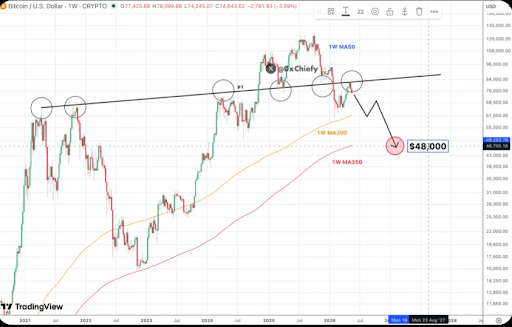
Source: Chart from Chiefy on X

Interestingly, the rejection zone also lines up with the 200MA. Rejections from this moving average have appeared around major cycle turning points in the past, including the 2014, 2018, and 2022 market phases.

The Levels That Now Matter

Now with the initial phase of Chiefy’s projection already confirmed, the next important thing is what comes next. Notably, there are three downside targets if Bitcoin continues to follow the pattern: $68,000, $61,000, and $48,000.

These levels fit the path drawn on the chart above, which shows Bitcoin first breaking lower below $76,000, then forming a brief relief bounce, before falling deeper into the red-circled $48,000 area. The most extreme bottom target of $48,000 is close to the weekly 350 moving average shown in pink and would be the final reset from the recent $83,000 bull-trap zone.

Bitcoin’s reaction around $74,000 now matters most because it could determine whether Chiefy’s bearish map will be feasible. The drop into that region came immediately after the rejection, but it has recovered back above $76,000 and is trading at $76,580 at the time of writing.

Even with that rebound, Bitcoin is still close to a support area that looks fragile. Sentiment shows that the market is no longer in a strong risk-on phase, with CoinMarketCap’s Crypto Fear & Greed Index now at 39, placing the market in a fear mood. A break below $74,000 would put $68,000 in focus as the next logical downside target.

BTC trading at $77,300 on the 1D chart | Source: BTCUSDT on Tradingview.com

Domande pertinenti

QAccording to the analyst Chiefy, at what key macro price level did Bitcoin face rejection for the first time in five years?

ABitcoin faced rejection at the $83,000 zone, which represents a five-year macro resistance trendline.

QWhat are the three potential downside price targets for Bitcoin mentioned in the article if it continues its bearish pattern?

AThe three potential downside targets mentioned are $68,000, $61,000, and $48,000.

QWhat other technical indicator does the $83,000 rejection zone align with, which has been significant at past cycle turning points?

AThe rejection zone at $83,000 also aligns with the 200-period moving average (200MA), which has marked major cycle turning points in the past.

QWhat does the article suggest is the significance of Bitcoin's price action around the $74,000 level?

ABitcoin's price action around $74,000 is crucial as a break below this level would shift the focus to $68,000 as the next downside target, confirming the analyst's bearish projection.

QWhat is the current market sentiment according to the Crypto Fear & Greed Index, as stated in the article?

AAccording to the article, the Crypto Fear & Greed Index is at 39, indicating that the market is in a 'fear' phase.

Letture associate

ETH Bull and Bear Views Compilation: Can Ethereum's Value Flow Back to ETH?

Titled "ETH Bull and Bear Views: Can Ethereum's Value Flow Back to ETH?", this article synthesizes the current heated debate around Ethereum's native token, ETH, following Bankless co-founder David Hoffman's decision to sell his entire ETH holdings. The **bullish case**, represented by figures like Tom Lee (BitMine CEO) and Raoul Pal, argues that ETH's core thesis remains intact. They contend Ethereum is the essential, secure, and neutral foundational layer for future finance—encompassing stablecoins, RWA, DeFi, L2s, and Agentic AI. Bulls bet on ETH's long-term revaluation as institutional adoption of on-chain finance grows, with significant buying activity from entities like BitMine and Consensys cited as evidence. Conversely, the **bearish perspective**, led by Hoffman and analysts like Markus Thielen, questions ETH's value capture mechanism. They acknowledge Ethereum's network success but argue that the value created by L2s, DeFi, and applications does not sufficiently accrue to the ETH token itself. Bears point to ETH's prolonged underperformance versus the broader crypto market, lack of traditional cash flows, weakening "ultrasound money" narrative, and apparent institutional retreat (e.g., Harvard Management Company exiting its ETH ETF position) as key concerns. The debate highlights a pivotal shift: ETH is no longer just a community belief asset. The central question is whether ETH can transition from being a "**used infrastructure**" to a "**continuously bought and held core asset**" as more value enters the Ethereum ecosystem. The market is now critically examining the direct link between network growth and ETH's value.

marsbit41 min fa

ETH Bull and Bear Views Compilation: Can Ethereum's Value Flow Back to ETH?

marsbit41 min fa

Crypto is dead, Perps are forever

The crypto industry is shifting from a focus on creating native assets (like altcoins and protocol tokens) to becoming a "global asset pipeline." Native cryptocurrencies, except for Bitcoin, are seen as failing in their value storage and utility promises, with demand driven largely by speculation. Attention and liquidity are now moving toward real-world assets (RWAs) like U.S. stocks, bonds, gold, and oil traded on-chain via perpetual contracts (Perps). Stablecoins like USDT and USDC set the precedent, proving blockchain's core strength is efficient global settlement and transfer, not inventing new monetary systems. Meanwhile, assets like Ethereum and many DeFi tokens struggle as their narratives weaken against tangible traditional assets and the rapid real-world progress of AI. Perpetual contracts have emerged as a pivotal innovation. They simplify trading by offering pure price exposure to any asset, bypassing complexities of ownership, custody, and traditional market hours. Projects like Hyperliquid gained traction by combining CEX-like efficiency with on-chain transparency, capitalizing on post-FTX distrust, macroeconomic volatility, and the surge in demand for 24/7 stock trading. In conclusion, while the era of speculative native "crypto assets" may be over, perpetual contracts persist as the industry's most potent financial instrument—transforming all assets into globally accessible, constantly tradable instruments centered on price speculation.

marsbit47 min fa

Crypto is dead, Perps are forever

marsbit47 min fa

Tencent, Alibaba, ByteDance in a Battle for the Skill Store

Skill is becoming a key concept in the AI field, essentially serving as a structured "instruction manual" for AI Agents that specifies tool calls, decision logic, and output standards. This allows Agents to execute predefined tasks. As the number of Skills grows, distribution platforms have emerged. Major tech companies are swiftly entering this space. In March, Tencent, Alibaba, and ByteDance launched Skill stores within their respective Agent platforms. Subsequently, players like Zhipu AI, Meituan, and Xiaohongshu joined the fray. This competition for the "Skill store" is fundamentally a battle for the AI-era user entry point; whoever controls distribution controls the users. While ByteDance's Coze has experimented with paid Skills, most platforms offer them for free. The real value lies not in the stores themselves but in using them to attract and retain users within an ecosystem, driving revenue from services like cloud computing, model calls, or advertising. The landscape features three main player types: 1) **Internet giants** (e.g., Alibaba, ByteDance, Tencent, Meituan), leveraging Skills to drive traffic and monetize through their broader ecosystems (cloud services, transactions, ads). 2) **Large model companies** (e.g., Zhipu AI, Moonshot AI), using Skill stores to increase user engagement and monetize model API calls. 3) **Content platforms** (e.g., Xiaohongshu), treating Skills as a new content format to generate traffic and ad revenue. However, transforming Skill stores into a sustainable business faces significant hurdles. Key challenges include: the **difficulty in pricing Skills** due to inconsistent outputs across different models and contexts; **lack of cost transparency** (varying token consumption); **security risks** like Skill poisoning; and the **absence of standardized protocols** for development and evaluation. Unlike standardized mobile apps, Skills are often personalized workflows resistant to uniformity, which hinders the establishment of a reliable review and monetization system akin to the App Store. While there is genuine user demand for paid Skills—particularly in enterprise (e.g., contract review) and certain personal productivity scenarios—current platforms offer developers limited and unpredictable distribution. The future of Skill stores depends on overcoming these standardization, evaluation, and safety challenges to make acquiring a Skill as straightforward as downloading an app. For now, the stores function more as display shelves than robust marketplaces.

marsbit47 min fa

Tencent, Alibaba, ByteDance in a Battle for the Skill Store

marsbit47 min fa

The Crypto Scene Is Dead, Perpetual Swaps Are Eternal

The crypto industry is undergoing a fundamental shift. The era defined by minting novel, native digital assets (altcoins) is fading. These assets, lacking real-world cash flows or clear value, are losing relevance as attention and capital flow elsewhere. Two powerful external forces are reshaping the space. First, traditional assets like U.S. stocks, bonds, gold, and oil are being tokenized and traded on-chain. Second, the explosive growth of AI, with its tangible products, has overshadowed crypto's once-dominant "future narrative." This marks a critical pivot: crypto is transitioning from being a "factory for new assets" to becoming a "global conduit for existing assets." Its validated utility is not complex financial reinvention but efficient global settlement, transfer, and trading—the original promise of blockchain. Stablecoins like USDT and USDC exemplify this, offering faster dollar movement rather than replacing it. Consequently, native ecosystems like Ethereum face profound challenges. While still crucial infrastructure, ETH struggles to capture value as users interact with Layer 2s or trade traditional assets without needing to hold it. DeFi's grand narrative of rebuilding finance has narrowed to core needs like cheap transfers and deep liquidity. The true breakout innovation is the perpetual contract (Perp). It brilliantly bypasses the complexities of direct asset ownership (custody, compliance, dividends) by creating pure price exposure. Users can speculate on the price movement of *any* asset—NVIDIA, gold, oil—24/7, globally, and with leverage. This "price casino" model, while risky and ethically fraught, delivers unmatched liquidity and accessibility. Projects like Hyperliquid succeeded not by inventing new mechanics but by perfecting the timing and execution of this model. Key drivers included making on-chain Perps feel like centralized exchanges, post-FTX trust migration towards transparency, and rising demand to trade macro assets and equities round-the-clock. In conclusion, the crypto world's most enduring successes are the dollar (via stablecoins), Bitcoin, and trading. Its new frontier is not creating alternative assets but providing a seamless, perpetual trading layer—a new API—for the world's existing financial system. The age of native altcoins is over; the age of perpetual synthetic exposure has begun.

Odaily星球日报56 min fa

The Crypto Scene Is Dead, Perpetual Swaps Are Eternal

Odaily星球日报56 min fa

Trading

Spot
Futures

Articoli Popolari

Cosa è BITCOIN

Comprendere HarryPotterObamaSonic10Inu (ERC-20) e la sua posizione nel mondo delle criptovalute Negli ultimi anni, il mercato delle criptovalute ha assistito a un aumento della popolarità delle meme coin, catturando l'interesse non solo dei trader, ma anche di coloro che cercano coinvolgimento comunitario e valore di intrattenimento. Tra questi token unici c'è HarryPotterObamaSonic10Inu (ERC-20), un progetto intrigante che mescola riferimenti culturali nel tessuto delle criptovalute. Questo articolo esplora gli aspetti chiave di HarryPotterObamaSonic10Inu, analizzando i suoi meccanismi, l'etica guidata dalla comunità e il suo coinvolgimento con il panorama crittografico più ampio. Che cos'è HarryPotterObamaSonic10Inu (ERC-20)? Come suggerisce il suo nome, HarryPotterObamaSonic10Inu è una meme coin costruita sulla blockchain di Ethereum, classificata secondo lo standard ERC-20. A differenza delle criptovalute tradizionali che possono enfatizzare l'utilità pratica o il potenziale investimento, questo token prospera grazie al valore di intrattenimento e alla forza della sua comunità. Il progetto mira a creare un ambiente in cui gli utenti coinvolti possono riunirsi, condividere idee e partecipare ad attività ispirate a diversi fenomeni culturali. Una caratteristica notevole di HarryPotterObamaSonic10Inu è la zero tassa sulle transazioni. Questo elemento allettante tende a incoraggiare il trading e il coinvolgimento della comunità, privo di costi aggiuntivi che possono scoraggiare i trader di piccole dimensioni. L'offerta totale della moneta è fissata a un miliardo di token, un numero che segna la sua intenzione di mantenere una circolazione sostanziale all'interno della comunità. Creatore di HarryPotterObamaSonic10Inu (ERC-20) Le origini di HarryPotterObamaSonic10Inu sono avvolte in un certo mistero; i dettagli sul creatore rimangono sconosciuti. Lo sviluppo di questo token non presenta un team identificabile o un piano esplicito, cosa non rara nel settore delle meme coin. Invece, il progetto è emerso organicamente, con il suo progresso fortemente dipendente dall'entusiasmo e dalla partecipazione della sua comunità. Investitori di HarryPotterObamaSonic10Inu (ERC-20) Per quanto riguarda investimenti esterni e finanziamenti, HarryPotterObamaSonic10Inu rimane ambiguo. Il token non elenca alcuna fondazione di investimento conosciuta o un sostegno organizzativo significativo. Invece, la linfa vitale del progetto è la sua comunità di base, che informa la sua crescita e sostenibilità attraverso azioni collettive e coinvolgimento nello spazio crittografico. Come funziona HarryPotterObamaSonic10Inu (ERC-20)? In quanto meme coin, HarryPotterObamaSonic10Inu opera principalmente al di fuori delle strutture tradizionali che governano spesso il valore degli asset. Ci sono diversi aspetti distintivi che definiscono il funzionamento del progetto: Transazioni senza tasse: Senza costi fiscali sulle transazioni, gli utenti possono comprare e vendere liberamente il token senza preoccuparsi di costi nascosti. Coinvolgimento della comunità: Il progetto prospera sull'interazione della comunità, sfruttando le piattaforme social per creare entusiasmo e facilitare il coinvolgimento. Discussioni, condivisione di contenuti e coinvolgimento sono elementi cruciali che aiutano ad espandere la sua portata e a favorire la lealtà tra i sostenitori. Nessuna utilità pratica: Va notato che HarryPotterObamaSonic10Inu non offre un'utilità concreta all'interno dell'ecosistema finanziario. Piuttosto, è classificato come un token principalmente per attività di intrattenimento e comunitarie. Riferimento culturale: Il token incorpora astutamente elementi della cultura pop per attirare interesse, collegandosi a appassionati di meme e seguaci delle criptovalute. HarryPotterObamaSonic10Inu esemplifica come le meme coin operino in modo diverso rispetto ai progetti di criptovalute più tradizionali, entrando nel mercato come costrutti sociali innovativi piuttosto che come asset utilitari. Cronologia di HarryPotterObamaSonic10Inu (ERC-20) La storia di HarryPotterObamaSonic10Inu è segnata da diversi traguardi notevoli: Creazione: Il token è emerso da un meme virale, catturando l'immaginazione di molti appassionati di criptovalute. Le date di creazione specifiche non sono disponibili, sottolineando la sua crescita organica. Inserimento negli scambi: HarryPotterObamaSonic10Inu ha fatto il suo ingresso in vari scambi, consentendo un accesso e un trading più facili da parte della comunità. Iniziative di coinvolgimento della comunità: Attività in corso volte a migliorare l'interazione della comunità, comprese gare, campagne sui social media e generazione di contenuti da parte di fan e sostenitori. Piani di espansione futura: La tabella di marcia del progetto include il lancio di una collezione NFT, merchandising e un sito di eCommerce relativo ai suoi temi culturali, coinvolgendo ulteriormente la comunità e cercando di aggiungere più dimensioni al suo ecosistema. Punti chiave su HarryPotterObamaSonic10Inu (ERC-20) Natura guidata dalla comunità: Il progetto dà priorità al contributo collettivo e alla creatività, garantendo che il coinvolgimento degli utenti sia al centro del suo sviluppo. Classificazione come meme coin: Rappresenta l'epitome delle criptovalute basate sull'intrattenimento, distinguendosi dai veicoli d'investimento tradizionali. Nessuna affiliazione diretta con Bitcoin: Nonostante la somiglianza nel nome del ticker, HarryPotterObamaSonic10Inu è distintivo e non ha alcuna relazione con Bitcoin o altre criptovalute consolidate. Focus sulla collaborazione: HarryPotterObamaSonic10Inu è progettato per creare uno spazio per la collaborazione e la condivisione di storie tra i suoi detentori, fornendo un canale per la creatività e il legame comunitario. Prospettive future: L'ambizione di espandersi oltre il suo presupposto iniziale verso NFT e merchandising delinea un percorso per il progetto per potenzialmente entrare in strade più mainstream all'interno della cultura digitale. Poiché le meme coin continuano a catturare l'immaginazione della comunità crittografica, HarryPotterObamaSonic10Inu (ERC-20) si distingue per i suoi legami culturali e il suo approccio centrato sulla comunità. Anche se potrebbe non adattarsi al modello tipico di un token orientato all'utilità, la sua essenza risiede nella gioia e nella camaraderia coltivate tra i suoi sostenitori, evidenziando la natura in evoluzione delle criptovalute in un'epoca sempre più digitale. Con la continuazione dello sviluppo del progetto, sarà importante osservare come le dinamiche della comunità influenzano la sua traiettoria nel panorama in continuo cambiamento della tecnologia blockchain.

1.5k Totale visualizzazioniPubblicato il 2024.04.01Aggiornato il 2024.12.03

Cosa è BITCOIN

Come comprare BTC

Benvenuto in HTX.com! Abbiamo reso l'acquisto di Bitcoin (BTC) semplice e conveniente. Segui la nostra guida passo passo per intraprendere il tuo viaggio nel mondo delle criptovalute.Step 1: Crea il tuo Account HTXUsa la tua email o numero di telefono per registrarti il tuo account gratuito su HTX. Vivi un'esperienza facile e sblocca tutte le funzionalità,Crea il mio accountStep 2: Vai in Acquista crypto e seleziona il tuo metodo di pagamentoCarta di credito/debito: utilizza la tua Visa o Mastercard per acquistare immediatamente BitcoinBTC.Bilancio: Usa i fondi dal bilancio del tuo account HTX per fare trading senza problemi.Terze parti: abbiamo aggiunto metodi di pagamento molto utilizzati come Google Pay e Apple Pay per maggiore comodità.P2P: Fai trading direttamente con altri utenti HTX.Over-the-Counter (OTC): Offriamo servizi su misura e tassi di cambio competitivi per i trader.Step 3: Conserva Bitcoin (BTC)Dopo aver acquistato Bitcoin (BTC), conserva nel tuo account HTX. In alternativa, puoi inviare tramite trasferimento blockchain o scambiare per altre criptovalute.Step 4: Scambia Bitcoin (BTC)Scambia facilmente Bitcoin (BTC) nel mercato spot di HTX. Accedi al tuo account, seleziona la tua coppia di trading, esegui le tue operazioni e monitora in tempo reale. Offriamo un'esperienza user-friendly sia per chi ha appena iniziato che per i trader più esperti.

3.9k Totale visualizzazioniPubblicato il 2024.12.12Aggiornato il 2026.06.02

Come comprare BTC

Cosa è $BITCOIN

ORO DIGITALE ($BITCOIN): Un'Analisi Completa Introduzione all'ORO DIGITALE ($BITCOIN) L'ORO DIGITALE ($BITCOIN) è un progetto basato su blockchain che opera sulla rete Solana, con l'obiettivo di combinare le caratteristiche dei metalli preziosi tradizionali con l'innovazione delle tecnologie decentralizzate. Sebbene condivida un nome con Bitcoin, spesso definito “oro digitale” a causa della sua percezione come riserva di valore, l'ORO DIGITALE è un token separato progettato per creare un ecosistema unico all'interno del panorama Web3. Il suo obiettivo è posizionarsi come un asset digitale alternativo valido, anche se i dettagli riguardanti le sue applicazioni e funzionalità sono ancora in fase di sviluppo. Cos'è l'ORO DIGITALE ($BITCOIN)? L'ORO DIGITALE ($BITCOIN) è un token di criptovaluta esplicitamente progettato per l'uso sulla blockchain di Solana. A differenza di Bitcoin, che fornisce un ruolo di stoccaggio di valore ampiamente riconosciuto, questo token sembra concentrarsi su applicazioni e caratteristiche più ampie. Aspetti notevoli includono: Infrastruttura Blockchain: Il token è costruito sulla blockchain di Solana, nota per la sua capacità di gestire transazioni ad alta velocità e a basso costo. Dinamiche di Offerta: L'ORO DIGITALE ha un'offerta massima fissata a 100 quadrilioni di token (100P $BITCOIN), sebbene i dettagli riguardanti la sua offerta circolante siano attualmente non divulgati. Utilità: Sebbene le funzionalità precise non siano esplicitamente delineate, ci sono indicazioni che il token potrebbe essere utilizzato per varie applicazioni, potenzialmente coinvolgendo applicazioni decentralizzate (dApp) o strategie di tokenizzazione degli asset. Chi è il Creatore dell'ORO DIGITALE ($BITCOIN)? Attualmente, l'identità dei creatori e del team di sviluppo dietro l'ORO DIGITALE ($BITCOIN) rimane sconosciuta. Questa situazione è tipica tra molti progetti innovativi nel settore blockchain, in particolare quelli allineati con la finanza decentralizzata e i fenomeni delle meme coin. Sebbene tale anonimato possa favorire una cultura guidata dalla comunità, intensifica le preoccupazioni riguardo alla governance e alla responsabilità. Chi sono gli Investitori dell'ORO DIGITALE ($BITCOIN)? Le informazioni disponibili indicano che l'ORO DIGITALE ($BITCOIN) non ha alcun sostenitore istituzionale noto o investimenti di venture capital prominenti. Il progetto sembra operare su un modello peer-to-peer incentrato sul supporto e sull'adozione della comunità piuttosto che su percorsi di finanziamento tradizionali. La sua attività e liquidità si trovano principalmente su exchange decentralizzati (DEX), come PumpSwap, piuttosto che su piattaforme di trading centralizzate consolidate, evidenziando ulteriormente il suo approccio di base. Come Funziona l'ORO DIGITALE ($BITCOIN) Le meccaniche operative dell'ORO DIGITALE ($BITCOIN) possono essere elaborate in base al suo design blockchain e alle caratteristiche della rete: Meccanismo di Consenso: Sfruttando il proof-of-history (PoH) unico di Solana combinato con un modello di proof-of-stake (PoS), il progetto garantisce una validazione efficiente delle transazioni contribuendo all'alta performance della rete. Tokenomics: Sebbene meccanismi deflazionistici specifici non siano stati dettagliati ampiamente, l'ampia offerta massima di token implica che potrebbe soddisfare microtransazioni o casi d'uso di nicchia che devono ancora essere definiti. Interoperabilità: Esiste il potenziale per l'integrazione con l'ecosistema più ampio di Solana, inclusi vari piattaforme di finanza decentralizzata (DeFi). Tuttavia, i dettagli riguardanti integrazioni specifiche rimangono non specificati. Cronologia degli Eventi Chiave Ecco una cronologia che evidenzia traguardi significativi riguardanti l'ORO DIGITALE ($BITCOIN): 2023: Il dispiegamento iniziale del token avviene sulla blockchain di Solana, contrassegnato dal suo indirizzo di contratto. 2024: L'ORO DIGITALE guadagna visibilità poiché diventa disponibile per il trading su exchange decentralizzati come PumpSwap, consentendo agli utenti di scambiarlo contro SOL. 2025: Il progetto assiste a un'attività di trading sporadica e a un potenziale interesse per impegni guidati dalla comunità, sebbene non siano state documentate partnership significative o avanzamenti tecnici fino ad ora. Analisi Critica Punti di Forza Scalabilità: L'infrastruttura sottostante di Solana supporta alti volumi di transazioni, il che potrebbe migliorare l'utilità di $BITCOIN in vari scenari di transazione. Accessibilità: Il potenziale basso prezzo di trading per token potrebbe attrarre investitori al dettaglio, facilitando una partecipazione più ampia grazie a opportunità di proprietà frazionata. Rischi Mancanza di Trasparenza: L'assenza di sostenitori, sviluppatori o di un processo di audit pubblicamente noti potrebbe generare scetticismo riguardo alla sostenibilità e all'affidabilità del progetto. Volatilità del Mercato: L'attività di trading è fortemente dipendente dal comportamento speculativo, il che può comportare una significativa volatilità dei prezzi e incertezze per gli investitori. Conclusione L'ORO DIGITALE ($BITCOIN) emerge come un progetto intrigante ma ambiguo all'interno dell'evolvente ecosistema di Solana. Sebbene tenti di sfruttare la narrativa dell'“oro digitale”, la sua partenza dal ruolo consolidato di Bitcoin come riserva di valore sottolinea la necessità di una chiara differenziazione della sua utilità e struttura di governance. L'accettazione e l'adozione future dipenderanno probabilmente dall'affrontare l'attuale opacità e dalla definizione più esplicita delle sue strategie operative ed economiche. Nota: Questo rapporto comprende informazioni sintetizzate disponibili a ottobre 2023, e potrebbero essersi verificati sviluppi oltre il periodo di ricerca.

99 Totale visualizzazioniPubblicato il 2025.05.13Aggiornato il 2025.05.13

Cosa è $BITCOIN

Discussioni

Benvenuto nella Community HTX. Qui puoi rimanere informato sugli ultimi sviluppi della piattaforma e accedere ad approfondimenti esperti sul mercato. Le opinioni degli utenti sul prezzo di BTC BTC sono presentate come di seguito.

活动图片














