Bitcoin Fork ECX, Created by Paul Sztorc, Surpasses 25,000 Blocks in Just 13 Hours

cryptonews.ruPubblicato 2026-08-23Pubblicato ultima volta 2026-08-23

Introduzione

The ECX Bitcoin fork, created by Drivechain developer Paul Sztorc, launched its alpha phase at Bitcoin block height 963,648. Remarkably, the network surpassed 25,000 blocks in just 13 hours due to its initial difficulty being set to 1, mirroring Bitcoin's 2009 launch. By Sunday morning, August 23, the difficulty had already skyrocketed to 16.78 million after several adjustments, with miners contributing a hashrate of 3.53 PH/s to the chain. This level of support from multiple mining pools starkly contrasts with the failed BIP-110 event earlier in the month, which lacked miner backing. While ECX has attracted real mining power and has a small number of wallets, the ecash (ECX) token currently has no established market value and is not yet listed on exchanges. Its economic viability will face a significant test after the initial mining surge subsides and block rewards diminish, especially during the long wait until the network's final phase is scheduled for launch on October 31, 2026. The early activity demonstrates technical feasibility, but sustained growth will depend on whether it can maintain miner interest and attract listings from wallets and exchanges in the absence of a tradable price.

The latest Bitcoin fork has begun its alpha phase: the ECX network, created by Paul Sztorc, the developer of Drivechain, launched at block height 963,648. As of 9 a.m. on Sunday, August 23rd, the new network had already processed over 25,000 blocks in just 13 hours. The intervals between blocks were incredibly short, as the network's difficulty started at 1—exactly like Bitcoin did at its launch in 2009.

As of 9 a.m. Eastern Time (EDT), after a series of difficulty adjustments every 2,016 blocks, ECX's difficulty soared to 16.78 million. According to current data, miners are processing 3.53 petahashes per second (PH/s) on the ECX chain. If every miner used the original Bitmain Antminer S19 model (not Pro), which provides 95 terahashes per second (TH/s), this would correspond to nearly 36 Antminer S19 units working on Sztorc's fork.

Image source: Explorer.alpha.ecash.ninja/mining at 9:00 AM EDT, August 23, 2026. The alpha snapshot was taken at Bitcoin block ~963,648 (August 22nd). Test coins can later be burned in exchange for a stake in the permanent ECX, which is scheduled to launch on the mainnet around October 31st. The difficulty will continue to rise as new hashpower joins, so now is the perfect time.

But miners can obviously deploy almost any old Antminer, including the vintage S9, along with brands like Sealminers, Whatsminers, Bitaxes, Nerdaxes, or even the weakest hash-rate machines, to earn Alpha rewards. What immediately distinguishes this fork from the failed BIP-110 fiasco earlier this month is mining support. ECX is clearly attracting more miners willing to support the chain with real hashpower.

Miners Direct Real Hashpower to Sztorc's Fork

The 3.53 PH/s hashpower is distributed among several pools, with Ecashpool-alpha leading. The remaining share consists of Kikko, L2L Pool, Nurserypool, Ckpool, Solo, Guilastuce, BIP300.xyz, Layertree, and Avonpool. Since the ECX network's difficulty is still low, blocks are being generated at a rate that makes Bitcoin's regular ten-minute intervals seem glacial in comparison. But although ECX already has miners and a small number of wallets, the ecash (ECX) crypto asset still has no established market value.
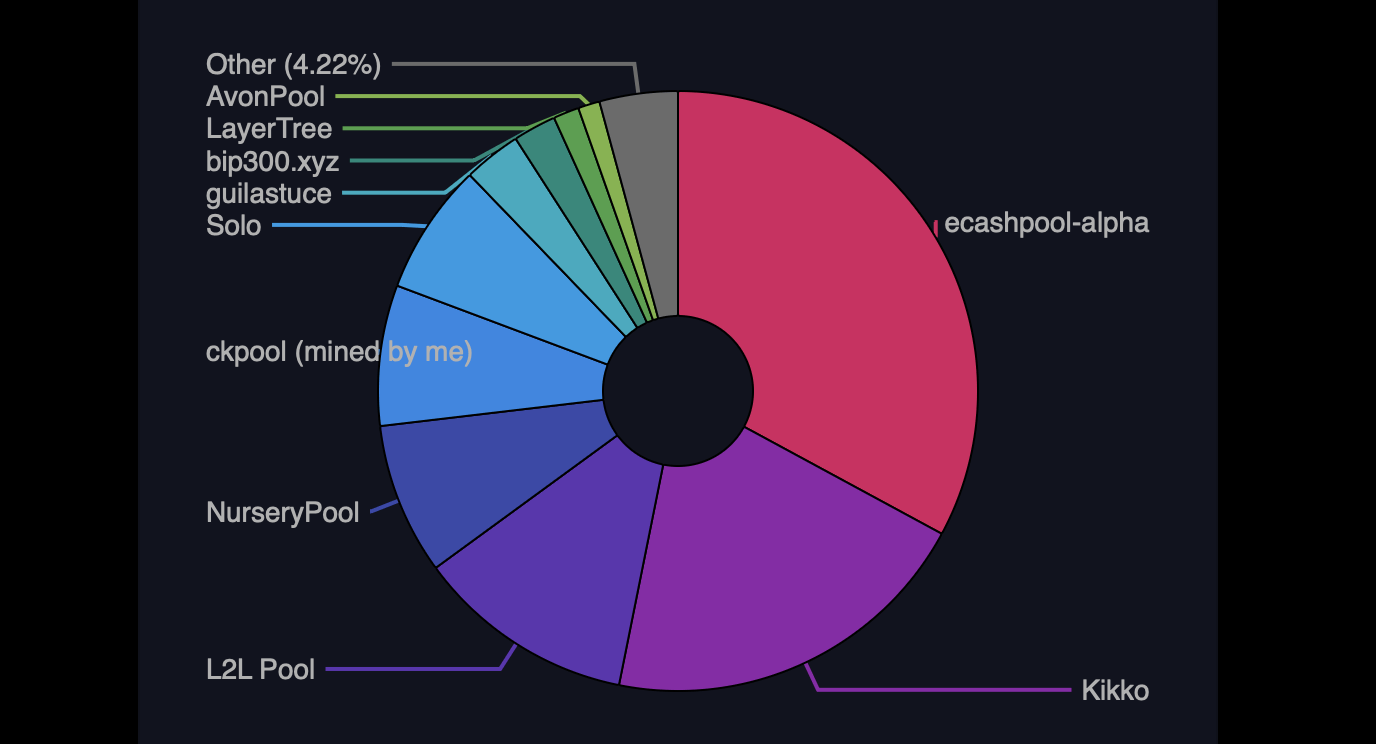
Mining pools directing SHA-256 hashpower to the ECX blockchain, as of 9:00 AM Eastern Daylight Time (EDT) on Sunday, August 23, 2026. Image source: Explorer.alpha.ecash.ninja/mining.

ECX is not yet listed on cryptocurrency exchanges, resulting in no defined price or real trading venue, and the situation may not change until the third and final phase of the network's development, timed for the 18th anniversary of the Bitcoin whitepaper's publication—October 31, 2026. Nevertheless, comparing Sztorc's fork with the BIP-110 event reveals a stark contrast: the former has tangible miner support, while the latter simply lacked it.

ECX Faces Its Biggest Test After the 'Mining Surge'

Nonetheless, the initial surge proves technical viability, not economic sustainability. Once the difficulty stabilizes and the block reward decreases, miner enthusiasm could evaporate in the absence of a tradable price. The long wait until October 2026 is a grave for growth dynamics, as hype quickly fades. On the other hand, this early surge could signal genuine support, growth dynamics could intensify, and infrastructure providers such as wallets and centralized crypto exchanges might see sufficient activity to begin listing ECX.

Time will tell.

Domande pertinenti

QWho created the ECX Bitcoin fork and what is their primary project known for?

AThe ECX Bitcoin fork was created by Paul Sztorc, who is known as the developer of Drivechain.

QHow quickly did the ECX network mine its first 25,000 blocks, and what was the starting difficulty?

AThe ECX network mined over 25,000 blocks in just 13 hours. Its starting difficulty was 1, the same as Bitcoin's at launch in 2009.

QWhat current hashrate is being processed on the ECX chain, and how does that translate to a specific miner model?

AMiners are processing 3.53 petahashes per second (PH/s) on the ECX chain. Using the original Bitmain Antminer S19 (95 TH/s) as a benchmark, this is equivalent to nearly 36 such miners working on Sztorc's fork.

QHow does the article contrast the initial support for the ECX fork with the earlier BIP-110 event?

AThe article highlights a sharp contrast: the ECX fork has tangible mining support with real hashrate directed to it, while the BIP-110 event simply lacked such support.

QAccording to the article, what is the most significant upcoming challenge for the ECX fork after the initial mining surge?

AThe most significant upcoming challenge is the wait until its mainnet launch, scheduled for around October 31, 2026. The article suggests the long wait could dampen growth dynamics as hype fades, testing the project's economic sustainability once block rewards decrease and without an established market price.

Letture associate

The Biggest Political Economy Question in the AI Era: As Robots Become More Capable, How Do Humans Share the Value?

In the AI era, the most pressing political economy question is: as machines become increasingly capable, how can humanity share in the value they create? An article originally critiquing China's tech focus has sparked a deeper debate on this global challenge. Historically, industrial progress improved efficiency but still relied on human labor for wealth creation and distribution. AI is fundamentally different—it is now replacing cognitive and knowledge work. As AI and robots take over more tasks, economic growth may continue while direct human participation in value creation shrinks, creating a core tension between productivity gains and widespread income generation. The issue is not unique to China. While leading tech companies amass enormous wealth, labor's share of income is declining globally. The core problem is a broken link: technological innovation and corporate profits are not translating into sufficient consumer income and demand. Three potential paths forward are outlined: a traditional capitalist model where profits primarily go to capital owners; a state-capitalist approach with public investment in AI; and more innovative models like digital sovereign wealth funds, universal shareholding, or AI-era basic income schemes to directly distribute AI-generated value. The future competitive advantage may lie not just in technological supremacy, but in which society can build a new, inclusive distribution system for the intelligent economy. The ultimate challenge is ensuring that as AI creates value, humans have a means to obtain income and share in the resulting widespread social benefits.

marsbit7 min fa

The Biggest Political Economy Question in the AI Era: As Robots Become More Capable, How Do Humans Share the Value?

marsbit7 min fa

Generating Profits for Seven Consecutive Quarters, Emerging Markets Carry Trade Outperforms Everything

For the seventh consecutive quarter, dollar-funded emerging market carry trades have delivered positive returns, marking the longest winning streak since 2008. According to Bloomberg's index, this strategy has gained approximately 22% since late 2024, outperforming U.S. Treasuries, emerging market sovereign, and corporate dollar debt. The core of the trade involves borrowing low-interest currencies like the U.S. dollar, euro, or yen to invest in high-yielding emerging market assets, such as Turkish lira bonds offering over 40% returns. Returns were amplified by favorable currency moves, with the dollar weakening against most emerging market currencies and other traditional funding currencies. For instance, the trade gained 48% on the Colombian peso in the past year. A key test came in August 2024 with a historic joint U.S.-Japan currency intervention, which caused only a modest 1% dip in the carry trade risk premium as investors shifted funding from the yen to the euro and Swiss franc. Looking ahead, the primary risk is the timing of Federal Reserve policy changes. While persistent inflation allows the Fed to hold rates, a rapid rise in long-term U.S. yields could threaten the trade. Another concern is crowding, as massive inflows increase vulnerability to a sudden reversal. High interest rates in regions like Latin America and Eastern Europe, supported by external factors like Middle East tensions and energy prices, continue to sustain the opportunity. Major investors remain engaged, favoring currencies like the Mexican peso, South African rand, and Turkish lira.

marsbit22 min fa

Generating Profits for Seven Consecutive Quarters, Emerging Markets Carry Trade Outperforms Everything

marsbit22 min fa

Unpacking the Truth Behind On-chain Assets: Leverage, Liquidity, and Risk

The article analyzes the concept of "real-world asset" (RWA) tokenization, arguing that while tokenizing assets on-chain is a useful step, it is far from transformative on its own. The author compares it to placing a barcode on a shipping container—it enables identification but does not build the necessary market infrastructure. The core argument is that true value emerges not from tokenization, but from integrating these tokens into DeFi systems where they can be valued, financed, hedged, traded, and liquidated under stress. Key challenges identified include: 1. **Multiple Time Clocks**: A fundamental tension exists between blockchain's 24/7 settlement and the slower, business-hour-dependent processes of traditional markets, custody, and redemption. This "duration mismatch" can create dangerous liquidity gaps during crises. 2. **Liquidity Misconceptions**: True liquidity is not measured by Total Value Locked (TVL) or trading pairs, but by the ability to exit a position within a required timeframe at an acceptable price. It requires analyzing multiple exit paths and stress-testing scenarios. 3. **Leverage and Risk**: Leverage unlocks economic utility (e.g., using tokenized assets as collateral) but also introduces fragility. Risk models must account for more than asset volatility, incorporating factors like legal enforceability, oracle freshness, and market structure. Paradoxically, a "safer" asset like tokenized Treasury bonds could require a higher collateral discount than ETH due to slower, less-proven liquidation mechanisms. 4. **A Risk Graph**: RWA risk should be modeled as a network of interconnected dependencies (e.g., issuers, custodians, oracles, stablecoin pools), not a single score. Failures can propagate through this graph, turning operational issues into systemic liquidity crises. The article states that tokenized government bonds are merely an entry point, while more complex frontiers like computing power and energy assets present greater challenges and opportunities. It also examines the interplay and risks between tokenized stocks and perpetual futures contracts. The conclusion is that the future lies not in "tokenizing everything," but in building robust market layers where tokenized rights become resilient financial primitives within a programmable capital system. The token is just the barcode; the market is the machine.

marsbit46 min fa

Unpacking the Truth Behind On-chain Assets: Leverage, Liquidity, and Risk

marsbit46 min fa

Trading

Spot
活动图片