Bitcoin Fork ECX, Created by Paul Sztorc, Surpasses 25,000 Blocks in Just 13 Hours

cryptonews.ruPubblicato 2026-08-23Pubblicato ultima volta 2026-08-23

Introduzione

The ECX Bitcoin fork, created by Drivechain developer Paul Sztorc, launched its alpha phase at Bitcoin block height 963,648. Remarkably, the network surpassed 25,000 blocks in just 13 hours due to its initial difficulty being set to 1, mirroring Bitcoin's 2009 launch. By Sunday morning, August 23, the difficulty had already skyrocketed to 16.78 million after several adjustments, with miners contributing a hashrate of 3.53 PH/s to the chain. This level of support from multiple mining pools starkly contrasts with the failed BIP-110 event earlier in the month, which lacked miner backing. While ECX has attracted real mining power and has a small number of wallets, the ecash (ECX) token currently has no established market value and is not yet listed on exchanges. Its economic viability will face a significant test after the initial mining surge subsides and block rewards diminish, especially during the long wait until the network's final phase is scheduled for launch on October 31, 2026. The early activity demonstrates technical feasibility, but sustained growth will depend on whether it can maintain miner interest and attract listings from wallets and exchanges in the absence of a tradable price.

The latest Bitcoin fork has begun its alpha phase: the ECX network, created by Paul Sztorc, the developer of Drivechain, launched at block height 963,648. As of 9 a.m. on Sunday, August 23rd, the new network had already processed over 25,000 blocks in just 13 hours. The intervals between blocks were incredibly short, as the network's difficulty started at 1—exactly like Bitcoin did at its launch in 2009.

As of 9 a.m. Eastern Time (EDT), after a series of difficulty adjustments every 2,016 blocks, ECX's difficulty soared to 16.78 million. According to current data, miners are processing 3.53 petahashes per second (PH/s) on the ECX chain. If every miner used the original Bitmain Antminer S19 model (not Pro), which provides 95 terahashes per second (TH/s), this would correspond to nearly 36 Antminer S19 units working on Sztorc's fork.

Image source: Explorer.alpha.ecash.ninja/mining at 9:00 AM EDT, August 23, 2026. The alpha snapshot was taken at Bitcoin block ~963,648 (August 22nd). Test coins can later be burned in exchange for a stake in the permanent ECX, which is scheduled to launch on the mainnet around October 31st. The difficulty will continue to rise as new hashpower joins, so now is the perfect time.

But miners can obviously deploy almost any old Antminer, including the vintage S9, along with brands like Sealminers, Whatsminers, Bitaxes, Nerdaxes, or even the weakest hash-rate machines, to earn Alpha rewards. What immediately distinguishes this fork from the failed BIP-110 fiasco earlier this month is mining support. ECX is clearly attracting more miners willing to support the chain with real hashpower.

Miners Direct Real Hashpower to Sztorc's Fork

The 3.53 PH/s hashpower is distributed among several pools, with Ecashpool-alpha leading. The remaining share consists of Kikko, L2L Pool, Nurserypool, Ckpool, Solo, Guilastuce, BIP300.xyz, Layertree, and Avonpool. Since the ECX network's difficulty is still low, blocks are being generated at a rate that makes Bitcoin's regular ten-minute intervals seem glacial in comparison. But although ECX already has miners and a small number of wallets, the ecash (ECX) crypto asset still has no established market value.
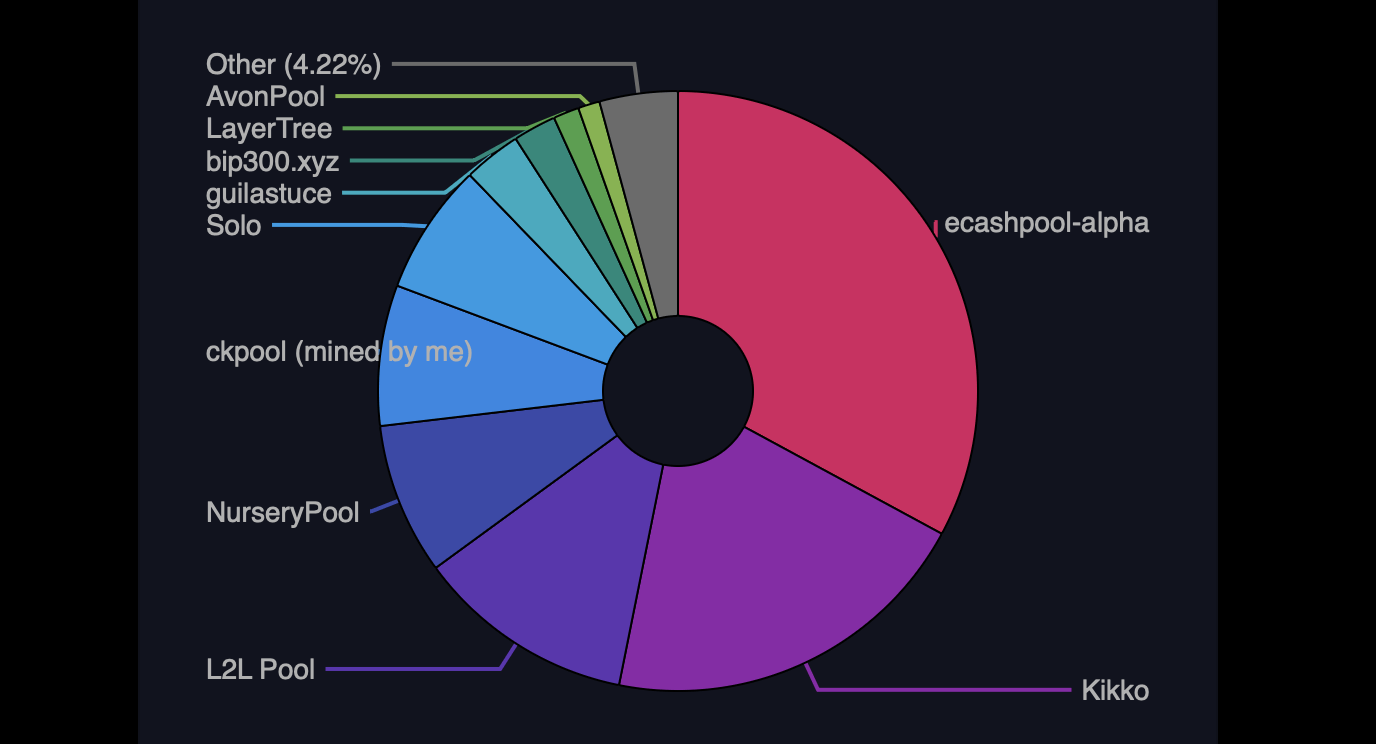
Mining pools directing SHA-256 hashpower to the ECX blockchain, as of 9:00 AM Eastern Daylight Time (EDT) on Sunday, August 23, 2026. Image source: Explorer.alpha.ecash.ninja/mining.

ECX is not yet listed on cryptocurrency exchanges, resulting in no defined price or real trading venue, and the situation may not change until the third and final phase of the network's development, timed for the 18th anniversary of the Bitcoin whitepaper's publication—October 31, 2026. Nevertheless, comparing Sztorc's fork with the BIP-110 event reveals a stark contrast: the former has tangible miner support, while the latter simply lacked it.

ECX Faces Its Biggest Test After the 'Mining Surge'

Nonetheless, the initial surge proves technical viability, not economic sustainability. Once the difficulty stabilizes and the block reward decreases, miner enthusiasm could evaporate in the absence of a tradable price. The long wait until October 2026 is a grave for growth dynamics, as hype quickly fades. On the other hand, this early surge could signal genuine support, growth dynamics could intensify, and infrastructure providers such as wallets and centralized crypto exchanges might see sufficient activity to begin listing ECX.

Time will tell.

Domande pertinenti

QWho created the ECX Bitcoin fork and what is their primary project known for?

AThe ECX Bitcoin fork was created by Paul Sztorc, who is known as the developer of Drivechain.

QHow quickly did the ECX network mine its first 25,000 blocks, and what was the starting difficulty?

AThe ECX network mined over 25,000 blocks in just 13 hours. Its starting difficulty was 1, the same as Bitcoin's at launch in 2009.

QWhat current hashrate is being processed on the ECX chain, and how does that translate to a specific miner model?

AMiners are processing 3.53 petahashes per second (PH/s) on the ECX chain. Using the original Bitmain Antminer S19 (95 TH/s) as a benchmark, this is equivalent to nearly 36 such miners working on Sztorc's fork.

QHow does the article contrast the initial support for the ECX fork with the earlier BIP-110 event?

AThe article highlights a sharp contrast: the ECX fork has tangible mining support with real hashrate directed to it, while the BIP-110 event simply lacked such support.

QAccording to the article, what is the most significant upcoming challenge for the ECX fork after the initial mining surge?

AThe most significant upcoming challenge is the wait until its mainnet launch, scheduled for around October 31, 2026. The article suggests the long wait could dampen growth dynamics as hype fades, testing the project's economic sustainability once block rewards decrease and without an established market price.

Letture associate

Fed Research: Crypto Investors Driven by Beliefs, Returns Change Their Decisions

A new working paper from the Federal Reserve Bank of Cleveland provides a novel explanation for cryptocurrency's divergence from traditional financial assets. It finds that American crypto investors are distinguished not by demographics or risk tolerance alone, but by their radically different beliefs about future returns. This divergence in expectations better explains who owns crypto than factors like age or income, a reversal of the pattern seen with stocks or bonds. The research, based on surveys of up to 25,000 US households, shows crypto owners expected an average 22% annual return, compared to just 7% for non-owners. A one-percentage-point increase in an individual's expected return was linked to a 0.8-point rise in ownership likelihood. A randomized experiment revealed that simply showing information about Bitcoin's past 12-month performance increased respondents' desired crypto portfolio share by about 47% and spurred subsequent purchases, primarily among those who previously felt uninformed. The study suggests this dynamic—where past gains attract new buyers, pushing prices higher and reinforcing bullish beliefs—could fuel speculative bubbles. It also indicates crypto wealth gains are treated more like "gambling winnings" than permanent income, boosting purchases of durable goods but not everyday spending. The broader conclusion is that crypto volatility stems partly from investor disagreement and learning, not just market fundamentals. With widespread misunderstanding and shifting expectations driven by performance data, price swings are likely to remain a defining feature of the asset class. Future retail demand may depend not just on Bitcoin's price, but on what information investors receive about its past performance.

cryptonews.ru56 min fa

Fed Research: Crypto Investors Driven by Beliefs, Returns Change Their Decisions

cryptonews.ru56 min fa

Senator Seeks Trump Ban on Cryptocurrencies as 63% in Poll Find His Earnings Inappropriate

U.S. Senator Kirsten Gillibrand (D-NY) is pushing for a legally enforceable ban to prevent presidents, their spouses, and senior officials from issuing, promoting, or profiting from cryptocurrencies while in office. She has made this ethics provision a condition for her support of the broader Digital Asset Market Clarity Act, a bipartisan crypto regulatory bill. Gillibrand argues that without a strong ban, the legislation would permit self-enrichment. Her push follows a Reuters/Ipsos poll showing 63% of American adults find former President Trump's cryptocurrency earnings inappropriate. Trump's 2025 financial disclosure reported over $1.4 billion in crypto-related income, largely from the "Trump" meme coin and World Liberty Financial. The poll also indicated 69% believe Trump allows private business interests to influence his presidential decisions. Gillibrand's initial focus was on officials issuing or promoting digital assets, but her latest position explicitly includes profiting from them, citing concerns over financial conflicts of interest. The ethics debate is now central to the Senate fight over the CLARITY Act, with several Democrats calling for stronger provisions on consumer protection, illicit finance, and market integrity. Critics say the current bill has enforcement gaps. The CLARITY Act faces a key procedural vote on September 15th, requiring 60 votes to advance. With 53 Republican seats, supporters will need votes from at least seven Democrats or independents if all Republicans support it. Gillibrand stated she will not vote to give any president a "taxpayer-backed license to cash in on the office."

cryptonews.ru58 min fa

Senator Seeks Trump Ban on Cryptocurrencies as 63% in Poll Find His Earnings Inappropriate

cryptonews.ru58 min fa

Trading

Spot
活动图片