Bitcoin & Ethereum ETF Outflows Persist: Monthly Netflows Remain Red

bitcoinistPubblicato 2025-12-31Pubblicato ultima volta 2025-12-31

Introduzione

Bitcoin and Ethereum spot ETFs have continued to experience net outflows over the past 30 days, with current netflows at -$656 million for BTC and -$422 million for ETH. This indicates sustained capital withdrawal from these digital assets, resembling outflows seen in early 2025. Despite a slight recent improvement, demand remains weak. Historically, such periods were followed by strong price rallies, but it's uncertain if a recovery will occur this time. Meanwhile, cryptocurrency treasury holdings have grown significantly, now exceeding $185 billion across 368 entities, with companies holding 73% of these assets. Bitcoin's price is currently consolidating around $88,100.

Data shows the 30-day ETF netflow is still negative for both Bitcoin and Ethereum, suggesting capital has been flowing away from the digital assets.

Bitcoin & Ethereum ETF Netflows Have Been Negative Recently

As explained by CryptoQuant community analyst Maartunn in a new post on X, Bitcoin and Ethereum spot exchange-traded funds (ETFs) have faced a negative netflow over the past month.

Spot ETFs are investment vehicles that allow investors to gain indirect exposure to an underlying asset’s price movements. In the context of cryptocurrencies, this means that an ETF investor never has to interact on-chain; the fund buys and custodies the tokens on their behalf.

US spot ETFs are a relatively new phenomenon in the digital asset sector, only getting approval by the Securities and Exchange Commission (SEC) in January 2024 for Bitcoin and July 2024 for Ethereum.

Spot ETFs can look like a convenient mode of investing for traders unfamiliar with cryptocurrency wallets and exchanges. Institutional entities, in particular, prefer to gain exposure through them.

Since their arrival, these investment vehicles have quickly gained popularity by tapping into this demand from the traditional investors and established themselves as one of the cornerstones of the sector.

Below is a chart that shows how the 30-day netflows related to the Bitcoin and Ethereum spot ETFs have changed during their existence so far.
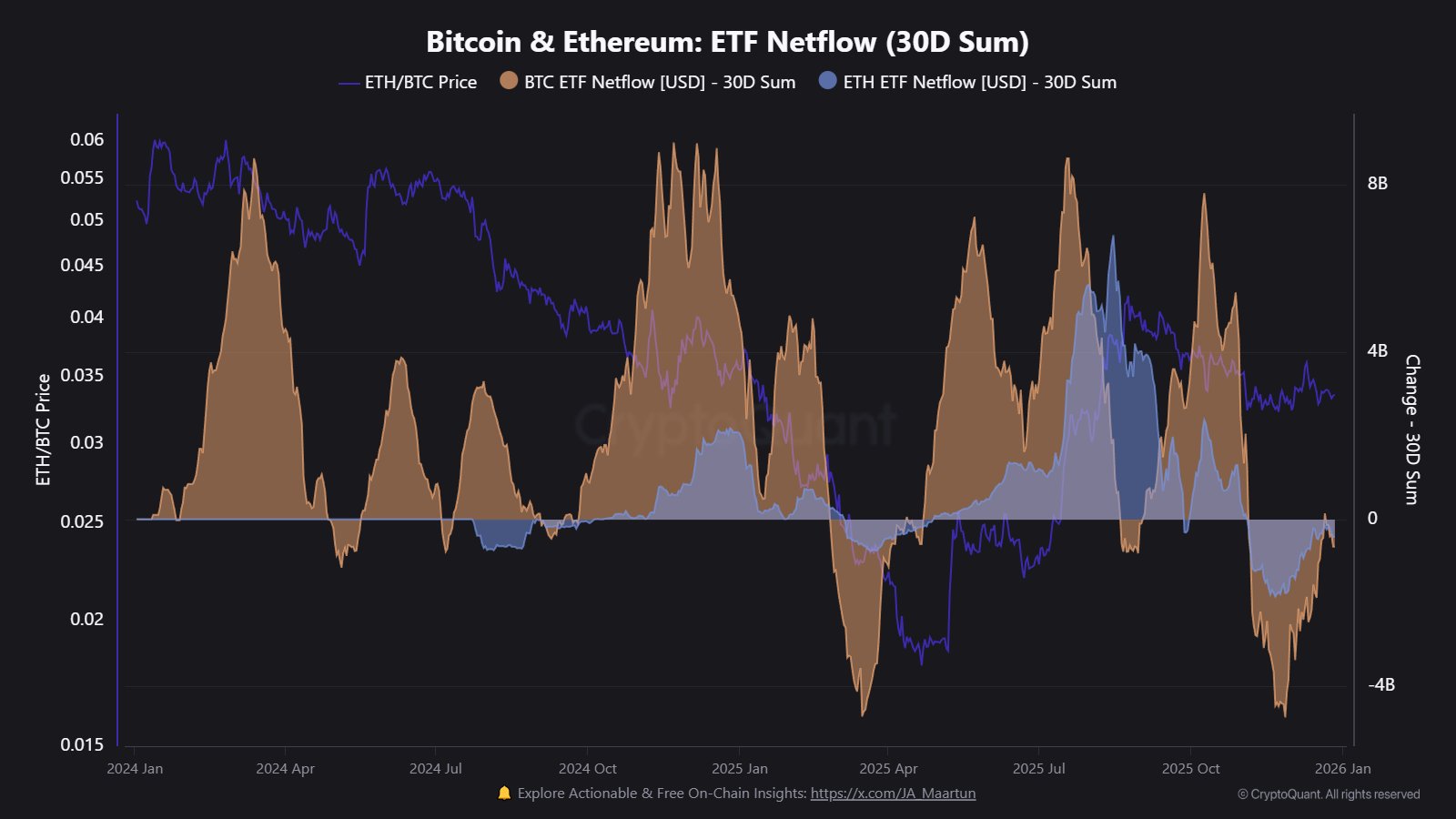
Looks like the value of the metric has been negative for both of these assets in recent weeks | Source: @JA_Maartun on X

As is visible in the graph, the 30-day spot ETF netflow has been negative for both Bitcoin and Ethereum since a while now, suggesting that the funds have been witnessing sustained net outflows.

The situation has improved a bit most recently, but the indicator is still red for both assets, sitting at -$656 million for BTC and -$422 million for ETH. The weak demand in the market is similar to the phase of outflows from the first half of 2025.

Back then, demand eventually made an explosive return, with Bitcoin and Ethereum witnessing sharp price rallies. It now remains to be seen whether a comeback will happen this time or if the slowdown in demand is here to stay for now.

Another relatively recent source of demand in the market is digital asset treasuries. As highlighted by institutional DeFi solutions provider Sentora in a new X post, holdings of cryptocurrency treasuries now exceed $185 billion across 368 entities.
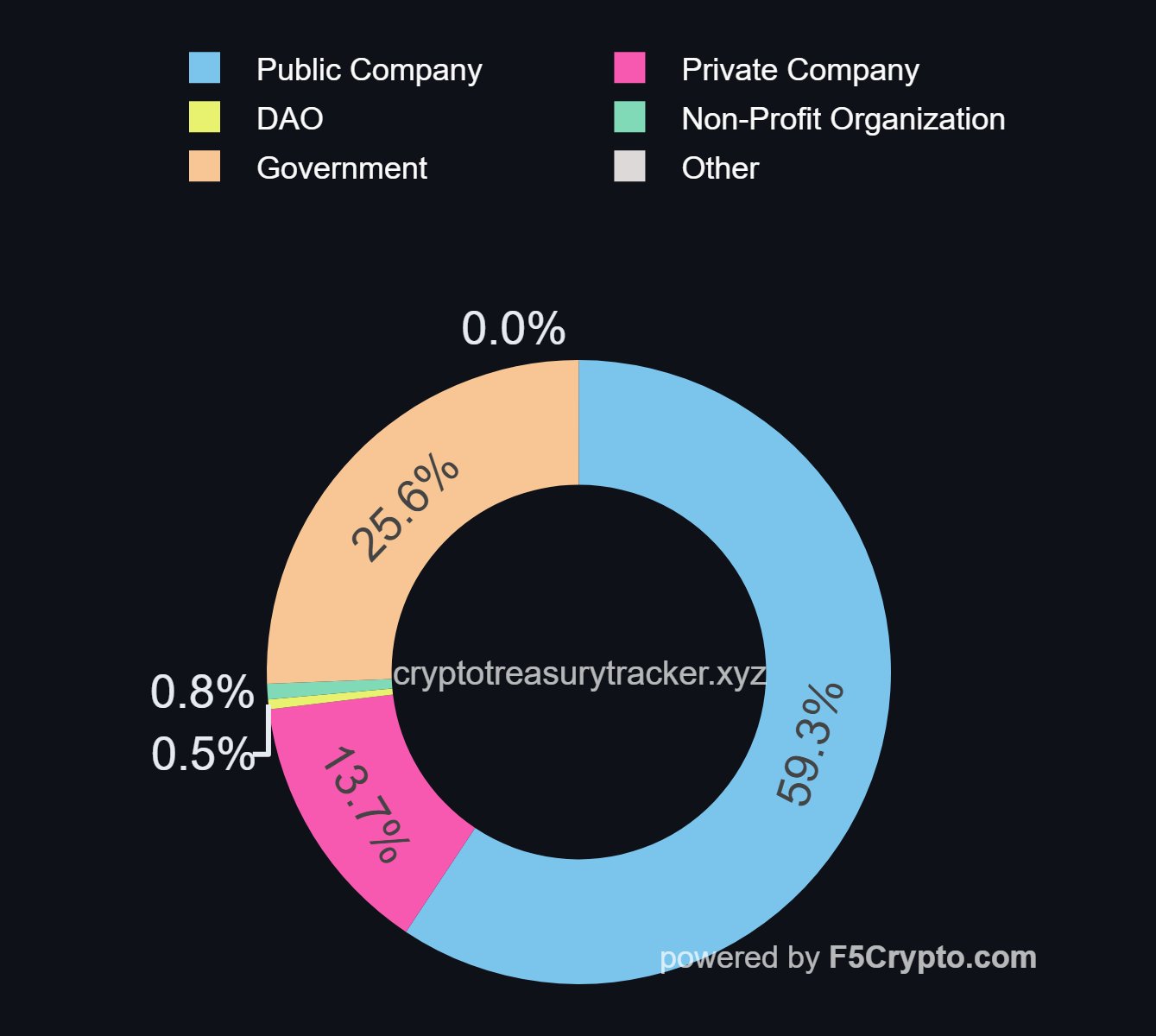
The breakdown of treasuries across various sectors | Source: Sentora on X

Out of this amount, 73% of the digital asset treasuries are controlled by companies, while the rest is in the hands of governments.

BTC Price

At the time of writing, Bitcoin is trading around $88,100, unchanged from last week.

The price of the coin seems to have been consolidating recently | Source: BTCUSDT on TradingView


Domande pertinenti

QWhat does the negative 30-day ETF netflow indicate for Bitcoin and Ethereum?

AThe negative 30-day ETF netflow indicates that capital has been flowing away from both Bitcoin and Ethereum, suggesting sustained net outflows from these digital assets.

QWhen did the SEC approve spot ETFs for Bitcoin and Ethereum in the US?

AThe SEC approved spot ETFs for Bitcoin in January 2024 and for Ethereum in July 2024.

QWhat are the current 30-day netflow values for Bitcoin and Ethereum ETFs mentioned in the article?

AThe current 30-day netflow is -$656 million for Bitcoin (BTC) and -$422 million for Ethereum (ETH).

QAccording to the article, what is the total value of digital asset treasuries held across entities, and what percentage is controlled by companies?

AThe total value of digital asset treasuries held across 368 entities is over $185 billion, with 73% controlled by companies.

QWhat was Bitcoin's price at the time of writing, and how has it performed recently?

AAt the time of writing, Bitcoin was trading around $88,100, unchanged from the previous week, and appears to be consolidating.

Letture associate

Farewell to Traditional Bull and Bear Markets, Deciphering the Logic of Today's Bubble Rotation

"Farewell to Traditional Bulls and Bears: Understanding Today's Market Logic of Bubble Rotation" The article draws a parallel between modern financial markets and a meteorological chain of thunderstorms, contrasting it with the past's slower-moving, more predictable 'layered cloud' systems of long bull/bear cycles and gradual sector rotations. The author argues that today's market has undergone a permanent structural shift, creating an environment where discrete, intense thematic bubbles (e.g., AI, GLP-1 drugs, crypto, robotics, quantum tech) sequentially form, swell, and burst. These 'storm cells' are triggered when capital fleeing a dying bubble acts like a meteorological 'cold air wedge,' forcing the warm, moist capital of latent interest in a new sector to rapidly rise and condense into the next speculative frenzy. This new 'convective' market regime is driven by eight fundamental changes: 1. Democratization of speculation via zero-commission trading, gamified apps, and heavy retail participation in instruments like 0DTE options. 2. Permanent, price-insensitive buying pressure from defined-contribution retirement plans (e.g., 401(k)s). 3. Passive investing creating inelastic market participants that amplify momentum, especially into mega-cap stocks. 4. The dominance of multi-strategy funds and high-frequency trading (HFT), weakening price discovery and creating fragile microstructure prone to synchronized sell-offs. 5. Artificially suppressed volatility that eventually erupts in violent spikes. 6. A transformed market index heavily weighted toward long-duration, narrative-driven tech companies instead of stable, cyclical industrials. 7. The total elimination of information delay, accelerating fear-of-missing-out (FOMO) and herd behavior. 8. A persistently loose fiscal and monetary policy environment. These structural shifts are deemed irreversible. The article outlines the common lifecycle of these thematic bubbles: latency, catalyzing event, narrative formation, peak divergence, and rupture—with outflowing capital seeding the next bubble. In this environment, two investor archetypes can thrive: deep domain experts who understand underlying technologies and business models, and disciplined trend-followers. The author concludes that while emotionally challenging, recognizing this new "climate" is crucial. The key is to elevate one's perspective above the immediate storm to see the cyclical chain of bubbles, avoiding being swept away by the emotions of any single thematic frenzy.

Foresight News21 min fa

Farewell to Traditional Bull and Bear Markets, Deciphering the Logic of Today's Bubble Rotation

Foresight News21 min fa

Michael Saylor's Latest Article: Bitcoin Must Find Balance Between Uniqueness and Universal Value

Michael Saylor outlines four key Bitcoin ideologies shaping its future: * **Bitcoin Maximalists** see Bitcoin as the dominant digital monetary network and a breakthrough in economic empowerment, emphasizing its superior property rights and role as a sound money solution. * **Bitcoin Capitalists** focus on integration, believing Bitcoin must embed into the global economy—through institutions, capital markets, and financial products—to reach its full potential as digital capital. * **Bitcoin Technologists** advocate for continuous protocol improvements in scalability, privacy, and security to adapt to evolving needs and threats, while acknowledging the high bar for change. * **Bitcoin Fundamentalists** guard Bitcoin's core principles of self-custody, decentralization, and censorship resistance, warning against dilution from institutions or risky modifications. Saylor argues that a healthy Bitcoin ecosystem requires a balance of these perspectives. Bitcoin's path forward involves disciplined expansion: preserving its immutable core (Fundamentalist insight), recognizing its dominant status (Maximalist view), integrating with the global economy (Capitalist drive), and enabling careful innovation, primarily in higher layers (Technologist role). The challenge is to maintain Bitcoin's unique properties while making it useful for the world, ensuring it remains Bitcoin as it grows.

Foresight News53 min fa

Michael Saylor's Latest Article: Bitcoin Must Find Balance Between Uniqueness and Universal Value

Foresight News53 min fa

Reddit Weekly Hot Stock Watch: RKLB/LUNR/ASTS Plunge Collectively, Is the Space Sector Still Worth Considering?

Reddit's stock communities witnessed a concentrated surge in discussion around space stocks last week, with SPCE, RKLB, LUNR, and ASTS leading the chatter. This often signals an underlying catalyst for investor attention. However, despite being grouped as "space plays," these companies have vastly different fundamentals and recent performances. While SPCE (Virgin Galactic) saw a 22% single-day surge—potentially fueled by short covering and fallout from Blue Origin's rocket test anomaly—the other three stocks declined sharply. RKLB dropped 15%, LUNR fell 13%, and ASTS was down 7%. This divergence highlights they are not a monolithic sector. The downturn for RKLB, LUNR, and ASTS stemmed from multiple headwinds converging: Blue Origin's New Glenn rocket explosion (directly impacting ASTS's launch plans), anticipation of SpaceX's massive IPO drawing funds away from these "alternative" public space stocks, and insider selling at RKLB after significant rallies. A closer look reveals key differences: RKLB stands out with substantial, growing revenue ($113.9M in Q1) and a $2.2B backlog, though its high valuation (~80x Forward P/S) prices in success for its upcoming Neutron rocket. LUNR's reported revenue growth is largely acquisition-driven, with its core moon landing business facing a crucial test with the upcoming IM-3 mission. ASTS has a large potential market in space-based cellular connectivity but faces significant execution risk, especially after the Blue Origin launch setback. SPCE, despite high discussion volume, has minimal revenue and its recent spike appears driven more by sentiment than fundamentals. The analysis suggests it's premature to call a "buying opportunity" for the sector broadly. RKLB is considered the most fundamentally sound but may be more attractive at a lower price point ($96-$102). For the others, investors are advised to wait for specific catalysts: LUNR's IM-3 mission outcome, clarity on ASTS's revised launch timeline, and for SPCE, to avoid the speculative frenzy. The long-term space thesis remains, but short-term valuations have run ahead of fundamentals for most names.

marsbit1 h fa

Reddit Weekly Hot Stock Watch: RKLB/LUNR/ASTS Plunge Collectively, Is the Space Sector Still Worth Considering?

marsbit1 h fa

Trading

Spot
Futures

Articoli Popolari

Come comprare RED

Benvenuto in HTX.com! Abbiamo reso l'acquisto di RedStone (RED) semplice e conveniente. Segui la nostra guida passo passo per intraprendere il tuo viaggio nel mondo delle criptovalute.Step 1: Crea il tuo Account HTXUsa la tua email o numero di telefono per registrarti il tuo account gratuito su HTX. Vivi un'esperienza facile e sblocca tutte le funzionalità,Crea il mio accountStep 2: Vai in Acquista crypto e seleziona il tuo metodo di pagamentoCarta di credito/debito: utilizza la tua Visa o Mastercard per acquistare immediatamente RedStoneRED.Bilancio: Usa i fondi dal bilancio del tuo account HTX per fare trading senza problemi.Terze parti: abbiamo aggiunto metodi di pagamento molto utilizzati come Google Pay e Apple Pay per maggiore comodità.P2P: Fai trading direttamente con altri utenti HTX.Over-the-Counter (OTC): Offriamo servizi su misura e tassi di cambio competitivi per i trader.Step 3: Conserva RedStone (RED)Dopo aver acquistato RedStone (RED), conserva nel tuo account HTX. In alternativa, puoi inviare tramite trasferimento blockchain o scambiare per altre criptovalute.Step 4: Scambia RedStone (RED)Scambia facilmente RedStone (RED) nel mercato spot di HTX. Accedi al tuo account, seleziona la tua coppia di trading, esegui le tue operazioni e monitora in tempo reale. Offriamo un'esperienza user-friendly sia per chi ha appena iniziato che per i trader più esperti.

406 Totale visualizzazioniPubblicato il 2025.03.05Aggiornato il 2026.06.02

Come comprare RED

Discussioni

Benvenuto nella Community HTX. Qui puoi rimanere informato sugli ultimi sviluppi della piattaforma e accedere ad approfondimenti esperti sul mercato. Le opinioni degli utenti sul prezzo di RED RED sono presentate come di seguito.

活动图片