Bitcoin is struggling to hold the $70,000 level as the market shows clear signs of weakening demand following weeks of sustained selling pressure. After several failed recovery attempts, price action continues to reflect fragile sentiment, with liquidity thinning and volatility increasing. Investors remain cautious as macro uncertainty, declining risk appetite, and persistent outflows from speculative assets weigh on the broader crypto market.
A recent analysis from Axel Adler indicates that the bear market underway since November 2025 has entered a deeper phase following last Friday’s sharp decline, which pushed total drawdown to roughly 46% from the cycle peak. This magnitude of correction historically marks a transition from an early pullback into a more mature bearish stage, where sentiment typically deteriorates further before stabilization occurs.
The report highlights that Bitcoin has approached the 1.25× Realized Price Band, a historically significant level that often separates standard corrections from capitulation phases. When price tests this boundary, market structure tends to become highly sensitive to liquidity shifts and investor positioning.
Whether Bitcoin can hold above this zone will likely determine the short-term direction. A sustained breakdown could signal deeper capitulation dynamics, while stabilization may provide the foundation for eventual accumulation.
Adler notes that the Bitcoin Bear Market Correction Drawdowns chart places the current 2025–2026 decline in historical context, comparing its magnitude with previous bear cycles. The metric tracks percentage drawdowns from each cycle’s all-time high on a logarithmic scale, allowing a clearer assessment of structural market stress rather than nominal price moves alone.
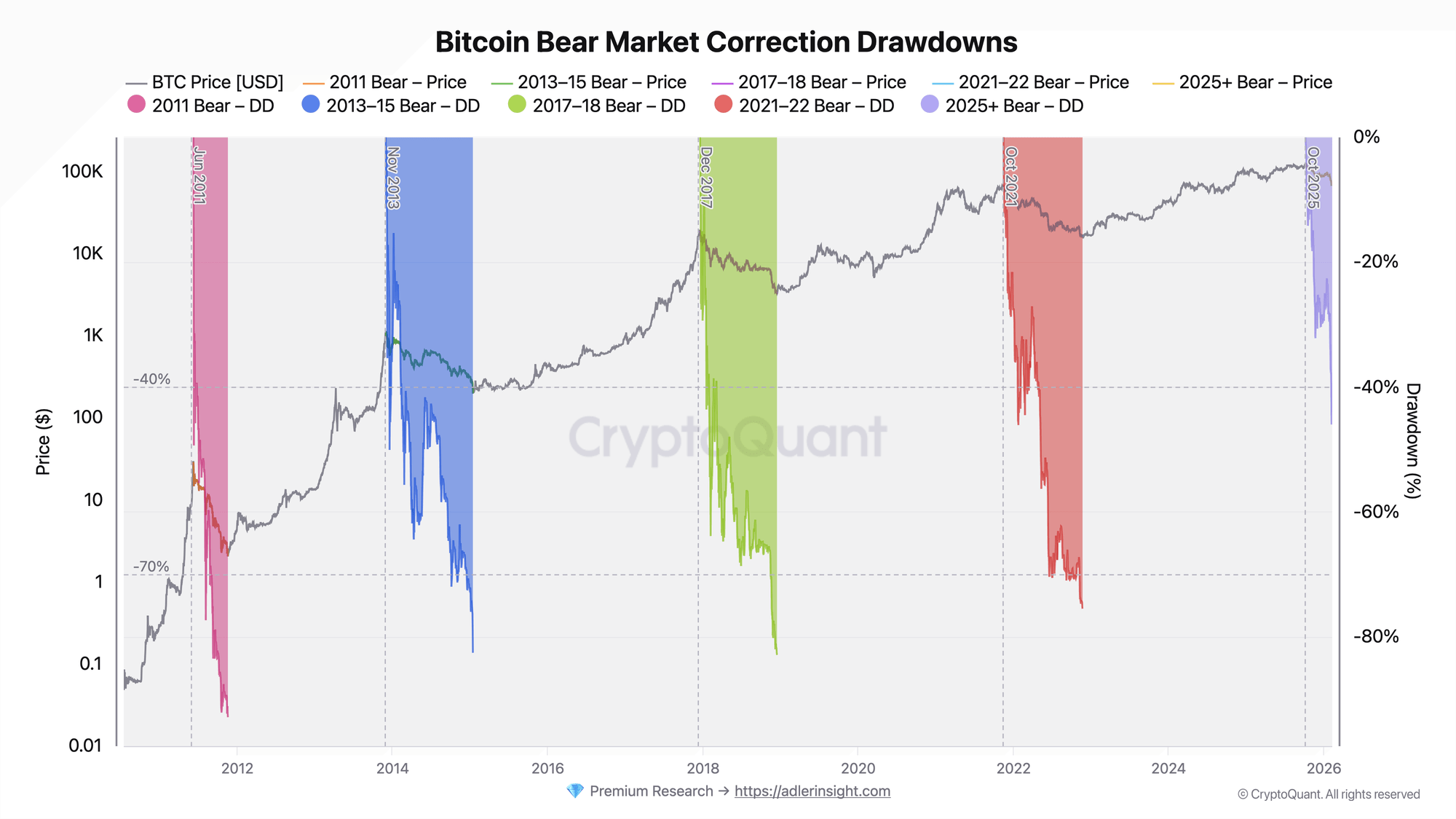
The current bear phase began after Bitcoin topped near $124,450 in October 2025. By November, the market had entered a persistent downtrend, with the correction expanding from roughly −20% to −30% initially before accelerating to around −46% by early February. Notably, the pace intensified sharply: the drawdown moved from approximately −28% on January 28 to −46% by February 6. A modest rebound followed, with price briefly stabilizing near $70,700, still implying a drawdown of roughly −43%.
Historically, earlier cycles saw significantly deeper declines, including roughly −93% in 2011, around −83% in both the 2013–2015 and 2017–2018 bear markets, and about −76% during the 2021–2022 correction. Against that backdrop, the current decline appears less severe so far.
Adler argues that three months of persistent downside momentum signal entry into a deeper corrective phase. Stabilization between −40% and −50% would suggest moderating cycle volatility, while a drop beyond −50% could reopen downside targets toward the −60% to −70% range.