Author: Jae, PANews
The Bitcoin network is undergoing an ideological debate no less intense than the "Block Size Wars" of 2017.
The catalyst is a technical proposal named BIP-110. It attempts, through a soft fork, to draw a red line on the amount of data that can be stuffed into a Bitcoin block. Simply put, it aims to restrict protocols like Ordinals and Runes from "inscribing" images, videos, and even code onto the chain.
The emergence of BIP-110 marks a counterattack launched by the "minimalist" camp, led by developer Dathon Ohm, against the "libertarian" camp.
Supporters call it "setting things right," while opponents denounce it as "extremely conservative." This debate has spread from technical circles to miners, institutions, major node operators, and even caught the attention of community leaders like Adam Back.
This is more than a debate about bytes; it's a battle over defining Bitcoin's value proposition.
BIP-110, Targeting Inscription Protocols Directly
BIP-110 is not a spur-of-the-moment idea; its雏形 (prototype/chrysalis) can be traced back to BIP-444 proposed by Dathon Ohm in October 2025, aiming to temporarily limit the scale of non-monetary data to observe the network's operation under low load.
The initial idea was just to "temporarily observe for a year." But with Bitcoin Core v30 removing the byte limit on OP_RETURN, the fundamentalists could no longer sit still, viewing this as a betrayal of Bitcoin's "monetary function," tantamount to giving a green light to "blockchain spam."
Thus, Dathon Ohm presented the more stringent BIP-110 last December, with constraints harsher than before.
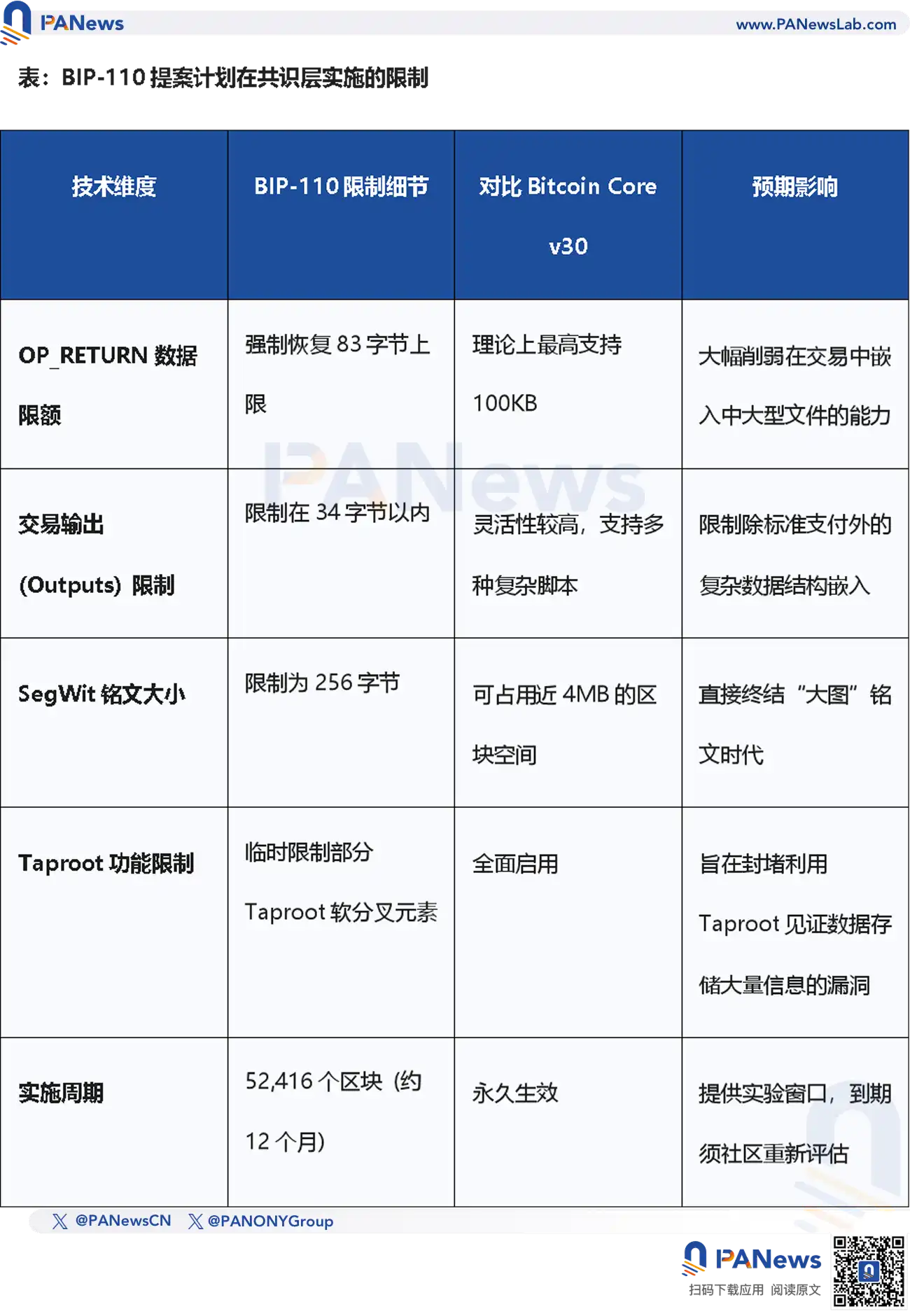
Supporters of BIP-110 believe these limits are not meant to stifle innovation but to restore the technical prudence Bitcoin maintained in its early days. These rules do not affect normal "payment" and "store of value" use cases; their矛头 (spearhead) is pointed directly at non-financial records deemed "data abuse."
55% Activation Threshold Sparks Controversy, Mob Rule or Decentralization?
What truly made the community erupt was BIP-110's activation threshold: support from 55% of the hash rate is sufficient for passage.
In Bitcoin's governance tradition, major consensus changes typically require support from 95% of the miner hash rate to ensure network stability and prevent chain splits. Previously, major upgrades like SegWit and Taproot followed this unwritten rule.
The setting of this threshold has caused significant governance chaos within the community.
The proponent faction argues that the 95% threshold effectively gives a minority a "veto power." The reason spam data can't be cleared is that a minority of stakeholders stubbornly resist. The 55% setting is primarily a "defensive activation" aimed at breaking the deadlock in protocol upgrades.
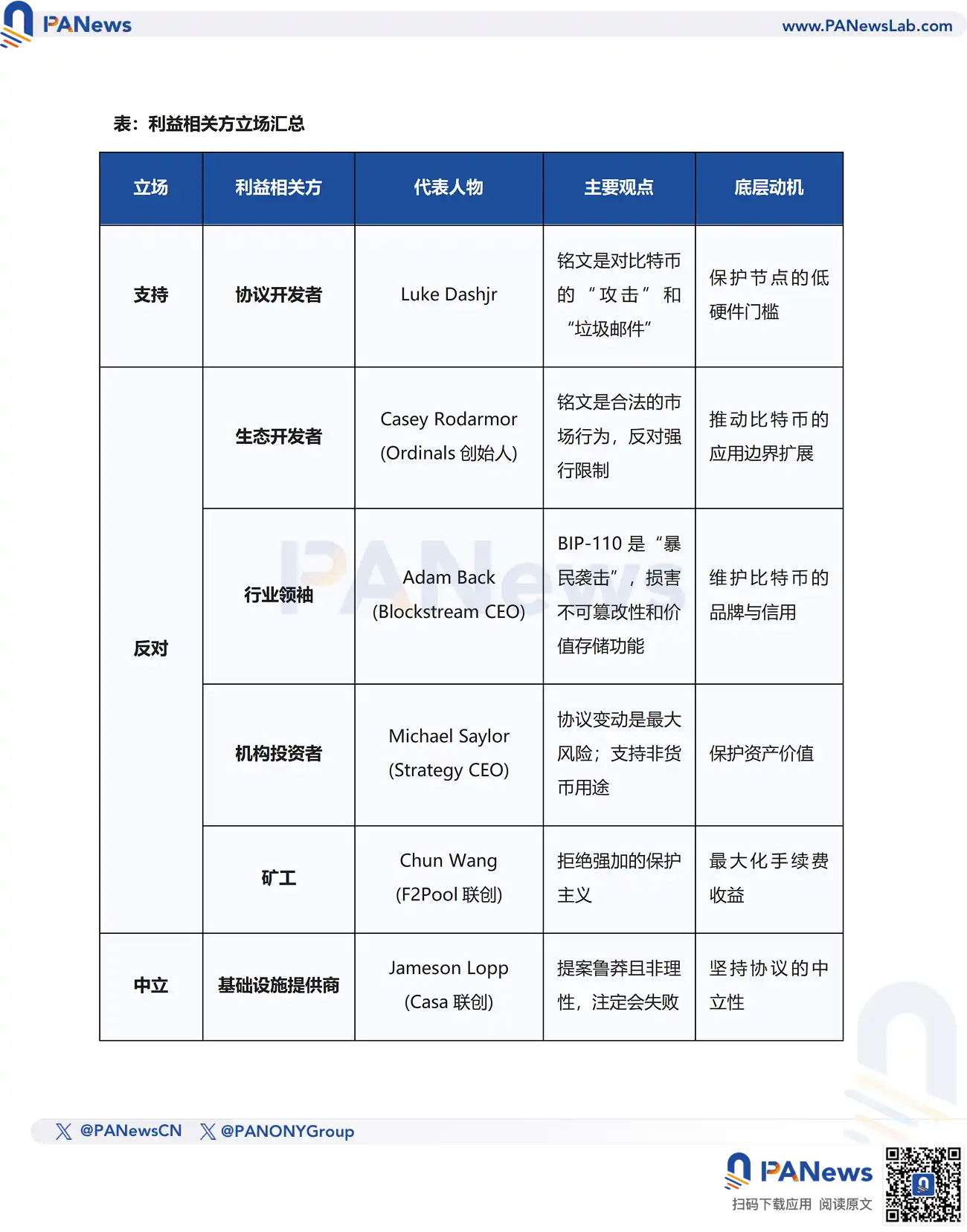
Opposition leader Adam Back accused this of being "a mob attack on Bitcoin's reputation," attempting to force a rule change without broad consensus.
55% means that a simple majority of miners agreeing forces the remaining 45% of miners and users to accept it. This is holding the entire network hostage with a low threshold, easily leading to chain splits and creating two or even multiple Bitcoin assets.
Even more frightening to contemplate is that once this precedent is set, if data can be limited today, could addresses be frozen tomorrow? Bitcoin's "immutability" would then exist in name only.
Camp Standoff, Minimalism Might Cut Off Miners' Revenue Stream
The developer community led by Luke Dashjr and loyal users of the full-node client Bitcoin Knots are the underlying driving force behind BIP-110. Their logic is rooted in concerns about Bitcoin's underlying hardware requirements.
Bitcoin advocate Matthew Kratter compared inscription protocols to ivy, suggesting that while they grow attached to the Bitcoin (tree), they will eventually crush the tree's structure, leading to the death of both.
If block space is filled with images, the blockchain's size will grow exponentially. This means ordinary users will be unable to run full nodes using regular consumer-grade hard drives, leading to the concentration of verification power in the hands of large nodes, undermining Bitcoin's decentralized foundation.
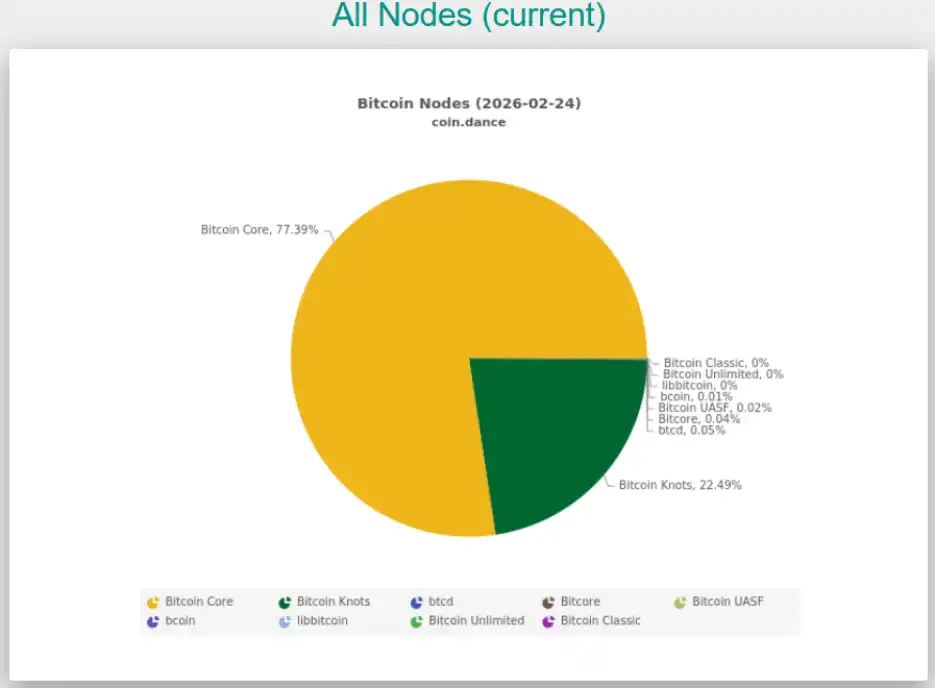
As the controversy fermented, Bitcoin Knots' market share has surged to 22.49%, while the share of the full-node client Bitcoin Core has significantly dropped to 77.39%. This trend indicates that a considerable number of nodes are expressing support for data limits by switching clients.
The opposition camp, consisting of highly influential opinion leaders like Adam Back and miners, has a more star-studded lineup.
MicroStrategy CEO Michael Saylor warned that frequent protocol changes are the biggest threat to Bitcoin.
Blockstream CEO Adam Back also pointed out that Bitcoin's greatest value lies in its immutability. If the rules can be easily changed based on the preferences of a subset of people, then Bitcoin's credibility as "digital gold" will be utterly destroyed.
From an economic perspective, the controversy over BIP-110 also reflects the community's anxiety about Bitcoin's "long-term security budget." As the halving cycles progress, the security of the Bitcoin network will rely increasingly on transaction fees rather than block rewards.
Fee contributions from non-monetary transactions to the Bitcoin network show high volatility. Dune data shows that, as of now, daily fees from inscription protocols have fallen below $10,000, but they contributed nearly ten million dollars in single-day fees in December 2023. Against the backdrop of持续减半 (continuously halving) block rewards, miners do not want to block off any potential revenue stream.
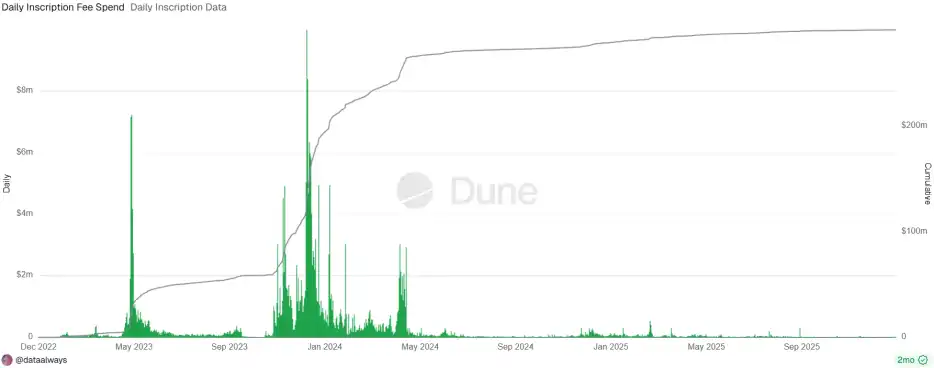
Miners generally believe that the market's cyclical fluctuations should not be a reason to modify the underlying protocol. Once the market recovers, these non-monetary transactions will remain an important source of income for them.
Fee Market Competition is Unfair, Governance Slippery Slope and Legal Risks Coexist
However, the decline in inscription fees has also given the supporting faction ammunition. Since the economic benefits from inscriptions are now minimal, the network optimization brought by cleaning them up (such as reducing UTXO set size, lowering node pressure) seems more cost-effective.
The deeper economic logic supporting BIP-110 lies in: the current SegWit discount mechanism is effectively subsidizing non-monetary transactions. Under the current fee calculation rules, storing 1MB of image data is much cheaper than sending a monetary transaction of the same size.
BIP-110 aims to end this "unfair competition" by setting a data上限 (upper limit) at the consensus layer, forcing these "low-value" data to compete for more expensive non-discounted space, or simply leave the mainnet.
Proponents believe only this can return the fee market to reality, ensuring that monetary transactions truly willing to pay a premium for "global consensus" are prioritized for inclusion.
However, if a proposal like BIP-110, labeled as "temporary + low threshold," is passed, it will break the institutional trust in the Bitcoin network. For institutional investors, the most attractive aspect of Bitcoin is that its rules are immutable.
Once a precedent is set, could asset freezes targeting specific addresses appear in the future? Or mandatory adjustments targeting specific fee rates?
This "governance slippery slope" is the risk most feared by Adam Back and Michael Saylor. For Bitcoin, even a protocol containing垃圾数据 (garbage data) is stronger than a "high-quality protocol" that can be modified at any time. Because the latter is unpredictable, and institutions seek certainty.
Additionally, BIP-110 could render certain existing UTXOs as "dead money," effectively temporarily depriving some users of their property rights. Such behavior, at a legal level, might expose miners to accusations of "interfering with private property."
The emergence of BIP-110 is an inevitable product of Bitcoin's growing pains. Its possibility of activation remains questionable, especially since the 55% threshold traditionally faces huge challenges within the community.
The greatest significance of this debate is: BIP-110 has brought the issue of "data abuse" to the forefront, forcing the community to think, "What exactly should the Bitcoin mainnet carry?"
Bitcoin's greatest value lies not in它永不改变 (it never changes), but in the fact that every change it undergoes has passed the strictest tests. The future Bitcoin might become purer because of this debate, or it might open a new chapter of diversification because of this split.
In this battle to defend the value of digital gold, every user running a node is casting a precious vote about the future with their hard drive and bandwidth.



















