Bitcoin is trading firmly above the $70,000 level and has recently tested the $76,000 region, signaling renewed momentum as activity across the cryptocurrency market intensifies. The move higher suggests that buyers are gradually regaining control after a period of volatility, with traders closely watching whether the current rally can sustain itself as macroeconomic uncertainty continues to shape global markets.
According to a recent CryptoQuant report, Bitcoin has shown a notable degree of resilience despite escalating geopolitical tensions involving Iran, an environment that has contributed to growing instability across several traditional asset classes. In contrast to Bitcoin’s recent strength, both equities and commodities are beginning to exhibit market structures that analysts increasingly describe as potentially topping formations.
This resilience is particularly striking given the broader macro backdrop. The upcoming Federal Reserve FOMC meeting is widely expected to deliver no change in interest rates, with market probabilities currently indicating roughly a 99% chance that policy will remain unchanged. Instead, investors are expected to focus primarily on the Fed’s forward guidance, especially whether policymakers begin to reopen the discussion around the possibility of future rate hikes.
Despite these headwinds, several on-chain and market signals suggest that Bitcoin’s underlying demand dynamics may be beginning to improve.
Buyer Activity Returns to Bitcoin Spot Markets
According to CryptoQuant analyst Darkfost, recent data from the Bitcoin Spot Net Volume Delta chart suggests that market dynamics are gradually shifting back in favor of buyers. The indicator, which tracks the difference between aggressive buying and selling volume in spot markets, shows that demand is slowly returning on major exchanges such as Binance and Coinbase.
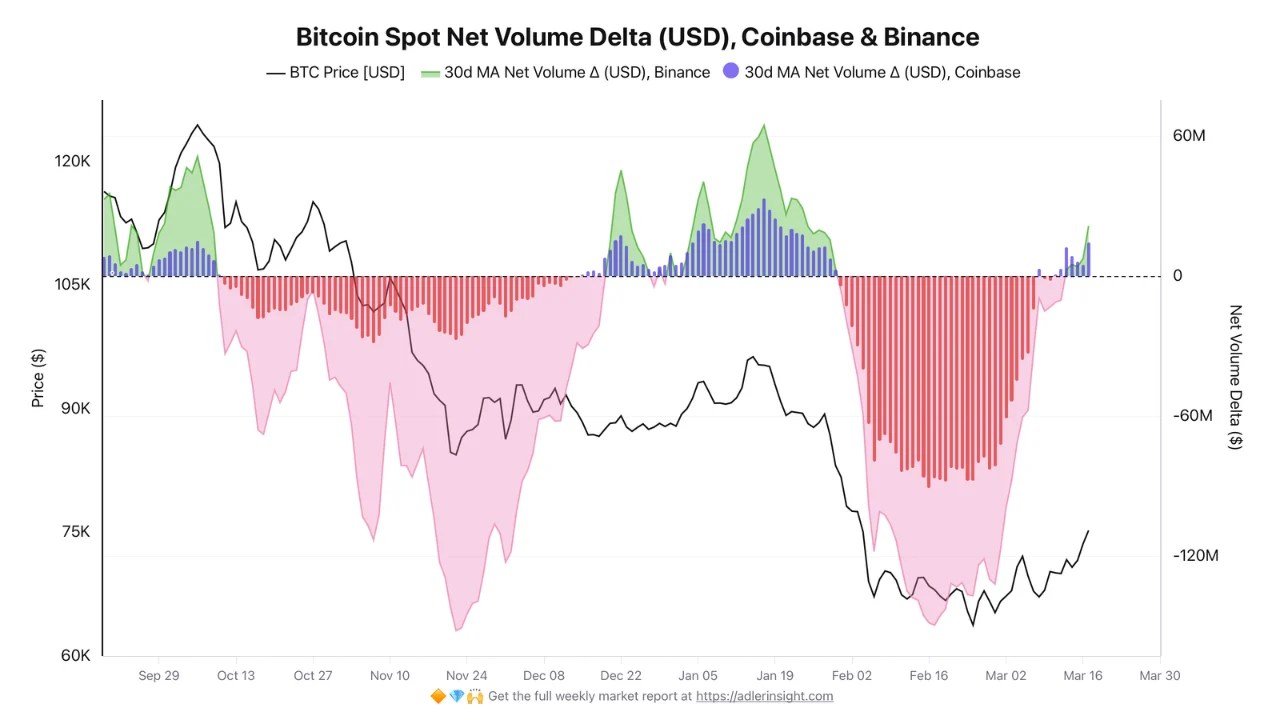
While the change remains relatively modest, it represents a clear improvement compared to the market conditions observed in February, when selling pressure dominated both retail and institutional flows. At that time, the 30-day moving average volume delta was deeply negative, reaching approximately -$145 million on Binance and -$88 million on Coinbase. These readings indicated that most participants were actively selling, reinforcing the broader market weakness seen during that period.
More recently, however, the trend has begun to reverse. The same 30-day averages have now moved back into positive territory, with the delta standing around +$21 million on Binance and +$14 million on Coinbase. This shift suggests that buyers are gradually regaining influence within the spot market.
Even so, Darkfost notes that the signal still requires confirmation. Market liquidity remains relatively thin, meaning that sustained demand will be necessary to solidify the recovery.
If this buyer-driven dynamic continues to strengthen, it could eventually support a breakout from Bitcoin’s current consolidation range.