Bitcoin bulls must defend key level to avoid $76K, say analysts

cointelegraphPubblicato 2025-12-08Pubblicato ultima volta 2025-12-08

Introduzione

Bitcoin is trading at a critical technical support level, the 0.382 Fibonacci retracement zone, which analysts warn must be defended to avoid a potential drop toward April lows around $76,000. A break below this level could disrupt the high time frame market structure. The asset recently experienced a leverage flush, falling briefly below $88,000 before recovering above $91,500, in what was described as weekend manipulation to liquidate both long and short positions. Market attention is focused on the upcoming FOMC meeting, where a 0.25% rate cut is widely expected. However, analysts note that the Fed Chair's cautious tone and data-dependent approach may sustain mild pressure on crypto into year-end. Key to market direction will be the Fed’s outlook statement, with some analysts remaining cautiously optimistic for 2026 due to anticipated further rate cuts. Upcoming economic data could also influence liquidity and potential market rebound.

Bitcoin is currently hovering at a critical technical level that needs to be defended to prevent major losses, according to crypto analyst “Daan Crypto Trades.”

He was referring to the 0.382 Fibonacci retracement zone, which serves as a key area of support and resistance during market cycles.

“I think this is a key area for the bulls to defend,” he said, observing that a break below it could result in a Bitcoin (BTC) fall to April lows around $76,000.

“It’s also pretty much the last major support before testing the April lows again, which would break this high time frame market structure.”

Late on Sunday, Bitcoin was hit with another short leverage flush, with leveraged positions being liquidated on both sides. The asset fell below $88,000 briefly before quickly bouncing back above $91,500.

“This is another example of manipulation on the low-liquidity weekend to wipe out both leveraged longs and shorts,” commented “Bull Theory.”
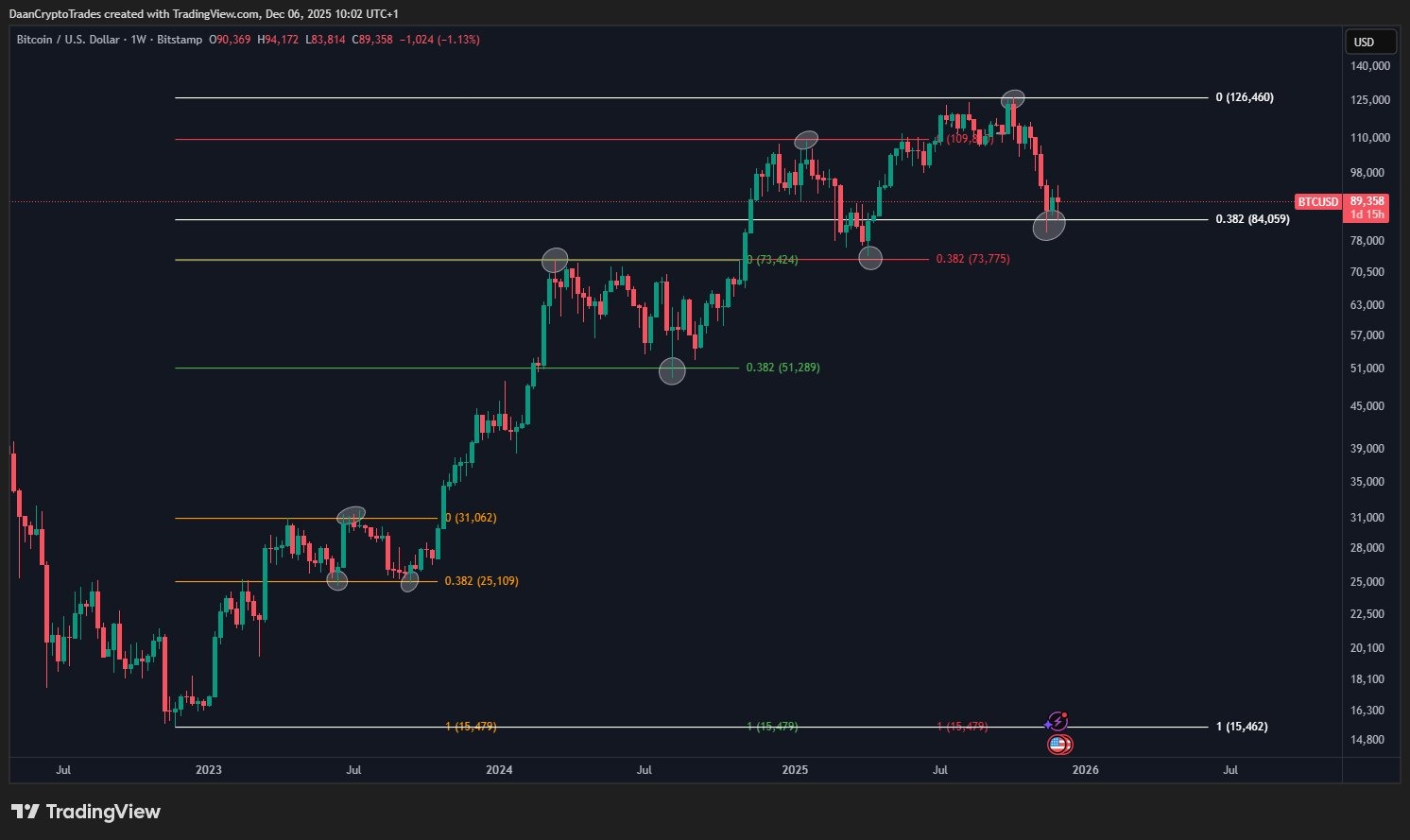
BTC is trading at a key support/resistance zone. Source: Daan Crypto Trades

All eyes are on the Fed meeting this week

The Federal Open Market Committee’s monetary-policy meeting on Tuesday and Wednesday will conclude with a decision on rates, with a 0.25% cut widely expected.

Crypto markets have lost momentum since the October cut, as Fed Chair Jerome Powell “signaled a non-linear, data-dependent easing path rather than a clear-cutting cycle,” 10x Research head Markus Thielen said in a note shared with Cointelegraph.

Related: Bitcoin buries the tulip myth after 17 years of proven resilience says ETF expert

He added that the market now expects a 25-basis-point cut on Dec. 10, followed by a cautious tone, “which would mirror October’s hawkish execution and sustain mild pressure into year-end.”

“With volumes already depressed and ETF flows negative, upside participation remains thin while the $70,000–$100,000 BTC range holds and implied volatility continues to compress, leaving downside risk more pronounced than upside.”

Fed outlook statement will be key

Apollo Capital’s Henrik Andersson echoed the sentiment, telling Cointelegraph that a Fed rate cut this week is already priced in, but the key for the market direction will be the outlook statement. He remained cautiously optimistic for next year.

“However, with the Fed chairman being replaced in May next year, we will likely get more interest rate cuts in 2026, which should be supportive for risk assets, including crypto.”

Director of LVRG Research, Nick Ruck, agreed, telling Cointelegraph that, in addition to the Fed meeting, upcoming jobs and inflation data releases “could unlock renewed liquidity inflows and propel a broader market rebound if they align with expectations for continued monetary easing.”

Magazine: XRP’s ‘now or never’ moment, Kalshi taps Solana: Hodler’s Digest

Letture associate

Altcoin: The ETF Boom Explodes – XRP, SOL, LTC, HBAR, DOGE, LINK, and the Emergence of New Opportunities

While the spotlight has been on Solana (SOL) ETFs, which have attracted approximately $682 million in inflows, XRP ETFs have quietly surpassed them with $874 million, despite launching later. Simultaneously, a new wave of altcoin ETFs for LTC, HBAR, DOGE, and LINK has entered the market, each recording modest but stable inflows since their debut. Seven separate Solana ETFs have generated $618.62 million in net inflows, holding $915.08 million in assets under management, representing about 1.15% of Solana's market cap. In contrast, four XRP ETFs have attracted $874.28 million, with Canary's XRPC leading at $357 million. The newly launched altcoin ETFs for LINK, HBAR, LTC, and DOGE have collectively seen $133.46 million in net inflows. Grayscale's GLNK attracted $40.90 million, Canary's LTCC (Litecoin) drew $7.67 million, and its HBR (HBAR) ETF recorded $82.04 million. Two DOGE ETFs brought in $2.85 million. This expansion signals a new market phase of diverse choices and intense competition. However, these new altcoin ETFs remain far behind the established Bitcoin and Ethereum ETFs in terms of total capital. Amid this ETF boom, Bitcoin Hyper (HYPER) is emerging as a potential altcoin outside the traditional ETF scope. It's a Bitcoin Layer-2 project built on the Solana Virtual Machine (SVM), combining Solana's speed with Bitcoin's security. Having raised nearly $29 million in its presale, it offers a fixed supply of 21 billion tokens and 40% staking APY, positioning itself to unlock Bitcoin's potential in DeFi.

bitcoinist5 min fa

Altcoin: The ETF Boom Explodes – XRP, SOL, LTC, HBAR, DOGE, LINK, and the Emergence of New Opportunities

bitcoinist5 min fa

Polymarket Revival: The Mainstreaming of Crypto Prediction Markets and Future Prospects

Polymarket, a crypto-based prediction market platform, has made a significant comeback in 2025 by re-entering the U.S. market through regulatory-compliant means, including the acquisition of regulated trading and清算 entities. This resurgence is further supported by institutional capital investment and integration with mainstream platforms like the MetaMask wallet, allowing users to trade directly without leaving their wallets. Mainstream financial data platforms have also begun displaying prediction market data, increasing market visibility. Once viewed primarily as a gambling or speculative platform, Polymarket is increasingly recognized as a mechanism for information pricing in financial markets. Widespread participation from both retail and institutional users has made its probability assessments of future events more representative and liquid. Prediction market data is now being incorporated by traditional financial media and data platforms, highlighting its growing potential. However, challenges remain. Prediction markets are not always accurate, with studies showing limited predictive reliability in certain contexts. Questions about platform neutrality and business models have emerged, such as the employment of internal market makers, which could undermine trust. Information asymmetry and insider risks are inherent, potentially disadvantaging ordinary users when some participants access information early. Regulatory, tax, and disclosure requirements also present ongoing uncertainties. The revival and transformation of Polymarket signify a broader shift of prediction markets from niche experiments toward mainstream financial infrastructure. By converting public expectations into tradable probabilities, these markets may complement traditional analysis and polling, providing real-time, decentralized signals in areas like macroeconomics, policy, technology, and geopolitics. As traditional financial institutions invest in compliance and structured products, DeFi is evolving beyond an alternative asset pool to resemble traditional financial infrastructure. Prediction market applications are expanding beyond crypto to potentially include stocks, macroeconomic indicators, sports events, and tech product launches, tightening the link between crypto and the real world. If platforms like Polymarket continue on a path of compliance, stable operation, and integration with mainstream financial services, they could become next-generation market infrastructures—event-driven financial tools alongside stocks, bonds, and options. Key factors for development include platform neutrality, prediction accuracy, regulatory environment, participant diversity, and the maturity of related financial products. In summary, Polymarket’s comeback represents a move of prediction markets from the fringe into the core of financial systems, reflecting deeper changes in how information is priced and how financial infrastructure is rebuilt. This shift brings not only new trading methods but also potential changes in how investors perceive and engage with future events and asset valuation.

cointelegraph_中文42 min fa

Polymarket Revival: The Mainstreaming of Crypto Prediction Markets and Future Prospects

cointelegraph_中文42 min fa

Trading

Spot
Futures
活动图片