BIP-110 Could Split Bitcoin In New Soft Fork Fight, Jameson Lopp Warns

bitcoinistPubblicato 2026-02-25Pubblicato ultima volta 2026-02-25

Jameson Lopp is escalating his criticism of BIP-110, arguing the proposal could trigger a disruptive Bitcoin chain split while failing to stop the behavior it is meant to curb. In a Feb. 23 post, Lopp frames the plan as a consensus-layer response to a policy and cultural dispute around transaction “spam,” with risks that extend well beyond mempool debates.

BIP-110 is pitched as a soft fork led by Luke Dashjr that would temporarily restrict arbitrary data in transactions. Lopp summarizes it as adding seven new transaction-validity restrictions, including limits on where data can be placed and constraints on certain script behavior, but says the tradeoffs are far more severe than supporters admit. He calls the proposal “reckless and doomed to fail,” setting the tone for a post that is less a technical explainer than a warning about governance and coordination risk.

Why Lopp Thinks The Activation Path Is Dangerous For Bitcoin

The core of Lopp’s argument is not just what BIP-110 changes, but how it tries to activate. He points to the proposal’s 55% miner-signaling threshold for a user-activated soft fork and says that low bar materially increases the probability of two competing chains if the ecosystem is not aligned.

He also stresses that BIP-110 nodes would reject non-compliant blocks outright, which raises coordination risk compared with soft forks that old nodes can continue to follow without enforcement conflicts.

Lopp is especially pointed on the mandatory activation posture at block height 961,632. In one of the sharpest passages, he writes: “This is not a neutral, low-drama deployment posture. It’s dogmatic bullying. [...] you cannot pretend it’s low-risk.” He ties that warning to a broader point: even if one views UASF tactics as legitimate, the proposal’s design increases the odds of a messy failure mode if miners, exchanges, wallets, and infrastructure providers do not converge in time.

He also pushes back on comparisons to 2017, noting that the UASF many people cite in the SegWit era never actually had to run to the edge because SegWit activated via miner signaling instead. That distinction matters in Lopp’s framing, because BIP-110 proponents are, in his view, leaning on a historical precedent that did not test the exact scenario they now describe as manageable.

Another major section of Lopp’s post targets the claim that BIP-110 has meaningful grassroots momentum. He argues that raw node counts (roughly 20% run Knots) are a weak proxy for consensus because signaling is cheap, node operation can be low-cost, and Tor addresses are “effectively zero” cost to create at scale. He publishes a breakdown of reachable nodes and highlights the higher Tor-to-IPv4 ratio among Knots and BIP-110 signaling nodes as a reason to treat node-count narratives cautiously.

On mining support, Lopp says the gap is more straightforward. At the time of publication, he writes miner signaling was “precisely [...] zero,” and he cites public opposition from F2Pool while arguing miners have limited incentive to back a proposal that could reduce fee revenue. That point reinforces his broader thesis that BIP-110 supporters are overestimating social signaling and underestimating the role of economically significant actors in Bitcoin upgrade politics.

Lopp’s post ultimately reads as a warning that the immediate issue is not simply whether BIP-110 activates, but what the campaign reveals about where Bitcoin’s internal dispute over neutrality, censorship resistance, and block-space usage is heading. Even a failed fork push, in his framing, can still impose real costs by forcing operators and businesses to plan around low-probability but high-impact coordination failure.

At press time, Bitcoin traded at $62,791.
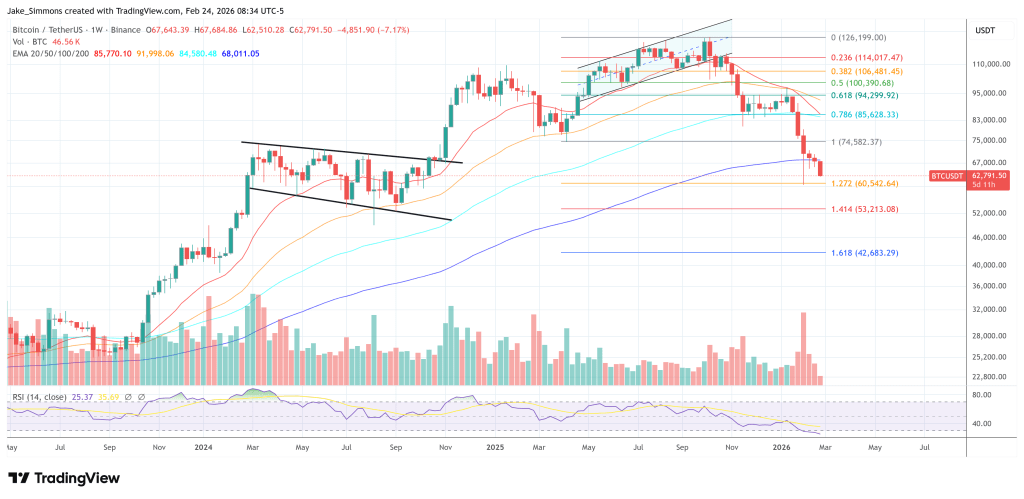
Bitcoin falls below $63,000, 1-week chart | Source: BTCUSDT on TradingView.com

Domande pertinenti

QWhat is the main concern Jameson Lopp raises about BIP-110?

AJameson Lopp's main concern is that BIP-110 could trigger a disruptive Bitcoin chain split due to its low 55% miner-signaling threshold for activation and its design that increases coordination risks, while failing to effectively stop the 'spam' behavior it aims to curb.

QHow does BIP-110 propose to activate, and why does Lopp find this dangerous?

ABIP-110 proposes a user-activated soft fork (UASF) with a 55% miner-signaling threshold. Lopp finds this dangerous because the low activation threshold and the node's policy of outright rejecting non-compliant blocks significantly increase the probability of creating two competing chains if the broader Bitcoin ecosystem is not fully aligned.

QWhat does Jameson Lopp say about the grassroots support for BIP-110?

ALopp argues that the raw node count signaling support for BIP-110 is a weak proxy for consensus. He highlights that a high percentage of these nodes are on the Tor network, which are cheap to create at scale, and cautions against overestimating this form of social signaling, especially since miner support was precisely zero at the time of his writing.

QAccording to Lopp, why is the comparison to the 2017 SegWit UASF flawed?

ALopp states the comparison is flawed because the 2017 SegWit UASF never actually had to run to its full extent; SegWit activated via miner signaling before the UASF was triggered. This means the historical precedent did not test the high-risk scenario of a contentious chain split that BIP-110 proponents are now describing as manageable.

QWhat is the broader implication of the BIP-110 debate, beyond the proposal itself?

AThe broader implication is that the debate reveals a deepening internal conflict within Bitcoin over core principles like neutrality, censorship resistance, and block-space usage. Even if BIP-110 fails, the campaign forces operators and businesses to incur real costs by having to plan for a low-probability but high-impact coordination failure.

Letture associate

OpenAI's 'Blueprint for the Future': Making AI Beneficial for Every Person on the Planet

A new transformative technology emerges every few generations. OpenAI draws a parallel with the advent of electricity in the 1920s, which initially brought convenience but ultimately enabled unprecedented progress in medicine, engineering, and living standards by empowering people to create new possibilities. AI is poised to recreate this phenomenon. Its true significance lies not in the technology itself, but in what people can achieve with it—from understanding a medical bill or starting a business to aiding scientific discovery. OpenAI believes AI should be universally accessible, allowing everyone to use it according to their own needs. This future, however, is not guaranteed. While transformative tech can centralize power, OpenAI's philosophy is that AI must serve humanity, augmenting human capabilities and broadly distributing its benefits. The company's first commitment is to build AI for human service, aiming to empower the many rather than concentrate power in a few. Safety, alignment with human intent, and oversight are paramount. OpenAI is optimistic about AI's potential to expand human welfare but remains clear-eyed about risks. The goal is to help people achieve more, not to replace them. Full automation is not the desired future; human judgment, values, and direction will become even more critical. OpenAI outlines three core goals: 1. Build automated AI researchers to accelerate and increasingly automate the research process itself, maintaining close human collaboration. The internal projection is that by March 2028, a significant portion of their research will be conducted by AI systems working alongside human researchers. 2. Accelerate economic development by advancing science, boosting productivity, and fostering growth, while ensuring the fruits are widely shared. 3. Provide a personal AGI for everyone on Earth, allowing individuals to benefit from this transformative technology in their own way. The company is entering its third phase, moving from foundational AGI research (Phase 1) to product deployment and learning from real-world use (Phase 2). The current challenge is making advanced AI abundant, affordable, safe, practical, and usable for all individuals and organizations. OpenAI concludes that a widely distributed power structure leads to a more resilient, adaptable, and free society. A positive AI future should not be controlled by a handful of entities but built, benefited from, and owned by many. If realized correctly, AI can become a cornerstone for enhancing global productivity, creativity, scientific advancement, and economic opportunity, fulfilling the mission to ensure AGI benefits all of humanity.

marsbit31 min fa

OpenAI's 'Blueprint for the Future': Making AI Beneficial for Every Person on the Planet

marsbit31 min fa

Arthur Hayes' New Article: AI Bubble Nears Bursting, Crypto Market Faces Short-Term Pressure

In a new essay, Arthur Hayes argues that the AI market bubble is approaching a rupture, which will place significant short-term pressure on crypto assets. He identifies rising oil prices, a trio of massive tech IPOs (SpaceX, Anthropic, OpenAI), and potential anti-AI political rhetoric from Trump as the three key catalysts for a correction. Hayes posits that the prolonged blockage of the Strait of Hormuz will drive energy prices higher, increasing operational costs for data centers and squeezing AI company profits. Simultaneously, the market may struggle to absorb the upcoming wave of multi-trillion dollar tech IPOs. Furthermore, with high inflation hurting his election chances, Trump could pivot to attacking the AI sector with proposals for heavy taxation and regulation to win over voters, spooking the market. Hayes notes that nearly all new dollar liquidity since 2022 has flowed into the AI sector, leaving little for Bitcoin, explaining its recent underperformance. He believes an AI stock crash would trigger a broad risk-off sentiment and credit contraction, dragging down crypto in the near term. Consequently, his fund, Maelstrom, has sold all AI-related stocks and non-core cryptocurrencies, retaining only Bitcoin and Ethereum while building positions in traditional energy stocks. He anticipates Bitcoin will bottom and resume its bull run only after the AI bubble pops and a new monetary easing cycle begins.

marsbit34 min fa

Arthur Hayes' New Article: AI Bubble Nears Bursting, Crypto Market Faces Short-Term Pressure

marsbit34 min fa

Trading

Spot
Futures
活动图片