Big Short Prototype: Trillion-Dollar AI Investment Started on the Wrong Path from the Beginning

marsbitPubblicato 2026-03-02Pubblicato ultima volta 2026-03-02

Introduzione

Michael Burry draws a parallel between a 19th-century case study and modern AI development to argue that the current path of large language models (LLMs) is fundamentally flawed. He references an 1880 article from the Smithsonian about Melville Ballard, a deaf man who, without formal language, engaged in complex abstract reasoning about the origins of the universe, life, and God. This story demonstrates that true reasoning and understanding exist prior to and independent of language. Burry contends that by prioritizing language processing over the development of genuine reasoning capabilities, LLMs are merely creating sophisticated mirrors of data, not true understanding. They operate in an intermediate zone, simulating reasoning but lacking the innate rational capacity that precedes language. This "language-first" approach, driven by immense computational brute force, leads to inherent flaws like hallucinations and an inability to achieve real comprehension. The proposed solution is a shift towards a "reasoning-first" architecture, which would focus on compressing information and utilizing System 2 reasoning to drastically reduce computational needs. Burry suggests that true AI must pass a "Ballard Test": demonstrating rational thought without language. He concludes by linking this technological critique to a cyclical pattern of speculative investment booms, comparing the current AI hype to the 19th-century mining speculation in San Francisco, warning of an inevitable bust...

Author: Michael Burry

Compiled by: Deep Tide TechFlow

The New York Times, Saturday, June 19, 1880

Welcome to the "History Always Rhymes" series. In this series, I illuminate current events from the key perspectives of the distant past.

On a quiet Saturday, as I was perusing old newspapers—a hobby of mine—I came across a report from June 19, 1880, which has a startling relevance to our current anxieties about AI.

This is the story of Melville Ballard. He grew up without language, yet by staring at a tree stump, he asked himself a question: Did the first man grow from here?
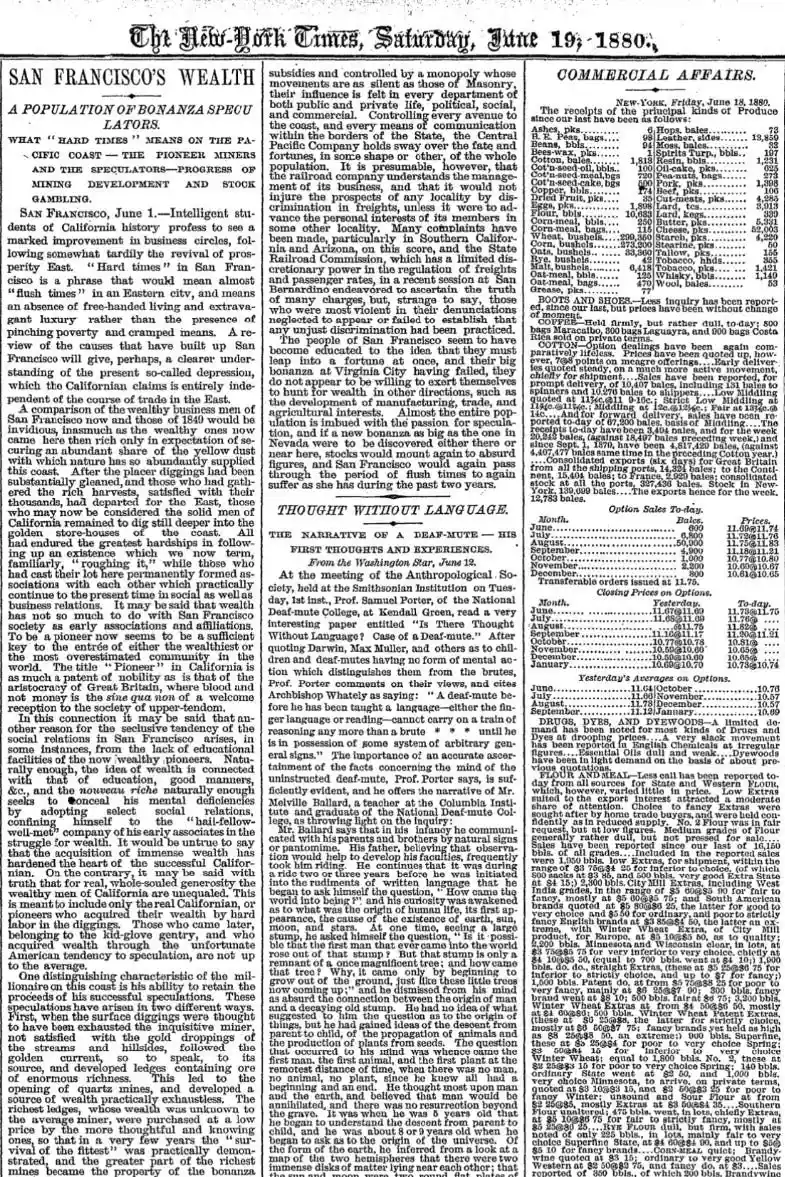
This case from 144 years ago—officially presented at the Smithsonian Institution—poses a potentially fatal challenge to today's large language models and the massive investments behind them. Through the story of an ordinary person, it boldly declares: complex thought is born in the silence that precedes language.

Today, deep in the 21st century, by placing language before rational capacity, we are not building intelligence—we are merely crafting an increasingly refined mirror.

In that old newspaper, two articles are worth noting. Let's start with the one in the middle of the third page, titled: "Thought Without Language."

Of course, large language models, small language models, and reasoning capabilities are the hottest topics right now.

The full title of that article was: "Thought Without Language—A Deaf-Mute's Account of His Earliest Thoughts and Experiences." It was first published in The Washington Star on June 12, 1880.

The subject was Professor Samuel Porter of the Kendall Green National Deaf-Mute College, who presented a paper at the Smithsonian Institution titled, "Can There Be Thought Without Language? A Case of a Deaf-Mute."

The paper began by discussing the mental activities of deaf-mutes and children without linguistic forms, using terminology far behind today's standards, and I was about to skip it.

But the case's subject was a teacher at the Columbia Institution for the Instruction of the Deaf and Dumb—Melville Ballard himself, a deaf-mute and also a graduate of the National Deaf-Mute College.

Ballard said that in his childhood he communicated with his parents and brothers through natural gestures or pantomime. His father believed observation would develop his intellect and often took him out riding.

He continued: Two or three years before he was formally introduced to the basics of written language, during one of these rides, he began to ask himself: "How did the world come to be?" He developed a strong curiosity about the origin of human life, its initial appearance, and the reason for the existence of the earth, sun, moon, and stars.

Once, he saw a large tree stump and a question arose in his mind: "Could the first man to come into the world have grown from that stump?" But then he thought, that stump was just the remnant of a once majestic tree; how did that tree come to be? It grew slowly from the ground, just like the small saplings before him—he then dismissed the idea of linking human origin to a decayed old stump as absurd.

He didn't know what triggered his inquiry into the origin of all things, but he had already established concepts of parental inheritance, animal reproduction, and plants growing from seeds.

The question truly lingering in his mind was: At the most distant beginning, when there were no people, no animals, no plants, where did the first man, the first animal, the first plant actually come from? He thought most about people and the earth, believing that people would eventually perish, with no resurrection after death.

Around the age of 5, he began to understand the concept of parental inheritance; by 8 or 9, he began to question the origin of the universe. Regarding the shape of the earth, he inferred from a map of two hemispheres that they were two huge material disks, adjacent to each other; the sun and moon were two circular luminous plates, and he felt a certain awe towards them, inferring from their rising and setting that there must be something with power governing their paths.

He thought the sun entered a hole in the west and emerged from another hole in the east, traveling through a huge pipe inside the earth along the same arc it traced in the sky. The stars, in his eyes, were tiny points of light embedded in the celestial curtain. He described how he pondered all this in vain until he entered school at age 11.

Before that, his mother had told him about a mysterious being in the sky, but when she couldn't answer his further questions, he could only give up in despair, filled with sadness because he couldn't gain any definite knowledge about that mysterious celestial life.

In his first year at school, he only learned a few sentences each Sunday, and although he studied these simple words, he never truly understood their meaning. He attended services, but due to insufficient mastery of sign language, he understood almost nothing. In the second year, he had a small catechism with a series of questions and answers.

The combination of language and rational capacity thus propelled the development of understanding.

Thereafter, he was able to understand the sign language used by the teachers. One might think his curious nature should have been satisfied. This was not the case—when he learned that the universe was created by that great ruling Spirit, he began to ask: Where did the Creator come from? He continued to pursue the nature and origin of that Ruler. Thinking about this, he asked himself: "After we enter the Lord's kingdom, can we know God's essence and understand His infinity?" Should he, like that patriarch, say: "Can you find out the deep things of God?"

Professor Porter then presented his core argument to the 1880 Smithsonian audience.

He said that animals might understand certain words and distinguish certain objects. But he pointed out:

"Even granting all the possibilities possessed by animals, is it not obvious—that man possesses some faculties which we cannot conceive of as developed from anything held in common with the lower animals, nor as merely an enhancement in degree of those common traits."

"...However similar the mode of impression or the structure of the organs, however dependent on organic activities—that is, however closely connected physiologically—the perception of the eye, as a sensation or perception, is inherently different from that of the ear, head, or tongue, and implies a special gift or faculty not contained in the latter. Rational action and the operation of the lower faculties are not so."

"...That the two share certain elements does not prove they belong to the same order, nor make it possible for one to develop into the other. If the soul's eye—that higher reason which enables us to discern the universe of things—cannot look inward and clearly distinguish its own nature and operations, we should not therefore forget its function, deny its essential superiority, or equate it with those lower, subordinate faculties which we can use it to examine. That which enables us to understand all things must, in its essence, be superior to anything understood by it."

One audience member particularly noted that Ballard's eyes, above all, perfectly conveyed meaning, without any misunderstanding:

"The most interesting part of the meeting was Mr. Ballard's description in gesture of how his mother told him he was going to a faraway school where he would read from books and write letters to fold and send to her; and the pantomime of a hunter who, after shooting a squirrel, accidentally shot himself. Mr. Ballard's gestures and movements, along with his eyes and facial expressions, perfectly conveyed his meaning to the audience. In the words of one member, the expression of the eyes is a language that cannot be misunderstood."

Consider these two sentences:

  • "That which enables us to understand all things must, in its essence, be superior to anything understood by it."
  • "The expression of the eyes is a language that cannot be misunderstood."

To summarize:

  • Language without rational capacity cannot achieve understanding
  • Only when rational capacity exists can language unlock understanding
  • Fully realized understanding transcends language itself

Large language models place language first, building a primitive form of reason purely through logical inference. But this reason has proven flawed, prone to hallucinations at the many rough edges of knowledge.

Rational capacity never truly exists within them. Therefore, language cannot be sublimated into understanding through reason.

The professor, in his work with deaf-mutes, found: true rational capacity must precede language for language to unlock understanding—understanding is the result produced by true rational capacity and language together.

"The expression of the eyes is a language that cannot be misunderstood."

In other words, the expression of the eyes is the form of perfect understanding—without the need for language.

Large language models, by placing language before true rational capacity, can never reach understanding.

If understanding truly transcends language—as revealed in this Smithsonian presentation 144 years ago—we shouldn't have trouble finding evidence for it today.

I can appreciate this from my own study and practice of medicine. Throughout pre-med courses and most of medical school, deductive logic is the tool students use to organize the vast body of medical knowledge. Entering the clinical phase, the art of medicine—physical signs, emotions, human expertise—develops. Then, at some point during residency or early practice, with the accumulation of much of this experience, understanding finally arrives. All the parts connect with each other in a vast, complex network, allowing experienced physicians to provide complete patient care.

Two surgeons handling a complex head and neck cancer surgery or trauma, or the nurses working with them, can sometimes communicate with just a glance—complete understanding is conveyed, action is triggered, because everyone present has reached an understanding that transcends logical inference and the primitive reasoning forms of memorization and puzzle-solving from early medical education.

The glance thus provides an intuitive grasp of reality, built on shared understanding, which in turn comes from rational capacity in the presence of language.

Large language models—and small language models—are permanently stuck in the middle. They can simulate reasoning, but lack true rational capacity, lack eyes, lack understanding.

The Ballard Test: An entity must demonstrate reason without language to truly possess understanding.

This is a known flaw, a bad starting point. The initial direction of AI research was to generate true rational capacity first, but this was never achieved, so the field turned to language-first—because it was easier.

This "bad starting point" led to a "parameter trap": brute-force language processing powered by countless power-hungry chips has become an extremely ironic bottleneck.

As highlighted in my conversation with Klarna founder Sebastian Siemiatkowski, the way forward lies in compression—prioritizing "System 2" reasoning, digesting information redundancy and the relatively limited set of queries generated by humans, thereby drastically reducing computational demands.

This new path rejects the route of language models talking to each other in an infinite mirror pursuit of the singularity—a directionless waste of resources and, lacking support from economic reality, ultimately impossible.

Cutting-edge research like Google's AlphaGeometry and Meta's Coconut is shifting towards this "reason-first" architecture, but they are essentially rediscovering what was presented at the Smithsonian 144 years ago: Language is the output of understanding, not the engine of reason.

This multi-trillion-dollar "compute myth" might be broken by a return—a return to the silence of pre-linguistic reason. It is the return of the full-bandwidth rational capacity of the deaf-mute, whose silent thoughts reached for the stars in the firmament before finding the words to express them.

Silicon Valley

As mentioned earlier, there was another noteworthy article on the same page. Its relevance to the first is greater than anyone in the 1880s could have imagined.

This article was called: "The Wealth of San Francisco: A City Full of Speculators Who Get Rich Quick."

It was written in San Francisco on June 1, 1880, but not published in The New York Times until June 19.

The French saying comes to mind: "The more things change, the more they stay the same." It feels apt here.

"What San Francisco calls 'hard times' might mean 'quite comfortable days' in Eastern cities, referring to a lack of extravagance and lavish spending, rather than poverty and dire straits."

California at that time was a paradise for small-scale capital players. To satisfy the desire for speculation, a unique open bidding system emerged: for just $50, you could buy a share in a mine, at one dollar per share, or two shares for fifty cents, or any quantity at different prices.

When a certain stock "boomed," it seemed only to fuel the urge to "do it again." It ignited the same speculative fervor in San Francisco, with people vying to chase the lost opportunities of the get-rich-quick groups; the "boom" came with market losses, the "boom" faded, and stock prices returned to normal.

The article's conclusion hits remarkably hard on today's reality:

San Franciscans seem to have grown accustomed to the notion that wealth must be obtained in one fell swoop, and after their big get-rich-quick scheme in Virginia City fell through, they seemed unwilling to rouse themselves to seek wealth in other directions like manufacturing, trade, and agriculture. Almost the entire city is filled with speculative enthusiasm, and if a new bonanza mine as big as Nevada's were discovered here or nearby, stock prices would again soar to absurd heights, San Francisco would again experience those get-rich-quick years, and then again endure everything it has suffered the past two years.

In my article "The Core Sign of a Bubble: Greed on the Supply Side," I traced this astonishing tendency originating from the San Francisco Bay Area: speculation constantly heats up, driving investment far beyond what any anticipated end demand could absorb in any reasonable timeframe.

Reading such old newspapers allows us to interpret today's events from a unique perspective. Whether Silicon Valley will "again experience those get-rich-quick years, and then again endure everything," as it has done time and again, or whether it will break the pattern—no one can say for sure. I hope this article has been beneficial to you.

Finally, I want to recommend Midjourney, a tool for generating images and videos, to the readers.

It's incredibly fun and thought-provoking. Get creative!
Until next time!

Domande pertinenti

QWhat is the core argument presented by Michael Burry regarding current AI investments?

ABurry argues that the current approach of prioritizing language processing over genuine reasoning capabilities in AI development is fundamentally flawed, leading to systems that can mimic but not truly understand, resulting in hallucinations and inefficient resource use.

QWho was Melville Ballard and why is his story significant to the AI discussion?

AMelville Ballard was a deaf-mute individual from the 19th century who developed complex abstract thoughts about existence and cosmology without formal language. His case demonstrates that reasoning and understanding can exist prior to language, challenging the language-first approach of current AI models.

QWhat does the 'Barrett Test' propose as a measure of true understanding in AI?

AThe 'Barrett Test' proposes that an entity must demonstrate reasoning capabilities without relying on language to be considered truly capable of understanding, emphasizing that genuine intelligence precedes linguistic expression.

QHow does Burry connect the historical speculation in 1880s San Francisco to modern AI investments?

ABurry draws a parallel between the speculative frenzy in 1880s San Francisco mining stocks and today's AI investment boom, highlighting how both are driven by irrational exuberance and overinvestment without realistic economic foundations, leading to inevitable bust cycles.

QWhat alternative approach does Burry suggest for future AI development?

ABurry advocates for a 'reasoning-first' architecture that prioritizes genuine cognitive capabilities and compression of information, reducing computational waste and moving away from the inefficient 'language-first' model that dominates current AI research.

Letture associate

Will the Fed Still Cut Interest Rates? Tonight's Data Is Crucial

The core debate surrounding the Federal Reserve's potential interest rate cuts is intensifying amid geopolitical conflict and rebounding inflation. The key question is whether high energy prices will cause persistent inflation or weaken consumer demand enough to force the Fed to cut rates. Citigroup presents a bullish case for cuts, arguing that oil supply disruptions from the Strait of Hormuz are temporary and will not lead to lasting inflationary pressure. They point to receding bond yields and oil prices as evidence the market is pricing in a short-lived shock. Citi's data also shows tightening financial conditions, a stabilizing labor market, and healthy tax returns, supporting their view that the path to lower rates remains open. Conversely, Deutsche Bank offers a starkly contrasting, more hawkish outlook. They argue the Fed's current policy is already neutral and expect rates to remain unchanged indefinitely. Their view is based on stalled disinflation progress and a shift toward more hawkish rhetoric from key Fed officials like Waller, who cited risks from prolonged Middle East conflict and tariffs. Other officials, including Williams and Hammack, signaled rates would likely stay on hold for a "considerable time." The market pricing has shifted dramatically, now forecasting zero cuts in 2026. The imminent release of the March retail sales "control group" data is highlighted as a critical test. This metric, which excludes gas station sales, will reveal if high gasoline prices are eroding consumer spending in other areas. A weak reading could support the case for imminent rate cuts, while a strong one would bolster the argument for the Fed to hold steady. This data is pivotal for determining the near-term policy path.

marsbit3 min fa

Will the Fed Still Cut Interest Rates? Tonight's Data Is Crucial

marsbit3 min fa

The Second Half of Macro Influencer Fu Peng's Career

Fu Peng, a prominent Chinese macroeconomist and former chief economist of Northeast Securities, has joined Hong Kong-based digital asset management firm Bitfire Group (formerly New Huo Group) as its chief economist. This move, announced in April 2026, triggered an 11% surge in Bitfire's stock price. Fu, known for his accessible macroeconomic commentary and large social media following, will focus on integrating digital assets into global asset allocation frameworks, particularly combining FICC (fixed income, currencies, and commodities) with cryptocurrencies for institutional clients. His career includes roles at Lehman Brothers and Solomon International, with significant influence gained through public communication. However, in late 2024, Fu faced temporary social media bans after a controversial private speech at HSBC on China's economic challenges, though he denied regulatory sanctions. He later left Northeast Securities citing health reasons. Bitfire, a licensed virtual asset manager serving high-net-worth clients, seeks to build trust and attract traditional capital through Fu’s expertise and credibility. The partnership represents a strategic shift for both: Fu enters the crypto sector after a traditional finance peak, while Bitfire aims to leverage his macro framework for institutional adoption. Outcomes remain uncertain regarding capital inflows and compatibility within corporate structure.

marsbit1 h fa

The Second Half of Macro Influencer Fu Peng's Career

marsbit1 h fa

Trading

Spot
Futures

Articoli Popolari

Cosa è GROK AI

Grok AI: Rivoluzionare la Tecnologia Conversazionale nell'Era Web3 Introduzione Nel panorama in rapida evoluzione dell'intelligenza artificiale, Grok AI si distingue come un progetto notevole che collega i domini della tecnologia avanzata e dell'interazione con l'utente. Sviluppato da xAI, un'azienda guidata dal rinomato imprenditore Elon Musk, Grok AI cerca di ridefinire il modo in cui interagiamo con l'intelligenza artificiale. Mentre il movimento Web3 continua a prosperare, Grok AI mira a sfruttare il potere dell'IA conversazionale per rispondere a query complesse, offrendo agli utenti un'esperienza che è non solo informativa ma anche divertente. Cos'è Grok AI? Grok AI è un sofisticato chatbot di intelligenza artificiale conversazionale progettato per interagire dinamicamente con gli utenti. A differenza di molti sistemi di intelligenza artificiale tradizionali, Grok AI abbraccia un'ampia gamma di domande, comprese quelle tipicamente considerate inappropriate o al di fuori delle risposte standard. Gli obiettivi principali del progetto includono: Ragionamento Affidabile: Grok AI enfatizza il ragionamento di buon senso per fornire risposte logiche basate sulla comprensione contestuale. Supervisione Scalabile: L'integrazione dell'assistenza degli strumenti garantisce che le interazioni degli utenti siano sia monitorate che ottimizzate per la qualità. Verifica Formale: La sicurezza è fondamentale; Grok AI incorpora metodi di verifica formale per migliorare l'affidabilità delle sue uscite. Comprensione del Lungo Contesto: Il modello di IA eccelle nel trattenere e richiamare una vasta storia di conversazione, facilitando discussioni significative e consapevoli del contesto. Robustezza Adversariale: Concentrandosi sul miglioramento delle sue difese contro input manipolati o malevoli, Grok AI mira a mantenere l'integrità delle interazioni degli utenti. In sostanza, Grok AI non è solo un dispositivo di recupero informazioni; è un partner conversazionale immersivo che incoraggia un dialogo dinamico. Creatore di Grok AI Il cervello dietro Grok AI non è altri che Elon Musk, un individuo sinonimo di innovazione in vari campi, tra cui automotive, viaggi spaziali e tecnologia. Sotto l'egida di xAI, un'azienda focalizzata sull'avanzamento della tecnologia AI in modi benefici, la visione di Musk mira a rimodellare la comprensione delle interazioni con l'IA. La leadership e l'etica fondamentale sono profondamente influenzate dall'impegno di Musk nel superare i confini tecnologici. Investitori di Grok AI Sebbene i dettagli specifici riguardanti gli investitori che sostengono Grok AI rimangano limitati, è pubblicamente riconosciuto che xAI, l'incubatore del progetto, è fondato e supportato principalmente dallo stesso Elon Musk. Le precedenti imprese e partecipazioni di Musk forniscono un robusto sostegno, rafforzando ulteriormente la credibilità e il potenziale di crescita di Grok AI. Tuttavia, al momento, le informazioni riguardanti ulteriori fondazioni di investimento o organizzazioni che supportano Grok AI non sono facilmente accessibili, segnando un'area per potenziali esplorazioni future. Come Funziona Grok AI? Le meccaniche operative di Grok AI sono innovative quanto il suo framework concettuale. Il progetto integra diverse tecnologie all'avanguardia che facilitano le sue funzionalità uniche: Infrastruttura Robusta: Grok AI è costruito utilizzando Kubernetes per l'orchestrazione dei container, Rust per prestazioni e sicurezza, e JAX per il calcolo numerico ad alte prestazioni. Questo trio garantisce che il chatbot operi in modo efficiente, si scaldi efficacemente e serva gli utenti prontamente. Accesso alla Conoscenza in Tempo Reale: Una delle caratteristiche distintive di Grok AI è la sua capacità di attingere a dati in tempo reale attraverso la piattaforma X—precedentemente nota come Twitter. Questa capacità consente all'IA di accedere alle informazioni più recenti, permettendole di fornire risposte e raccomandazioni tempestive che altri modelli di IA potrebbero perdere. Due Modalità di Interazione: Grok AI offre agli utenti la scelta tra “Modalità Divertente” e “Modalità Normale”. La Modalità Divertente consente uno stile di interazione più giocoso e umoristico, mentre la Modalità Normale si concentra sulla fornitura di risposte precise e accurate. Questa versatilità garantisce un'esperienza su misura che soddisfa varie preferenze degli utenti. In sostanza, Grok AI sposa prestazioni con coinvolgimento, creando un'esperienza che è sia arricchente che divertente. Cronologia di Grok AI Il viaggio di Grok AI è segnato da traguardi fondamentali che riflettono le sue fasi di sviluppo e distribuzione: Sviluppo Iniziale: La fase fondamentale di Grok AI si è svolta in circa due mesi, durante i quali sono stati condotti l'addestramento iniziale e il perfezionamento del modello. Rilascio Beta di Grok-2: In un significativo avanzamento, è stata annunciata la beta di Grok-2. Questo rilascio ha introdotto due versioni del chatbot—Grok-2 e Grok-2 mini—ognuna dotata delle capacità per chattare, programmare e ragionare. Accesso Pubblico: Dopo lo sviluppo beta, Grok AI è diventato disponibile per gli utenti della piattaforma X. Coloro che hanno account verificati tramite un numero di telefono e attivi per almeno sette giorni possono accedere a una versione limitata, rendendo la tecnologia disponibile a un pubblico più ampio. Questa cronologia racchiude la crescita sistematica di Grok AI dall'inizio all'impegno pubblico, enfatizzando il suo impegno per il miglioramento continuo e l'interazione con gli utenti. Caratteristiche Chiave di Grok AI Grok AI comprende diverse caratteristiche chiave che contribuiscono alla sua identità innovativa: Integrazione della Conoscenza in Tempo Reale: L'accesso a informazioni attuali e rilevanti differenzia Grok AI da molti modelli statici, consentendo un'esperienza utente coinvolgente e accurata. Stili di Interazione Versatili: Offrendo modalità di interazione distinte, Grok AI soddisfa varie preferenze degli utenti, invitando alla creatività e alla personalizzazione nella conversazione con l'IA. Avanzata Struttura Tecnologica: L'utilizzo di Kubernetes, Rust e JAX fornisce al progetto un solido framework per garantire affidabilità e prestazioni ottimali. Considerazione del Discorso Etico: L'inclusione di una funzione di generazione di immagini mette in mostra lo spirito innovativo del progetto. Tuttavia, solleva anche considerazioni etiche riguardanti il copyright e la rappresentazione rispettosa di figure riconoscibili—una discussione in corso all'interno della comunità AI. Conclusione Come entità pionieristica nel campo dell'IA conversazionale, Grok AI incarna il potenziale per esperienze utente trasformative nell'era digitale. Sviluppato da xAI e guidato dall'approccio visionario di Elon Musk, Grok AI integra conoscenze in tempo reale con capacità di interazione avanzate. Si sforza di spingere i confini di ciò che l'intelligenza artificiale può realizzare, mantenendo un focus su considerazioni etiche e sicurezza degli utenti. Grok AI non solo incarna il progresso tecnologico, ma rappresenta anche un nuovo paradigma conversazionale nel panorama Web3, promettendo di coinvolgere gli utenti con sia conoscenze esperte che interazioni giocose. Man mano che il progetto continua a evolversi, si erge come testimonianza di ciò che l'incrocio tra tecnologia, creatività e interazione simile a quella umana può realizzare.

350 Totale visualizzazioniPubblicato il 2024.12.26Aggiornato il 2024.12.26

Cosa è GROK AI

Cosa è ERC AI

Euruka Tech: Una Panoramica di $erc ai e delle sue Ambizioni in Web3 Introduzione Nel panorama in rapida evoluzione della tecnologia blockchain e delle applicazioni decentralizzate, nuovi progetti emergono frequentemente, ciascuno con obiettivi e metodologie uniche. Uno di questi progetti è Euruka Tech, che opera nel vasto dominio delle criptovalute e del Web3. L'obiettivo principale di Euruka Tech, in particolare del suo token $erc ai, è presentare soluzioni innovative progettate per sfruttare le crescenti capacità della tecnologia decentralizzata. Questo articolo si propone di fornire una panoramica completa di Euruka Tech, un'esplorazione dei suoi obiettivi, della funzionalità, dell'identità del suo creatore, dei potenziali investitori e della sua importanza nel contesto più ampio del Web3. Cos'è Euruka Tech, $erc ai? Euruka Tech è caratterizzato come un progetto che sfrutta gli strumenti e le funzionalità offerte dall'ambiente Web3, concentrandosi sull'integrazione dell'intelligenza artificiale nelle sue operazioni. Sebbene i dettagli specifici sul framework del progetto siano piuttosto sfuggenti, è progettato per migliorare l'engagement degli utenti e automatizzare i processi nello spazio crypto. Il progetto mira a creare un ecosistema decentralizzato che non solo faciliti le transazioni, ma incorpori anche funzionalità predittive attraverso l'intelligenza artificiale, da cui il nome del suo token, $erc ai. L'obiettivo è fornire una piattaforma intuitiva che faciliti interazioni più intelligenti e un'elaborazione delle transazioni più efficiente all'interno della crescente sfera del Web3. Chi è il Creatore di Euruka Tech, $erc ai? Attualmente, le informazioni riguardanti il creatore o il team fondatore di Euruka Tech rimangono non specificate e piuttosto opache. Questa assenza di dati solleva preoccupazioni, poiché la conoscenza del background del team è spesso essenziale per stabilire credibilità nel settore blockchain. Pertanto, abbiamo classificato queste informazioni come sconosciute fino a quando dettagli concreti non saranno resi disponibili nel dominio pubblico. Chi sono gli Investitori di Euruka Tech, $erc ai? Allo stesso modo, l'identificazione degli investitori o delle organizzazioni di supporto per il progetto Euruka Tech non è prontamente fornita attraverso la ricerca disponibile. Un aspetto cruciale per i potenziali stakeholder o utenti che considerano di impegnarsi con Euruka Tech è la garanzia che deriva da partnership finanziarie consolidate o dal supporto di società di investimento rispettabili. Senza divulgazioni sulle affiliazioni di investimento, è difficile trarre conclusioni complete sulla sicurezza finanziaria o sulla longevità del progetto. In linea con le informazioni trovate, anche questa sezione rimane allo stato di sconosciuto. Come funziona Euruka Tech, $erc ai? Nonostante la mancanza di specifiche tecniche dettagliate per Euruka Tech, è essenziale considerare le sue ambizioni innovative. Il progetto cerca di sfruttare la potenza computazionale dell'intelligenza artificiale per automatizzare e migliorare l'esperienza dell'utente all'interno dell'ambiente delle criptovalute. Integrando l'IA con la tecnologia blockchain, Euruka Tech mira a fornire funzionalità come operazioni automatizzate, valutazioni del rischio e interfacce utente personalizzate. L'essenza innovativa di Euruka Tech risiede nel suo obiettivo di creare una connessione fluida tra gli utenti e le vaste possibilità presentate dalle reti decentralizzate. Attraverso l'utilizzo di algoritmi di apprendimento automatico e IA, mira a ridurre le sfide degli utenti alle prime armi e semplificare le esperienze transazionali all'interno del framework Web3. Questa simbiosi tra IA e blockchain sottolinea l'importanza del token $erc ai, fungendo da ponte tra le interfacce utente tradizionali e le avanzate capacità delle tecnologie decentralizzate. Cronologia di Euruka Tech, $erc ai Sfortunatamente, a causa delle limitate informazioni disponibili riguardo a Euruka Tech, non siamo in grado di presentare una cronologia dettagliata dei principali sviluppi o traguardi nel percorso del progetto. Questa cronologia, tipicamente preziosa per tracciare l'evoluzione di un progetto e comprendere la sua traiettoria di crescita, non è attualmente disponibile. Man mano che le informazioni su eventi notevoli, partnership o aggiunte funzionali diventano evidenti, gli aggiornamenti miglioreranno sicuramente la visibilità di Euruka Tech nella sfera crypto. Chiarimento su Altri Progetti “Eureka” È importante sottolineare che più progetti e aziende condividono una nomenclatura simile con “Eureka.” La ricerca ha identificato iniziative come un agente IA della NVIDIA Research, che si concentra sull'insegnamento ai robot di compiti complessi utilizzando metodi generativi, così come Eureka Labs ed Eureka AI, che migliorano l'esperienza utente nell'istruzione e nell'analisi del servizio clienti, rispettivamente. Tuttavia, questi progetti sono distinti da Euruka Tech e non dovrebbero essere confusi con i suoi obiettivi o funzionalità. Conclusione Euruka Tech, insieme al suo token $erc ai, rappresenta un attore promettente ma attualmente oscuro nel panorama del Web3. Sebbene i dettagli sul suo creatore e sugli investitori rimangano non divulgati, l'ambizione centrale di combinare intelligenza artificiale e tecnologia blockchain si erge come un punto focale di interesse. Gli approcci unici del progetto nel promuovere l'engagement degli utenti attraverso l'automazione avanzata potrebbero distinguerlo mentre l'ecosistema Web3 progredisce. Con l'evoluzione continua del mercato crypto, gli stakeholder dovrebbero tenere d'occhio gli sviluppi riguardanti Euruka Tech, poiché lo sviluppo di innovazioni documentate, partnership o una roadmap definita potrebbe presentare opportunità significative nel prossimo futuro. Così com'è, attendiamo ulteriori approfondimenti sostanziali che potrebbero svelare il potenziale di Euruka Tech e la sua posizione nel competitivo panorama crypto.

359 Totale visualizzazioniPubblicato il 2025.01.02Aggiornato il 2025.01.02

Cosa è ERC AI

Cosa è DUOLINGO AI

DUOLINGO AI: Integrare l'apprendimento delle lingue con Web3 e innovazione AI In un'era in cui la tecnologia rimodella l'istruzione, l'integrazione dell'intelligenza artificiale (AI) e delle reti blockchain annuncia una nuova frontiera per l'apprendimento delle lingue. Entra in scena DUOLINGO AI e la sua criptovaluta associata, $DUOLINGO AI. Questo progetto aspira a fondere la potenza educativa delle principali piattaforme di apprendimento delle lingue con i benefici della tecnologia decentralizzata Web3. Questo articolo esplora gli aspetti chiave di DUOLINGO AI, esaminando i suoi obiettivi, il framework tecnologico, lo sviluppo storico e il potenziale futuro, mantenendo chiarezza tra la risorsa educativa originale e questa iniziativa indipendente di criptovaluta. Panoramica di DUOLINGO AI Alla sua base, DUOLINGO AI cerca di stabilire un ambiente decentralizzato in cui gli studenti possono guadagnare ricompense crittografiche per il raggiungimento di traguardi educativi nella competenza linguistica. Applicando smart contracts, il progetto mira ad automatizzare i processi di verifica delle competenze e le allocazioni di token, aderendo ai principi di Web3 che enfatizzano la trasparenza e la proprietà da parte degli utenti. Il modello si discosta dagli approcci tradizionali all'acquisizione linguistica, facendo forte affidamento su una struttura di governance guidata dalla comunità, che consente ai detentori di token di suggerire miglioramenti ai contenuti dei corsi e alle distribuzioni delle ricompense. Alcuni degli obiettivi notevoli di DUOLINGO AI includono: Apprendimento Gamificato: Il progetto integra traguardi blockchain e token non fungibili (NFT) per rappresentare i livelli di competenza linguistica, promuovendo la motivazione attraverso ricompense digitali coinvolgenti. Creazione di Contenuti Decentralizzati: Apre opportunità per educatori e appassionati di lingue di contribuire con i propri corsi, facilitando un modello di condivisione dei ricavi che beneficia tutti i collaboratori. Personalizzazione Guidata dall'AI: Utilizzando modelli avanzati di machine learning, DUOLINGO AI personalizza le lezioni per adattarsi ai progressi individuali, simile alle funzionalità adattive presenti nelle piattaforme consolidate. Creatori del Progetto e Governance A partire da aprile 2025, il team dietro $DUOLINGO AI rimane pseudonimo, una pratica comune nel panorama decentralizzato delle criptovalute. Questa anonimato è inteso a promuovere la crescita collettiva e il coinvolgimento degli stakeholder piuttosto che concentrarsi su sviluppatori individuali. Lo smart contract distribuito sulla blockchain di Solana annota l'indirizzo del wallet dello sviluppatore, che segna l'impegno verso la trasparenza riguardo alle transazioni, nonostante l'identità dei creatori sia sconosciuta. Secondo la sua roadmap, DUOLINGO AI mira a evolversi in un'Organizzazione Autonoma Decentralizzata (DAO). Questa struttura di governance consente ai detentori di token di votare su questioni critiche come l'implementazione di funzionalità e le allocazioni del tesoro. Questo modello si allinea con l'etica dell'empowerment della comunità presente in varie applicazioni decentralizzate, enfatizzando l'importanza del processo decisionale collettivo. Investitori e Partnership Strategiche Attualmente, non ci sono investitori istituzionali o capitalisti di rischio identificabili pubblicamente legati a $DUOLINGO AI. Invece, la liquidità del progetto proviene principalmente da scambi decentralizzati (DEX), segnando un netto contrasto con le strategie di finanziamento delle aziende tradizionali di tecnologia educativa. Questo modello di base indica un approccio guidato dalla comunità, riflettendo l'impegno del progetto verso la decentralizzazione. Nel suo whitepaper, DUOLINGO AI menziona la formazione di collaborazioni con “piattaforme educative blockchain” non specificate, mirate ad arricchire la sua offerta di corsi. Sebbene partnership specifiche non siano ancora state divulgate, questi sforzi collaborativi suggeriscono una strategia per mescolare innovazione blockchain con iniziative educative, ampliando l'accesso e il coinvolgimento degli utenti attraverso diverse vie di apprendimento. Architettura Tecnologica Integrazione AI DUOLINGO AI incorpora due componenti principali guidate dall'AI per migliorare la sua offerta educativa: Motore di Apprendimento Adattivo: Questo sofisticato motore apprende dalle interazioni degli utenti, simile ai modelli proprietari delle principali piattaforme educative. Regola dinamicamente la difficoltà delle lezioni per affrontare le sfide specifiche degli studenti, rinforzando le aree deboli attraverso esercizi mirati. Agenti Conversazionali: Utilizzando chatbot alimentati da GPT-4, DUOLINGO AI offre una piattaforma per gli utenti per impegnarsi in conversazioni simulate, promuovendo un'esperienza di apprendimento linguistico più interattiva e pratica. Infrastruttura Blockchain Costruito sulla blockchain di Solana, $DUOLINGO AI utilizza un framework tecnologico completo che include: Smart Contracts per la Verifica delle Competenze: Questa funzionalità assegna automaticamente token agli utenti che superano con successo i test di competenza, rinforzando la struttura di incentivi per risultati di apprendimento genuini. Badge NFT: Questi token digitali significano vari traguardi che gli studenti raggiungono, come completare una sezione del loro corso o padroneggiare competenze specifiche, consentendo loro di scambiare o mostrare digitalmente i loro successi. Governance DAO: I membri della comunità dotati di token possono partecipare alla governance votando su proposte chiave, facilitando una cultura partecipativa che incoraggia l'innovazione nell'offerta di corsi e nelle funzionalità della piattaforma. Cronologia Storica 2022–2023: Concettualizzazione I lavori per DUOLINGO AI iniziano con la creazione di un whitepaper, evidenziando la sinergia tra i progressi dell'AI nell'apprendimento delle lingue e il potenziale decentralizzato della tecnologia blockchain. 2024: Lancio Beta Un lancio beta limitato introduce offerte in lingue popolari, premiando i primi utenti con incentivi in token come parte della strategia di coinvolgimento della comunità del progetto. 2025: Transizione DAO Ad aprile, avviene un lancio completo della mainnet con la circolazione di token, stimolando discussioni nella comunità riguardo a possibili espansioni nelle lingue asiatiche e ad altri sviluppi dei corsi. Sfide e Direzioni Future Ostacoli Tecnici Nonostante i suoi obiettivi ambiziosi, DUOLINGO AI affronta sfide significative. La scalabilità rimane una preoccupazione costante, in particolare nel bilanciare i costi associati all'elaborazione dell'AI e nel mantenere una rete decentralizzata reattiva. Inoltre, garantire la creazione e la moderazione di contenuti di qualità in un'offerta decentralizzata presenta complessità nel mantenere standard educativi. Opportunità Strategiche Guardando al futuro, DUOLINGO AI ha il potenziale per sfruttare partnership di micro-credentialing con istituzioni accademiche, fornendo validazioni verificate dalla blockchain delle competenze linguistiche. Inoltre, l'espansione cross-chain potrebbe consentire al progetto di attingere a basi utenti più ampie e a ulteriori ecosistemi blockchain, migliorando la sua interoperabilità e portata. Conclusione DUOLINGO AI rappresenta una fusione innovativa di intelligenza artificiale e tecnologia blockchain, presentando un'alternativa focalizzata sulla comunità ai sistemi tradizionali di apprendimento delle lingue. Sebbene il suo sviluppo pseudonimo e il modello economico emergente comportino alcuni rischi, l'impegno del progetto verso l'apprendimento gamificato, l'istruzione personalizzata e la governance decentralizzata illumina un percorso per la tecnologia educativa nel regno di Web3. Man mano che l'AI continua a progredire e l'ecosistema blockchain evolve, iniziative come DUOLINGO AI potrebbero ridefinire il modo in cui gli utenti interagiscono con l'istruzione linguistica, potenziando le comunità e premiando il coinvolgimento attraverso meccanismi di apprendimento innovativi.

330 Totale visualizzazioniPubblicato il 2025.04.11Aggiornato il 2025.04.11

Cosa è DUOLINGO AI

Discussioni

Benvenuto nella Community HTX. Qui puoi rimanere informato sugli ultimi sviluppi della piattaforma e accedere ad approfondimenti esperti sul mercato. Le opinioni degli utenti sul prezzo di AI AI sono presentate come di seguito.

活动图片