Beyond Islamic Doctrine, Iran Needs Bitcoin

marsbitPubblicato 2026-03-03Pubblicato ultima volta 2026-03-03

Introduzione

Amid escalating tensions in the Middle East, Iranians are increasingly turning to cryptocurrencies like Bitcoin and USDT as a safe haven for their assets, seeking protection from the rapid devaluation of the national currency, the rial. Following recent military actions, outflow from Iran’s largest crypto exchange, Nobitex, surged by 700%, with over $10 million in crypto assets leaving the country in just four days. Iran’s economy, heavily constrained by U.S. sanctions and high inflation, faces persistent currency instability. The rial has plummeted from 32,000 to over 1.5 million per dollar since 2015, driving demand for stable assets. Despite Islamic教义’s restrictions on speculative financial activities, both the public and state entities use crypto for preservation and evasion. The government exhibits a dual stance: tolerating crypto for useful purposes like bypassing sanctions—state-linked groups have moved billions in crypto—while periodically restricting access to protect the rial. Meanwhile, illegal crypto mining consumes significant electricity, worsening national power shortages. Over 95% of mining is unlicensed, often protected by privileged groups, including religious and military sites, straining resources and causing blackouts for ordinary citizens. Cryptocurrency remains a critical, if controversial, lifeline in Iran’s unstable economy.

Author: Zen, PANews

The world's spotlight is on Iran and the Persian Gulf. When the outside world discusses Iran, the narratives often revolve around military and regime risks, and the impact on energy and shipping. The immediate reports from mainstream media focus on military actions, oil and gas facilities, the Strait of Hormuz, and the sharp fluctuations in financial markets.

But beneath these grand narratives, if you zoom in on the specific ordinary individuals in cities like Tehran, Mashhad, and Ahvaz, you will find that in times of high tension, the most important things are the safety of life and the hedging of assets.

After the US and Israel launched their attacks, the outflow of assets from Iran's largest cryptocurrency exchange, Nobitex, surged, increasing by about 700% in just a few minutes. A report from Chainalysis also confirmed that within hours of the attack, the hourly trading volume of crypto assets within Iran rapidly increased.

Over the four days leading up to March 2nd, crypto assets worth over ten million US dollars had accelerated their outflow from Iran. The funds of the Iranian people are finding a safer passage through cryptocurrency.

Iran's Economy Under the "Dominance" of the US Dollar

For Iran, any escalation of the situation can quickly transmit to its two fragile nerves: the exchange rate and the financial system. Cryptocurrency has unexpectedly become an important medium.

Over the past few years, the Iranian economy has sunk deeper into a cycle of external sanctions, internal imbalances, and currency depreciation. The continuous weakening of the rial is no longer just a price change but has become a societal panic.

In 2015, after the JCPOA (Iran nuclear deal) was reached, the market once expected sanctions to ease: the free market rate was roughly 32,000 rials to 1 US dollar. However, after the US withdrew from the JCPOA in 2018 and announced the phased restoration of sanctions, the rial quickly moved from tens of thousands into the "hundred thousand rial era." Subsequently, the long-term sanctions, combined with inflation, tight foreign exchange supply, and geopolitical conflicts, caused it to break the one million rial mark in the first half of last year. During the surge of protests at the beginning of this year, it even hit a historical low of 1.5 million rials.
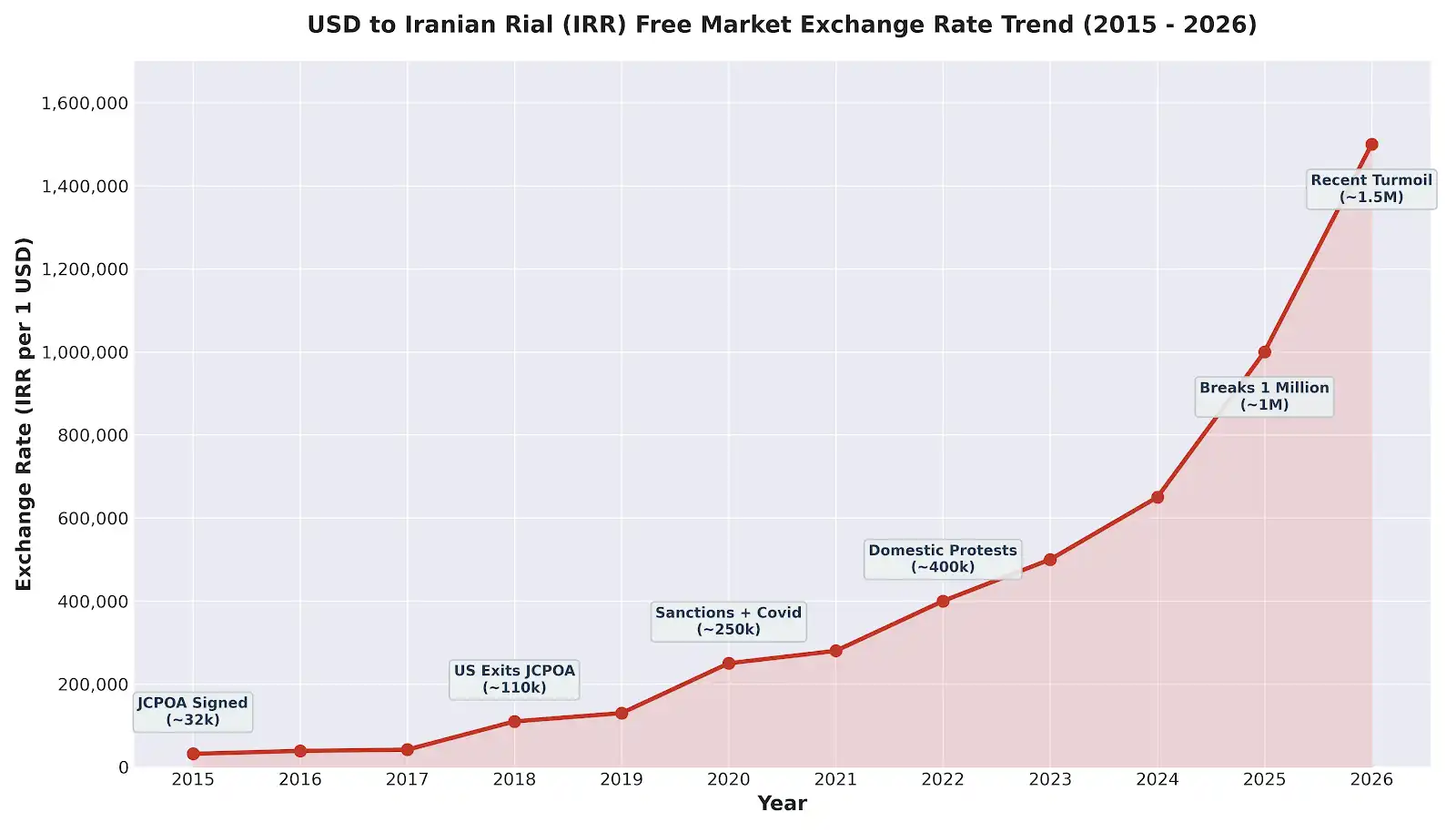
In a global financial structure centered on the US dollar, Iran, strangled by sanctions, has to face a situation dominated by the dollar and continuous depreciation of the rial.

The US dollar, as the "hub currency" for global foreign exchange transactions, can complete cross-border transactions for imports, debt, insurance, shipping, and key component procurement stably and with low friction. Even if Iran's printing presses roar and issue more rials domestically, they cannot replace this critical capability.

In many pricing systems for bulk commodities and supply chains, the US dollar remains the natural pricing anchor; in a sanctions environment, it is even harder for Iran to obtain US dollar clearing services through normal banking channels, making the entry point for hard currency scarce and expensive.

Therefore, many people's expectation for the future is to quickly convert their rials into something more reliable—US dollar cash, gold, and cryptocurrencies, mainly Bitcoin and stablecoins like USDT.

As an Islamic country, financial activities must also comply with the norms of Sharia law. Islamic doctrine strictly prohibits all forms of usury (Riba) and gambling (Gharar), and cryptocurrency trading, due to its high fluctuations and speculative nature, is viewed with caution.

However, Iran's former Supreme Leader Khamenei held a relatively open attitude towards crypto and called for keeping the law与时俱进 (evolving with the times). Khamenei's statement, in essence, was more like a realist compromise when the economy was facing a desperate situation.

From Government to Public, Iran Needs Cryptocurrency

Due to long-term sanctions and high inflation, both the Iranian government and its people are chasing hard currency substitutes in their own ways. This is why crypto assets, represented by Bitcoin and dollar stablecoins, have gradually transformed from "speculative instruments" into a nearly essential tool of value in Iran. It is both a financial safety valve for citizens and a "cyber money house" for the state apparatus to evade sanctions.

The Iranian government's attitude towards cryptocurrency can be described as "love-hate, utilizing and suppressing in parallel."

At the state level, when crypto activities help provide alternative channels for import settlement, foreign exchange acquisition, or fund transfers, regulators tolerate or even absorb them within a certain range, such as initially allowing Bitcoin mining domestically. Cryptocurrency is also an important means in the "shadow financial network" of the Iranian government and military for transferring funds and evading supervision.

According to TRM Labs, the company identified over 5,000 addresses marked as related to the Islamic Revolutionary Guard Corps (IRGC) and estimated that since 2023, the organization has transferred $3 billion worth of cryptocurrency. British blockchain research company Elliptic stated that the Central Bank of Iran acquired at least $507 million worth of the stablecoin USDT in 2025.

However, when cryptocurrency is seen as accelerating the depreciation of the rial, strengthening expectations of capital flight, or forming hard-to-regulate private financial networks, the Iranian government quickly turns to tightening controls.

In early 2025, the Central Bank of Iran (CBI) "suddenly stopped all rial payment channels for crypto exchanges," leaving over 10 million crypto users unable to use rials to purchase crypto assets like Bitcoin; reports indicated that one of the main goals was to prevent further depreciation of the rial and avoid the rapid conversion of the local currency into foreign currency or stablecoins through exchanges.

This method of cutting off the fiat currency entry point essentially uses administrative means to sever the most convenient channel for the public to convert rials into value. But this does not mean Iranian society no longer needs crypto; instead, it squeezes demand into grayer, more decentralized paths, including over-the-counter (OTC) trading, alternative payment accounts, or more covert on-chain transfers.

And when the state repeatedly uses this governance method during currency crises, the public's preference for "assets outside the system" is further reinforced. Because every sudden restriction reminds them that financial rules can change at any time, and assets are not entirely under their control.

At the citizen level, crypto demand is mainly driven by three forces: value preservation, transferability, and speculation. According to TRM Labs estimates, 95% of fund flows related to Iran come from retail investors. Iran's largest cryptocurrency exchange, Nobitex, disclosed that it has 11 million customers, with most trading activity coming from retail and small investors. The exchange stated: "For many users, cryptocurrency primarily serves as a store of value to cope with the continuous depreciation of the local currency."

Even more surreal, in mid-2024, Telegram "Tap-to-Earn" crypto mini-games like "Hamster Kombat" and "Notcoin" triggered a national frenzy in Iran. On the Tehran subway and streets, countless Iranians frantically tapped their phone screens, trying to use free "crypto airdrops" to fight soaring prices. Reports indicated that nearly a quarter of Iran's population participated in such games at the time. When the national currency loses credibility, even the hope of clicking the screen for meager virtual coins becomes a glimmer of light in the darkness.

Therefore, in Iran, we see a paradox: on the one hand, the authorities worry that crypto accelerates the depreciation of the rial and weakens capital controls, so they cut off rial payment channels at critical moments; on the other hand, in the long-term structure of sanctions and foreign exchange scarcity, cryptocurrency is constantly proving its utility. And for ordinary Iranians, this utility is extremely important, becoming an emergency exit in a life of crisis.

The Covert Battle for Power and the Increasing "Black Miners"

Unlike the frontal confrontation of hot weapons on the front lines, a silent covert battle over power resources has been ongoing within Iran for years.

In a country like Iran with "scarce social resources," electricity is no longer just a necessity of life but is redefined as a strategic resource that can be arbitraged. But the cost of this arbitrage is ultimately borne by ordinary residents, causing severe power difficulties.

Although Iran is a typical energy-rich country, it has long been trapped in a cycle of power shortages and rolling blackouts. The main reasons are insufficient infrastructure investment, aging power generation and transmission systems, and price subsidies leading to excessively rapid demand growth.

In a public account during the summer of 2025, Iran's power company Tavanir stated that crypto mining consumed nearly 2000MW of electricity, roughly equivalent to the output of two Bushehr nuclear power plants. More critically, mining accounted for about 5% of total electricity consumption but might account for 15%–20% of the current power shortage.

Tavanir claimed that during an internet outage related to the conflict with Israel, national electricity consumption dropped by about 2400MW; Tavanir partly attributed this to a large number of illegal mining machines going offline, claiming the shutdown involved 900,000 illegal devices, which indirectly confirms the scale of underground mining.

The CEO of Tehran Province Power Distribution Company also stated that Iran has become the world's fourth-largest cryptocurrency mining center, with over 95% of active mining machines operating without licenses, indicating an extremely high degree of illegality, making it a "paradise for illegal miners." This statement shifts responsibility from the government to ordinary Iranians.

The Iranian authorities have ostensibly been cracking down on illegal mining in recent years, but the problem has only grown. This means that so-called illegal mining has transformed from a marginal phenomenon into a structural industry. Behind it lies not only electricity price套利 (arbitrage) but also gray protection, enforcement rent-seeking, and complex local interest networks, marked deeply by privilege.

Mosques and industrial zones controlled by the military even enjoy the benefits of free mining.

"Ordinary people and even private companies cannot obtain the electricity needed to run and cool such a large number of mining machines." Professionals in the cryptocurrency mining field believe that only industrial-scale production could cause such huge power consumption.

According to revelations from multiple media and investigative agencies, the privileged class in Iran absolutely dominates this power盛宴 (feast). In Iran, religious sites like mosques legally enjoy extremely cheap or even free electricity supply, leading many mosques to become roaring "underground mines."

At the same time, large-scale mining farms are often hidden within heavy industrial parks controlled by the military and some保密 (confidential) facilities exempt from blackout quotas. While the privileged class uses free "national electricity" to疯狂套取 (frantically arbitrage) Bitcoin, ordinary residents burdened by high inflation can't even奢望 (dare to hope for) enough power to run a fan on a summer night.

In the final analysis, Iran's power crisis and illegal mining are not simple law and order issues but a battle for electricity围绕 (revolving around) subsidized resources, currency depreciation, and survival pressure. And the pain of blackouts will continue to linger in the summer nights of ordinary families.

And now, amidst endless geopolitical conflicts and political uncertainty, Iran's economic future is once again cast in shadow.


Domande pertinenti

QWhy did the outflow of assets from Iran's largest cryptocurrency exchange Nobitex surge dramatically after the US-Israel attack?

AThe outflow surged by about 700% within minutes because Iranian citizens sought to move their assets to safer channels through cryptocurrency as a form of financial避险 during heightened geopolitical tensions.

QWhat is the US dollar's role in Iran's economy according to the article?

AThe US dollar acts as the dominant global reserve currency, crucial for cross-border transactions like imports, debt, insurance, and shipping. Despite Iran printing more rials, it cannot replace the dollar's key function, making hard currency scarce and expensive under sanctions.

QHow does the Iranian government's attitude towards cryptocurrency exhibit a 'love-hate' relationship?

AThe government tolerates and even utilizes cryptocurrency when it aids in bypassing sanctions for imports, foreign exchange acquisition, or fund transfers, but cracks down on it when it accelerates the rial's devaluation or facilitates capital flight, such as by halting rial payment channels on exchanges.

QWhat paradox exists regarding cryptocurrency usage in Iran as described in the article?

AThe paradox is that the government intermittently restricts crypto access to protect the rial and control capital, yet cryptocurrency remains a critical tool for citizens and the state to preserve value and circumvent financial isolation due to long-term sanctions and economic instability.

QWhat is the main cause of Iran's electricity shortage crisis, and how is it linked to cryptocurrency mining?

AThe main causes are inadequate infrastructure investment, aging power systems, and subsidized prices driving demand. Cryptocurrency mining, particularly by illegal and privileged entities like religious sites and military-controlled zones using free or cheap electricity, consumes a significant portion of the national power supply, exacerbating shortages for ordinary citizens.

Letture associate

Trading

Spot
Futures

Articoli Popolari

Cosa è $S$

Comprendere SPERO: Una Panoramica Completa Introduzione a SPERO Mentre il panorama dell'innovazione continua a evolversi, l'emergere delle tecnologie web3 e dei progetti di criptovaluta gioca un ruolo fondamentale nel plasmare il futuro digitale. Un progetto che ha attirato l'attenzione in questo campo dinamico è SPERO, denotato come SPERO,$$s$. Questo articolo mira a raccogliere e presentare informazioni dettagliate su SPERO, per aiutare gli appassionati e gli investitori a comprendere le sue basi, obiettivi e innovazioni nei domini web3 e crypto. Che cos'è SPERO,$$s$? SPERO,$$s$ è un progetto unico all'interno dello spazio crypto che cerca di sfruttare i principi della decentralizzazione e della tecnologia blockchain per creare un ecosistema che promuove l'impegno, l'utilità e l'inclusione finanziaria. Il progetto è progettato per facilitare interazioni peer-to-peer in modi nuovi, fornendo agli utenti soluzioni e servizi finanziari innovativi. Al suo interno, SPERO,$$s$ mira a responsabilizzare gli individui fornendo strumenti e piattaforme che migliorano l'esperienza dell'utente nello spazio delle criptovalute. Questo include la possibilità di metodi di transazione più flessibili, la promozione di iniziative guidate dalla comunità e la creazione di percorsi per opportunità finanziarie attraverso applicazioni decentralizzate (dApps). La visione sottostante di SPERO,$$s$ ruota attorno all'inclusività, cercando di colmare le lacune all'interno della finanza tradizionale mentre sfrutta i vantaggi della tecnologia blockchain. Chi è il Creatore di SPERO,$$s$? L'identità del creatore di SPERO,$$s$ rimane piuttosto oscura, poiché ci sono risorse pubblicamente disponibili limitate che forniscono informazioni dettagliate sul suo fondatore o fondatori. Questa mancanza di trasparenza può derivare dall'impegno del progetto per la decentralizzazione—un ethos che molti progetti web3 condividono, dando priorità ai contributi collettivi rispetto al riconoscimento individuale. Centrando le discussioni attorno alla comunità e ai suoi obiettivi collettivi, SPERO,$$s$ incarna l'essenza dell'empowerment senza mettere in evidenza individui specifici. Pertanto, comprendere l'etica e la missione di SPERO rimane più importante che identificare un creatore singolo. Chi sono gli Investitori di SPERO,$$s$? SPERO,$$s$ è supportato da una varietà di investitori che vanno dai capitalisti di rischio agli investitori angelici dedicati a promuovere l'innovazione nel settore crypto. Il focus di questi investitori generalmente si allinea con la missione di SPERO—dando priorità a progetti che promettono avanzamenti tecnologici sociali, inclusività finanziaria e governance decentralizzata. Queste fondazioni di investitori sono tipicamente interessate a progetti che non solo offrono prodotti innovativi, ma contribuiscono anche positivamente alla comunità blockchain e ai suoi ecosistemi. Il supporto di questi investitori rafforza SPERO,$$s$ come un concorrente degno di nota nel dominio in rapida evoluzione dei progetti crypto. Come Funziona SPERO,$$s$? SPERO,$$s$ impiega un framework multifunzionale che lo distingue dai progetti di criptovaluta convenzionali. Ecco alcune delle caratteristiche chiave che sottolineano la sua unicità e innovazione: Governance Decentralizzata: SPERO,$$s$ integra modelli di governance decentralizzati, responsabilizzando gli utenti a partecipare attivamente ai processi decisionali riguardanti il futuro del progetto. Questo approccio favorisce un senso di proprietà e responsabilità tra i membri della comunità. Utilità del Token: SPERO,$$s$ utilizza il proprio token di criptovaluta, progettato per servire varie funzioni all'interno dell'ecosistema. Questi token abilitano transazioni, premi e la facilitazione dei servizi offerti sulla piattaforma, migliorando l'impegno e l'utilità complessivi. Architettura Stratificata: L'architettura tecnica di SPERO,$$s$ supporta la modularità e la scalabilità, consentendo un'integrazione fluida di funzionalità e applicazioni aggiuntive man mano che il progetto evolve. Questa adattabilità è fondamentale per mantenere la rilevanza nel panorama crypto in continua evoluzione. Coinvolgimento della Comunità: Il progetto enfatizza iniziative guidate dalla comunità, impiegando meccanismi che incentivano la collaborazione e il feedback. Nutrendo una comunità forte, SPERO,$$s$ può affrontare meglio le esigenze degli utenti e adattarsi alle tendenze di mercato. Focus sull'Inclusione: Offrendo basse commissioni di transazione e interfacce user-friendly, SPERO,$$s$ mira ad attrarre una base utenti diversificata, inclusi individui che potrebbero non aver precedentemente interagito nello spazio crypto. Questo impegno per l'inclusione si allinea con la sua missione generale di empowerment attraverso l'accessibilità. Cronologia di SPERO,$$s$ Comprendere la storia di un progetto fornisce preziose intuizioni sulla sua traiettoria di sviluppo e sui traguardi. Di seguito è riportata una cronologia suggerita che mappa eventi significativi nell'evoluzione di SPERO,$$s$: Fase di Concettualizzazione e Ideazione: Le idee iniziali che formano la base di SPERO,$$s$ sono state concepite, allineandosi strettamente con i principi di decentralizzazione e focus sulla comunità all'interno dell'industria blockchain. Lancio del Whitepaper del Progetto: Dopo la fase concettuale, è stato rilasciato un whitepaper completo che dettaglia la visione, gli obiettivi e l'infrastruttura tecnologica di SPERO,$$s$ per suscitare interesse e feedback dalla comunità. Costruzione della Comunità e Prime Interazioni: Sono stati effettuati sforzi attivi di outreach per costruire una comunità di early adopters e potenziali investitori, facilitando discussioni attorno agli obiettivi del progetto e ottenendo supporto. Evento di Generazione del Token: SPERO,$$s$ ha condotto un evento di generazione del token (TGE) per distribuire i propri token nativi ai primi sostenitori e stabilire una liquidità iniziale all'interno dell'ecosistema. Lancio della Prima dApp: La prima applicazione decentralizzata (dApp) associata a SPERO,$$s$ è stata attivata, consentendo agli utenti di interagire con le funzionalità principali della piattaforma. Sviluppo Continuo e Partnership: Aggiornamenti e miglioramenti continui alle offerte del progetto, inclusi partnership strategiche con altri attori nello spazio blockchain, hanno plasmato SPERO,$$s$ in un concorrente competitivo e in evoluzione nel mercato crypto. Conclusione SPERO,$$s$ rappresenta una testimonianza del potenziale del web3 e delle criptovalute di rivoluzionare i sistemi finanziari e responsabilizzare gli individui. Con un impegno per la governance decentralizzata, il coinvolgimento della comunità e funzionalità progettate in modo innovativo, apre la strada verso un panorama finanziario più inclusivo. Come per qualsiasi investimento nello spazio crypto in rapida evoluzione, si incoraggiano potenziali investitori e utenti a ricercare approfonditamente e a impegnarsi in modo riflessivo con gli sviluppi in corso all'interno di SPERO,$$s$. Il progetto mostra lo spirito innovativo dell'industria crypto, invitando a ulteriori esplorazioni delle sue innumerevoli possibilità. Mentre il percorso di SPERO,$$s$ è ancora in fase di sviluppo, i suoi principi fondamentali potrebbero effettivamente influenzare il futuro di come interagiamo con la tecnologia, la finanza e tra di noi in ecosistemi digitali interconnessi.

75 Totale visualizzazioniPubblicato il 2024.12.17Aggiornato il 2024.12.17

Cosa è $S$

Cosa è AGENT S

Agent S: Il Futuro dell'Interazione Autonoma in Web3 Introduzione Nel panorama in continua evoluzione di Web3 e criptovalute, le innovazioni stanno costantemente ridefinendo il modo in cui gli individui interagiscono con le piattaforme digitali. Uno di questi progetti pionieristici, Agent S, promette di rivoluzionare l'interazione uomo-computer attraverso il suo framework agentico aperto. Aprendo la strada a interazioni autonome, Agent S mira a semplificare compiti complessi, offrendo applicazioni trasformative nell'intelligenza artificiale (AI). Questa esplorazione dettagliata approfondirà le complessità del progetto, le sue caratteristiche uniche e le implicazioni per il dominio delle criptovalute. Cos'è Agent S? Agent S si presenta come un innovativo framework agentico aperto, progettato specificamente per affrontare tre sfide fondamentali nell'automazione dei compiti informatici: Acquisizione di Conoscenze Specifiche del Dominio: Il framework apprende in modo intelligente da varie fonti di conoscenza esterne ed esperienze interne. Questo approccio duale gli consente di costruire un ricco repository di conoscenze specifiche del dominio, migliorando le sue prestazioni nell'esecuzione dei compiti. Pianificazione su Lungo Orizzonte di Compiti: Agent S impiega una pianificazione gerarchica potenziata dall'esperienza, un approccio strategico che facilita la suddivisione e l'esecuzione efficiente di compiti complessi. Questa caratteristica migliora significativamente la sua capacità di gestire più sottocompiti in modo efficiente ed efficace. Gestione di Interfacce Dinamiche e Non Uniformi: Il progetto introduce l'Interfaccia Agente-Computer (ACI), una soluzione innovativa che migliora l'interazione tra agenti e utenti. Utilizzando Modelli Linguistici Multimodali di Grandi Dimensioni (MLLM), Agent S può navigare e manipolare senza sforzo diverse interfacce grafiche utente. Attraverso queste caratteristiche pionieristiche, Agent S fornisce un framework robusto che affronta le complessità coinvolte nell'automazione dell'interazione umana con le macchine, preparando il terreno per innumerevoli applicazioni nell'AI e oltre. Chi è il Creatore di Agent S? Sebbene il concetto di Agent S sia fondamentalmente innovativo, informazioni specifiche sul suo creatore rimangono elusive. Il creatore è attualmente sconosciuto, il che evidenzia sia la fase embrionale del progetto sia la scelta strategica di mantenere i membri fondatori sotto anonimato. Indipendentemente dall'anonimato, l'attenzione rimane sulle capacità e sul potenziale del framework. Chi sono gli Investitori di Agent S? Poiché Agent S è relativamente nuovo nell'ecosistema crittografico, informazioni dettagliate riguardanti i suoi investitori e sostenitori finanziari non sono documentate esplicitamente. La mancanza di approfondimenti pubblicamente disponibili sulle fondazioni di investimento o sulle organizzazioni che supportano il progetto solleva interrogativi sulla sua struttura di finanziamento e sulla roadmap di sviluppo. Comprendere il supporto è cruciale per valutare la sostenibilità del progetto e il suo potenziale impatto sul mercato. Come Funziona Agent S? Al centro di Agent S si trova una tecnologia all'avanguardia che gli consente di funzionare efficacemente in contesti diversi. Il suo modello operativo è costruito attorno a diverse caratteristiche chiave: Interazione Uomo-Computer Simile a Quella Umana: Il framework offre una pianificazione AI avanzata, cercando di rendere le interazioni con i computer più intuitive. Mimando il comportamento umano nell'esecuzione dei compiti, promette di elevare le esperienze degli utenti. Memoria Narrativa: Utilizzata per sfruttare esperienze di alto livello, Agent S utilizza la memoria narrativa per tenere traccia delle storie dei compiti, migliorando così i suoi processi decisionali. Memoria Episodica: Questa caratteristica fornisce agli utenti una guida passo-passo, consentendo al framework di offrire supporto contestuale mentre i compiti si sviluppano. Supporto per OpenACI: Con la capacità di funzionare localmente, Agent S consente agli utenti di mantenere il controllo sulle proprie interazioni e flussi di lavoro, allineandosi con l'etica decentralizzata di Web3. Facile Integrazione con API Esterne: La sua versatilità e compatibilità con varie piattaforme AI garantiscono che Agent S possa adattarsi senza problemi agli ecosistemi tecnologici esistenti, rendendolo una scelta attraente per sviluppatori e organizzazioni. Queste funzionalità contribuiscono collettivamente alla posizione unica di Agent S all'interno dello spazio crittografico, poiché automatizza compiti complessi e multi-fase con un intervento umano minimo. Man mano che il progetto evolve, le sue potenziali applicazioni in Web3 potrebbero ridefinire il modo in cui si svolgono le interazioni digitali. Cronologia di Agent S Lo sviluppo e le tappe di Agent S possono essere riassunti in una cronologia che evidenzia i suoi eventi significativi: 27 Settembre 2024: Il concetto di Agent S è stato lanciato in un documento di ricerca completo intitolato “Un Framework Agentico Aperto che Usa i Computer Come un Umano”, mostrando le basi per il progetto. 10 Ottobre 2024: Il documento di ricerca è stato reso pubblicamente disponibile su arXiv, offrendo un'esplorazione approfondita del framework e della sua valutazione delle prestazioni basata sul benchmark OSWorld. 12 Ottobre 2024: È stata rilasciata una presentazione video, fornendo un'idea visiva delle capacità e delle caratteristiche di Agent S, coinvolgendo ulteriormente potenziali utenti e investitori. Questi indicatori nella cronologia non solo illustrano i progressi di Agent S, ma indicano anche il suo impegno per la trasparenza e il coinvolgimento della comunità. Punti Chiave su Agent S Man mano che il framework Agent S continua a evolversi, diversi attributi chiave si distinguono, sottolineando la sua natura innovativa e il potenziale: Framework Innovativo: Progettato per fornire un uso intuitivo dei computer simile all'interazione umana, Agent S porta un approccio nuovo all'automazione dei compiti. Interazione Autonoma: La capacità di interagire autonomamente con i computer attraverso GUI segna un passo avanti verso soluzioni informatiche più intelligenti ed efficienti. Automazione di Compiti Complessi: Con la sua metodologia robusta, può automatizzare compiti complessi e multi-fase, rendendo i processi più veloci e meno soggetti a errori. Miglioramento Continuo: I meccanismi di apprendimento consentono ad Agent S di migliorare dalle esperienze passate, migliorando continuamente le sue prestazioni e la sua efficacia. Versatilità: La sua adattabilità attraverso diversi ambienti operativi come OSWorld e WindowsAgentArena garantisce che possa servire un'ampia gamma di applicazioni. Man mano che Agent S si posiziona nel panorama di Web3 e delle criptovalute, il suo potenziale per migliorare le capacità di interazione e automatizzare i processi segna un significativo avanzamento nelle tecnologie AI. Attraverso il suo framework innovativo, Agent S esemplifica il futuro delle interazioni digitali, promettendo un'esperienza più fluida ed efficiente per gli utenti in vari settori. Conclusione Agent S rappresenta un audace passo avanti nell'unione tra AI e Web3, con la capacità di ridefinire il modo in cui interagiamo con la tecnologia. Sebbene sia ancora nelle sue fasi iniziali, le possibilità per la sua applicazione sono vaste e coinvolgenti. Attraverso il suo framework completo che affronta sfide critiche, Agent S mira a portare le interazioni autonome al centro dell'esperienza digitale. Man mano che ci addentriamo nei regni delle criptovalute e della decentralizzazione, progetti come Agent S giocheranno senza dubbio un ruolo cruciale nel plasmare il futuro della tecnologia e della collaborazione uomo-computer.

398 Totale visualizzazioniPubblicato il 2025.01.14Aggiornato il 2025.01.14

Cosa è AGENT S

Come comprare S

Benvenuto in HTX.com! Abbiamo reso l'acquisto di Sonic (S) semplice e conveniente. Segui la nostra guida passo passo per intraprendere il tuo viaggio nel mondo delle criptovalute.Step 1: Crea il tuo Account HTXUsa la tua email o numero di telefono per registrarti il tuo account gratuito su HTX. Vivi un'esperienza facile e sblocca tutte le funzionalità,Crea il mio accountStep 2: Vai in Acquista crypto e seleziona il tuo metodo di pagamentoCarta di credito/debito: utilizza la tua Visa o Mastercard per acquistare immediatamente SonicS.Bilancio: Usa i fondi dal bilancio del tuo account HTX per fare trading senza problemi.Terze parti: abbiamo aggiunto metodi di pagamento molto utilizzati come Google Pay e Apple Pay per maggiore comodità.P2P: Fai trading direttamente con altri utenti HTX.Over-the-Counter (OTC): Offriamo servizi su misura e tassi di cambio competitivi per i trader.Step 3: Conserva Sonic (S)Dopo aver acquistato Sonic (S), conserva nel tuo account HTX. In alternativa, puoi inviare tramite trasferimento blockchain o scambiare per altre criptovalute.Step 4: Scambia Sonic (S)Scambia facilmente Sonic (S) nel mercato spot di HTX. Accedi al tuo account, seleziona la tua coppia di trading, esegui le tue operazioni e monitora in tempo reale. Offriamo un'esperienza user-friendly sia per chi ha appena iniziato che per i trader più esperti.

785 Totale visualizzazioniPubblicato il 2025.01.15Aggiornato il 2025.03.21

Come comprare S

Discussioni

Benvenuto nella Community HTX. Qui puoi rimanere informato sugli ultimi sviluppi della piattaforma e accedere ad approfondimenti esperti sul mercato. Le opinioni degli utenti sul prezzo di S S sono presentate come di seguito.

活动图片