Best Crypto Presales 2026: Analysts Flag Early Projects Worth Tracking

bitcoinistPubblicato 2026-02-06Pubblicato ultima volta 2026-02-06

Introduzione

Crypto markets face a risk-off environment in early 2026, with BTC near $66,805 and ETH at $1,895, alongside significant Bitcoin ETF outflows. In this climate, capital is focusing on infrastructure and distribution. A key trend is Bitcoin Layer-2 solutions, where execution moves off-chain while Bitcoin remains the settlement layer. Bitcoin Hyper emerges as a notable presale, positioning itself as the first Bitcoin L2 with Solana Virtual Machine integration for high-speed, low-cost transactions. It has raised over $31 million, with early whale activity, and aims to enable DeFi, NFTs, and payments on Bitcoin. Key questions remain about its bridge security and developer adoption.

Crypto is kicking off February 2026 with a distinct chill in the air. The tape is doing exactly what it always does during drawdowns: punishing leverage first, then forcing narratives to prove they have actual demand.

At the time of writing, $BTC hovers around $66,805 and $ETH struggles near $1,895, per CoinGecko, following a sharp multi-month retrace from late-2025 highs. (coingecko.com) But price is just the headline. The real signal is positioning. When the market de-risks this aggressively, liquidity fragments, spreads widen, and “beta” plays (memecoins, small caps) stop being forgiving.

ETF flows tell a similar story. Data tracked by SoSoValue indicates U.S. spot Bitcoin ETFs recently endured a $1.33B net outflow week—the worst bleed since February 2025—even though flows managed a notable one-day rebound early this month. (fastbull.com) Meanwhile, mainstream coverage notes that the post-2025 euphoria has given way to deleveraging and renewed regulatory friction. It’s the classic cocktail that squeezes speculative excess out of the system. (apnews.com)

Why does this matter for the “best crypto presales 2026” conversation?

Because presales don’t exist in a vacuum. Gravity applies here too. However, capital tends to concentrate around two specific themes that survive risk-off regimes: infrastructure and distribution. If smart money is going to take early-stage risk right now, it wants a defensible thesis—scaling, settlement, and credible user demand. Which raises the uncomfortable question: where is crypto’s next useful throughput coming from—especially on Bitcoin?

Bitcoin L2s Take Center Stage As Execution Moves Off L1

The most actionable presale theme in 2026 is simple: Bitcoin remains the settlement layer, but the actual work is moving elsewhere.

Lightning continues to anchor the payments narrative. Capacity metrics hit records around 5,637 BTC in late 2025, suggesting that “Bitcoin as a medium of exchange” is compounding quietly even while price sentiment sours. (bitcoinmagazine.com) In the same vein, Stacks has pushed the “programmable Bitcoin” thesis forward via its Nakamoto upgrade milestones. (stacks.co)

But here’s what most coverage misses: when markets draw down, builders don’t stop. They consolidate. Payments networks (Lightning) and execution environments (Bitcoin L2s) are currently fighting for the same prize—Bitcoin liquidity that actually does something.

That’s where Bitcoin Hyper enters the fray.

The project pitches itself as “THE FIRST EVER BITCOIN LAYER 2” with Solana Virtual Machine (SVM) integration. The goal? Deliver extremely low-latency L2 processing and fast smart contract execution while relying on Bitcoin L1 for final settlement. The architecture is modular—Bitcoin settles, the SVM executes—with a decentralized canonical bridge for BTC transfers. (Yes, combining Bitcoin security with Solana speed is an ambitious play).

The risk? Execution speed narratives can be intoxicating. Bridging design and sequencer assumptions—Bitcoin Hyper utilizes a single trusted sequencer with periodic L1 state anchoring—are where serious investors will focus their due diligence. Fast is easy to market; resilient is hard to ship.

Review Bitcoin Hyper’s L2 thesis.

Bitcoin Hyper ($HYPER) Presale Metrics: Big Raise, Clear Narrative

In this environment, metrics speak louder than whitepapers. Presales that survive 2026 typically show sustained fundraising and a narrative that aligns with the market’s “infrastructure-first” bias.

On the fundraising front, Bitcoin Hyper’s numbers aren’t small. According to the official presale page, the project has raised $31,257,822.88, with tokens priced at $0.0136751. In a market actively repricing risk, these figures suggest the bid isn’t purely momentum—there’s conviction behind the theme.
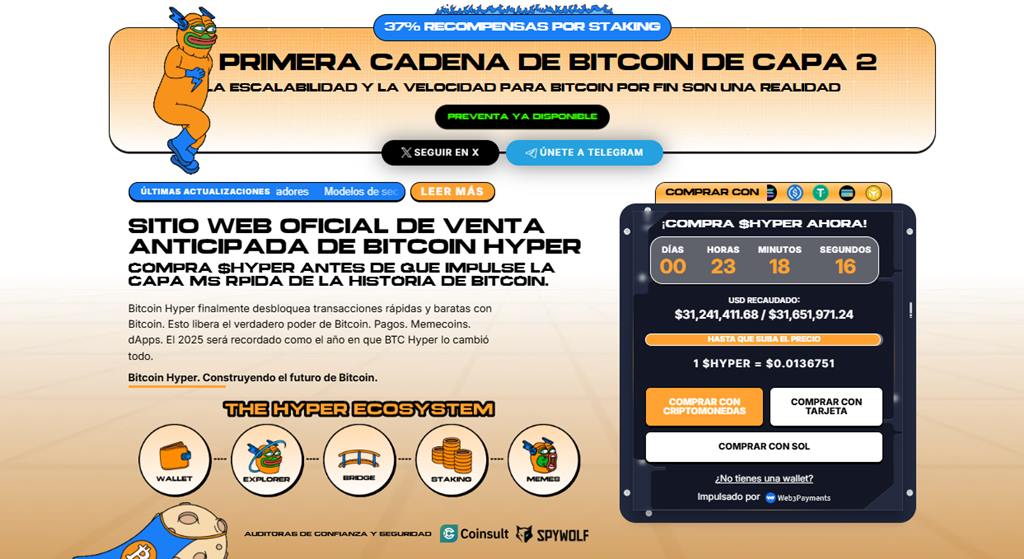
We’re also seeing early “smart money” movement. Etherscan records show 2 whale wallets have accumulated $116K, with the largest single transaction of $63K occurring on Jan 15, 2026. (Etherscan) While whale buys aren’t a guarantee of future performance, in a skittish tape, they often function as a sentiment catalyst.

Utility-wise, Bitcoin Hyper is targeting:

  • High-speed payments in wrapped BTC with negligible fees.
  • DeFi primitives (swaps, lending, staking protocols).
  • NFT and gaming dApps, supported by a developer SDK/API in Rust.

On the incentive side, staking is advertised with high APY (rate not disclosed), featuring immediate staking after TGE and a 7-day vesting period for presale stakers, plus rewards tied to governance participation.

For traders building a 2026 watchlist, here are the key questions: 1) Can the bridge model earn trust under stress? 2) Will developers actually deploy SVM apps, or will it remain theoretical? 3) Does Bitcoin liquidity migrate into on-chain apps as ETF flows stabilize?

If the macro clouds part and Bitcoin’s ecosystem narrative rotates from “hold” to “use,” Bitcoin Hyper is positioned squarely in that slipstream.

Visit the official Bitcoin Hyper site.

This article is not financial advice; crypto is volatile, presales are high risk, and smart-contract/bridge designs can fail. Always do your own research.

Key Takeaways

  • $BTC (~$66,805) and $ETH (~$1,895) signal a risk-off market where leverage unwinds faster than narratives can rebuild.
  • ETF flow whiplash (heavy outflows followed by rebounds) suggests institutional positioning is tactical, not a blind “up only” bet.
  • Bitcoin scaling is fragmenting into payments (Lightning) and execution layers (L2s), putting “productive BTC” back in focus.
  • Bitcoin Hyper targets this shift by bringing fast SVM execution to a Bitcoin-settled L2 environment.


Domande pertinenti

QWhat are the two main themes that capital tends to concentrate around during risk-off regimes in the crypto market, according to the article?

AInfrastructure and distribution.

QWhat is the name of the Bitcoin Layer 2 project featured in the article and what key technology does it integrate?

AThe project is called Bitcoin Hyper ($HYPER) and it integrates the Solana Virtual Machine (SVM).

QHow much had the Bitcoin Hyper presale raised at the time of writing, and what was the token price?

AThe presale had raised $31,257,822.88, with tokens priced at $0.0136751.

QWhat was the approximate price of Bitcoin ($BTC) and Ethereum ($ETH) mentioned at the beginning of the article?

ABitcoin was around $66,805 and Ethereum was near $1,895.

QWhat does the article cite as the risk associated with Bitcoin Hyper's design?

AThe risk is in its bridging design and sequencer assumptions, which utilize a single trusted sequencer with periodic L1 state anchoring, making resilience hard to ship.

Letture associate

Stuck Polymarket: The Real Test After Riding the Traffic Boom Has Arrived

Polymarket, a leading prediction market platform, is facing significant technical challenges as its growth outpaces its current infrastructure on Polygon. Users are experiencing laggy transactions, unresponsive orders, and delayed confirmations, severely impacting the trading experience. In response, DeFi Engineering VP Josh Stevens outlined a comprehensive engineering overhaul. The plan includes reducing on-chain data delays, fixing order cancellation issues, rebuilding the central limit order book (CLOB), improving website performance, and developing a unified SDK and API. A major revelation was the ongoing "chain migration," indicating a potential move away from Polygon. The core issue is that Polymarket has evolved from a simple prediction market into a high-frequency trading platform, making Polygon's limitations—such as block space, gas fees, and block time—a ceiling for further growth. The migration is not just a simple chain switch but a fundamental rebuild of its trading system to support more complex products like perpetual contracts (Perps). This announcement has sparked competition among chains like Solana, Sui, and Algorand, all vying to host Polymarket. For Polygon, losing this key application, which contributes significantly to its gas fee revenue, would be a major setback. The real test for Polymarket is no longer attracting users but proving it can provide a stable, reliable trading environment that retains them.

Odaily星球日报9 min fa

Stuck Polymarket: The Real Test After Riding the Traffic Boom Has Arrived

Odaily星球日报9 min fa

Lowering Expectations for BTC's Next Bull Market

The author, Alex Xu, explains his decision to significantly reduce his Bitcoin holdings (from full to ~30% of his portfolio) during the current bull cycle, citing a lowered long-term outlook for BTC's price appreciation in the next cycle. He outlines six key reasons for this reduced expectation: 1. **Diminished Growth Drivers:** The narrative of exponential user adoption has largely played out with institutional ETF adoption. The next major growth phase—adoption by sovereign national reserves or central banks—seems unlikely in the near future. 2. **Personal Opportunity Cost:** More attractive investment opportunities have emerged in other assets, such as undervalued companies. 3. **Industry-Wide Contraction:** The broader crypto industry is struggling, with most Web3 business models (SocialFi, GameFi, DePIN) failing. This overall萧条 (depression) reduces the fundamental demand and consensus for Bitcoin. 4. **Strain on Major Buyer:** MicroStrategy, a major corporate buyer of BTC, faces rising financing expenses for its debt, which could slow its purchasing rate and create significant marginal pressure on the market. 5. **Increased Competition from Gold:** The emergence of "tokenized gold" has closed the functional gap (portability, divisibility) between physical gold and Bitcoin, offering a strong competitor in the non-sovereign store-of-value space. 6. **Security Budget Concerns:** The block reward halving continues to exacerbate the long-standing issue of funding Bitcoin's network security, with new fee source explorations like Ordinals and L2s largely failing. The author's decision to hold a significant (though reduced) position reflects a cautious, not bearish, outlook. He remains open to increasing his exposure if the fundamental reasons for his skepticism change or if new positive catalysts emerge.

marsbit47 min fa

Lowering Expectations for BTC's Next Bull Market

marsbit47 min fa

Can Iran 'Control' the Strait of Hormuz?

Iran has announced a comprehensive plan to assert control over the strategic Strait of Hormuz, a critical global oil shipping chokepoint. The proposed measures include requiring all vessels to obtain Iranian permission for passage, imposing fees for security, environmental protection, and navigation management—preferably paid in Iranian rials—and absolutely banning Israeli ships. Vessels from countries deemed hostile by Iran’s top security bodies may also be barred. Analysts suggest Iran’s motives are multifaceted: increasing pressure on the U.S. and Israel by leveraging control over oil transit to influence global prices and inflation; creating a new revenue stream, potentially exceeding $7.7 billion annually, to counter Western sanctions and support postwar reconstruction; and using transit permissions as bargaining chips in future negotiations, notably with the U.S. However, the plan faces significant practical and diplomatic challenges. Enforcing comprehensive interception and fee collection in the busy waterway, patrolled by international military forces, would be difficult. The U.S. has already countering with a blockade of Iranian ports and threats to intercept any ship paying fees, potentially strangling Iran’s oil exports and fee revenue. Broad international opposition, led by European and Gulf states, and legal controversies further complicate implementation. The proposal may ultimately serve more as a negotiating tactic than a feasible policy, with its execution remaining highly uncertain.

marsbit1 h fa

Can Iran 'Control' the Strait of Hormuz?

marsbit1 h fa

Trading

Spot
Futures
活动图片