Bernstein Interprets SpaceX's First Quarterly Report Since IPO: How Does the $239 Target Price Hold Up?

marsbitPubblicato 2026-08-06Pubblicato ultima volta 2026-08-06

Introduzione

Bernstein maintains its "Outperform" rating and $239 price target for SpaceX following its first earnings report as a public company. The Q2 2026 results showed strong growth, with revenue reaching $7.814B, a 92% year-over-year increase, beating expectations. The Starlink Connectivity business remained the profit driver, generating $1.656B in operating income. The AI segment saw revenue surge 247% to $2.561B, though it required massive capital expenditures of $15.828B. The $239 target is based on a sum-of-the-parts valuation projecting 2031 revenue of $554B, significantly below CEO Elon Musk's accelerated goal of $1 trillion by 2030. Bernstein's model assumes AI computing prices will eventually fall to around $10/watt, not the $30-$50/watt range cited by management. The valuation hinges on three key pillars: continued profit growth from Connectivity, the AI business converting its heavy investment into scalable revenue, and the Starship achieving full and rapid reusability to enable low-cost expansion. While quarterly performance was strong, post-IPO stock lock-up expirations and execution risks around Starship and AI returns contributed to a subsequent share price decline.

SpaceX's first quarterly earnings since going public have presented the market with an even more aggressive growth story: the Connectivity business continues to contribute profits, AI computing revenue is growing rapidly, and Musk has moved forward the target year for reaching $1 trillion in annual revenue from 2031 to 2030, suggesting it could be achieved as early as 2029.

According to the company's SEC filing, Space Exploration Technologies Corp. Class A common stock has begun trading on Nasdaq and Nasdaq Texas under the ticker SPCX. Following the release of its Q2 results for the period ending June 30 on August 4, Bernstein maintained its 'Outperform' rating and a $239 price target. Based on the closing price of $125.33 on August 4 as cited in the report, this implies an approximate 91% upside potential.

However, the $239 target price is not predicated on the full realization of the $1 trillion revenue goal. Bernstein's own revenue forecast for SpaceX in 2031 is $554 billion, significantly lower than management's vision; its AI computing price model also still assumes a long-term decline to approximately $10 per watt. In other words, higher computing prices and more aggressive revenue targets represent potential upside beyond the current valuation.

On August 5, SpaceX's stock price fell further to $108.27, a single-day drop of 13.6%. This indicates the market is not solely focused on this quarter's performance but is simultaneously weighing AI capital expenditures, potential stock supply pressure from the post-IPO lock-up period expiration, and whether Starship can enter a phase of high-frequency, low-cost launches.

Revenue Growth of 92%, Connectivity Remains the Profit Pillar

SpaceX's Q2 revenue reached $7.814 billion, a year-on-year increase of 92%. The consensus cited by Axios from S&P Visible Alpha was $6.9 billion, while Bernstein's report used a market consensus of $6.546 billion. Despite differing methodologies, both point to the same conclusion: revenue this quarter significantly exceeded expectations.

The company's Q2 diluted loss per share was $0.09, also better than the market expectation of a $0.24 loss per share. The three business segments combined posted an operating loss of $143 million, far better than the $1.73 billion market expectation used by Bernstein, primarily due to a narrower AI segment loss and Connectivity margins higher than expected.

Looking at the segments, the most stable currently remains the Connectivity business centered on Starlink. Starlink user count reached 12 million by the end of Q2, an increase of 1.7 million from Q1, with average monthly revenue per user remaining stable at $66.

Connectivity's quarterly revenue was $4.291 billion, with operating profit of $1.656 billion, corresponding to an operating margin of approximately 38.6%, higher than the 37% market expectation used by Bernstein. It is also SpaceX's only currently profitable business segment at the operating level, providing crucial support for the company's continued investments in AI and Starship.

The Space business completed 38 launches in Q2, comprising 10 customer launches and 28 internal launches, delivering a total mass to orbit (MTO) of 485 tons. This segment's revenue was $962 million, higher than the market expectation of $874 million, but operating losses still reached $542 million due to increased Starship R&D investment.

The AI business possesses both the greatest revenue elasticity and funding requirements. By the end of Q2, SpaceX's nominal compute capacity reached 1.4 GW, up from 1.0 GW in Q1, with expectations to exceed 2 GW by the end of 2026. The AI segment's quarterly revenue was $2.561 billion, a year-on-year increase of 247%, with AI solutions and infrastructure revenue reaching $2.194 billion.

The AI business's operating loss was $1.257 billion, corresponding to an operating margin of approximately -49.1%, but this is a significant improvement from the Q1 operating loss of $2.469 billion; segment adjusted EBITDA turned positive to $1.146 billion from a Q1 loss of $609 million.

Meanwhile, the AI business's quarterly capital expenditure in Q2 reached $15.828 billion, higher than Q1's $7.723 billion. SpaceX's total Q2 capital expenditure reached $18.369 billion. Whether this massive investment can translate into sustained revenue and cash returns remains one of the market's key concerns.
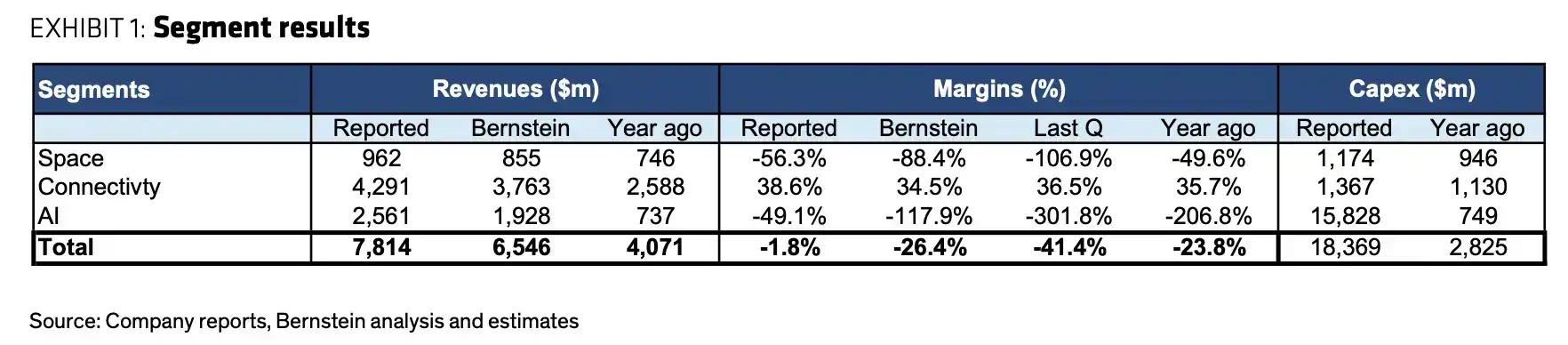
Table of SpaceX's Q2 performance by its three business segments. Connectivity contributes the main profit, while AI segment capital expenditure reached $15.828 billion. Source: Bernstein

AI Compute Opens Revenue Potential; A Trillion in Revenue Can't Rely Solely on Satellite Internet

The most notable change from the earnings call was Musk moving the target year for reaching $1 trillion in annual revenue from 2031 to 2030, suggesting it could be achieved as early as 2029. Management also presented expectations for an annualized revenue run rate of at least $100 billion, though this Bernstein report summary does not explicitly state the corresponding timeframe.

To approach this target, SpaceX clearly cannot rely solely on Starlink user growth. Connectivity needs to continue expanding its consumer, enterprise, and government customer base; the AI business needs to convert massive compute capacity into long-term contracts and stable revenue; and Starship needs to reduce the costs of satellite deployment and orbital data center construction.

Among these, AI compute pricing is the most sensitive variable.

Musk stated that compute service pricing could remain in the range of $30 to $50 per watt, noting this assessment aligns with prices agreed upon in deals with Anthropic and Google. In contrast, Bernstein's current model still assumes compute prices will eventually revert to approximately $10 per watt.

This means that the $30 to $50 per watt range is not the base assumption already incorporated into Bernstein's $239 target price, but rather potential model upside. If SpaceX can maintain higher prices while expanding capacity, its long-term revenue and EBITDA could significantly exceed Bernstein's current forecasts.

However, the sustainability of this price range remains uncertain. Customer contract terms and cancellation clauses, AI compute supply and demand dynamics, semiconductor supply, and competitor expansion could all impact actual realized prices.

Capacity expansion targets are similarly aggressive. SpaceX's nominal compute capacity was 1.4 GW at the end of Q2. The company expects to exceed 2 GW by the end of 2026, approach 10 GW by the end of 2027, and move toward 20 GW in 2028. If this pace is realized, SpaceX's business structure will evolve beyond just rocket launches and satellite internet, extending further into large-scale AI infrastructure.

Key financial and valuation projection table. Bernstein forecasts SpaceX's revenue for 2025-2027 to be $18.674 billion, $40.236 billion, and $84.990 billion respectively, with the EV/Adjusted EBITDA multiple decreasing from 245.7x to 37.2x.

The Prerequisite for High-Frequency Launches is Full Reusability for Starship

In SpaceX's valuation framework, Connectivity answers the question "Is there a current profit foundation?", AI compute answers "How much faster can revenue grow?", and Starship answers "Can future scale be achieved at a sufficiently low cost?"

If SpaceX is to approach $1 trillion in annual revenue around 2030, relying solely on Starlink user growth is insufficient. Starship's launch frequency, payload capacity, and degree of full reusability will directly impact the costs of next-generation Starlink satellite deployment, orbital data center construction, and the expansion of other space businesses.

Management has still presented a very aggressive timeline. The company plans to continue advancing Starship orbital flights and V3 satellite deployment, while attempting more complex booster and upper stage recovery maneuvers. Its long-term goal is to approach a daily launch rate by the end of 2027, operating five launch pads, with two in Texas and three in Florida.

Achieving this frequency requires SpaceX not only to reuse the booster but also to solve the upper stage recovery problem for Starship. Bernstein believes a durable heat shield is key to full upper stage reusability. Musk indicated that flight number 13 may have addressed the heat shield issue, but analysis is not yet complete and will require further flights for validation.

Regulatory approvals, launch pad construction, flight anomalies, and iteration cycles could also affect the pace at which Starship transitions from high-frequency testing to industrialized operations. Therefore, full reusability remains the most critical, yet also the most uncertain, component in Bernstein's valuation model.

The $239 Target Price Relies on Three Pillars Being Realized in Tandem

Bernstein's $239 12-month target price is derived by calculating the 2030 enterprise value based on projected 2031 EBITDA for each business, using sum-of-the-parts valuation and forward EV/EBITDA multiples, then discounting each segment's valuation back to mid-2027. Connectivity and AI are discounted using late-stage venture capital discount rates of 25% and 35%, respectively.

Notably, Bernstein's model projects SpaceX's 2031 revenue at $554 billion, significantly lower than management's $1 trillion target. Its long-term compute price assumption also remains a reversion to approximately $10 per watt, not the $30 to $50 per watt suggested by Musk.

Therefore, the $239 target price does not require SpaceX to fully achieve all of management's vision but still incorporates strong business expansion assumptions. It requires at least three elements to be realized in tandem: continued profit growth from Connectivity, AI compute translating high capital expenditure into scaled revenue, and Starship achieving its planned full reusability milestones.

SpaceX's stock price has declined noticeably since its IPO, yet Bernstein maintains its $239 price target and Outperform rating. Source: Bernstein

This also explains why SpaceX's stock price fell significantly after the earnings release despite Q2 revenue and earnings per share exceeding expectations. Quarterly performance can only demonstrate that current growth remains strong; it cannot directly alleviate market concerns about AI investment returns, post-lock-up stock supply, and Starship execution risk.

If AI compute pricing can be maintained in the $30 to $50 per watt range for a longer duration, Starship's full reusability progresses as planned, and Starlink consumer and enterprise customer growth continues, Bernstein's current model still has room for upward revision. Conversely, if compute contract fulfillment, semiconductor supply, or Starship development progress falls short of expectations, the $239 target price itself will face pressure.


Crypto di tendenza

Domande pertinenti

QWhat is Bernstein's target price for SpaceX and what is the implied upside based on the August 4th closing price?

ABernstein maintains a target price of $239 for SpaceX. Based on the August 4th closing price of $125.33, this represents an implied upside of approximately 91%.

QAccording to the article, what are the three key elements Bernstein's $239 target price relies on being fulfilled?

ABernstein's $239 target price relies on three key elements: 1) Continued profit growth from the Connectivity (Starlink) business, 2) AI computing transforming high capital expenditures into scaled revenue, and 3) Starship successfully achieving full and rapid reusability as planned.

QWhat was SpaceX's Q2 revenue and how did it compare to market expectations?

ASpaceX's Q2 revenue was $7.814 billion, representing 92% year-over-year growth. This significantly exceeded market expectations, which Bernstein cited as $6.546 billion and another consensus at $6.9 billion.

QWhat is the critical difference between Bernstein's and SpaceX management's assumptions regarding the long-term price of AI computing power?

AThe critical difference is the assumed long-term price per watt for AI computing. SpaceX management (Musk) suggests prices could remain in the $30-$50/watt range based on recent deals. In contrast, Bernstein's valuation model still assumes the price will eventually fall to around $10/watt.

QWhy did SpaceX's stock price fall sharply after the release of its strong Q2 earnings, according to the article?

AThe stock price fell because the market was looking beyond the strong quarterly results. Investors were simultaneously weighing concerns about the return on massive AI capital expenditures, potential selling pressure from the post-IPO lockup expiration, and the execution risk of Starship achieving high-frequency, low-cost launch capability.

Letture associate

Writing Censorship Resistance into the Protocol: Who Decides If an Ethereum Transaction Can Be On-Chained?

Building censorship resistance into the protocol: who decides if an Ethereum transaction gets into a block? In Ethereum, censorship resistance is a technical capability, not a political stance. A key challenge emerges from the current Proposer-Builder Separation (PBS) model, where specialized Builders construct most blocks. This centralizes the power to include transactions, creating risks, as Builders can exclude certain transactions under external pressure. The core problem is ensuring any transaction following protocol rules gets a fair chance to enter a block. To address Builder dominance, Ethereum researchers are exploring Inclusion Lists—mechanisms allowing validators to specify transactions that must be included if valid and space permits. Two primary proposals are detailed: 1. **FOCIL (Fork-Choice Enforced Inclusion Lists)**: Distributes the power to create an inclusion list from a single Proposer to a randomly selected committee of validators. If a Builder ignores the committee's aggregated list, the network's consensus rules will reject the block, making censorship costly. 2. **FairFIL (Fair Forward Inclusion Lists)**: Focuses on accountability and economic disincentives. Builders must publicly list valid transactions they exclude, creating a verifiable record. Persistently censoring transactions by omitting them from this list can lead to escalating penalties, including loss of block rewards. For users, these mechanisms aim to improve transaction inclusion certainty without changing how they interact with wallets. Valid, fee-paying transactions should no longer be indefinitely delayed by a Builder's choice. While Builders retain control over transaction ordering for MEV extraction, their gatekeeping power over *who gets in* is constrained. Current status: FOCIL is advancing in Ethereum's development pipeline, while FairFIL is an earlier-stage research proposal. Ultimately, Ethereum's approach acknowledges that not all participants will remain neutral. The goal is to make censorship observable, expensive, and unsustainable through protocol-level rules, moving the network's credible neutrality from a social promise to a technically enforced property.

marsbit1 min fa

Writing Censorship Resistance into the Protocol: Who Decides If an Ethereum Transaction Can Be On-Chained?

marsbit1 min fa

Dice vs. Hackers: Why South Korean Bitcoiners Escaped the Coldcard Hack Unscathed

South Korea's Bitcoin community suffered minimal direct losses from the recent Coldcard hardware wallet hack, despite the device's popularity among its most experienced users. An error in random number generation in certain Coldcard models allowed attackers to access vulnerable seed phrases, leading to the theft of over 1,596 BTC (approx. $130M) from thousands of addresses globally. Analyst Koji Higashi attributes Korea's resilience not to luck, but to a long-standing community culture of self-custody and caution. Local leaders have long promoted generating seed phrases independently from any device, relying on offline, analog methods like dice rolls or coin flips to create true randomness, followed by offline BIP39 phrase creation and verification. In contrast, English-speaking self-custody communities, despite high technical literacy, experienced more significant losses. Higashi links this to greater reliance on influencers, some with ties to the manufacturer (Coinkite), creating an echo chamber of trust in the device's security without independent verification. Korean leaders, lacking commercial ties, provided more neutral risk assessments that their followers heeded. The incident underscores applying Bitcoin's "don't trust, verify" principle not just to code, but to information sources. The key takeaway is to create seed phrases using independent physical methods where possible and to default to distrusting any device's built-in random number generator.

cryptonews.ru4 min fa

Dice vs. Hackers: Why South Korean Bitcoiners Escaped the Coldcard Hack Unscathed

cryptonews.ru4 min fa

Senate to Vote on CLARITY Act Before August Recess, Lummis Says

U.S. Senator Cynthia Lummis (R-WY), chair of the Senate's digital assets subcommittee, stated the Senate may work past Friday and through the weekend to secure a vote on the CLARITY Act before the August recess. This vote would force senators to take a public position on the bill. Over 300 pages of amendments, requested by Democrats, have been prepared after 11 months of negotiations, with final discussions ongoing regarding CFTC jurisdiction, law enforcement provisions, and ethics rules for senior federal officials. Key unresolved issues, per Democratic staff, include securities protection, illicit finance, national security, and presidential conflicts of interest. A bipartisan counterproposal, allowing state attorneys general to enforce federal crypto ethics rules, has been sent to President Trump, who reportedly agreed to broader restrictions than those applied to previous presidents. Lummis asserted that if the bill fails, it will be due to Democratic opposition. Regulators have expressed support. CFTC Chairman Michael S. Selig endorsed congressional action for clearer digital asset rules, while SEC Chairman Paul Atkins expressed optimism about the bill's passage. The CLARITY Act aims to divide oversight between the CFTC and SEC, providing distinct regulatory frameworks for cryptocurrencies and securities. Proponents argue this clarity will help retain crypto companies, capital, and innovation within the United States, preventing an exodus to jurisdictions like Switzerland or Singapore. The approaching recess deadline increases pressure to secure the 60 votes typically needed. With Republicans holding 53 seats, Democratic support is crucial. A Senate vote would lock in each legislator's stance before negotiations with the House on a final bill text.

cryptonews.ru15 min fa

Senate to Vote on CLARITY Act Before August Recess, Lummis Says

cryptonews.ru15 min fa

Trading

Spot

Articoli Popolari

Cosa è $S$

Comprendere SPERO: Una Panoramica Completa Introduzione a SPERO Mentre il panorama dell'innovazione continua a evolversi, l'emergere delle tecnologie web3 e dei progetti di criptovaluta gioca un ruolo fondamentale nel plasmare il futuro digitale. Un progetto che ha attirato l'attenzione in questo campo dinamico è SPERO, denotato come SPERO,$$s$. Questo articolo mira a raccogliere e presentare informazioni dettagliate su SPERO, per aiutare gli appassionati e gli investitori a comprendere le sue basi, obiettivi e innovazioni nei domini web3 e crypto. Che cos'è SPERO,$$s$? SPERO,$$s$ è un progetto unico all'interno dello spazio crypto che cerca di sfruttare i principi della decentralizzazione e della tecnologia blockchain per creare un ecosistema che promuove l'impegno, l'utilità e l'inclusione finanziaria. Il progetto è progettato per facilitare interazioni peer-to-peer in modi nuovi, fornendo agli utenti soluzioni e servizi finanziari innovativi. Al suo interno, SPERO,$$s$ mira a responsabilizzare gli individui fornendo strumenti e piattaforme che migliorano l'esperienza dell'utente nello spazio delle criptovalute. Questo include la possibilità di metodi di transazione più flessibili, la promozione di iniziative guidate dalla comunità e la creazione di percorsi per opportunità finanziarie attraverso applicazioni decentralizzate (dApps). La visione sottostante di SPERO,$$s$ ruota attorno all'inclusività, cercando di colmare le lacune all'interno della finanza tradizionale mentre sfrutta i vantaggi della tecnologia blockchain. Chi è il Creatore di SPERO,$$s$? L'identità del creatore di SPERO,$$s$ rimane piuttosto oscura, poiché ci sono risorse pubblicamente disponibili limitate che forniscono informazioni dettagliate sul suo fondatore o fondatori. Questa mancanza di trasparenza può derivare dall'impegno del progetto per la decentralizzazione—un ethos che molti progetti web3 condividono, dando priorità ai contributi collettivi rispetto al riconoscimento individuale. Centrando le discussioni attorno alla comunità e ai suoi obiettivi collettivi, SPERO,$$s$ incarna l'essenza dell'empowerment senza mettere in evidenza individui specifici. Pertanto, comprendere l'etica e la missione di SPERO rimane più importante che identificare un creatore singolo. Chi sono gli Investitori di SPERO,$$s$? SPERO,$$s$ è supportato da una varietà di investitori che vanno dai capitalisti di rischio agli investitori angelici dedicati a promuovere l'innovazione nel settore crypto. Il focus di questi investitori generalmente si allinea con la missione di SPERO—dando priorità a progetti che promettono avanzamenti tecnologici sociali, inclusività finanziaria e governance decentralizzata. Queste fondazioni di investitori sono tipicamente interessate a progetti che non solo offrono prodotti innovativi, ma contribuiscono anche positivamente alla comunità blockchain e ai suoi ecosistemi. Il supporto di questi investitori rafforza SPERO,$$s$ come un concorrente degno di nota nel dominio in rapida evoluzione dei progetti crypto. Come Funziona SPERO,$$s$? SPERO,$$s$ impiega un framework multifunzionale che lo distingue dai progetti di criptovaluta convenzionali. Ecco alcune delle caratteristiche chiave che sottolineano la sua unicità e innovazione: Governance Decentralizzata: SPERO,$$s$ integra modelli di governance decentralizzati, responsabilizzando gli utenti a partecipare attivamente ai processi decisionali riguardanti il futuro del progetto. Questo approccio favorisce un senso di proprietà e responsabilità tra i membri della comunità. Utilità del Token: SPERO,$$s$ utilizza il proprio token di criptovaluta, progettato per servire varie funzioni all'interno dell'ecosistema. Questi token abilitano transazioni, premi e la facilitazione dei servizi offerti sulla piattaforma, migliorando l'impegno e l'utilità complessivi. Architettura Stratificata: L'architettura tecnica di SPERO,$$s$ supporta la modularità e la scalabilità, consentendo un'integrazione fluida di funzionalità e applicazioni aggiuntive man mano che il progetto evolve. Questa adattabilità è fondamentale per mantenere la rilevanza nel panorama crypto in continua evoluzione. Coinvolgimento della Comunità: Il progetto enfatizza iniziative guidate dalla comunità, impiegando meccanismi che incentivano la collaborazione e il feedback. Nutrendo una comunità forte, SPERO,$$s$ può affrontare meglio le esigenze degli utenti e adattarsi alle tendenze di mercato. Focus sull'Inclusione: Offrendo basse commissioni di transazione e interfacce user-friendly, SPERO,$$s$ mira ad attrarre una base utenti diversificata, inclusi individui che potrebbero non aver precedentemente interagito nello spazio crypto. Questo impegno per l'inclusione si allinea con la sua missione generale di empowerment attraverso l'accessibilità. Cronologia di SPERO,$$s$ Comprendere la storia di un progetto fornisce preziose intuizioni sulla sua traiettoria di sviluppo e sui traguardi. Di seguito è riportata una cronologia suggerita che mappa eventi significativi nell'evoluzione di SPERO,$$s$: Fase di Concettualizzazione e Ideazione: Le idee iniziali che formano la base di SPERO,$$s$ sono state concepite, allineandosi strettamente con i principi di decentralizzazione e focus sulla comunità all'interno dell'industria blockchain. Lancio del Whitepaper del Progetto: Dopo la fase concettuale, è stato rilasciato un whitepaper completo che dettaglia la visione, gli obiettivi e l'infrastruttura tecnologica di SPERO,$$s$ per suscitare interesse e feedback dalla comunità. Costruzione della Comunità e Prime Interazioni: Sono stati effettuati sforzi attivi di outreach per costruire una comunità di early adopters e potenziali investitori, facilitando discussioni attorno agli obiettivi del progetto e ottenendo supporto. Evento di Generazione del Token: SPERO,$$s$ ha condotto un evento di generazione del token (TGE) per distribuire i propri token nativi ai primi sostenitori e stabilire una liquidità iniziale all'interno dell'ecosistema. Lancio della Prima dApp: La prima applicazione decentralizzata (dApp) associata a SPERO,$$s$ è stata attivata, consentendo agli utenti di interagire con le funzionalità principali della piattaforma. Sviluppo Continuo e Partnership: Aggiornamenti e miglioramenti continui alle offerte del progetto, inclusi partnership strategiche con altri attori nello spazio blockchain, hanno plasmato SPERO,$$s$ in un concorrente competitivo e in evoluzione nel mercato crypto. Conclusione SPERO,$$s$ rappresenta una testimonianza del potenziale del web3 e delle criptovalute di rivoluzionare i sistemi finanziari e responsabilizzare gli individui. Con un impegno per la governance decentralizzata, il coinvolgimento della comunità e funzionalità progettate in modo innovativo, apre la strada verso un panorama finanziario più inclusivo. Come per qualsiasi investimento nello spazio crypto in rapida evoluzione, si incoraggiano potenziali investitori e utenti a ricercare approfonditamente e a impegnarsi in modo riflessivo con gli sviluppi in corso all'interno di SPERO,$$s$. Il progetto mostra lo spirito innovativo dell'industria crypto, invitando a ulteriori esplorazioni delle sue innumerevoli possibilità. Mentre il percorso di SPERO,$$s$ è ancora in fase di sviluppo, i suoi principi fondamentali potrebbero effettivamente influenzare il futuro di come interagiamo con la tecnologia, la finanza e tra di noi in ecosistemi digitali interconnessi.

240 Totale visualizzazioniPubblicato il 2024.12.17Aggiornato il 2024.12.17

Cosa è $S$

Cosa è AGENT S

Agent S: Il Futuro dell'Interazione Autonoma in Web3 Introduzione Nel panorama in continua evoluzione di Web3 e criptovalute, le innovazioni stanno costantemente ridefinendo il modo in cui gli individui interagiscono con le piattaforme digitali. Uno di questi progetti pionieristici, Agent S, promette di rivoluzionare l'interazione uomo-computer attraverso il suo framework agentico aperto. Aprendo la strada a interazioni autonome, Agent S mira a semplificare compiti complessi, offrendo applicazioni trasformative nell'intelligenza artificiale (AI). Questa esplorazione dettagliata approfondirà le complessità del progetto, le sue caratteristiche uniche e le implicazioni per il dominio delle criptovalute. Cos'è Agent S? Agent S si presenta come un innovativo framework agentico aperto, progettato specificamente per affrontare tre sfide fondamentali nell'automazione dei compiti informatici: Acquisizione di Conoscenze Specifiche del Dominio: Il framework apprende in modo intelligente da varie fonti di conoscenza esterne ed esperienze interne. Questo approccio duale gli consente di costruire un ricco repository di conoscenze specifiche del dominio, migliorando le sue prestazioni nell'esecuzione dei compiti. Pianificazione su Lungo Orizzonte di Compiti: Agent S impiega una pianificazione gerarchica potenziata dall'esperienza, un approccio strategico che facilita la suddivisione e l'esecuzione efficiente di compiti complessi. Questa caratteristica migliora significativamente la sua capacità di gestire più sottocompiti in modo efficiente ed efficace. Gestione di Interfacce Dinamiche e Non Uniformi: Il progetto introduce l'Interfaccia Agente-Computer (ACI), una soluzione innovativa che migliora l'interazione tra agenti e utenti. Utilizzando Modelli Linguistici Multimodali di Grandi Dimensioni (MLLM), Agent S può navigare e manipolare senza sforzo diverse interfacce grafiche utente. Attraverso queste caratteristiche pionieristiche, Agent S fornisce un framework robusto che affronta le complessità coinvolte nell'automazione dell'interazione umana con le macchine, preparando il terreno per innumerevoli applicazioni nell'AI e oltre. Chi è il Creatore di Agent S? Sebbene il concetto di Agent S sia fondamentalmente innovativo, informazioni specifiche sul suo creatore rimangono elusive. Il creatore è attualmente sconosciuto, il che evidenzia sia la fase embrionale del progetto sia la scelta strategica di mantenere i membri fondatori sotto anonimato. Indipendentemente dall'anonimato, l'attenzione rimane sulle capacità e sul potenziale del framework. Chi sono gli Investitori di Agent S? Poiché Agent S è relativamente nuovo nell'ecosistema crittografico, informazioni dettagliate riguardanti i suoi investitori e sostenitori finanziari non sono documentate esplicitamente. La mancanza di approfondimenti pubblicamente disponibili sulle fondazioni di investimento o sulle organizzazioni che supportano il progetto solleva interrogativi sulla sua struttura di finanziamento e sulla roadmap di sviluppo. Comprendere il supporto è cruciale per valutare la sostenibilità del progetto e il suo potenziale impatto sul mercato. Come Funziona Agent S? Al centro di Agent S si trova una tecnologia all'avanguardia che gli consente di funzionare efficacemente in contesti diversi. Il suo modello operativo è costruito attorno a diverse caratteristiche chiave: Interazione Uomo-Computer Simile a Quella Umana: Il framework offre una pianificazione AI avanzata, cercando di rendere le interazioni con i computer più intuitive. Mimando il comportamento umano nell'esecuzione dei compiti, promette di elevare le esperienze degli utenti. Memoria Narrativa: Utilizzata per sfruttare esperienze di alto livello, Agent S utilizza la memoria narrativa per tenere traccia delle storie dei compiti, migliorando così i suoi processi decisionali. Memoria Episodica: Questa caratteristica fornisce agli utenti una guida passo-passo, consentendo al framework di offrire supporto contestuale mentre i compiti si sviluppano. Supporto per OpenACI: Con la capacità di funzionare localmente, Agent S consente agli utenti di mantenere il controllo sulle proprie interazioni e flussi di lavoro, allineandosi con l'etica decentralizzata di Web3. Facile Integrazione con API Esterne: La sua versatilità e compatibilità con varie piattaforme AI garantiscono che Agent S possa adattarsi senza problemi agli ecosistemi tecnologici esistenti, rendendolo una scelta attraente per sviluppatori e organizzazioni. Queste funzionalità contribuiscono collettivamente alla posizione unica di Agent S all'interno dello spazio crittografico, poiché automatizza compiti complessi e multi-fase con un intervento umano minimo. Man mano che il progetto evolve, le sue potenziali applicazioni in Web3 potrebbero ridefinire il modo in cui si svolgono le interazioni digitali. Cronologia di Agent S Lo sviluppo e le tappe di Agent S possono essere riassunti in una cronologia che evidenzia i suoi eventi significativi: 27 Settembre 2024: Il concetto di Agent S è stato lanciato in un documento di ricerca completo intitolato “Un Framework Agentico Aperto che Usa i Computer Come un Umano”, mostrando le basi per il progetto. 10 Ottobre 2024: Il documento di ricerca è stato reso pubblicamente disponibile su arXiv, offrendo un'esplorazione approfondita del framework e della sua valutazione delle prestazioni basata sul benchmark OSWorld. 12 Ottobre 2024: È stata rilasciata una presentazione video, fornendo un'idea visiva delle capacità e delle caratteristiche di Agent S, coinvolgendo ulteriormente potenziali utenti e investitori. Questi indicatori nella cronologia non solo illustrano i progressi di Agent S, ma indicano anche il suo impegno per la trasparenza e il coinvolgimento della comunità. Punti Chiave su Agent S Man mano che il framework Agent S continua a evolversi, diversi attributi chiave si distinguono, sottolineando la sua natura innovativa e il potenziale: Framework Innovativo: Progettato per fornire un uso intuitivo dei computer simile all'interazione umana, Agent S porta un approccio nuovo all'automazione dei compiti. Interazione Autonoma: La capacità di interagire autonomamente con i computer attraverso GUI segna un passo avanti verso soluzioni informatiche più intelligenti ed efficienti. Automazione di Compiti Complessi: Con la sua metodologia robusta, può automatizzare compiti complessi e multi-fase, rendendo i processi più veloci e meno soggetti a errori. Miglioramento Continuo: I meccanismi di apprendimento consentono ad Agent S di migliorare dalle esperienze passate, migliorando continuamente le sue prestazioni e la sua efficacia. Versatilità: La sua adattabilità attraverso diversi ambienti operativi come OSWorld e WindowsAgentArena garantisce che possa servire un'ampia gamma di applicazioni. Man mano che Agent S si posiziona nel panorama di Web3 e delle criptovalute, il suo potenziale per migliorare le capacità di interazione e automatizzare i processi segna un significativo avanzamento nelle tecnologie AI. Attraverso il suo framework innovativo, Agent S esemplifica il futuro delle interazioni digitali, promettendo un'esperienza più fluida ed efficiente per gli utenti in vari settori. Conclusione Agent S rappresenta un audace passo avanti nell'unione tra AI e Web3, con la capacità di ridefinire il modo in cui interagiamo con la tecnologia. Sebbene sia ancora nelle sue fasi iniziali, le possibilità per la sua applicazione sono vaste e coinvolgenti. Attraverso il suo framework completo che affronta sfide critiche, Agent S mira a portare le interazioni autonome al centro dell'esperienza digitale. Man mano che ci addentriamo nei regni delle criptovalute e della decentralizzazione, progetti come Agent S giocheranno senza dubbio un ruolo cruciale nel plasmare il futuro della tecnologia e della collaborazione uomo-computer.

689 Totale visualizzazioniPubblicato il 2025.01.14Aggiornato il 2025.01.14

Cosa è AGENT S

Come comprare S

Benvenuto in HTX.com! Abbiamo reso l'acquisto di Sonic (S) semplice e conveniente. Segui la nostra guida passo passo per intraprendere il tuo viaggio nel mondo delle criptovalute.Step 1: Crea il tuo Account HTXUsa la tua email o numero di telefono per registrarti il tuo account gratuito su HTX. Vivi un'esperienza facile e sblocca tutte le funzionalità,Crea il mio accountStep 2: Vai in Acquista crypto e seleziona il tuo metodo di pagamentoCarta di credito/debito: utilizza la tua Visa o Mastercard per acquistare immediatamente SonicS.Bilancio: Usa i fondi dal bilancio del tuo account HTX per fare trading senza problemi.Terze parti: abbiamo aggiunto metodi di pagamento molto utilizzati come Google Pay e Apple Pay per maggiore comodità.P2P: Fai trading direttamente con altri utenti HTX.Over-the-Counter (OTC): Offriamo servizi su misura e tassi di cambio competitivi per i trader.Step 3: Conserva Sonic (S)Dopo aver acquistato Sonic (S), conserva nel tuo account HTX. In alternativa, puoi inviare tramite trasferimento blockchain o scambiare per altre criptovalute.Step 4: Scambia Sonic (S)Scambia facilmente Sonic (S) nel mercato spot di HTX. Accedi al tuo account, seleziona la tua coppia di trading, esegui le tue operazioni e monitora in tempo reale. Offriamo un'esperienza user-friendly sia per chi ha appena iniziato che per i trader più esperti.

1.4k Totale visualizzazioniPubblicato il 2025.01.15Aggiornato il 2026.06.02

Come comprare S

Discussioni

Benvenuto nella Community HTX. Qui puoi rimanere informato sugli ultimi sviluppi della piattaforma e accedere ad approfondimenti esperti sul mercato. Le opinioni degli utenti sul prezzo di S S sono presentate come di seguito.

活动图片