Behind the Circle Freeze Controversy: Where Are the Power Boundaries of Dollar Stablecoins?

marsbitPubblicato 2026-04-14Pubblicato ultima volta 2026-04-14

Introduzione

The recent controversy surrounding Circle's freezing of 16 unrelated business wallets, as publicly criticized by on-chain investigator ZachXBT, has ignited a critical debate about the power and boundaries of centralized dollar stablecoin issuers. This incident, occurring alongside Tether's simultaneous unfreezing of previously blacklisted addresses, highlights a fundamental question: who controls the stablecoins users believe they own? The core issue extends beyond a single error. A mistaken freeze can disrupt entire payment flows, preventing users from moving funds and triggering compliance alarms at exchanges. With USDT and USDC dominating over 82% of the stablecoin market, the reality is that most "on-chain dollars" are centralized, subject to freezing, and can be intervened with by their issuers. This event shifts the industry discussion from technical concerns to questions of power and accountability: Who has the authority to freeze funds? What are the public justifications? How is transparency ensured? And what recourse exists for those wrongly affected? Ultimately, the incident underscores that dollar stablecoins are not unregulated digital cash but financial instruments operating within a gray area of centralized control. As stablecoins become critical infrastructure for global value transfer, the power to freeze assets must itself be constrained and held accountable.

If one day, you find that your stablecoins suddenly cannot be transferred, withdrawn, or even explained—at that moment, you will realize: the money you thought belonged to you may not truly be yours.

This is not a hypothetical scenario.

Recently, two almost simultaneous events have made this issue concrete, real, and unavoidable for the first time. On one side, Circle faced public questioning due to a freezing operation; on the other, Tether began unfreezing USDT addresses that were previously blacklisted.

These seemingly independent events actually point to the same core question: How much power do dollar stablecoin issuers have, and where are the boundaries?

A Freeze That Was Publicly "Slapped"

The starting point of the incident is even somewhat ironic.

Dollar stablecoin issuer Circle announced its selection as one of Fast Company's Most Innovative Companies of 2026, proudly stating: "The speed of money movement is upgrading to the speed of the internet. We are building the infrastructure to support this transformation, enabling the instant exchange of global value."

But almost simultaneously, a "heavy blow" struck. On-chain investigator ZachXBT publicly pointed out: Circle froze 16 completely unrelated commercial hot wallets. From on-chain behavior, these addresses appeared to be normal operational accounts; the related case was even an undisclosed civil matter. Without public justification, these commercial addresses were directly frozen.

His assessment was very direct: "This is possibly the most incompetent freezing operation I have seen in my 5-year investigative career."

More crucially, it wasn't just a mistake: "You outsourced the freezing decision to a federal judge instead of establishing your own review mechanism."

This is the real key point.

Freezing Is More Than Just Freezing

Many people underestimate the impact of "freezing," thinking it only affects a single address. But this incident has proven: freezing never targets just one address; it affects an entire flow of funds.

The chain reaction quickly emerged:

  • Users were unable to withdraw funds from exchanges to the affected addresses
  • Exchanges' KYT (Know Your Transaction) systems were triggered
  • Normal business operations were directly interrupted

This means that a single erroneous decision can directly cut off an entire flow of funds.

And just as Circle was pushed into the spotlight, Tether suddenly unfroze multiple previously blacklisted USDT addresses.

This timing is hard to simply dismiss as a coincidence.

Although superficially, both companies did the same thing—unfreezing. But if we dig deeper, a key difference emerges: Circle was passively correcting its mistake after public questioning, while Tether was making simultaneous adjustments without clear accusations.

Whose Stablecoins Are They, Really?

This incident has brought to light a long-overlooked fact: dollar stablecoins have never been "non-intervenable dollars."

As of the time of writing, USDT and USDC together account for 82.4% of the total stablecoin market capitalization, almost monopolizing the entire market. This means that the vast majority of dollar stablecoins in people's hands are essentially built on the same set of rules:

  • Centralized issuance
  • Possession of freezing authority
  • Subject to human intervention

So the question arises: Are you using "on-chain dollars" or "freezable dollars"? Essentially, this is a classic question: Are dollar stablecoins financial infrastructure or regulatory tools?

A "Gray Area" That Is Being Opened

After this incident, the focus of industry discussion has shifted to:

  • Who has the authority to freeze?
  • Is the basis for freezing made public?
  • Is transparent on-chain review necessary?
  • How are erroneous freezes compensated?

In other words, the issue with dollar stablecoins is shifting from a "technical problem" to a "power problem."

Perhaps many might think this is just a game between institutions. But in reality, if you hold stablecoins, trade with them, or participate in on-chain activities, you are already part of this system.

And one question left by this incident is very direct: If one day, your money is mistakenly frozen, what can you do?

This discussion surrounding the "power boundaries" of dollar stablecoins is far from over. Stablecoins are becoming the foundational vehicle for global capital flow. And any vehicle, once it holds the power to "freeze," is no longer just a tool.

It itself becomes a power that needs to be constrained.

*This content is from the Hong Kong Monetary Authority and is for reference only. It does not constitute any investment advice. The market carries risks, and investment requires caution.


Domande pertinenti

QWhat recent event involving Circle has raised questions about the power of stablecoin issuers?

ACircle was publicly criticized by on-chain investigator ZachXBT for freezing 16 unrelated business hot wallets without clear public justification, based on an undisclosed civil case, which was described as one of the most incompetent freezing operations in his five-year career.

QWhat key difference in approach to freezing and unfreezing was highlighted between Circle and Tether in the article?

ACircle was seen as passively correcting its mistake after public criticism, while Tether proactively unfroze previously blacklisted USDT addresses without explicit external pressure, indicating a difference in their operational transparency and responsiveness.

QWhat fundamental question about dollar stablecoins does the article raise following the Circle freezing incident?

AThe article questions whether dollar stablecoins are truly 'unstoppable dollars' or essentially 'freezable dollars,' highlighting their centralized issuance, built-in freezing permissions, and susceptibility to human intervention, thus blurring the line between being a financial infrastructure and a regulatory tool.

QWhat are some of the critical issues the industry is now discussing regarding stablecoin freezing powers?

AThe industry is debating who has the authority to freeze assets, whether freezing criteria should be public, if on-chain transparency and review mechanisms are necessary, and how to compensate users for erroneous freezes, shifting the focus from technical issues to questions of power and accountability.

QWhy is the freezing of a stablecoin address more impactful than just immobilizing a single wallet, according to the article?

AFreezing triggers a chain reaction: users cannot withdraw to affected addresses, exchange KYT (Know Your Transaction) systems are activated, and normal business operations are disrupted, effectively severing an entire segment of fund flow and causing broader operational and financial consequences.

Letture associate

Should You Buy SpaceX Stock at $1.7 Trillion? Here's What the Market Is Worried About

SpaceX is preparing for a massive IPO aiming to raise around $75 billion at a valuation of approximately $1.75 trillion. While its achievements in reusable rockets and the profitable Starlink satellite internet service are clear, the market is concerned about the aggressive valuation. Key issues include: the current $1.75 trillion valuation, which is about 94 times 2025 revenue, seems to price in not just existing businesses but also unproven future ventures like AI infrastructure and orbital data centers. Financially, while Starlink is profitable, the AI division, bolstered by the acquisition of xAI, is incurring massive losses and consuming the majority of capital expenditures. This acquisition also introduced complex related-party financing arrangements and debt onto SpaceX's balance sheet. Furthermore, corporate governance poses a challenge. SpaceX's dual-class share structure ensures founder Elon Musk retains absolute control, limiting ordinary shareholders' influence over high-risk, long-term strategic decisions. The future success of ambitious projects like the Starship rocket—critical for lowering costs and enabling new services—remains a significant variable for the valuation. In summary, the market's apprehension (FUD) centers not on doubting SpaceX's past technological triumphs but on questioning how much premium public investors should pay for a future that combines proven profits with highly speculative and capital-intensive new ventures, all under a governance structure that offers limited shareholder oversight.

marsbit54 min fa

Should You Buy SpaceX Stock at $1.7 Trillion? Here's What the Market Is Worried About

marsbit54 min fa

Breaking the DeFi Cascading Liquidation Curse: Vitalik Proposes a New Solution

Vitalik Buterin has proposed a new DeFi design to eliminate the automatic liquidation mechanism that causes market instability during sharp downturns. The current system, used by protocols like Aave, triggers forced sales when collateral value falls below a threshold, often exacerbating price drops and creating systemic selling pressure. Buterin's alternative model is based on splitting an asset like ETH into two synthetic option-like tokens, P and N, pegged to a price index. Their combined value always equals one ETH. Instead of sudden liquidation, a position's value gradually drifts from its target peg if the market moves. Users must proactively rebalance their holdings to maintain their desired exposure, transferring the management burden from the protocol to the user or automated tools. A key advantage is the reduced reliance on real-time oracles. Pricing decisions are deferred until contract expiry, allowing for more robust, fault-tolerant oracle designs. This removes a clear liquidation threshold that speculators can target for manipulation or MEV extraction. However, significant challenges remain. Frequent rebalancing could incur high slippage and transaction costs, necessitating new liquidity provider models. The design is better suited for hedging instruments than for stablecoins requiring a rigid 1:1 peg. While not an immediate replacement for existing systems, the proposal challenges the foundational assumption that instantaneous forced liquidation is an unavoidable necessity in DeFi, opening the door for fundamentally different risk management architectures.

marsbit59 min fa

Breaking the DeFi Cascading Liquidation Curse: Vitalik Proposes a New Solution

marsbit59 min fa

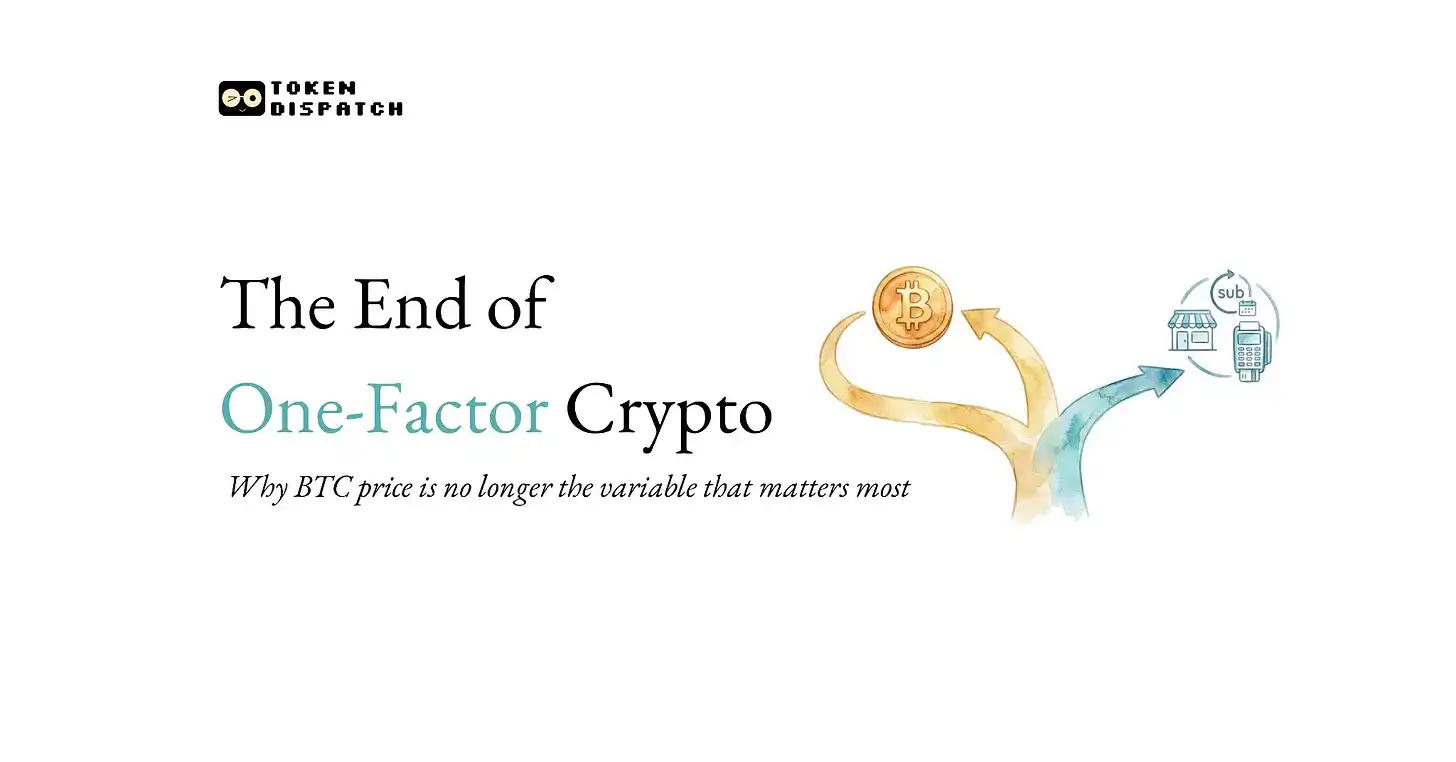
The End of Single-Factor Cryptography

The article "The End of Single-Factor Crypto" posits a fundamental shift in the cryptocurrency ecosystem. It argues the era where crypto asset valuations were predominantly driven by, and correlated with, Bitcoin's price is ending. The space is bifurcating into two distinct economies: endogenous and exogenous. The endogenous economy represents traditional crypto, where token and project values are directly tied to crypto market prices. The emerging exogenous economy comprises projects and businesses that may utilize blockchain technology or tokens but derive their fundamental value from external, non-crypto factors like consumer demand, subscription revenue, or real-world utility. Examples include AI inference platforms like Venice, fintech lenders using blockchain for efficiency, and stablecoin/payment infrastructure companies acquired by giants like Mastercard and Stripe. This shift means investment analysis must change. For exogenous assets, evaluating traditional business fundamentals—such as revenue streams, unit economics, and competitive moats—becomes more critical than tracking Bitcoin charts. While endogenous assets like Bitcoin remain relevant, the growth of the exogenous category is driven by measurable demand independent of crypto price cycles, paving the way for a new, more diversified market phase. Consequently, crypto is evolving from a single-factor, reflexive asset class into a multifaceted ecosystem with varied drivers and investment theses.

marsbit59 min fa

The End of Single-Factor Cryptography

marsbit59 min fa

Morning Post | Bitmine Plans to Raise $300 Million Through Preferred Stock Issuance; Polymarket Accuses Kalshi of Commercial Espionage

ChainCatcher's Daily Crypto Brief: Key developments from the past 24 hours include significant funding moves, regulatory actions, and market predictions. Bitmine announced a $300 million preferred stock fundraising. Polymarket accused rival prediction platform Kalshi of corporate espionage, citing numerous suspicious coincidences in product launches, a claim Kalshi strongly denied. The U.S. Department of Justice, in a joint "Disruption Week" anti-fraud operation with companies like Coinbase and Meta, froze over $3.8 million in cryptocurrency linked to scams. In infrastructure news, Macau completed its integration with the multi-central bank digital currency bridge, mBridge, aiming to build efficient cross-border payment channels. Cosmos Labs acquired the block explorer Mintscan. Market-wise, Geoffrey Kendrick, Standard Chartered's Head of Digital Assets Research, stated Bitcoin is nearing a bottom around $63,000, maintaining a year-end target of $100,000. He noted stability in U.S. spot Bitcoin ETF holdings. Ahead of SpaceX's anticipated IPO, internal insiders at Rocket Lab (RKLB) sold over $18.41 million in stock. In tokenization, Goldman Sachs partnered with Apex and Archax to launch a tokenized real estate fund. The meme token tracker GMGN reported the top trending tokens: on Ethereum, HEX, SHIB, LINK, PEPE, mUSD; on Solana, TROLL, swarms, WORLDCUP, neet, Buttcoin; and on Base, PEPE, toby, ODDS, ELSA, SKI.

链捕手1 h fa

Morning Post | Bitmine Plans to Raise $300 Million Through Preferred Stock Issuance; Polymarket Accuses Kalshi of Commercial Espionage

链捕手1 h fa

Trading

Spot
Futures

Articoli Popolari

Come comprare ONE

Benvenuto in HTX.com! Abbiamo reso l'acquisto di Harmony (ONE) semplice e conveniente. Segui la nostra guida passo passo per intraprendere il tuo viaggio nel mondo delle criptovalute.Step 1: Crea il tuo Account HTXUsa la tua email o numero di telefono per registrarti il tuo account gratuito su HTX. Vivi un'esperienza facile e sblocca tutte le funzionalità,Crea il mio accountStep 2: Vai in Acquista crypto e seleziona il tuo metodo di pagamentoCarta di credito/debito: utilizza la tua Visa o Mastercard per acquistare immediatamente HarmonyONE.Bilancio: Usa i fondi dal bilancio del tuo account HTX per fare trading senza problemi.Terze parti: abbiamo aggiunto metodi di pagamento molto utilizzati come Google Pay e Apple Pay per maggiore comodità.P2P: Fai trading direttamente con altri utenti HTX.Over-the-Counter (OTC): Offriamo servizi su misura e tassi di cambio competitivi per i trader.Step 3: Conserva Harmony (ONE)Dopo aver acquistato Harmony (ONE), conserva nel tuo account HTX. In alternativa, puoi inviare tramite trasferimento blockchain o scambiare per altre criptovalute.Step 4: Scambia Harmony (ONE)Scambia facilmente Harmony (ONE) nel mercato spot di HTX. Accedi al tuo account, seleziona la tua coppia di trading, esegui le tue operazioni e monitora in tempo reale. Offriamo un'esperienza user-friendly sia per chi ha appena iniziato che per i trader più esperti.

319 Totale visualizzazioniPubblicato il 2024.12.12Aggiornato il 2026.06.02

Come comprare ONE

Discussioni

Benvenuto nella Community HTX. Qui puoi rimanere informato sugli ultimi sviluppi della piattaforma e accedere ad approfondimenti esperti sul mercato. Le opinioni degli utenti sul prezzo di ONE ONE sono presentate come di seguito.

活动图片