Behind the $1 Billion Revenue: How Long Can Pump.fun's Money Printer Keep Running?

比推Pubblicato 2026-03-17Pubblicato ultima volta 2026-03-17

Introduzione

Pump.fun, a leading meme coin launch platform on Solana, has surpassed $1 billion in cumulative revenue, becoming the first on the chain to reach this milestone. Despite a broader market downturn in 2026, its dominance has solidified, capturing over 90% of daily trading volume and token creation on Solana. While its daily metrics remain strong, a significant portion of its revenue is shared with creators and LPs or used for token buybacks, which hasn't prevented its native token's price from falling over 76% from its peak. The analysis extends to other major players, revealing a market consolidation where traffic and profits are increasingly concentrated among top platforms. GMGN saw a five-fold quarterly revenue increase, primarily driven by activity on BSC, while Four.meme, BSC's main launchpad, operates at a fraction of its peak income. In contrast, platforms like Axiom, Photon, BullX, and BONKbot show steeper, sustained declines in revenue. The conclusion is that the meme coin sector is not disappearing but is undergoing a rapid shakeout. The survivors are platforms with robust, full-cycle ecosystems for token launches, trading, and liquidity. If another meme wave emerges, these established players are poised to capture the majority of the gains.

Author: Frank, PANews

Original Title: Pump.fun Joins the Billion-Dollar Club, How Much Business Does the "MEME Cash Machine" Have Left?


On March 8, Pump.fun's cumulative revenue exceeded $1 billion, making it the first platform on Solana to reach this milestone and solidifying its position as the most prominent money printer in the MEME sector. However, after the hype subsided, the question is no longer just "who made the most money," but rather how much business these MEME-driven platforms still have left.

Looking at top ecosystem projects like Pump.fun, GMGN, Four.meme, Axiom, as well as Photon, BullX, and BONK, the answer is becoming increasingly clear: MEME hasn't disappeared, but the business is increasingly concentrated among the top players, and the divergence between chains and platforms is becoming more pronounced.

Pump.fun: The "Absolute Oligarch" Across Bull and Bear Markets, Billions in Profits but Hard to Retain

If the last wave of MEME frenzy was a non-stop gold rush, then Pump.fun was undoubtedly the most profitable toll booth in this gold rush town. Public data shows that as of March 2026, Pump.fun's cumulative total revenue has exceeded $1 billion. Of this, 2024 contributed approximately $321 million, and 2025 further increased to about $664 million. Starting in 2026, the MEME industry experienced a significant downturn, but Pump.fun seemed relatively unaffected, still generating about $98.3 million in revenue to date.

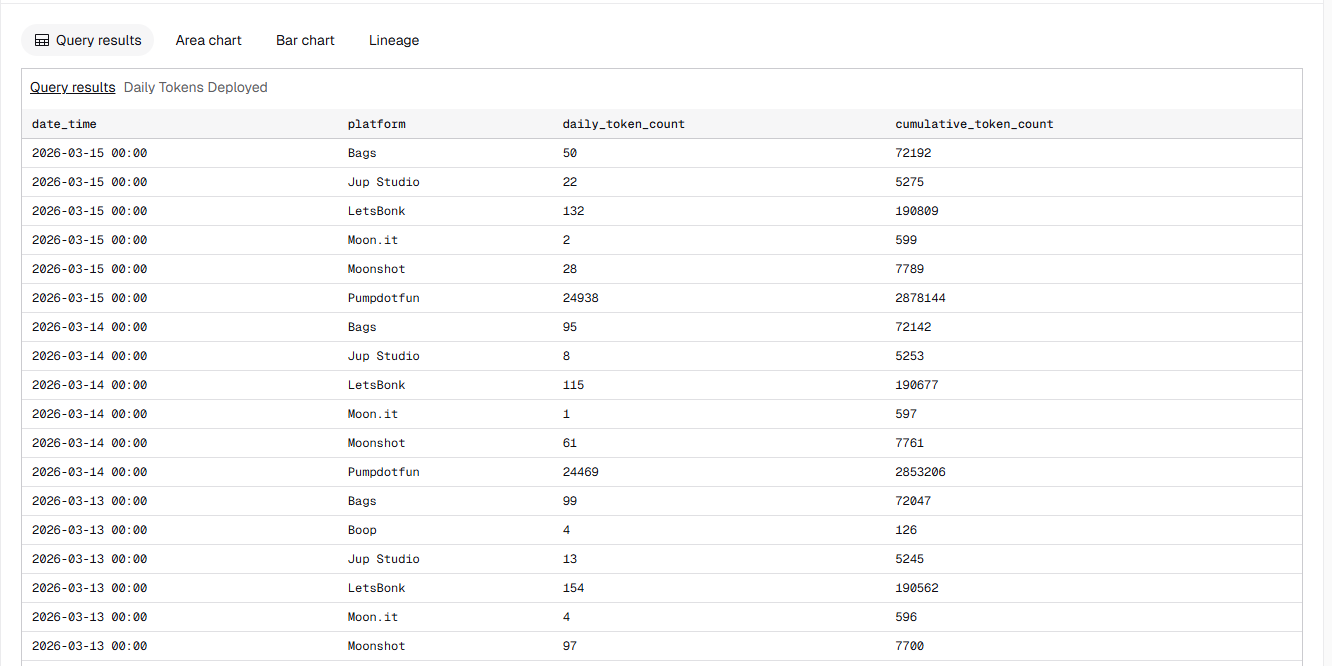
In terms of market structure, Pump.fun's dominant position in the Solana ecosystem has further strengthened. Taking data from March 15 as an example, Pump.fun's token creation share reached 99.1%, the graduation rate of tokens was 94.8%, and its daily trading volume share was about 93%. That day, Pump.fun launched 24,938 tokens, while LetsBonk had only 132, Bags had 50, and Moonshot had 28. The daily volume of other token launch platforms is no longer competitive with Pump.fun.
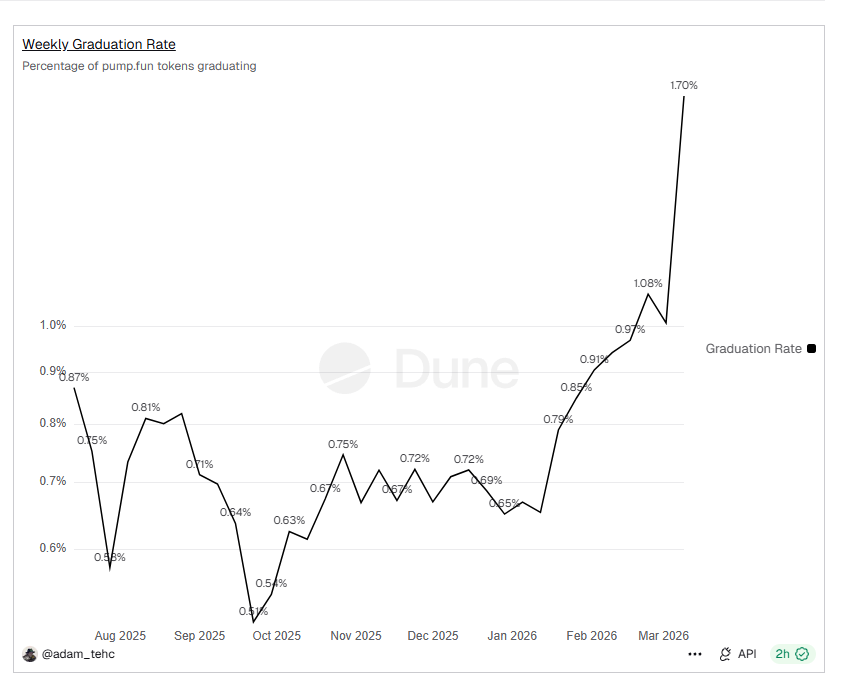
Looking back at Pump.fun's own data, it has also maintained a surprisingly high standard. Rough calculations based on visible data from the past two weeks show that Pump.fun currently averages about 29,700 token launches per day, with approximately 157,700 daily active wallets, a daily trading volume of about $93.65 million, and daily revenue of about $870,000. At the same time, the graduation rate, long seen as a weakness of the platform, has shown signs of recovery, recently even surging to around 1.70%. Although the specific reason behind this short-term peak is not yet clear, Pump.fun's graduation efficiency is indeed improving.
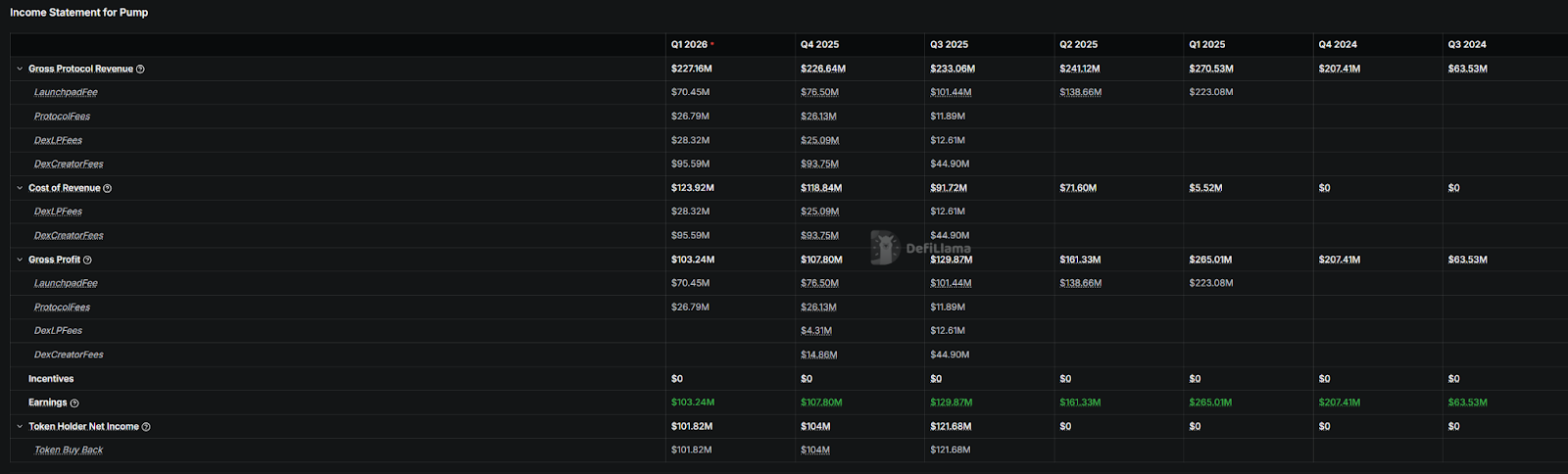
However, although fee generation remains robust, for Pump.fun, it does not mean that all this revenue can be fully converted into protocol profits. First, more than half of the fees are given to creators and LPs. Second, the remaining revenue is also used for token buybacks. In the first quarter of 2026, Pump.fun generated a total of $227 million in fees, of which $123 million was distributed to creators and LPs, and the remaining $100 million was almost entirely used for token buybacks.
The problem is that the buybacks did not automatically translate into a rise in token price. As of March 16, the price of PUMP was about $0.002, still about 76.21% lower than its all-time high of $0.0088. A more reasonable explanation is that buybacks can only provide support and maintain the narrative but are insufficient to reverse the overall compression of valuations in the MEME sector. In other words, Pump.fun's cash flow machine is still running at high speed, but the market is no longer willing to give it higher valuation multiples simply because it "makes money," as it did during the last hype cycle.

In summary, for Pump.fun, the market structure remains relatively stable. Although the entire meme coin sector is experiencing a decline, it's mostly the competitors that have died off,反而 making Pump.fun's dominance even stronger. If this market can explode again, Pump.fun is likely to capture even greater红利.

GMGN: Quarterly Revenue Grows Fivefold, BSC Becomes the "New Traffic Hotspot"

GMGN's revenue saw another explosive growth in the first quarter of 2026. Total revenue for Q1 2026 reached $25.31 million, a nearly fivefold increase compared to $5.64 million in Q4 2025. This quarter's revenue also became the second-highest quarterly revenue in GMGN's history (only lower than Q1 2025's $40.81 million).

A closer look at this revenue structure shows that it is mainly driven by the BSC chain. Starting in October 2025, GMGN's trading volume on the BSC chain began to significantly exceed that on Solana, and by 2026 this trend had stabilized. To date, the trading share on the BSC chain on GMGN is nearly three times that of the Solana chain.

From an overall trading volume perspective, user activity and trading volume on GMGN improved somewhat in Q1 2026, but the increase is not as high as the revenue change suggests. Therefore, from this angle, the revenue improvement in Q1 2026 is real, but the explosive growth is likely a statistical issue with DefiLlama (BSC chain revenue data was empty before October 2025).

However, this growth was primarily driven by a surge in MEME trading volume on the BSC chain in January, which generated $16.34 million in cross-chain revenue that month. This number dropped to $5.18 million in February and is about $3.77 million so far in March. The overall level for Q1 this year is similar to that of the same period in 2025.

Four.meme: The "Face" of BSC, Daily Revenue Only a Fraction of Its Peak

If Pump.fun has almost absorbed most of the traffic on Solana launch platforms, then on BSC, the closest to a similar role is Four.meme.

DeFiLlama data shows that as of March 16, Four.meme's protocol revenue for Q1 2026 has reached $16 million, significantly lower than the $54.24 million in Q4 2025. However, looking at the monthly revenue changes this year, there has been a slight recovery.
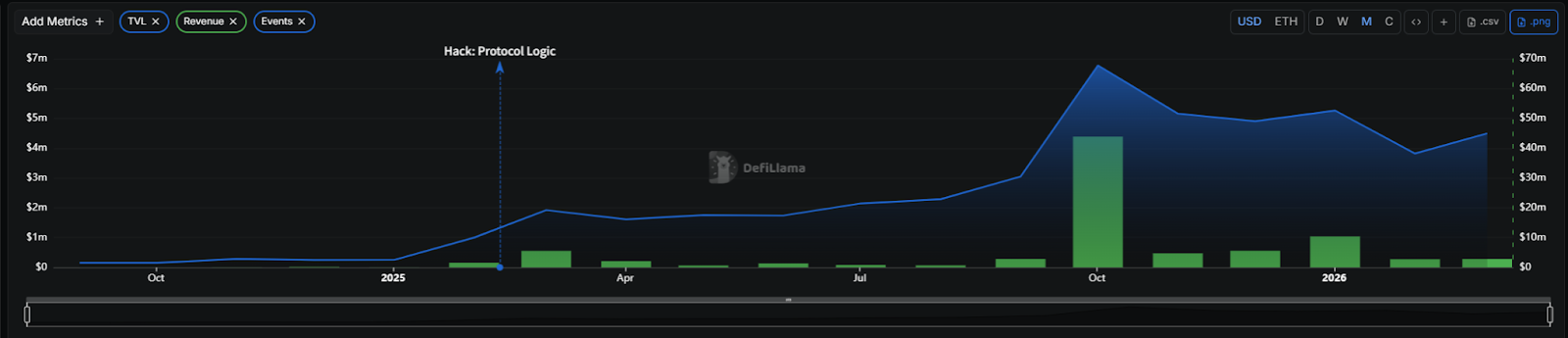
According to visible data tracked by Dune for the last 10 days, Four.meme averages about 4,858 token launches per day, with approximately 5,749 daily users. Only about 25.7 tokens are listed on the DEX Pancake daily, and the short-term graduation rate has further dropped to around 0.53%. Judging from these data changes, the current Four.meme is also operating at a low level. Compared to the peak daily revenue of $4.22 million in October 2025, current revenue has fallen to the $200,000-$300,000 level.
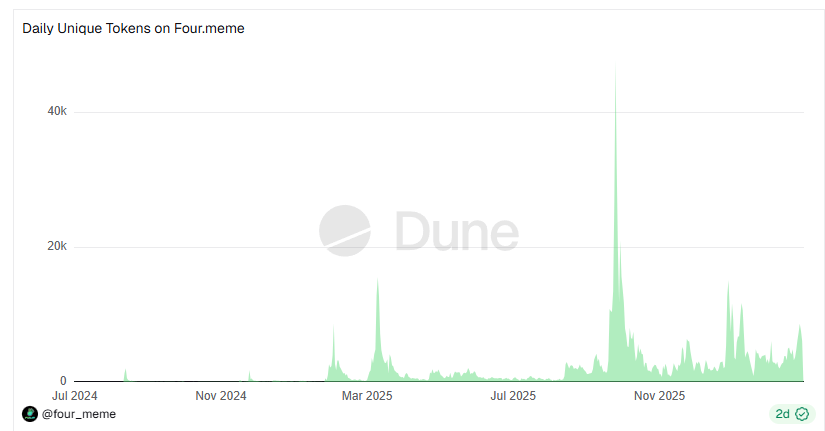
For comparison, estimates based on Pump.fun's data from the past two weeks show it still averages about 29,700 token launches per day and a daily trading volume of about $93.65 million. Clearly, as the main platforms for MEME coins on Solana and BSC respectively, there is a significant gap in scale and token quality between Four.meme and Pump.fun, reflecting the development of MEME on these two chains.

Axiom: Farewell to High Growth, Stuck in a Continuous Volume Contraction Quagmire

If GMGN's growth in Q1 2026 was more like catching the红利 of the BSC rotation, then Axiom's situation is almost the opposite.

According to DeFiLlama data, as of now, the protocol's revenue in Q1 2026 is approximately $29.03 million, higher than GMGN's $25.31 million for the same period.
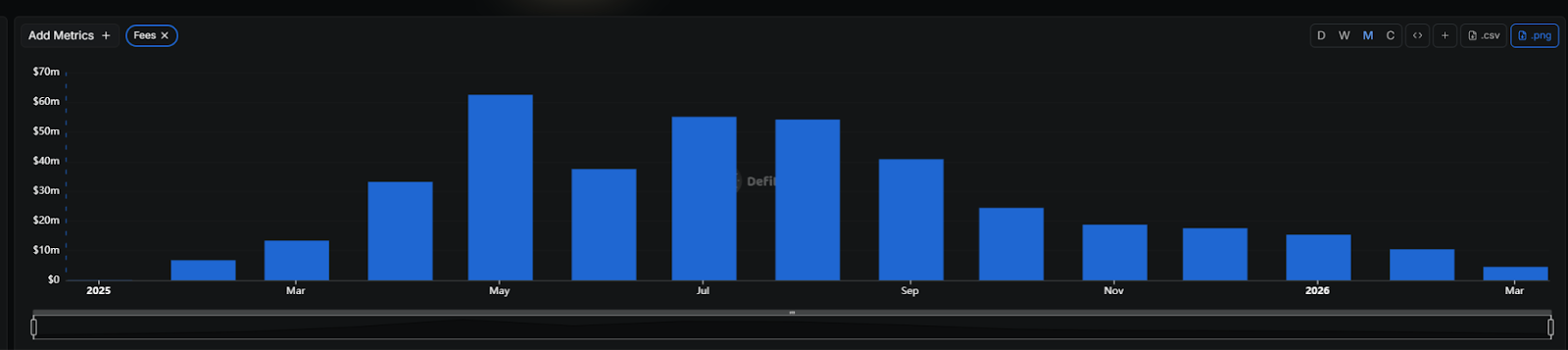
However, Axiom's current problem is that its business is in a state of continuous decline. According to DeFiLlama's quarterly revenue data, Axiom's protocol revenue reached highs of $133 million and $150 million in Q2 and Q3 2025 respectively, but fell to $60.66 million in Q4 2025, and is currently $29.03 million for Q1 2026. Compared to the most疯狂 phase last year, the business volume has significantly contracted. Comparing this with GMGN reveals that although both are in a post-peak decline phase, GMGN's revenue still has occasional阶段性 rebounds, while Axiom seems unable to regain its momentum.

For Axiom, it is no longer just a tool reliant on MEME hype bursts but更像是一台经历过多轮行情检验的成熟交易机器 (more like a mature trading machine that has been tested through multiple market cycles). Compared to GMGN, which is still talking about growth elasticity, Axiom's imagination space seems to be shrinking.

Photon, BullX, and BONK: The "Stragglers" After the Tide Recedes

Compared to GMGN, which still has rebounds, and Axiom, which maintains a leading scale, the revenue curves of Photon, BullX, and BONKbot have more clearly entered a downward trend in 2026.

According to DeFiLlama data as of March 16, Photon's cumulative revenue is approximately $438 million, but its quarterly revenue has declined from $122.8 million in Q1 2025, to $32.31 million in Q2, $18.99 million in Q3, $5.29 million in Q4, and is only $4.52 million so far in Q1 2026, showing a nearly阶梯式坠落 (stepped decline) trend.
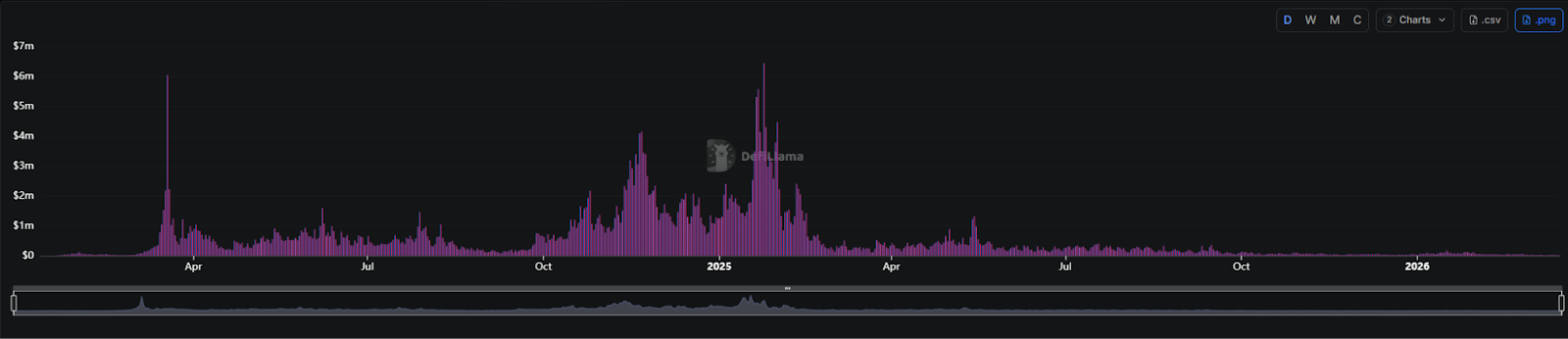
BullX's cumulative revenue is about $203 million, but it also experienced rapid contraction. Quarterly revenue dropped from $87.37 million in Q1 2025 to $14.25 million in Q2, $3.86 million in Q3, $878,000 in Q4, and is only $491,000 so far in Q1 2026.
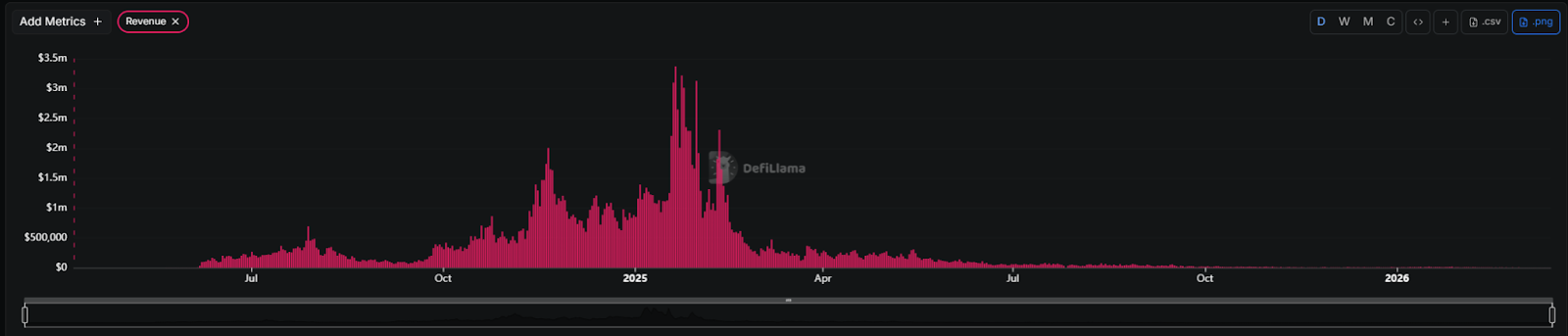
BONKbot's decline is relatively less steep but has also clearly receded. According to DeFiLlama data, its cumulative revenue is about $93.57 million. Quarterly revenue was $12.61 million in Q1 2025, then fell to $3.40 million in Q2, $2.85 million in Q3, $1.85 million in Q4, and is $1.84 million so far in Q1 2026.
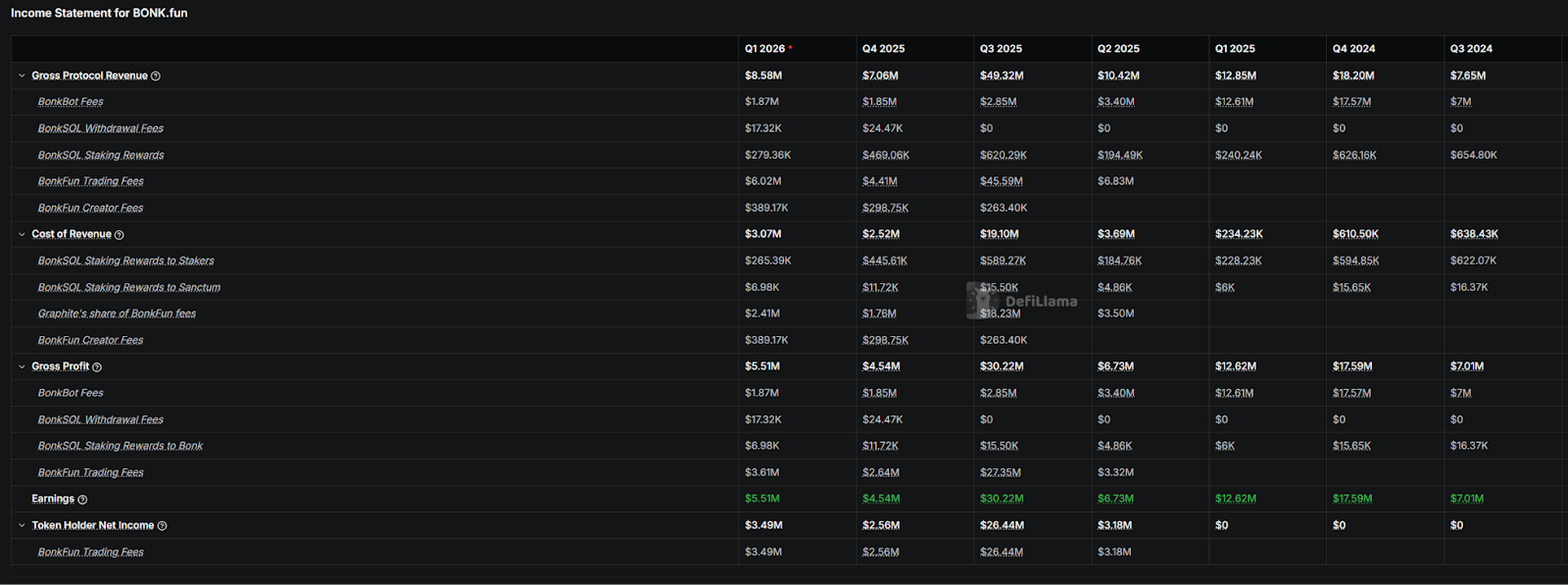
However, the BONK ecosystem itself has not simultaneously熄火 (fizzled out). As of now, BONK.fun's protocol revenue for Q1 2026 is approximately $8.51 million, already higher than the $7.06 million in Q4 2025. Of this current quarter's revenue, about $6 million comes from Bonk.Fun, and about $1.84 million comes from BonkBot.

Looking at this MEME coin battle royale, it's not hard to draw a conclusion: the MEME track is not dying out; it's just that the era of wild competition has彻底终结 (completely ended), and the reshuffling speed has far exceeded everyone's expectations.

After the tide receded, the platforms that truly remained are no longer just the fastest runners but those that have built a complete closed loop encompassing launch, trading, liquidity, and fee collection. If the next wave of MEME行情 (market trend) starts again, they are most likely the ones to benefit first.


Twitter:https://twitter.com/BitpushNewsCN

Bitpush TG Discussion Group:https://t.me/BitPushCommunity

Bitpush TG Subscription: https://t.me/bitpush

Original link:https://www.bitpush.news/articles/7620497

Domande pertinenti

QWhat is Pump.fun's total cumulative revenue as of March 8th, and why is this milestone significant?

APump.fun's cumulative revenue reached $1 billion as of March 8th, making it the first platform on Solana to achieve this milestone. It solidifies its position as the most prominent revenue generator in the MEME sector.

QHow has Pump.fun's revenue distribution changed, and what happens to the fees collected?

AA significant portion of Pump.fun's fees are distributed to creators and liquidity providers (LPs). For example, in Q1 2026, out of $227 million in fees, $123 million was given to creators and LPs, and the remaining $100 million was almost entirely used for token buybacks.

QWhich platform experienced a nearly 5x quarter-over-quarter revenue growth in Q1 2026, and on which blockchain was this growth primarily driven?

AGMGN experienced a nearly 5x quarter-over-quarter revenue growth in Q1 2026, reaching $25.31 million. This growth was primarily driven by a surge in activity on the BSC (Binance Smart Chain), which now accounts for nearly three times the trading volume of its Solana chain.

QHow does the current daily revenue of Four.meme compare to its peak, and what does this indicate about the BSC MEME market?

AFour.meme's current daily revenue has fallen to the $200,000-$300,000 range, which is only a fraction of its peak daily revenue of $4.22 million in October 2025. This indicates a significant cooling off and lower activity levels in the BSC MEME market compared to its previous highs.

QWhich MEME-related platforms are described as 'laggards' with clearly declining revenue curves in 2026?

AThe platforms described as 'laggards' with clearly declining revenue curves in 2026 are Photon, BullX, and BONKbot. Their quarterly revenues have shown a consistent and significant downward trend throughout 2025 and into 2026.

Letture associate

Understanding CPO (Co-Packaged Optics) in One Article: Why Nvidia Is Willing to Spend $3.2 Billion on a Fiber?

NVIDIA and Corning announced a multi-year strategic partnership on May 6, 2026, with NVIDIA committing up to $3.2 billion to support Corning's U.S. expansion. This investment will triple Corning's manufacturing plants and significantly boost its optical fiber and communications production capacity. The core driver behind this massive investment is the fundamental shift from copper to optical interconnect technology within AI data centers. As GPU clusters scale, copper wires face critical limitations: severe signal attenuation over distance, high energy consumption for signal integrity, and excessive heat generation. Optical fiber, transmitting light instead of electrical signals, solves these issues with minimal loss, near-light speed, and lower power needs. The article outlines a three-stage evolution of data center interconnect: 1. **Traditional Copper Interconnects:** The mainstream solution of the 2010s, now being phased out due to scaling bottlenecks. 2. **Pluggable Optical Modules:** The current mainstream, where modules convert electrical signals to light externally. This process still introduces energy loss and latency. 3. **CPO (Co-Packaged Optics):** The next-generation technology where the optical engine is integrated directly with the GPU chip package. This drastically reduces the electrical signal travel distance to mere millimeters, slashing power consumption and latency while boosting data density. NVIDIA CEO Jensen Huang has identified CPO as an essential core technology for AI infrastructure. NVIDIA's investment signifies a strategic shift from being a buyer to actively controlling its supply chain for critical components. With demand for specialized optical fiber far outstripping supply—evidenced by soaring prices—securing long-term manufacturing capacity has become a competitive necessity. While Corning's expansion may pressure some suppliers, a projected global fiber supply gap of 5-15% over the next few years creates a significant opportunity window, particularly for Chinese manufacturers competitive in optical preforms, chips, and modules. Ultimately, NVIDIA's move is not about chasing a trend but an engineering imperative. The transition to light-based interconnects like CPO is driven by the physical limits of copper, marking a definitive step in the ongoing AI computing revolution.

marsbit1 min fa

Understanding CPO (Co-Packaged Optics) in One Article: Why Nvidia Is Willing to Spend $3.2 Billion on a Fiber?

marsbit1 min fa

KOL's Perspective: Why Is SOL Set to Rise from This Point?

**Summary: Why SOL is Positioned for Growth at This Level** The article argues that SOL is poised for an upward move from its current price point, citing several key factors. Primarily, SOL has just broken out of a 4-month consolidation phase. This breakout signals a return of risk appetite to the broader crypto market, as SOL is seen as a key indicator of overall crypto health. The token's ownership has reportedly shifted from short-term traders and tourists to long-term accumulators, leading to low volume. Any meaningful increase in trading activity could thus trigger significant upward momentum. Fundamental strengths include strong institutional adoption, integration with DeFi and RWAs (Real-World Assets), and the potential benefits from the Clarity Act. Despite its high volatility—having dropped 70% from its all-time high but still up 12x from its bear market low—SOL is highlighted as one of the few tokens from the last cycle to reach new highs. It boasts a robust ecosystem of applications, users, and protocols. Future catalysts include the expected influx of AI developers following the Miami Accelerate conference, which focused on AI on Solana. Furthermore, Solana is positioned as the premier chain for memecoin activity, a trend expected to continue and drive network usage and fees. The article concludes that recent price action reflects a healthy transfer to long-term holders, setting the stage for growth.

marsbit51 min fa

KOL's Perspective: Why Is SOL Set to Rise from This Point?

marsbit51 min fa

Those Pre-Bitcoin PoW Protocols Have Recently Been Reimplemented

This article details a recent surge in replicating pre-Bitcoin Proof-of-Work (PoW) protocols, specifically focusing on Hal Finney's 2004 RPOW (Reusable Proofs of Work). Within five days in May 2026, multiple independent builders in the Bitcoin/cypherpunk community launched projects inspired by this early electronic cash proposal. The initiative began with Fred Krueger's `rpow2.com`, a centralized but auditable system that replaced RPOW's original IBM 4758 hardware with Ed25519 signatures. Initially a faithful replica, it later adopted Bitcoin-like features (21M supply cap, difficulty adjustment) and a controversial 5.24% founder allocation. This sparked rapid forks, including `rpow4.com` which incorporated full Bitcoin parameters, a prediction market (`rpowmarket.com`), and a DEX (`rpow2swap.com`). Concurrently, Mike In Space created a prototype of Wei Dai's 1998 b-money proposal (`b-money.replit.app`), pushing the historical exploration even further back. The article contrasts these centralized, server-dependent experiments with Bitcoin's core innovation of decentralized, trustless consensus. It also highlights a parallel development: the `HASH` project on Ethereum, which uses smart contract hooks to enable a purely fair-launch, browser-mineable PoW token with 0% allocations to team or VCs. The collective activity is framed as a meme-driven, educational exploration of cypherpunk history rather than a serious financial movement, with all projects heavily disclaiming any investment value.

marsbit56 min fa

Those Pre-Bitcoin PoW Protocols Have Recently Been Reimplemented

marsbit56 min fa

South Korean Exchanges 'Battle' Regulators, Challenging the Boundaries of Enforcement and Legislation

South Korea's cryptocurrency industry is engaged in a rare, direct confrontation with regulators. The Financial Intelligence Unit (FIU), the primary anti-money laundering (AML) watchdog, has recently imposed heavy penalties on major exchanges like Upbit and Bithumb for alleged violations involving unregistered overseas VASPs and AML procedures. However, exchanges are now actively challenging these actions in court and through industry associations. In a significant shift, the Seoul Administrative Court ruled in favor of Upbit's operator, Dunamu, overturning part of an FIU-ordered business suspension. The court found the FIU's penalty criteria and justification insufficiently clear. Similarly, the court suspended the enforcement of a six-month business suspension against Bithumb pending a final ruling, citing potential irreversible harm to the exchange. Beyond legal battles, the industry is contesting proposed legislative amendments. The Digital Asset eXchange Alliance (DAXA) strongly opposes a draft rule that would mandate Suspicious Transaction Reports (STRs) for all crypto transfers over 10 million KRW (~$6,800). DAXA argues this "poison pill" clause violates legal principles and would overwhelm the STR system, increasing reports from 63,000 to an estimated 5.45 million annually for major exchanges, thereby crippling effective AML monitoring. This conflict highlights a structural tension in South Korea's crypto governance: comprehensive digital asset laws are still developing, while regulators rely heavily on AML enforcement. The industry's move from passive compliance to active legal and legislative challenges signifies a new phase, pressing for clearer rules and more proportionate enforcement. While short-term disputes may intensify, this clash could ultimately lead to a more mature and sustainable regulatory framework for South Korea's vibrant crypto market.

marsbit1 h fa

South Korean Exchanges 'Battle' Regulators, Challenging the Boundaries of Enforcement and Legislation

marsbit1 h fa

Trading

Spot
Futures
活动图片