Behind OpenAI's $110 Billion Financing: The Game Between Amazon and Microsoft

Odaily星球日报Pubblicato 2026-02-28Pubblicato ultima volta 2026-02-28

Introduzione

OpenAI has secured $110 billion in new funding at a $730 billion pre-money valuation, with major investments from Amazon ($50 billion), Nvidia ($30 billion), and SoftBank ($30 billion). Notably, CEO Sam Altman’s public acknowledgment included Microsoft—an existing investor and partner—immediately after Amazon, signaling strategic alignment shifts. A key insight lies in two technical distinctions: “Stateless API” and “Stateful Runtime Environment.” Stateless API, the current mainstream model, handles single-request tasks without retaining context, but faces commoditization and margin pressure. In contrast, Stateful Runtime Environment supports persistent, autonomous AI agents capable of complex multi-step workflows, representing the future of enterprise AI adoption. Microsoft’s existing agreement ensures Azure remains the exclusive cloud provider for OpenAI’s Stateless API, securing present-day revenue streams. Meanwhile, Amazon’s expanded $100 billion partnership with OpenAI focuses on co-developing Stateful Runtime Environments via AWS Bedrock, positioning AWS as the infrastructure backbone for next-generation AI agents. This dual-cloud strategy enhances OpenAI’s leverage, reducing dependency on Microsoft while pitting Amazon and Microsoft in competition for future AI dominance. OpenAI gains negotiating power by diversifying its infrastructure partnerships and aligning each cloud giant with distinct—yet complementary—AI futures.

Original | Odaily Planet Daily (@OdailyChina)

Author | Azuma (@azuma_eth)

On the evening of February 27, OpenAI announced the completion of its latest funding round of $110 billion at a pre-money valuation of $730 billion.

The funding for this round came from three giants: Amazon invested $50 billion (an initial investment of $15 billion, with the remaining $35 billion to be delivered over the coming months upon meeting specific conditions), NVIDIA invested $30 billion (which will be recouped through the procurement of a total of 5 GW of computing power), and SoftBank also invested $30 billion.

After the funding was completed, OpenAI founder Sam Altman expressed his thanks to the three investors on his personal X account. Notably, Sam Altman's order of thanks was Amazon, Microsoft, NVIDIA, SoftBank — the name of Microsoft, the "old" shareholder and important partner who did not contribute in this round, was mentioned immediately after Amazon, which committed the most funding.
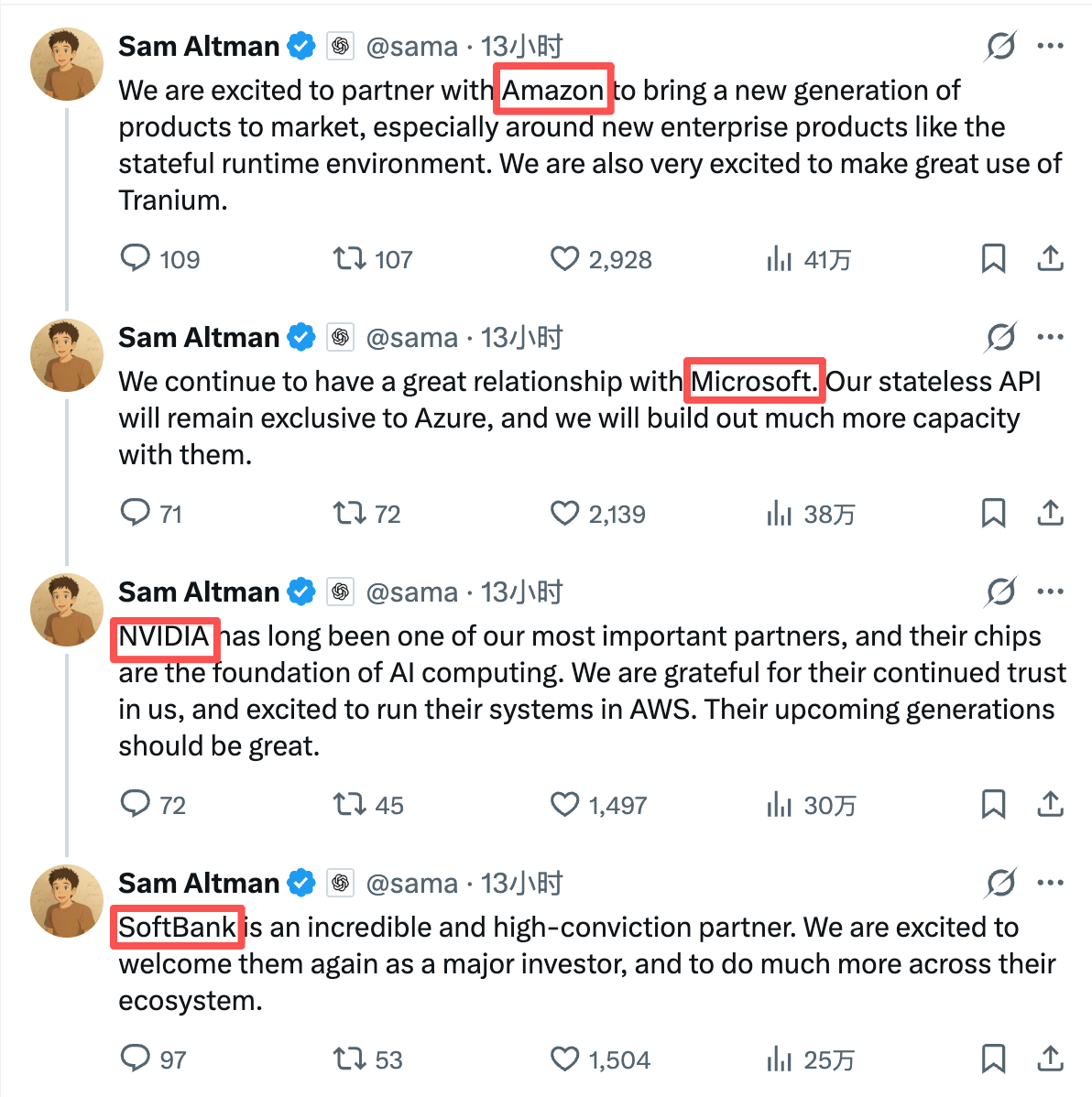
Aakash Gupta, an overseas blogger who has long followed the AI sector, pointed out that while most people are focused on the astronomical figure of $110 billion, the most critical piece of information in Sam Altman's statement lies in two overlooked technical terms: "Stateless API" and "Stateful Runtime Environment," which were attributed to Microsoft and Amazon, respectively.

Behind the Technical Terms: The Present and Future of AI

The core difference between Stateless API and Stateful Runtime Environment lies in the two words: "Stateless" and "Stateful".

The "Stateless" nature of a Stateless API means that the server does not maintain persistent state across requests — one call completes one inference; you ask a question, the AI answers, and after the lifecycle of this request ends, the system does not retain context or continue running. The "Stateful" nature of a Runtime Environment, on the other hand, implies a persistent execution environment — the Agent has historical memory, can persist, collaborate across tasks, and perform tasks over the long term.

Stateless API is currently the mainstream form of LLM commercialization. Industries such as finance, retail, manufacturing, and healthcare mostly integrate AI in this form to embed it into existing systems (e.g., various Q&A assistants, document summarization, search enhancement, etc.). The advantage of this model is that enterprises can quickly overlay AI capabilities into their existing architecture with minimal friction, achieving functional optimization without significant restructuring of organization and processes. However, as model capabilities converge, computing power costs continue to decrease, and price competition intensifies, the token-based billing of Stateless APIs is more likely to become standardized and commoditized, with marginal profits facing ongoing compression.

In contrast, Stateful Runtime Environment currently has limited commercial scale, but it represents not just simple "functional optimization" but a shift in business paradigm — it is not only able to answer questions but can also be seen as a digital workforce to concretely execute tasks. This means that the budget it touches will extend from mere interface call fees to automation, process management, and even part of the labor costs. Because of this, the market's expectations for Stateful Runtime Environment are far higher than its current scale.

Aakash Gupta also stated on this matter that in 2026 and 2027, almost all enterprise roadmaps will revolve around "autonomous agent workflows," not one-off API calls. Companies that invest heavily in AI in the future will increasingly tend to purchase systems that can run sustainably, collaborate across tools, and maintain context over the long term.

To put it in the simplest terms: Stateless API represents the present, while Stateful Runtime Environment represents the future.

What Did Microsoft and Amazon Take, Respectively?

On the day the funding was completed, Microsoft and Amazon each announced their latest cooperation agreements with OpenAI.

Microsoft stated in its announcement that the terms of the partnership jointly announced by Microsoft and OpenAI in October 2025 would remain unchanged (the terms include OpenAI purchasing $250 billion worth of Azure services). Azure remains the exclusive cloud provider for OpenAI's Stateless API; any Stateless API calls to OpenAI models generated through cooperation with any third party (including Amazon) will be hosted on Azure; OpenAI's first-party products, including Frontier, will also continue to be hosted on Azure.

Amazon stated in its announcement that AWS and OpenAI will jointly build a Stateful Runtime Environment powered by OpenAI models and provide services to AWS customers through Amazon Bedrock, helping enterprises build generative AI applications and Agents at production scale; AWS will also become the exclusive third-party cloud distribution service provider for OpenAI Frontier; the existing $38 billion multi-year cooperation agreement between AWS and OpenAI will be expanded to $100 billion, with a term of 8 years. OpenAI will consume 2 GW of Trainium computing power through AWS infrastructure to support the needs of Stateful Runtime Environment, Frontier, and other advanced workloads; OpenAI and Amazon will also develop customized models that can be used to support Amazon's customer-facing applications.

Comparing the two announcements, the current situation becomes clear.

Microsoft, with its $250 billion agreement and exclusive service rights, has locked in the current traffic engine. As long as OpenAI's Stateless API is called, Azure will bill behind the scenes — regardless of who the customer is or where the channel is, the traffic will ultimately return to Azure. This is a highly certain cash flow, but the problem lies in the trend of shrinking profit margins for Stateless APIs; call volume may continue to grow, but actual profits may not necessarily remain stable in the long run.

On the other hand, Amazon, with its $50 billion in real money and a $100 billion expanded agreement, has secured the underlying hosting rights for the AI Agent era for AWS. Once Agents become the core carriers of enterprise productivity, the resources that are truly consumed over the long term — computing power, storage, scheduling systems, workflow orchestration, and cross-tool collaboration — will all be deposited on AWS's runtime environment.

One controls the current cash flow; the other bets on the future structure of productivity.

OpenAI's Diversified Bet

Before the future truly arrives, no one knows whether Microsoft's or Amazon's choice is correct. But what is certain is that under these two clearly defined cooperation agreements with explicit interest divisions, OpenAI's initiative is significantly increasing.

Over the past few years, OpenAI has been highly dependent on Microsoft for cloud infrastructure. Microsoft is not only a major shareholder holding 27% of the shares but also the controller of the infrastructure. This binding brought effective early-stage resource advantages to OpenAI, but it also meant that the balance of bargaining power would naturally tilt toward Microsoft. With Amazon's strong entry, it and Microsoft are bound to engage in direct competition to seize the future service rights of OpenAI.

For OpenAI, this is a typical diversified betting strategy — not deeply binding with any single cloud service provider, not letting future growth be entirely constrained by one party, and using future business as a bargaining chip to obtain better terms.

Neither Microsoft nor Amazon can afford to give up OpenAI at present. When neither can leave the table, bargaining power naturally returns to OpenAI's hands.


Domande pertinenti

QWhat is the core difference between Stateless API and Stateful Runtime Environment in the context of AI?

AStateless API refers to a server-side service that does not retain persistent state across requests—each call completes one inference, and the system does not retain context or continue running after the request lifecycle ends. Stateful Runtime Environment, on the other hand, involves a persistent execution environment where AI agents have historical memory, can exist continuously, collaborate across tasks, and perform long-term tasks.

QWhich companies invested in OpenAI's latest $110 billion funding round, and what were their respective contributions?

AAmazon invested $50 billion ($15 billion initially, with the remaining $35 billion to be delivered over the coming months upon meeting specific conditions), Nvidia invested $30 billion (which will be recouped through the procurement of a total of 5 GW of computing power), and SoftBank also invested $30 billion.

QWhat did Microsoft secure in its agreement with OpenAI regarding Stateless API?

AMicrosoft secured Azure as the exclusive cloud provider for OpenAI's Stateless API. Any Stateless API calls to OpenAI models generated through cooperation with any third party, including Amazon, will be hosted on Azure. OpenAI's first-party products, including Frontier, will also continue to be hosted on Azure.

QWhat did Amazon obtain through its expanded agreement with OpenAI, particularly in relation to Stateful Runtime Environment?

AAmazon obtained a partnership with OpenAI to jointly build a Stateful Runtime Environment powered by OpenAI models, which will be provided to AWS customers via Amazon Bedrock. AWS also became the exclusive third-party cloud distribution service provider for OpenAI Frontier. The existing $38 billion multi-year cooperation agreement was expanded to $100 billion over 8 years, with OpenAI consuming 2 GW of Trainium computing power through AWS infrastructure to support Stateful Runtime Environment, Frontier, and other advanced workloads.

QHow does OpenAI's strategy of engaging with both Microsoft and Amazon reflect its approach to future growth and bargaining power?

AOpenAI's strategy reflects a分散押注 (diversified betting) approach. By not deeply binding with any single cloud service provider and avoiding complete dependence on one party for future growth, OpenAI uses its future business as a bargaining chip to secure more favorable terms. As both Microsoft and Amazon are unwilling to withdraw from the partnership, bargaining power naturally returns to OpenAI.

Letture associate

From South Korea to the United States: Blue-Collar Jobs Are Becoming Increasingly Popular, Thanks to AI

AI is reshaping the labor market's value proposition. The traditional four-year college degree is losing its appeal as a guaranteed career path, while skilled blue-collar trades like electricians, welders, and plumbers are experiencing historic demand and wage premiums. This shift is driven by dual pressures: AI's displacement of certain white-collar roles and a booming need for physical infrastructure and data center construction. Data confirms the trend. In the U.S., vocational school revenue surged, and a significant portion of recent layoffs are AI-related. Surveys show a majority of Gen Z adults plan to pursue blue-collar work, citing better job security against AI automation. Vocational education interest has exploded recently. Experts cite a psychological shift as younger generations seek tangible, AI-resistant careers and avoid high student debt. In many cases, salaries for skilled trades now match or exceed those requiring a bachelor's degree. In South Korea, semiconductor vocational high schools boast near-total employment, with graduates securing high-paying roles at companies like Samsung. The shortage is structural, exacerbated by a retiring baby boomer workforce and massive infrastructure projects. Companies like JPMorgan Chase, Meta, and Lowe's are investing heavily in training programs. However, overcoming historical stigma and a "perception gap" around trade careers remains a key challenge to closing the talent gap.

marsbit21 min fa

From South Korea to the United States: Blue-Collar Jobs Are Becoming Increasingly Popular, Thanks to AI

marsbit21 min fa

Qualcomm: AI Hype Subsides, When Will Smartphones Emerge from the Gloom?

Qualcomm reported its Q3 FY2026 results (ending June 2026), with revenue of $9.95B, down 4% YoY but above expectations. Gross margin declined to 53.1%, pressured by rising costs across manufacturing and memory. Key business segments showed mixed performance: Handset revenue fell 19.6% YoY to $5.09B, dragged by an 11% decline in non-Apple Android shipments and weaker high-end mix. Conversely, Automotive revenue surged 61% to $1.59B, and IoT grew 9% to $1.83B. Core operating profit dropped 41% YoY due to margin compression and higher expenses. Management's Q4 FY2026 guidance projects revenue of $9.7B-$10.5B, in line with consensus, but Non-GAAP EPS guidance of $2.05-$2.25 fell short of expectations. Amidst persistent weakness in its core handset market, Qualcomm is pursuing growth in AI, focusing on Edge AI (smartphones, PCs, automotive) and Data Center AI. Its data center strategy includes four pillars: AI accelerators (e.g., AI200), commercial CPUs (Dragonfly C1000), custom silicon, and connectivity solutions. While these initiatives initially boosted its stock, concerns over AI capital expenditure sustainability have since erased those gains. The company targets $5B in data center revenue for FY2027 and $15B for FY2029. The report concludes that with the traditional handset business still under pressure, the data center opportunity is currently viewed as a longer-term option, and a more conservative valuation based on core operations may be warranted until AI contributions materialize.

marsbit26 min fa

Qualcomm: AI Hype Subsides, When Will Smartphones Emerge from the Gloom?

marsbit26 min fa

From TPU to Self-Evolving Agents: How Jeff Dean Predicts the Next Step in AI

At the 2026 YC Startup School, Jeff Dean outlined his vision for AI's next phase, shifting focus from simply scaling models to building intelligent, autonomous systems. He believes AI's progress is no longer just about creating smarter models, but about integrating them into systems capable of long-term, iterative work, automated experimentation, and continuous learning. This evolution moves the competition from "who has the bigger model" to "who can best organize intelligence." Dean suggests AI capabilities are now comparable to a junior engineer, enabling the automation of complex workflows. However, the true challenge and opportunity lie in managing these AI "workers" at scale. He emphasizes the importance of **context engineering**—structuring tools, memory, and feedback loops—over raw model power. For startups, this means building deep expertise in niche domains where general models currently fail (near 0-1% success rates), leveraging proprietary data, specialized tools, and domain-specific evaluators. A recurring theme is re-examining fundamental constraints. Dean's past work, like moving Google's search index to memory or creating the TPU, stemmed from questioning outdated assumptions about hardware and cost. He sees similar inflection points today, particularly in **specialized inference hardware** to drastically reduce latency and energy consumption for real-time Agent operation. Notably, he points out that in modern AI systems, the dominant cost is often not computation but **data movement**. Reliable, long-running Agents require robust system design, borrowing concepts from distributed computing like checkpointing, state management, and parallel exploration to handle failures and maintain progress over days or weeks. As AI automates execution, the scarcest human skills will shift to **defining clear specifications**, **judging what problems are worth solving** (taste), and designing effective feedback loops. Ultimately, Dean's framework prioritizes understanding the problem deeply, identifying the true bottlenecks, and systematically building closed-loop systems where AI can not only perform tasks but also improve AI itself.

marsbit26 min fa

From TPU to Self-Evolving Agents: How Jeff Dean Predicts the Next Step in AI

marsbit26 min fa

Trading

Spot
活动图片




