Behind OpenAI's $110 Billion Financing: The Game Between Amazon and Microsoft

Odaily星球日报Pubblicato 2026-02-28Pubblicato ultima volta 2026-02-28

Introduzione

OpenAI has secured $110 billion in new funding at a $730 billion pre-money valuation, with major investments from Amazon ($50 billion), Nvidia ($30 billion), and SoftBank ($30 billion). Notably, CEO Sam Altman’s public acknowledgment included Microsoft—an existing investor and partner—immediately after Amazon, signaling strategic alignment shifts. A key insight lies in two technical distinctions: “Stateless API” and “Stateful Runtime Environment.” Stateless API, the current mainstream model, handles single-request tasks without retaining context, but faces commoditization and margin pressure. In contrast, Stateful Runtime Environment supports persistent, autonomous AI agents capable of complex multi-step workflows, representing the future of enterprise AI adoption. Microsoft’s existing agreement ensures Azure remains the exclusive cloud provider for OpenAI’s Stateless API, securing present-day revenue streams. Meanwhile, Amazon’s expanded $100 billion partnership with OpenAI focuses on co-developing Stateful Runtime Environments via AWS Bedrock, positioning AWS as the infrastructure backbone for next-generation AI agents. This dual-cloud strategy enhances OpenAI’s leverage, reducing dependency on Microsoft while pitting Amazon and Microsoft in competition for future AI dominance. OpenAI gains negotiating power by diversifying its infrastructure partnerships and aligning each cloud giant with distinct—yet complementary—AI futures.

Original | Odaily Planet Daily (@OdailyChina)

Author | Azuma (@azuma_eth)

On the evening of February 27, OpenAI announced the completion of its latest funding round of $110 billion at a pre-money valuation of $730 billion.

The funding for this round came from three giants: Amazon invested $50 billion (an initial investment of $15 billion, with the remaining $35 billion to be delivered over the coming months upon meeting specific conditions), NVIDIA invested $30 billion (which will be recouped through the procurement of a total of 5 GW of computing power), and SoftBank also invested $30 billion.

After the funding was completed, OpenAI founder Sam Altman expressed his thanks to the three investors on his personal X account. Notably, Sam Altman's order of thanks was Amazon, Microsoft, NVIDIA, SoftBank — the name of Microsoft, the "old" shareholder and important partner who did not contribute in this round, was mentioned immediately after Amazon, which committed the most funding.
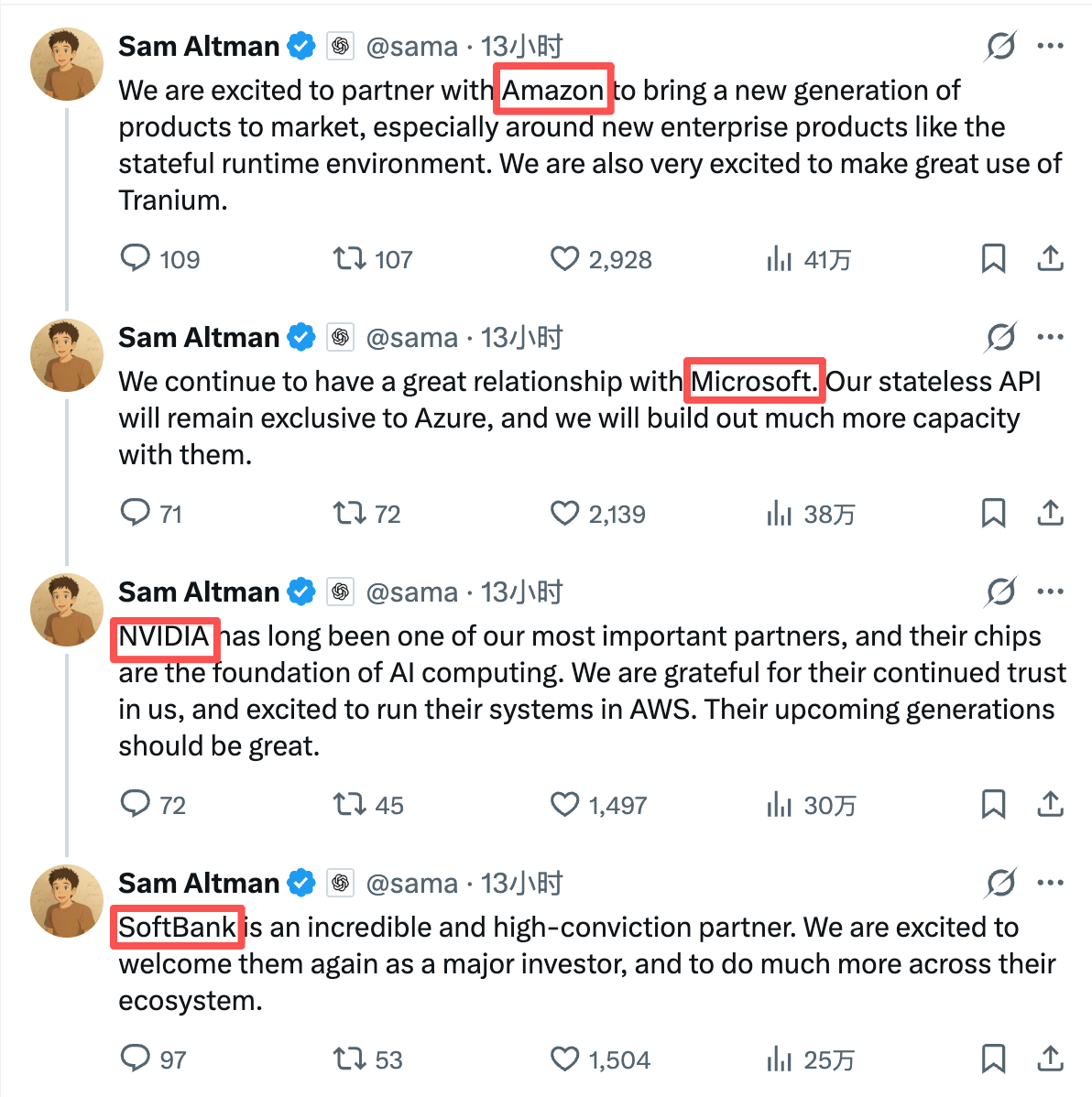
Aakash Gupta, an overseas blogger who has long followed the AI sector, pointed out that while most people are focused on the astronomical figure of $110 billion, the most critical piece of information in Sam Altman's statement lies in two overlooked technical terms: "Stateless API" and "Stateful Runtime Environment," which were attributed to Microsoft and Amazon, respectively.

Behind the Technical Terms: The Present and Future of AI

The core difference between Stateless API and Stateful Runtime Environment lies in the two words: "Stateless" and "Stateful".

The "Stateless" nature of a Stateless API means that the server does not maintain persistent state across requests — one call completes one inference; you ask a question, the AI answers, and after the lifecycle of this request ends, the system does not retain context or continue running. The "Stateful" nature of a Runtime Environment, on the other hand, implies a persistent execution environment — the Agent has historical memory, can persist, collaborate across tasks, and perform tasks over the long term.

Stateless API is currently the mainstream form of LLM commercialization. Industries such as finance, retail, manufacturing, and healthcare mostly integrate AI in this form to embed it into existing systems (e.g., various Q&A assistants, document summarization, search enhancement, etc.). The advantage of this model is that enterprises can quickly overlay AI capabilities into their existing architecture with minimal friction, achieving functional optimization without significant restructuring of organization and processes. However, as model capabilities converge, computing power costs continue to decrease, and price competition intensifies, the token-based billing of Stateless APIs is more likely to become standardized and commoditized, with marginal profits facing ongoing compression.

In contrast, Stateful Runtime Environment currently has limited commercial scale, but it represents not just simple "functional optimization" but a shift in business paradigm — it is not only able to answer questions but can also be seen as a digital workforce to concretely execute tasks. This means that the budget it touches will extend from mere interface call fees to automation, process management, and even part of the labor costs. Because of this, the market's expectations for Stateful Runtime Environment are far higher than its current scale.

Aakash Gupta also stated on this matter that in 2026 and 2027, almost all enterprise roadmaps will revolve around "autonomous agent workflows," not one-off API calls. Companies that invest heavily in AI in the future will increasingly tend to purchase systems that can run sustainably, collaborate across tools, and maintain context over the long term.

To put it in the simplest terms: Stateless API represents the present, while Stateful Runtime Environment represents the future.

What Did Microsoft and Amazon Take, Respectively?

On the day the funding was completed, Microsoft and Amazon each announced their latest cooperation agreements with OpenAI.

Microsoft stated in its announcement that the terms of the partnership jointly announced by Microsoft and OpenAI in October 2025 would remain unchanged (the terms include OpenAI purchasing $250 billion worth of Azure services). Azure remains the exclusive cloud provider for OpenAI's Stateless API; any Stateless API calls to OpenAI models generated through cooperation with any third party (including Amazon) will be hosted on Azure; OpenAI's first-party products, including Frontier, will also continue to be hosted on Azure.

Amazon stated in its announcement that AWS and OpenAI will jointly build a Stateful Runtime Environment powered by OpenAI models and provide services to AWS customers through Amazon Bedrock, helping enterprises build generative AI applications and Agents at production scale; AWS will also become the exclusive third-party cloud distribution service provider for OpenAI Frontier; the existing $38 billion multi-year cooperation agreement between AWS and OpenAI will be expanded to $100 billion, with a term of 8 years. OpenAI will consume 2 GW of Trainium computing power through AWS infrastructure to support the needs of Stateful Runtime Environment, Frontier, and other advanced workloads; OpenAI and Amazon will also develop customized models that can be used to support Amazon's customer-facing applications.

Comparing the two announcements, the current situation becomes clear.

Microsoft, with its $250 billion agreement and exclusive service rights, has locked in the current traffic engine. As long as OpenAI's Stateless API is called, Azure will bill behind the scenes — regardless of who the customer is or where the channel is, the traffic will ultimately return to Azure. This is a highly certain cash flow, but the problem lies in the trend of shrinking profit margins for Stateless APIs; call volume may continue to grow, but actual profits may not necessarily remain stable in the long run.

On the other hand, Amazon, with its $50 billion in real money and a $100 billion expanded agreement, has secured the underlying hosting rights for the AI Agent era for AWS. Once Agents become the core carriers of enterprise productivity, the resources that are truly consumed over the long term — computing power, storage, scheduling systems, workflow orchestration, and cross-tool collaboration — will all be deposited on AWS's runtime environment.

One controls the current cash flow; the other bets on the future structure of productivity.

OpenAI's Diversified Bet

Before the future truly arrives, no one knows whether Microsoft's or Amazon's choice is correct. But what is certain is that under these two clearly defined cooperation agreements with explicit interest divisions, OpenAI's initiative is significantly increasing.

Over the past few years, OpenAI has been highly dependent on Microsoft for cloud infrastructure. Microsoft is not only a major shareholder holding 27% of the shares but also the controller of the infrastructure. This binding brought effective early-stage resource advantages to OpenAI, but it also meant that the balance of bargaining power would naturally tilt toward Microsoft. With Amazon's strong entry, it and Microsoft are bound to engage in direct competition to seize the future service rights of OpenAI.

For OpenAI, this is a typical diversified betting strategy — not deeply binding with any single cloud service provider, not letting future growth be entirely constrained by one party, and using future business as a bargaining chip to obtain better terms.

Neither Microsoft nor Amazon can afford to give up OpenAI at present. When neither can leave the table, bargaining power naturally returns to OpenAI's hands.


Domande pertinenti

QWhat is the core difference between Stateless API and Stateful Runtime Environment in the context of AI?

AStateless API refers to a server-side service that does not retain persistent state across requests—each call completes one inference, and the system does not retain context or continue running after the request lifecycle ends. Stateful Runtime Environment, on the other hand, involves a persistent execution environment where AI agents have historical memory, can exist continuously, collaborate across tasks, and perform long-term tasks.

QWhich companies invested in OpenAI's latest $110 billion funding round, and what were their respective contributions?

AAmazon invested $50 billion ($15 billion initially, with the remaining $35 billion to be delivered over the coming months upon meeting specific conditions), Nvidia invested $30 billion (which will be recouped through the procurement of a total of 5 GW of computing power), and SoftBank also invested $30 billion.

QWhat did Microsoft secure in its agreement with OpenAI regarding Stateless API?

AMicrosoft secured Azure as the exclusive cloud provider for OpenAI's Stateless API. Any Stateless API calls to OpenAI models generated through cooperation with any third party, including Amazon, will be hosted on Azure. OpenAI's first-party products, including Frontier, will also continue to be hosted on Azure.

QWhat did Amazon obtain through its expanded agreement with OpenAI, particularly in relation to Stateful Runtime Environment?

AAmazon obtained a partnership with OpenAI to jointly build a Stateful Runtime Environment powered by OpenAI models, which will be provided to AWS customers via Amazon Bedrock. AWS also became the exclusive third-party cloud distribution service provider for OpenAI Frontier. The existing $38 billion multi-year cooperation agreement was expanded to $100 billion over 8 years, with OpenAI consuming 2 GW of Trainium computing power through AWS infrastructure to support Stateful Runtime Environment, Frontier, and other advanced workloads.

QHow does OpenAI's strategy of engaging with both Microsoft and Amazon reflect its approach to future growth and bargaining power?

AOpenAI's strategy reflects a分散押注 (diversified betting) approach. By not deeply binding with any single cloud service provider and avoiding complete dependence on one party for future growth, OpenAI uses its future business as a bargaining chip to secure more favorable terms. As both Microsoft and Amazon are unwilling to withdraw from the partnership, bargaining power naturally returns to OpenAI.

Letture associate

US Stocks Suffer Worst Plunge Since 2025: Three Triggers Ignite Tech Stock Valuation Reset

The US stock market experienced its most severe sell-off since the 2025 tariff crisis on June 5th, 2025. The Nasdaq Composite plummeted 4.18%, the S&P 500 fell 2.64%, and the Dow Jones dropped 695 points. The panic stemmed from three converging factors. First, Broadcom's earnings report ignited fears of a slowdown in AI growth. While its AI chip revenue surged 143% YoY to $10.8B, its Q3 AI revenue guidance of $16B fell short of the $17.2B consensus. This triggered a massive sector-wide sell-off, with the Philadelphia Semiconductor Index crashing 10.26% and semiconductor stocks losing roughly $1.3 trillion in market value in a single day. Second, a shockingly strong May jobs report crushed hopes for Federal Reserve rate cuts. Non-farm payrolls added 172,000 jobs, doubling expectations. This robust data, combined with persistently high oil prices above $92/barrel due to the ongoing Iran war and blockade of the Strait of Hormuz, drastically increased market expectations for a potential Fed rate hike instead of a cut. Higher interest rates compress the valuations of growth-heavy tech stocks. Third, the prolonged Iran conflict continues to fuel inflationary pressures, complicating the Fed's policy decisions and undermining the "inflation is tamed" narrative. Together, these events challenged the twin pillars of the market rally: the "limitless AI growth" story and expectations for imminent monetary easing. The sell-off spread globally, impacting Asian and European markets and cryptocurrencies. The article posits this is likely a severe "valuation repricing" rather than the end of the AI story. The underlying demand for AI remains strong, but investor expectations for growth speed and the prices they are willing to pay are being recalibrated. Key upcoming factors include the June FOMC meeting, future AI company earnings, and developments in the Iran conflict.

marsbit30 min fa

US Stocks Suffer Worst Plunge Since 2025: Three Triggers Ignite Tech Stock Valuation Reset

marsbit30 min fa

From Madison Square Garden to Kalshi: Prediction Markets Break into the NBA Finals

From Madison Square Garden to Kalshi: Prediction Markets Break into the NBA Finals Prediction markets are playing a significant role in the 2026 NBA Finals, particularly around the New York Knicks' unexpected 2-0 series lead. Platforms like Kalshi and Polymarket have seen massive trading volumes, exceeding hundreds of millions of dollars on championship and related markets. Their influence extends beyond online trading. Kalshi's official partnership with Madison Square Garden has given it prominent physical branding at the arena. Furthermore, local businesses like The Jeffrey bar are using prediction market contracts to hedge the risk of game-result-based promotions, turning potential losses into manageable costs—a concept similar to the famous "Mattress Mack" strategy from traditional sports betting. These markets differentiate themselves by offering a wider, more entertainment-focused range of "event contracts" beyond typical game outcomes, such as predicting celebrity attendance. They also have broader accessibility across the U.S. compared to age- and location-restricted traditional sportsbooks. However, their rapid integration into sports raises regulatory and ethical questions. The NBA is cautiously engaging, discussing integrity frameworks with regulators like the CFTC. While the league permits minor investments like Giannis Antetokounmpo's stake in Kalshi, it advocates for strict rules to prevent insider trading. Many fans express concern on platforms like Reddit, fearing that the close ties between prediction markets, the league, and players could compromise the game's integrity. The NBA Finals has thus become a high-stakes testing ground, showcasing prediction markets' commercial potential while challenging traditional boundaries between financial trading, entertainment, and gambling.

marsbit2 h fa

From Madison Square Garden to Kalshi: Prediction Markets Break into the NBA Finals

marsbit2 h fa

Recursive Self-Improvement AI Gains Traction, Google Pours Cold Water, While DeepSeek and Others Approach the Fringes

The term "recursive self-improvement" (RSI), where AI improves itself autonomously, is gaining momentum in the AI industry. Startups like Recursive Superintelligence and projects such as Andrej Karpathy's Auto-Research aim to create systems where AI designs, implements, and validates its own research, moving toward superintelligence. While Google CEO Sundar Pichai cautions that such exponential acceleration is not yet a reality, progress is evident. For instance, Anthropic reported its Claude Code writes nearly 100% of the team's code, though it still lacks true self-direction. Analysts frame RSI development in stages: "adequacy" (systems functioning without humans), "parity" (matching human research quality), and "supremacy" (exceeding human-AI collaboration). Reaching parity could trigger rapid, unpredictable advancement due to AI's continuous operation. In China, companies like DeepSeek and Baidu incorporate self-optimization techniques without explicitly branding them as RSI, focusing on algorithmic efficiency and reinforcement learning. However, challenges remain, including "model collapse" from training on AI-generated data and the immense computational and open-collaboration requirements. Ultimately, RSI represents a trend of increasing automation in AI development, potentially reducing human oversight in the creation process itself.

marsbit2 h fa

Recursive Self-Improvement AI Gains Traction, Google Pours Cold Water, While DeepSeek and Others Approach the Fringes

marsbit2 h fa

Trading

Spot
Futures
活动图片