Behind NEAR's Doubling: Three Major Trends Fueling Its Price Surge

链捕手Pubblicato 2026-05-26Pubblicato ultima volta 2026-05-26

Introduzione

NEAR's price has recently doubled, driven by three key catalysts. First, its strong AI narrative: co-founder Illia Polosukhin co-authored the foundational Transformer paper, and NEAR has integrated AI into its super-app, positioning it as decentralized AI infrastructure. Second, it has evolved into a privacy-focused chain, launching features like Confidential Payments to enable private cross-chain transfers, balancing privacy with usability for institutional and DeFi users. Third, its tokenomics are bolstered by a buyback mechanism: with full circulation achieved and inflation halved, fees from the NEAR Intents layer are used to repurchase NEAR tokens, reducing sell pressure. Combined with a recovering TVL exceeding $80 million, these factors are fueling NEAR's current market outperformance.

Author: Ma He, Foresight News

On May 25, the price of NEAR, the native token of the NEAR protocol, stands at $2.37. Since early May, NEAR has surged from a low of $1.24 to a high of $2.5, with its market capitalization returning above $3 billion. While mainstream crypto assets like Bitcoin have been fluctuating, NEAR has charted its own independent upward trajectory, emerging as one of the brightest performing tokens alongside others like ZEC, ONDO, and HYPE. What are the underlying reasons for this breakout?

The AI Narrative

NEAR co-founder Illia Polosukhin is a seasoned professional in the AI field. Illia is one of the eight co-authors of the seminal Transformer paper, alongside others like Ashish Vaswani and Noam Shazeer from Google Brain / Google Research. This paper introduced the Transformer architecture, which relies entirely on attention mechanisms, significantly improving parallel training efficiency and model scale. It is the foundational framework for all major contemporary large models like ChatGPT, Claude, and Gemini.

NEAR has made AI a core strategy from its early days. In February of this year, NEAR officially launched the Near.com super-app, integrating cross-chain swaps, privacy tools, and smart contract management into one platform with built-in AI capabilities, supporting autonomous agent application scenarios. In November 2023, Illia also formally assumed the role of NEAR Foundation CEO, focusing the strategy primarily around the AI narrative.

In May, Nvidia's earnings report spurred a broader recovery in the AI sector, with NEAR being viewed as a representative of decentralized AI infrastructure, alongside tokens like TAO.
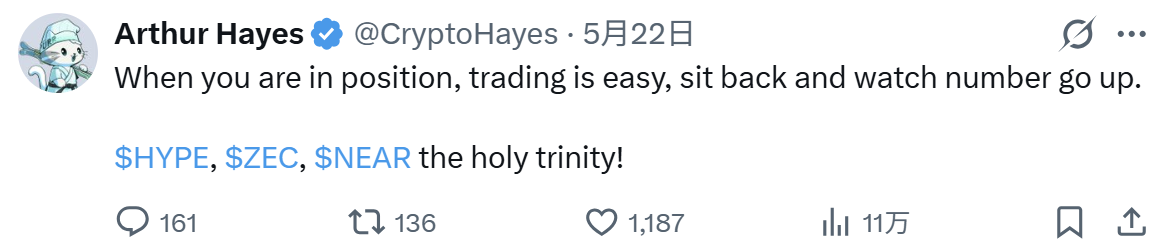
On May 22, BitMEX co-founder Arthur Hayes, in an article, grouped NEAR with HYPE and ZEC in a call for attention, directly igniting market sentiment.

Privacy-Focused Blockchain

Blockchain has long faced the privacy dilemma where 'transparency equals publicity.' The sharp rise of privacy coins like ZEC and XMR has refocused the industry's attention on the privacy sector, leading various protocols, including public blockchains, to start incorporating privacy features.

NEAR was founded in 2018. Its initial core positioning was not AI, but scalability. Its earliest progress primarily revolved around continuously optimizing sharding technology, making it one of the hot 'Ethereum killer' public blockchains at the time.
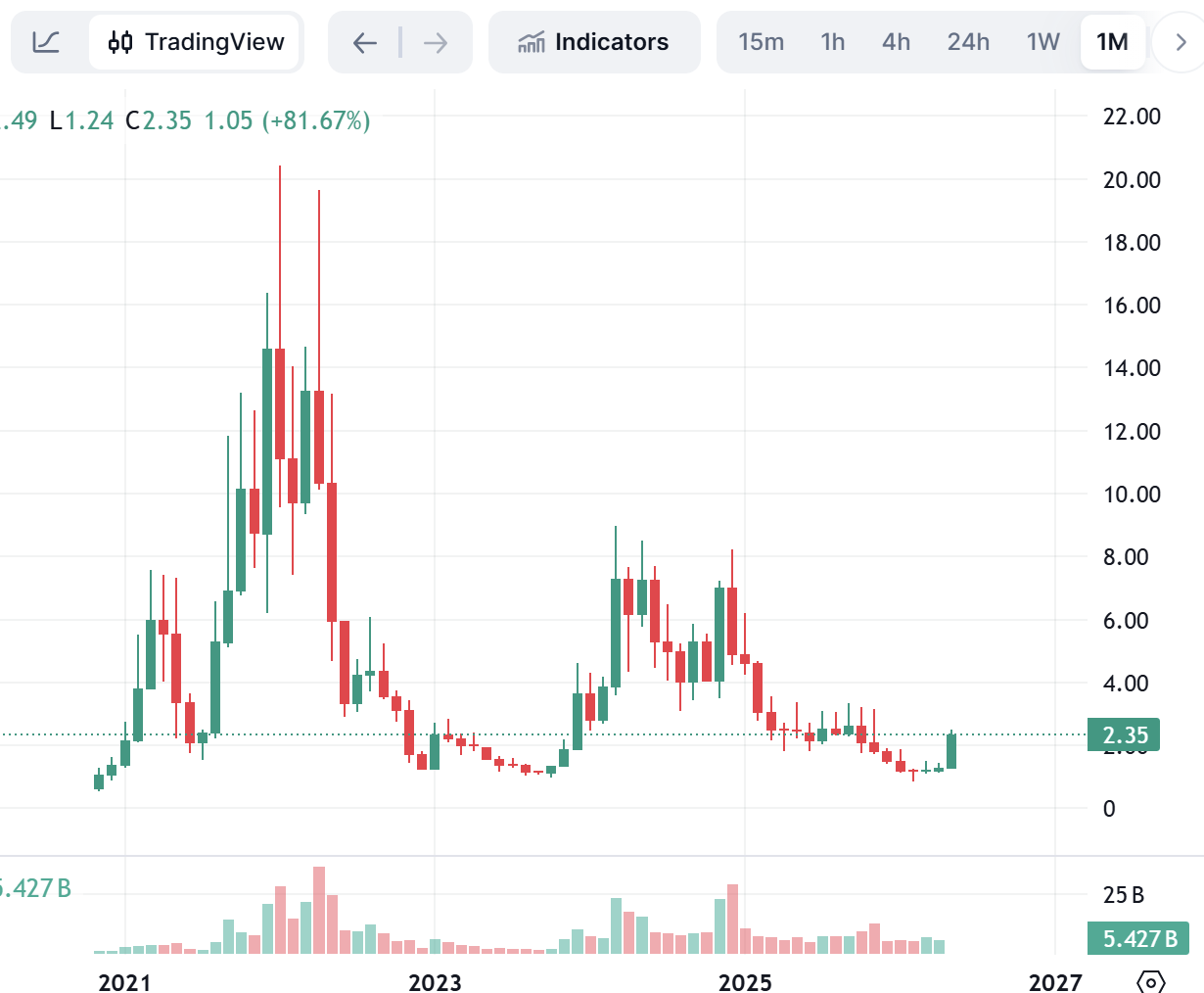
Because of this, NEAR's public sale on CoinList once crashed the latter's website. During the 2020-2021 bull cycle, NEAR soared from $0.5 to a peak of $20.59, becoming one of the most watched star tokens that year.

However, fast-forwarding to this cycle, the vast majority of older tokens and new VC-backed tokens have been shunned by the market. Therefore, even in this bull cycle, NEAR only reached a high of around $9 in 2024 before declining steadily, hitting a low of $0.84 in 2026.

With the official launch of NEAR Intents, privacy requirements have become critically important. Intents are core to cross-chain transactions, allowing users to execute actions simply by expressing intent. However, large on-chain transactions are vulnerable to MEV (Maximal Extractable Value) attacks when public, a significant drawback for institutions, large holders, and ordinary DeFi users alike.

The NEAR team began planning privacy as a crucial complement to Intents. In late May this year, the NEAR Intents team launched Confidential Payments and Confidential Intents features, supporting private cross-chain transfers for assets like ETH, BTC, SOL, and USDC across 35+ chains. The sender, amount, and path are all hidden, with only the result visible on the target chain, utilizing a private shard + TEE (Trusted Execution Environment) bridge at the underlying layer.
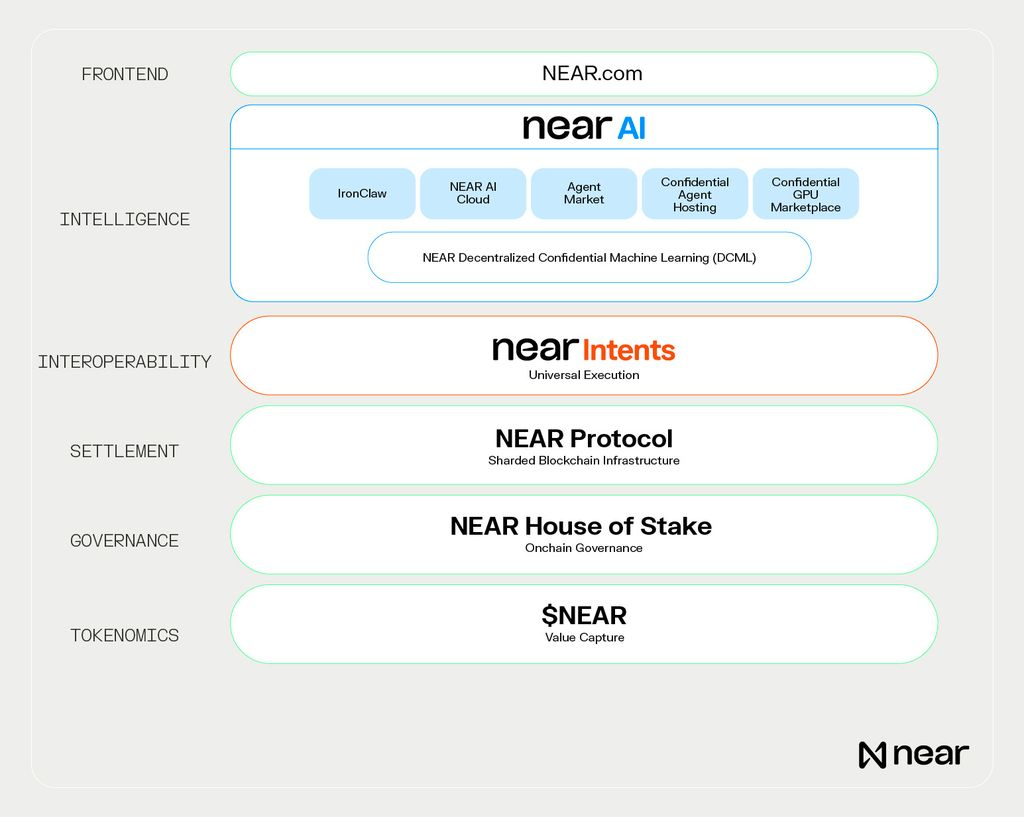
NEAR also opened a privacy mode, where user balances, transfers, and transaction activities are private by default. Whether for ordinary users, enterprise users, or AI agents executing complex strategies, this prevents data leakage. The Confidential Treasuries (Trezu) launched around the same time further supports private multi-signature wallets, payroll, and cross-chain payments, having already processed $68 million in confidential transactions.

Compared to pure privacy coins like Zcash, NEAR's balance between privacy, usability, and cross-chain functionality is more practical, directly addressing enterprise-level demand and driving a recovery in TVL and developer activity.

NEAR Intents Fee Buyback

In October 2025, NEAR completed the unlocking of its final batch of initial supply, bringing its circulating supply close to 100%.
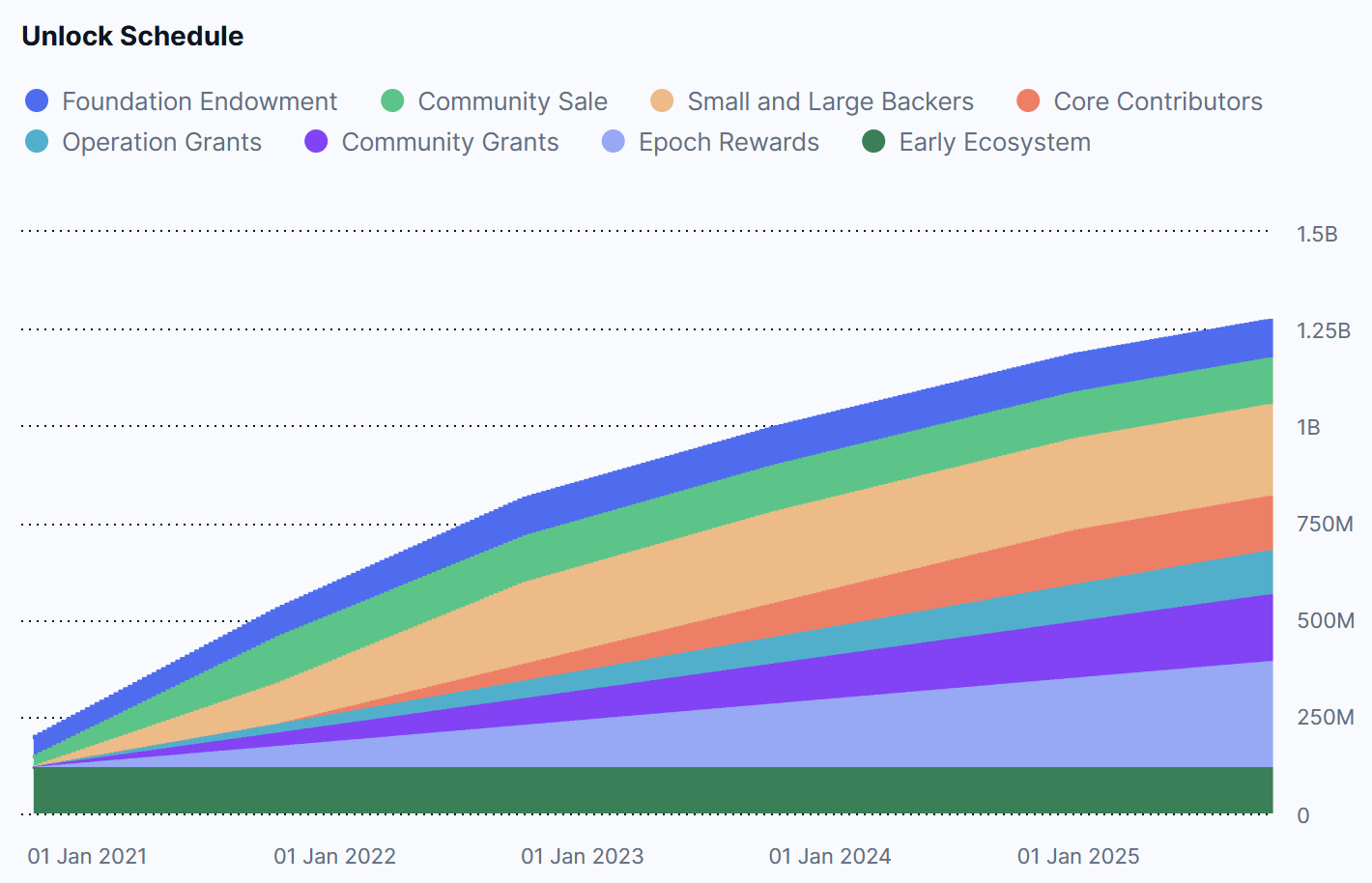
NEAR designed a dual mechanism of inflation + burning from its mainnet's early days: a maximum annual inflation of 5% (permanently halved to 2.5% via an upgrade in October 2025), with 90% going to validators as rewards and 10% entering the protocol treasury. Entering 2026, the project has no major unlock events or linear unlocks remaining, only the regular epoch reward emissions (approximately 5.4 million NEAR released in the last 30 days, about 0.4% of total supply).

In addition, the fee revenue generated by NEAR Intents is used to directly buy back NEAR tokens on the market, also creating significant buying pressure.

NEAR's intent-driven cross-chain transaction layer on the protocol allows users to simply express their desired outcome (e.g., swapping BTC for SOL), and it provides the optimal execution path, supporting multiple chains without the need for bridging/wrapped assets and featuring low fees.

NEAR Intents previously had two fee components: protocol fees and distribution fees (shared with third-party integrators). However, protocol fees now entirely go into the buyback path. The repurchased NEAR isn't necessarily burned immediately; instead, after being bought back, it is staked, locked, or removed from liquidity. It still counts towards the total supply but reduces circulating supply pressure while also earning staking rewards.
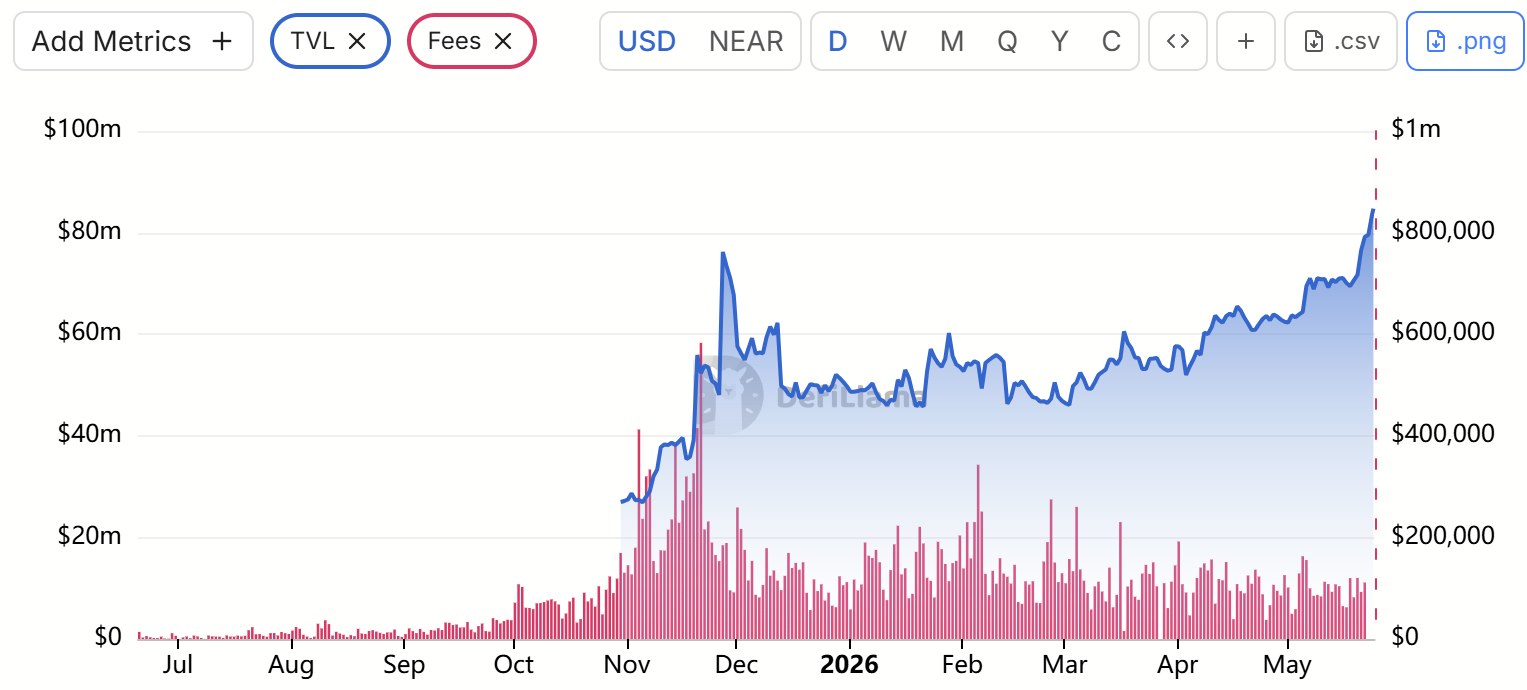
According to the latest data from defiLlama, the TVL of NEAR Intents has exceeded $80 million, with its daily generated fees fluctuating around $100,000, translating to a monthly buyback amount of approximately $3 million.

At the end of this month, its core development team, Near One, also announced the latest technical progress. The team plans to release dynamic resharding by the end of Q2 2026 to significantly enhance scalability. Additionally, the team will introduce NEAR's post-quantum secure signature scheme and perform upgrades in June this year, improving its resistance to quantum computing.


Domande pertinenti

QWhat are the three main catalysts driving NEAR's recent price surge according to the article?

AThe three main catalysts are: 1) AI Narrative, due to co-founder Illia Polosukhin's AI background and NEAR's strategic focus. 2) Privacy Public Chain, through features like Confidential Payments and Intents. 3) NEAR Intents fee buybacks, which reduce circulating supply.

QWho is Illia Polosukhin and what is his significance in the AI field?

AIllia Polosukhin is a co-founder of NEAR. He is one of the eight co-authors of the seminal Transformer paper, which introduced the Transformer architecture that forms the foundation of modern large language models like ChatGPT, Claude, and Gemini.

QWhat specific privacy features did NEAR Intents launch in May, and what problem do they solve?

AIn May, NEAR Intents launched Confidential Payments and Confidential Intents features. They solve the privacy problem for cross-chain transfers by hiding the sender, amount, and transaction path across 35+ chains, protecting users from MEV attacks and data leaks during large or complex transactions.

QHow does the NEAR Intents fee buyback mechanism work and what is its impact?

AFees generated by the NEAR Intents protocol are used to buy back NEAR tokens from the market. These bought-back tokens are then staked, locked, or removed from liquidity. This reduces selling pressure on the circulating supply and creates consistent buy-side demand, with current monthly buybacks estimated around $3 million.

QWhat are the key upcoming technical upgrades mentioned for NEAR in the article?

AThe key upcoming upgrades are: 1) Dynamic Resharding, to be released at the end of Q2 2026, which will significantly improve scalability. 2) A post-quantum secure signature scheme, planned for introduction and upgrade in June of this year, to enhance its resistance to quantum computing attacks.

Letture associate

Blocked Its Own Treasure, WeChat AI Steps Up

Tencent's stock surged over 10% on June 2nd amid reports that WeChat, with 1.43 billion monthly users, is finalizing tests for a native AI Agent. The reported feature, accessible by swiping right from the main interface, allows users to issue commands in natural language. The AI then decomposes tasks and automatically calls upon relevant Mini Programs within WeChat to complete actions like ordering food, booking tickets, or making payments, creating a closed-loop service execution system. This strategic shift follows the internal conflict and subsequent "blocking" of Tencent's standalone AI app, Yuanbao, by WeChat for violating sharing rules during a 2026 Spring Festival promotion. The incident highlighted a lack of internal consensus and exposed the weakness of competing in the standalone AI assistant arena against rivals like ByteDance's Doubao (345M MAU) and Alibaba's Qianwen. The new WeChat AI Agent aims to leverage WeChat's unique assets—its massive user base, standardized Mini Program APIs, WeChat Pay, and identity system—to move from simple content generation to actual task execution. Analysts note this changes the competitive landscape from model benchmarks to which AI can connect to more real-world services. However, success depends on key variables: the capability of Tencent's underlying Hunyuan model, managing massive inference costs, and redesigning incentives for Mini Program developers whose traffic might be bypassed. The move is seen as an attempt to keep user service intent within WeChat's ecosystem as AI begins to redefine how users access services.

marsbit50 min fa

Blocked Its Own Treasure, WeChat AI Steps Up

marsbit50 min fa

ByteDance Adopts Arm CPUs, Jensen Huang: So Sad I Didn't Buy Arm

**Summary:** At Computex 2026, Arm CEO Rene Haas announced that ByteDance and Oracle have adopted Arm's self-designed Arm AGI data center CPU. The company expects significant revenue growth from this product, projecting $20 billion in demand for the 2027/2028 fiscal years. Haas noted that restricting AI-capable CPUs from the US to China is nearly impossible due to their widespread applications. Arm's stock has surged dramatically this year, notably rising 16% after NVIDIA's Arm-based Vera CPU and RTX Spark announcements. A highlight was the informal, humorous on-stage conversation between Haas and NVIDIA CEO Jensen Huang. Huang joked about NVIDIA's failed attempt to acquire Arm and playfully lamented selling his Arm shares. Both executives showed a clear sense of camaraderie and shared regret over the missed merger. Key technical topics were discussed: 1. **AI PC Design:** Huang explained NVIDIA's RTX Spark superchip (with a 20-core Arm CPU) is designed for future AI agents that will autonomously run and use tools on PCs, blending local and cloud processing. 2. **Agent vs. OS:** Huang emphasized the operating system remains crucial, as AI agents rely on its APIs and tools to function. 3. **Growth Constraints:** He identified the shift to "useful AI" that generates profitable tokens as a primary driver for immense, almost limitless, computational demand. Haas outlined Arm's strategy across PC and data centers. For PCs, Arm collaborates with partners like NVIDIA and MediaTek, offering its compute subsystem (CSS) for custom SoCs. In data centers, its Arm AGI CPU (built on TSMC's 3nm process) has gained major partners including OpenAI, Meta, and now ByteDance and Oracle. Arm presented a multi-year roadmap for its in-house CPU line. The article concludes that while GPUs dominated the AI training race, the explosion of AI agents is shifting significant focus to CPUs for inference, state management, and tool orchestration. The industry is trending towards vertical integration, with companies like cloud providers designing chips and chip/IP firms offering full solutions, all competing to deliver more efficient computing per watt.

marsbit1 h fa

ByteDance Adopts Arm CPUs, Jensen Huang: So Sad I Didn't Buy Arm

marsbit1 h fa

New Wall Street Play: Yen Shorts Still Adding, But Japan Stocks Don't Rely on Carry Trade Unwinding

On June 3rd, USD/JPY hit 160.44, its highest level since July 2024, while the Nikkei 225 surged past 68,000 points. Contrary to popular narratives of an imminent "carry trade unwind" akin to August 2024, data reveals a more complex picture. Speculative net short positions in yen futures have actually increased, reaching -114,667 contracts by late May, suggesting traders are doubling down rather than retreating. Meanwhile, Japan's Finance Ministry conducted its largest-ever single-round FX intervention (11.73 trillion yen) in April-May but failed to hold the 160 yen line. The Nikkei's rally is not driven by carry trade dynamics. Foreign investors are aggressively buying Japanese stocks, with net purchases in 2026 running nearly 16 times higher than 2025 levels. This inflow is concentrated in AI and semiconductor-related stocks like SoftBank and Socionext, fueled by positive sector outlooks, rather than being a flight from unwinding yen shorts. Furthermore, the Nikkei has continued climbing despite the Bank of Japan's (BOJ) rate hikes to 0.75%. This disconnect exists because the current equity boom is fueled by AI-driven foreign investment, not reliant on cheap yen funding. However, this relationship remains fragile. Should the BOJ hike rates further (e.g., to 1.0%) while dollar weakness increases carry trade costs, the trajectories of the yen and Japanese stocks could reconverge, potentially triggering volatility.

marsbit1 h fa

New Wall Street Play: Yen Shorts Still Adding, But Japan Stocks Don't Rely on Carry Trade Unwinding

marsbit1 h fa

Broadcom's Q3 Guidance Misses Expectations by $12 Billion, After-Hours Trading Plummets Over 13%, AI Narrative "Cooling"?

On June 3, Broadcom released record Q2 FY26 results with revenue of $22.19B, up 48% YoY, and AI chip sales of $10.8B, up 143%. Adjusted EPS of $2.44 beat estimates. However, its Q3 AI semiconductor revenue guidance of $16B, while up over 200% YoY, fell roughly $1.2B (7%) short of analyst consensus expectations of $17.2B. This miss, coupled with slightly weaker-than-expected software revenue, triggered a severe market reaction. CEO Hock Tan maintained the FY26 AI revenue outlook of over $100B but did not raise it, disappointing investors who had priced in more robust growth. The stock plummeted over 13% in after-hours trading, erasing roughly $270B in market cap. The sell-off extended to peers like Marvell. A key concern for markets, particularly for Chinese optical module suppliers, was Tan's comment that the contribution of AI networking (e.g., Ethernet switches, optical interconnect chips) to AI revenue, currently near 40%, is expected to normalize to around 30% over time, signaling a potential peak in growth for that segment. Despite the guidance shortfall, Tan reiterated that AI demand remains "insatiable" and reaffirmed the long-term target of exceeding $100B in AI revenue by FY27. The reaction highlights the heightened sensitivity and premium valuation placed on AI-exposed stocks, where anything less than stellar guidance can prompt significant profit-taking. The broader question is whether this represents a cooling AI narrative or a correction in overstretched valuations.

marsbit1 h fa

Broadcom's Q3 Guidance Misses Expectations by $12 Billion, After-Hours Trading Plummets Over 13%, AI Narrative "Cooling"?

marsbit1 h fa

Trading

Spot
Futures
活动图片