Behind Changxin Technology, Stands a Group of A-Share Companies

marsbitPubblicato 2026-05-28Pubblicato ultima volta 2026-05-28

Introduzione

Changxin Technology, a leading Chinese DRAM (Dynamic Random Access Memory) manufacturer, has passed the review by the STAR Market listing committee, moving closer to an IPO. The company, seeking to raise 29.5 billion yuan, is the first to utilize the new "pre-review mechanism" on the STAR Market, expediting its approval process within five months. As China's largest and most technologically advanced integrated DRAM company, Changxin has achieved mass production of mainstream DDR5 and LPDDR5X products. It holds the fourth-largest global market share and ranks first in China, though it still trails behind industry leaders Samsung, SK Hynix, and Micron in areas like HBM technology. The company reported its first annual profit in 2025, with net profit surging to 24.762 billion yuan in Q1 2026, driven by booming AI-related demand. The IPO has drawn significant market attention due to Changxin's extensive and prestigious shareholder base. This includes state-backed funds like the National Integrated Circuit Industry Investment Fund II, industrial partner GigaDevice, internet giants (Xiaomi, Alibaba, Tencent), and several securities firms and A-share listed companies such as InfoMotion, Shangfeng Cement, and Hefei Urban Construction, which stand to benefit from the listing. The company's founder, Zhu Yiming, a pivotal figure in China's semiconductor industry who also founded GigaDevice, has committed to an unprecedented long-term lock-up of his shares and a massive personal equit...

Source: Cailian Press

Today (May 27), the domestic DRAM (Dynamic Random-Access Memory) leader—Changxin Technology Group Co., Ltd. (hereinafter referred to as "Changxin Technology")—successfully passed the review by the STAR Market listing committee and is about to enter the capital market.
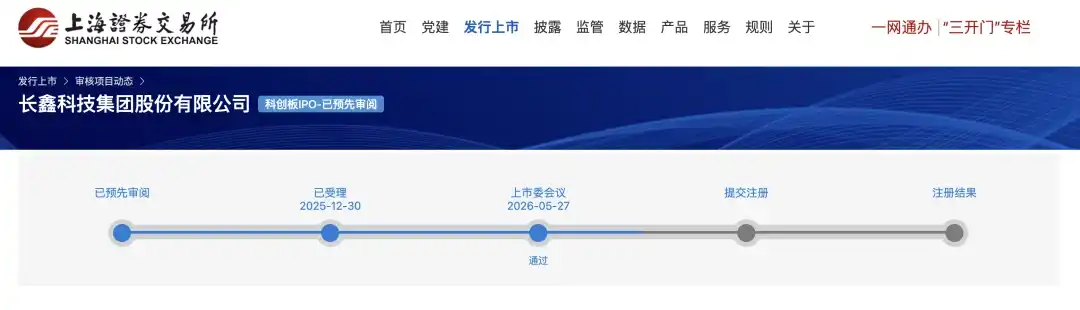
As the first "pre-review" project on the STAR Market and a hard-tech behemoth aiming to raise 29.5 billion yuan, Changxin Technology's passage of the review coincides with its tenth anniversary. This is not only a milestone for the company's own development but also marks a crucial step for China's memory chip industry in breaking the long-term overseas monopoly and moving towards self-reliance and controllability.

From Acceptance to Passing Review: Less Than 5 Months

It took Changxin Technology less than five months from IPO acceptance on the STAR Market to passing the review.

As the first company to apply for listing using the IPO "Pre-Review Mechanism" after the STAR Market reform policy in July 2025, Changxin Technology's listing review process was special and high-priority, significantly shortening the listing cycle while avoiding targeted competition from peers due to early disclosure of business and technical information.

Judging from previous rounds of inquiries by the exchange, concerns primarily focused on three core issues: the industry cycle, technological gap, and sustainability of profitability, all directly addressing the pain points of the DRAM industry and key aspects of the company's development.

In response, Changxin Technology stated in its inquiry replies that the DRAM industry is significantly influenced by market supply-demand fluctuations and exhibits pronounced cyclical characteristics. Furthermore, as the supply side of the DRAM market is highly concentrated, with Samsung Electronics, SK Hynix, and Micron Technology holding the vast majority of market share, their capital expenditures are relatively concentrated. Decisions to add or reduce capacity are often released simultaneously, thereby intensifying the industry's cyclical nature and causing significant volatility in DRAM market prices. DRAM products have a high degree of standardization, and the company sets product prices with reference to market prices. Fluctuations in market prices directly affect the company's product unit prices and revenue, thereby impacting its profits.

Samsung Electronics, SK Hynix, and Micron Technology have developed over several decades, possessing first-mover technological advantages and cost advantages, making them more resilient to risks and market shocks. In contrast, Changxin Technology started its development relatively late and is still in the capacity construction and ramp-up phase. Ramping up production capacity for new production lines typically takes multiple quarters, and building a new wafer fab from capital expenditure to capacity release can take several years. Consequently, at this stage, the company still lags behind international leading manufacturers in terms of revenue scale, production capacity scale, and product portfolio. Not only are its production costs relatively higher, but it is also more prone to negative product gross margins or increased inventory write-downs when market competition intensifies and product prices fall compared to leading manufacturers.

In the 2024 global DRAM market, Samsung Electronics, SK Hynix, and Micron Technology held market shares of 40.35%, 33.19%, and 20.73% respectively. Changxin Technology ranked fourth globally and first in China in terms of global market share.

In its inquiries, the exchange also focused on the technological gap between Changxin Technology and the aforementioned overseas leaders, as well as the progress of industry localization.

Changxin Technology has achieved mass production of DDR5/LPDDR5X, filling the domestic gap for general-purpose DRAM. However, a gap still exists in HBM (High Bandwidth Memory) compared to Samsung and SK Hynix.

Changxin Technology stated that after years of development, it has become China's largest, most technologically advanced, and most comprehensively positioned DRAM research, design, and manufacturing integrated enterprise. It has established product portfolios covering the two major mainstream product series: DDR and LPDDR. Moreover, each series can provide the most advanced DDR5, LPDDR5/5X products currently on the market. Its products are widely used in markets such as servers, mobile devices, personal computers, and smart vehicles. The performance of its main products has reached internationally advanced levels, demonstrating strong product competitiveness.

Starting from the second half of 2025, the AI computing power explosion drove a surge in memory prices, allowing Changxin Technology to achieve its first annual profit turnaround. For the full year 2025, the company achieved a net profit attributable to shareholders of 1.875 billion yuan. By the first quarter of 2026, its net profit attributable to shareholders reached 24.762 billion yuan, with a daily profit exceeding 275 million yuan.

In the SSE's inquiry, Changxin was required to disclose its future profit prospects and uncertainties regarding its future development.

Changxin Technology stated that DRAM, as the core hub of artificial intelligence computing power systems, has seen explosive growth in market demand driven by the rapid development of AI and high-speed growth in related infrastructure investment. This was one of the main reasons for the company's performance growth since the second half of 2025.

However, the performance of companies in the DRAM industry is susceptible to cyclical fluctuations. Represented by Samsung Electronics, SK Hynix, and Micron Technology, these companies started relatively early and, after years of development and accumulation, have built strong scale, product, and technological advantages, equipping them with a certain degree of resilience against cyclical fluctuations.

Nevertheless, Changxin Technology also stated, "As production capacity continues to be released, the company's production capacity scale is rapidly catching up with the top three international manufacturers, and its competitiveness continues to strengthen. Meanwhile, with product sales achieving rapid growth, the company has developed strong resilience against cyclical fluctuations. Therefore, under the current favorable market expectations, the company expects to achieve profitability in 2026 or 2027, which is reasonable and prudent."

Luxurious Shareholder List, Many A-Share Companies May Benefit

Due to the extremely high upfront production and R&D investments required for storage chip manufacturers using the IDM model, Changxin Technology's development has undergone multiple rounds of financing, ultimately forming a large-scale and diverse shareholder base.

Changxin Technology has no controlling shareholder or actual controller. Its largest shareholder is Hefei Qinghui Jidian Enterprise Management Partnership (Limited Partnership), directly holding 21.67% of the company's shares.

Among Changxin Technology's shareholders are state-backed investors such as the National Integrated Circuit Industry Investment Fund Phase II (Big Fund II), Anhui Provincial Investment Group, and Guotiao Fund.

Simultaneously, industrial capital like Gigadevice is deeply bound with it, and internet and consumer electronics giants such as Midea Capital, Xiaomi, Alibaba, and Tencent also appear on the shareholder list.

Furthermore, Changxin Technology's early-stage investors include a host of well-known market-oriented investment institutions such as China Merchants Capital, Legend Capital, An Yuan Fund, Cornerstone Capital, Yanchuang Capital, Lanpu Investment, Yunfeng Capital, Yan Yuan Venture Capital, Mingsheng Capital, Qianhai Fund of Funds, and Huafu Jiaye.

On the eve of Changxin Technology's listing, as several listed companies' affiliated funds had previously invested in Changxin, the market derived a related concept sector for Changxin Technology. Every time its listing progress was updated, from its tutoring filing to the review meeting, it attracted high market attention.

In Changxin Technology's latest prospectus, five brokerages—China Merchants Securities, Huaan Securities, China Securities Co., Ltd., Founder Securities, and China International Capital Corporation Limited—appeared, having invested in Changxin Technology through their subsidiaries or participating funds respectively. Considering that Changxin Technology's market capitalization may reach trillions of yuan upon listing, the book value of these brokerages' equity holdings is expected to significantly boost their net profit figures. Brokerage stocks have also been sought after by market funds due to the progress of Changxin's IPO.

Additionally, since the beginning of this year, several listed companies have disclosed their equity investment ties with Changxin Technology through channels such as investor interaction platforms.

Apart from Gigadevice, multiple A-share companies including Infusion, Shangfeng Cement, Hefei Urban Construction, Hefei Department Store Group, and Zhongshan Public Utilities have successively revealed that they had invested in Changxin Technology through their affiliated private equity funds.

According to an announcement disclosed by Gigadevice in 2024, after participating in Changxin Technology's financing with 1.5 billion yuan of its own funds, its shareholding increased to approximately 1.88% post-investment. Infusion indicated on an interactive platform as early as July 2025 that it had made early-stage investments in Changxin Storage. Infusion is a long-term partner and important supplier of Changxin Storage, cooperating with Changxin's Hefei, Beijing, and Shanghai plants. Shangfeng Cement also stated on an interactive platform in October 2025 that the company invested 200 million yuan in Changxin Technology through the private equity investment fund Shanghai Junzhipu Venture Capital Partnership (Limited Partnership), indirectly holding about 0.15% of the shares.

Zhu Yiming's Hardcore Chip Making and Breakthrough Path

In the wave of domestic DRAM breaking through from being "strangled" to achieving breakthroughs, Zhu Yiming is an unavoidable core figure. He single-handedly founded Gigadevice, turning it into the "first domestic storage design stock," and on the other hand, established Changxin Technology, breaking the nearly four-decade DRAM monopoly of Samsung, SK Hynix, and Micron, making it the world's fourth-largest memory manufacturer.

Born in 1972 into an ordinary family in Funing, Yancheng, Jiangsu, Zhu Yiming came from a modest background but possessed exceptional talent. At 17, he entered the Physics Department of Tsinghua University with the second-highest college entrance examination score in the county, earning his bachelor's and master's degrees within five years, showcasing his technical aptitude.

In 1997, Zhu Yiming went to the United States for further studies, pursuing a master's degree in Electrical Engineering at Stony Brook University, State University of New York. After graduation, he successively worked at ipolicy Networks Inc. and Monolithic System Technologies Inc., rising from a senior engineer to project leader in the industry, with an annual salary of millions and settled in California. However, a comfortable life never eroded his original aspiration. After years of research and experience in the industry, Zhu witnessed firsthand the transfer of the storage industry from the US to Japan, South Korea, and Taiwan, China. He also deeply understood the "stranglehold" situation of China's annual hundred-billion-level chip imports, profoundly realizing that China cannot be "chip-less." "Being chip-less means being soul-less. Without mastering core technologies, the nation's prosperity is built on sand."

In 2004, after accumulating rich experience, Zhu Yiming decided to return to China to start a business, embarking on the path of chip making.

A widely circulated assertion by Zhu Yiming about the storage industry is: If a computer is likened to a crown, the CPU is the jewel on the crown, and the memory is the base of the crown. Naturally, the base requires more gold and jewels. The memory market is the largest in the IC industry; whenever a new process is born, the first thing it makes is memory. As semiconductor processes move into the deep sub-micron era, the proportion of various memory types in integrated circuits gradually increases. Whoever leads memory technology can dominate the entire integrated circuit industry.

In 2005, in a roughcast room at Tsinghua Science Park in Beijing, Zhu Yiming founded "Xin Ji Jia Yi," the predecessor of Gigadevice, with a startup capital of only $920,000. The initial stage of entrepreneurship could be described as a "hellish start." Therefore, in strategic choice, Zhu avoided the crowded DRAM track and chose the relatively niche NOR Flash memory field. Until 2016, Gigadevice was listed on the main board of the Shanghai Stock Exchange, becoming the first domestic memory stock. Today, Gigadevice has grown into the world's second-largest NOR Flash supplier and a leading domestic MCU chip enterprise, with a latest market capitalization of 360 billion yuan.

After what the world saw as "success and fame," Zhu Yiming resolutely turned around, choosing to partner with the Hefei Municipal Government to establish Changxin Technology in May 2016, targeting the DRAM track monopolized overseas, with a total project investment exceeding 50 billion yuan.

In July 2018, Zhu Yiming resigned as General Manager of Gigadevice and took up the positions of Chairman and CEO of Changxin Technology full-time, vowing: "Before Changxin turns a profit, I will not receive a single cent in salary or bonus." For eight years until Changxin Technology achieved its first annual profit in 2025, Changxin continued to incur losses and faced external skepticism that "China cannot make DRAM," but Zhu gritted his teeth and persevered.

In May 2026, as Changxin Technology's STAR Market listing review approached, Zhu Yiming released the largest personal equity incentive plan in A-share history.

The updated prospectus of Changxin Technology shows that Zhu Yiming voluntarily pledged to allocate 50% of his partnership interest in Hefei Jixin Sishiyihao Enterprise Management Partnership (Limited Partnership)—amounting to approximately 768 million shares—to the employees of Changxin Technology and its consolidated subsidiaries over the 10 natural years following the 36th month after Changxin Technology's listing, for employee incentive purposes.

It is noteworthy that the incentive recipients do not include Zhu Yiming himself.

Based on a conservative market estimate of a 2 trillion yuan market capitalization, the incentive value may exceed 20 billion yuan, setting an A-share record for personal equity incentives.

Simultaneously, Zhu Yiming also pledged an ultra-long share lock-up period, promising not to transfer his held shares for the first ten years after Changxin Technology's listing. In the second ten years after the tenth anniversary of the listing, he would sell no more than 20% of the remaining locked shares from the end of the previous year annually. This arrangement of an ultra-long share lock-up period is also relatively rare in A-share history.

An investor familiar with Changxin Technology told the STAR Market Daily reporter that the high-end development of domestic memory has entered a critical stage from breakthrough to volume production, with very broad prospects. Domestic memory enterprises represented by Changxin Technology have already transitioned from followers to runners alongside, and potentially future leaders.

At the technological level, represented by domestically mass-produced DDR5 memory chips entering mainstream server supply chains, domestic DRAM has achieved alignment with international mainstream product generations. At the industrial level, from storage media and chips to systems, China has achieved breakthroughs across the entire chain, with continuously enhancing industrial chain synergy and self-reliance and controllability capabilities. At the market level, AI computing power, data center construction, and the proliferation of smart terminals have created strong and sustained demand pull for high-end memory products such as HBM and DDR5.


Domande pertinenti

QWhat is the significance of ChangXin Technology's recent approval for listing on the STAR Market?

AChangXin Technology's approval marks a milestone as the first company to use the IPO 'pre-review mechanism' on the STAR Market, signifying a major step in China's semiconductor industry towards breaking long-term foreign monopolies and achieving self-sufficiency in DRAM production.

QWho are the major shareholders of ChangXin Technology?

AChangXin Technology's shareholders include state-backed funds like the National Integrated Circuit Industry Investment Fund II, Anhui Investment Group, and Guotiao Fund; industrial capital such as GigaDevice; internet and consumer electronics giants like Midea Capital, Xiaomi, Alibaba, and Tencent; and notable market investment institutions.

QWhat challenges does ChangXin Technology face compared to international DRAM leaders like Samsung and SK Hynix?

AChangXin Technology faces challenges including a later market entry, smaller production scale, higher relative costs, and technological gaps, particularly in HBM (High Bandwidth Memory) compared to leaders like Samsung and SK Hynix. It is also more vulnerable to market cyclical fluctuations and price competition.

QWhat personal commitment did Zhu Yiming make regarding his shares in ChangXin Technology?

AZhu Yiming committed to allocating 50% of his shares in Hefei Jixin Sishiyihao (approximately 768 million shares) to employees of ChangXin Technology and its subsidiaries over ten years after the company has been listed for 36 months. He also pledged an unusually long lock-up period for his remaining shares.

QWhich A-listed companies are expected to benefit from ChangXin Technology's IPO?

AA-listed companies expected to benefit include GigaDevice, Zhenfan Technology, Shangfeng Cement, Hefei Urban Construction, Hefei Department Store Group, and Zhongshan Public Utilities, which have invested in ChangXin Technology through private equity funds. Several securities firms like China Merchants Securities are also shareholders.

Letture associate

Justin Sun’s Interview with Hurun Report: A New Order and Certainty for Value Flow in the Era of Transformation

In an interview with *Hurun Report*, Justin Sun, founder of TRON, discussed the evolution of the Web3 industry as it moves from initial exploration to large-scale adoption. He emphasized that the core value of blockchain lies in building an open and inclusive internet of value, enabling anyone globally to transfer and use funds efficiently and at low cost, regardless of location or access to banking. Sun highlighted that projects with lasting impact are those built on genuine demand and real-world usage. He pointed to the stablecoin payment ecosystem as the most mature and scalable application currently, noting that TRON has rapidly become one of the world's largest stablecoin networks. The circulation of USDT on TRON has surpassed $86.3 billion, driven by actual use cases such as cross-border transfers and daily payments, demonstrating strong network effects. Regarding strategy, Sun outlined a methodology combining data-driven iteration, rapid execution, and user-centric focus. He cited the decision to partner with Tether to launch TRC-20 USDT as a key strategic move, based on an assessment of market trends and long-term potential, which has become a significant growth engine for the TRON ecosystem. On globalization, Sun stressed the importance of local compliance and cultural adaptation, noting that success in different markets depends on deep understanding and local partnerships. He also addressed the convergence of AI and blockchain, describing it as a transformative direction where blockchain provides decentralized infrastructure for AI, while AI enhances the intelligence and user experience of blockchain systems. For industry participants and young entrepreneurs, Sun advised continuous learning and adaptability in a fast-changing environment, focusing on building irreplaceable core strengths rather than spreading resources too thinly. Through infrastructure development, global strategy, and technological foresight, TRON aims to advance the practical implementation and evolution of the value internet.

marsbit18 min fa

Justin Sun’s Interview with Hurun Report: A New Order and Certainty for Value Flow in the Era of Transformation

marsbit18 min fa

Samsung Leverages Technology Cycles, SK Hynix Relies on HBM, What Enabled Micron to Win a Trillion-Dollar Market Cap?

Micron Technology, the Idaho-based memory chip maker, recently saw its market cap surpass $1 trillion, securing its position as one of the top three DRAM manufacturers alongside Samsung and SK Hynix. Its survival and growth story is marked by a unique combination of political maneuvering and hard-won manufacturing efficiency, but also strategic missteps that now challenge its future. Founded in 1978 in Boise without significant government or capital backing, Micron repeatedly turned to Washington for survival during critical junctures. In the 1980s, it filed anti-dumping complaints against Japanese firms, leading to the U.S.-Japan Semiconductor Agreement. Ironically, this created an opening for Samsung, which Micron had earlier licensed its 64K DRAM technology to. In 2002, Micron avoided heavy fines in a price-fixing investigation by acting as a whistleblower against its competitors, cementing its reputation as a "political opportunist." A major strategic error occurred in 2013 with its $2.5 billion acquisition of bankrupt Japanese firm Elpida. This deal burdened Micron with integrating incompatible manufacturing processes just as the industry was pivoting toward HBM (High Bandwidth Memory), a critical technology for AI. SK Hynix had launched its first HBM chip that same year. By the time AI demand exploded with ChatGPT in 2022, SK Hynix commanded about 85% of the HBM3 market, while Micron, playing catch-up, held only around 3%. In 2017, Micron employed similar tactics against a new competitor, Chinese startup Fujian Jinhua, by alleging intellectual property theft, which led to U.S. sanctions effectively crippling the firm. However, this strategy backfired in 2023 when China banned Micron's products from its critical infrastructure, causing its revenue share from China to plummet from 14% in FY2023 to just 7.1% by FY2025. Today, Micron faces a triple squeeze: it lags in the high-margin HBM race, faces pricing pressure in low-end DRAM from Chinese manufacturers like CXMT, and has lost crucial access to the booming Chinese AI server market. Despite its political strategies, Micron's core strength is its exceptional manufacturing cost control, achieved through decades of engineering. Its DRAM chips have a smaller cell area than its rivals, yielding more chips per wafer. This efficiency has been vital for weathering industry downturns. However, this advantage cannot compensate for the decade lost in HBM development. Micron is now racing to ramp up production of its HBM3E, certified by NVIDIA, and develop HBM4. Its future hinges on whether it can close this technological "time debt" through relentless R&D and execution, in a marathon where its competitors, having started earlier, are not slowing down.

marsbit36 min fa

Samsung Leverages Technology Cycles, SK Hynix Relies on HBM, What Enabled Micron to Win a Trillion-Dollar Market Cap?

marsbit36 min fa

Deconstructing Mysterious Researcher Serenity's Chokepoint Algorithm and the Global Revaluation of Equity Assets

Unmasking Serenity's "Chokepoint Theory": A Framework for AI-Era Investment This article deconstructs the investment methodology of the pseudonymous online researcher Serenity (formerly AleaBito on Reddit), who claims extraordinary returns by identifying critical bottlenecks in AI and robotics supply chains. Rejecting Wall Street's typical top-down analysis, Serenity employs a bottom-up, reverse-engineering approach. Starting with an end product like an Nvidia GPU cluster, he meticulously maps the global supply chain down to its most essential, irreplaceable physical components—the "choke points." These are low-profile, often monopolized sub-sectors where a disruption could paralyze entire downstream industries, analogous to a strategic strait controlling global oil flow. His primary focus is the physical evolution of AI data centers, specifically the shift from copper interconnects to silicon photonics and Co-Packaged Optics (CPO). He identifies five critical, monopolized technical barriers within CPO: high-precision fiber alignment components (e.g., FOCI), external light sources and high-power lasers (e.g., SIVE), molecular beam epitaxy equipment (ALRIB/Riber), ultra-high-purity red phosphorus raw materials, and Silicon-on-Insulator (SOI) wafers (Soitec). Serenity extends this framework to humanoid robotics, arguing that while the AI "brain" resides in the US, the physical "body" hardware (actuators, gears, motors) is dominated by Asian manufacturers. He highlights a looming "demand tsunami" for specific rare earth elements essential for robot motors, presenting a severe future supply chain and geopolitical challenge. The article cites several of his investment targets (RPI, SIVE, Soitec, VLN, NBIS) where identifying such choke points, coupled with correcting market mispricings (e.g., ticker code confusion for VLN), allegedly led to significant re-ratings. Ultimately, the article posits that Serenity's core value is not in providing stock picks, but in demonstrating a paradigm: using deep technical analysis to find the silent, indispensable "physical switches" within complex systems, thereby exploiting institutional research blind spots. However, it warns of major risks, including illiquidity in micro-cap stocks, potential "pump-and-dump" accusations, and the foundational gamble that his identified technological paths (like CPO) are the correct and inevitable ones.

marsbit38 min fa

Deconstructing Mysterious Researcher Serenity's Chokepoint Algorithm and the Global Revaluation of Equity Assets

marsbit38 min fa

Cross-strait Regulators Jointly Block Hong Kong Stock Account Openings: Where Can Your Money Go Now?

**Summary:** On May 22, 2026, financial regulators in mainland China and Hong Kong launched a synchronized crackdown targeting informal channels used by mainland investors to trade in Hong Kong and US stocks via Hong Kong-based securities firms. The Hong Kong Securities and Futures Commission (SFC) issued a stringent circular to licensed brokers, mandating stricter onboarding procedures for mainland clients. New requirements include a mandatory written declaration stating that all investment funds originate from *outside* mainland China and are from legal sources. The SFC also demanded the closure of accounts opened with suspicious documents and dormant accounts. Simultaneously, China's securities regulator, along with seven other ministries, initiated a two-year rectification plan, penalizing firms like Futu and Tiger Brokers for illegal cross-border operations. This effectively ends the previously common grey-area practice for mainlanders. Immediate impacts are evident. Social media reports show mainland investors traveling to Hong Kong for in-person account openings are now frequently denied after signing the new declaration, even at firms like uSMART that still accept applications. The declaration acts as both a compliance shield for brokers and a filter for clients. While major internet brokers have halted new mainland accounts, limited options remain. A few Hong Kong-licensed firms like uSMART, Fosun Wealth, and Cheerful still offer avenues, but approval is not guaranteed and hinges on proving offshore fund sources. Crucially, funding accounts must now be in the investor's own name at qualified Hong Kong or international banks, blocking previous informal methods like third-party transfers. For compliant access, official channels like Stock Connect, QDII, and the Cross-boundary Wealth Management Connect remain open. Individuals with verifiable overseas residency or status have better prospects. The crackdown signals the definitive end of the loosely regulated expansion period, forcing mainland investors toward stricter, fully compliant pathways for overseas asset allocation.

marsbit43 min fa

Cross-strait Regulators Jointly Block Hong Kong Stock Account Openings: Where Can Your Money Go Now?

marsbit43 min fa

Iran and the Fed -- Three Scenarios That Will Impact Global Markets Next

"Three Scenarios for Iran and the Fed Shaping Global Markets" Iranian geopolitics and the Fed's monetary policy path are two dominant themes for markets. Deutsche Bank Research outlines three scenarios linking Iran ceasefire outcomes to Fed policy, with oil prices as the key transmission channel. **Scenario 1: Peace Deal.** A breakthrough leading to the Strait of Hormuz reopening would ease near-term Fed tightening pressure. Recent inflation would be viewed as a temporary energy shock. However, medium-term risks remain; rate hikes could resurface in 2027 if inflation persists. **Scenario 2: Stalemate.** A breakdown in talks and a prolonged Strait closure, but no major escalation, is deemed the scenario with the *highest* Fed hike risk. Sustained high oil prices would feed into core inflation and threaten inflation expectations, while not severely damaging demand enough to give the Fed a reason to pause. This environment could necessitate multiple Fed rate hikes in 2026. **Scenario 3: Conflict Escalation.** Renewed conflict and sharply higher oil prices create a two-way risk for Fed policy. On one hand, it would risk severe inflation expectations de-anchoring, forcing a hawkish response. On the other, extreme oil prices could severely damage demand and the labor market, potentially shifting the Fed's focus toward easing. The ultimate policy decision would depend on which risk materializes first. Overall, Deutsche Bank's framework emphasizes that the path for oil prices, dictated by Iran, will define the nature of inflation pressures and ultimately determine the Fed's policy space. Key signals to watch include ceasefire progress, whether Brent crude stabilizes below $100, and any shift in Fed officials' rhetoric from discussing cuts to potential hikes.

marsbit52 min fa

Iran and the Fed -- Three Scenarios That Will Impact Global Markets Next

marsbit52 min fa

Trading

Spot
Futures

Articoli Popolari

Cosa è DOGE M

Doge Matrix ($doge m): La Nuova Razza di Criptovaluta Guidata dalla Comunità Introduzione Nel panorama in continua evoluzione delle criptovalute, nuovi progetti emergono costantemente, ciascuno con l'obiettivo di catturare l'interesse di investitori ed appassionati. Uno degli ultimi ingressi in questo dominio è Doge Matrix, rappresentato dal simbolo ticker $doge m. Questo progetto ha attirato attenzione grazie alle sue radici nella popolare cultura dei meme che circonda Dogecoin, stabilendo il suo posto all'interno dello spazio web3. Questo articolo mira a fornire un'analisi completa di Doge Matrix, coprendo la sua panoramica, il creatore, gli investitori, la funzionalità, la cronologia e gli aspetti notevoli. Cos'è Doge Matrix ($doge m)? Doge Matrix è un progetto di criptovaluta guidato dalla comunità che apparentemente si basa sull'ampio appeal di Dogecoin, una valuta digitale nota per il suo mascotte Shiba Inu e le sue origini nei meme. Sebbene gli obiettivi generali di Doge Matrix non siano ampiamente definiti, è caratterizzato da un impegno a sfruttare il coinvolgimento e il supporto della comunità. A differenza delle criptovalute tradizionali che spesso enfatizzano l'utilità o il valore intrinseco attraverso tecnologie sottostanti, Doge Matrix si posiziona all'interno di uno spazio che abbraccia il fenomeno culturale delle criptovalute, particolarmente attraente per coloro che risuonano con l'etica degli asset basati sui meme. Attraendo i punti di forza della comunità di Dogecoin, Doge Matrix opera come parte di un ecosistema più ampio, invitando alla partecipazione e all'impegno degli utenti che condividono un interesse per le criptovalute e il panorama digitale. Chi è il Creatore di Doge Matrix ($doge m)? L'identità del creatore di Doge Matrix rimane sconosciuta. Questa mancanza di trasparenza non è un evento raro nello spazio delle criptovalute, dove alcuni progetti vengono lanciati senza rivelare le identità dei loro fondatori. L'assenza di informazioni riguardanti il team fondatore può sollevare domande tra i potenziali investitori sulla responsabilità e la direzione del progetto. Chi sono gli Investitori di Doge Matrix ($doge m)? Al momento, non ci sono informazioni pubblicamente disponibili che dettagliano gli investitori o le fondazioni di investimento che supportano Doge Matrix. Il progetto sembra fare affidamento principalmente sul supporto della comunità piuttosto che su investimenti istituzionali. Questo modello si allinea con la natura guidata dalla comunità dell'iniziativa, favorendo un ambiente in cui la direzione del progetto è plasmata dai suoi partecipanti piuttosto che essere dettata da un selezionato gruppo di finanziatori. Come Funziona Doge Matrix ($doge m)? I dettagli riguardanti i meccanismi operativi di Doge Matrix sono piuttosto vaghi, riflettendo una tendenza più ampia di progetti nello spazio delle meme coin in cui le funzionalità innovative non sono sempre chiaramente articolate. Tuttavia, Doge Matrix sembra essere progettato per sfruttare l'ecosistema esistente delle criptovalute incoraggiando la partecipazione degli utenti mentre attinge ai riferimenti culturali familiari associati a Dogecoin. Le sue potenzialmente uniche caratteristiche derivano dalle interazioni della comunità piuttosto che dai progressi tecnologici, enfatizzando esperienze condivise e collaborazione tra i detentori di token. Sebbene le esatte innovazioni non siano state esplicitamente delineate, il progetto sembra creare uno spazio in cui i membri della comunità possono impegnarsi, condividere idee e promuovere il potenziale del progetto. Cronologia di Doge Matrix ($doge m) Riflettendo sulla cronologia del progetto, emergono eventi notevoli che hanno definito il suo percorso fino ad ora: 25 Novembre 2024: Doge Matrix ha raggiunto il suo valore massimo storico, segnando un traguardo significativo nella sua storia iniziale. 1 Gennaio 2025: Al contrario, Doge Matrix ha toccato il suo valore minimo storico, illustrando la volatilità spesso associata alle criptovalute, specialmente nelle prime fasi del ciclo di vita di un progetto. In Corso: Il progetto continua ad essere attivamente scambiato e supportato dalla sua comunità, sebbene specifici traguardi o obiettivi futuri debbano ancora essere divulgati. Punti Chiave su Doge Matrix ($doge m) Focus sulla Comunità Al centro di Doge Matrix c'è un impegno per il coinvolgimento della comunità. Il progetto prospera sulla premessa della collaborazione e degli obiettivi condivisi tra i suoi membri, enfatizzando l'importanza dello sforzo collettivo. A differenza dei progetti centralizzati che spesso hanno una struttura di leadership definita, Doge Matrix attualmente mostra un approccio più fluido alla governance, dove la voce di ogni membro della comunità conta. Volatilità Il mercato delle criptovalute è noto per la sua volatilità, e Doge Matrix non fa eccezione. La sua storia dei prezzi riflette fluttuazioni significative tra valori alti e bassi, il che è tipico di molte nuove criptovalute ma sottolinea i rischi associati all'investimento in token emergenti. Mancanza di Informazioni Dettagliate Una delle caratteristiche più sorprendenti di Doge Matrix è la scarsità di informazioni dettagliate riguardanti le sue fondamenta tecnologiche e i meccanismi operativi. Questa ambiguità richiede che i potenziali investitori conducano un'accurata due diligence prima di impegnarsi con il progetto. Conclusione In sintesi, Doge Matrix ($doge m) illustra una nuova ondata di progetti di criptovaluta che si basano fortemente sul coinvolgimento della comunità e sulla rilevanza culturale. Sebbene manchi di alcuni dettagli—come una leadership chiara, obiettivi definiti e funzionalità dettagliate—il progetto è riuscito a generare interesse all'interno della comunità crypto, sfruttando l'appello consolidato della cultura dei meme. Come per qualsiasi investimento nello spazio delle criptovalute, comprendere i rischi intrinseci e condurre una ricerca approfondita è essenziale per i potenziali partecipanti. Doge Matrix si erge come un promemoria della natura dinamica, a volte imprevedibile, dell'industria crypto, caratterizzata da un'evoluzione costante e dall'entusiasmo per le iniziative guidate dalla comunità.

375 Totale visualizzazioniPubblicato il 2025.02.03Aggiornato il 2025.02.03

Cosa è DOGE M

Cosa è $M

Comprendere Mantis ($M): Una Nuova Era nell'Interoperabilità Cross-Chain Nel panorama in continua evoluzione del Web3 e delle criptovalute, nuovi progetti si sforzano di offrire soluzioni innovative mirate a migliorare l'esperienza dell'utente e ad ampliare le possibilità funzionali all'interno dell'ecosistema finanziario decentralizzato. Uno di questi progetti che sta attirando attenzione è Mantis ($M), un protocollo pionieristico fondato sui principi dell'interoperabilità cross-chain e dei pagamenti basati sull'intento. Questo articolo esplora gli aspetti essenziali di Mantis, inclusa la sua funzionalità principale, i creatori, il supporto agli investimenti, le caratteristiche innovative e le tappe fondamentali. Che cos'è Mantis ($M)? Mantis è descritto come un protocollo di regolamento dell'intento multi-dominio che semplifica le interazioni cross-chain, consentendo agli utenti di eseguire transazioni finanziarie complesse su varie piattaforme blockchain senza soluzione di continuità. Il protocollo opera attraverso tre livelli principali: Espressione dell'Intento: Gli utenti possono articolare i loro obiettivi di transazione utilizzando un linguaggio naturale facilitato dal DISE LLM, un avanzato modello di linguaggio AI. Ad esempio, un utente potrebbe esprimere il desiderio di scambiare Ethereum (ETH) con Solana (SOL) con una tolleranza di slippage specifica dell'1%. Esecuzione: Questo livello impiega una rete di risolutori che competono per soddisfare gli intenti degli utenti. Le transazioni vengono eseguite utilizzando meccanismi come la Coincidenza dei Desideri (CoWs) e le Aste sul Flusso degli Ordini (OFAs), che garantiscono che le richieste degli utenti siano soddisfatte in modo ottimale. Regolamento: Sfruttando il protocollo di Comunicazione Inter-Blockchain (IBC), Mantis consente transazioni atomic cross-chain, permettendo agli utenti di operare su varie catene supportate, tra cui Ethereum, Solana e Cosmos. Mantis è progettato per introdurre generazione di rendimento nativa per asset inattivi, impiegando prove crittografiche per mantenere l'integrità delle transazioni durante l'intero processo. Creatori e Team di Sviluppo Mantis è stato concepito dalla Composable Foundation, un'organizzazione orientata alla ricerca nota per il suo focus sulle soluzioni di interoperabilità blockchain. Questa fondazione collabora con istituzioni accademiche di prestigio, tra cui l'Università di Harvard e l'Università di Lisbona, contribuendo a sforzi di ricerca e sviluppo estesi che informano l'architettura e la funzionalità di Mantis. L'impegno della Composable Foundation a promuovere l'innovazione nello spazio blockchain posiziona Mantis come una soluzione robusta per la crescente domanda di interoperabilità tra più reti blockchain. Investitori e Supporto Sebbene i dettagli specifici sugli investitori individuali non siano stati resi pubblici, Mantis gode di un sostegno sostanziale da parte di vari enti, tra cui: Sovvenzioni ecosistemiche da catene abilitate IBC, che supportano la crescita e l'integrazione del protocollo all'interno degli ecosistemi finanziari decentralizzati. Partnership strategiche con fornitori di infrastrutture che migliorano le capacità di rete e le strategie di distribuzione di Mantis. Finanziamenti attraverso il tesoro della Composable Foundation, garantendo un supporto finanziario sostenuto per lo sviluppo continuo e i costi operativi. Questi sforzi collaborativi riflettono un consenso tra le parti interessate sull'importanza di migliorare la funzionalità cross-chain e il potenziale utilizzo delle innovazioni infrastrutturali di Mantis. Innovazioni Chiave Mantis si distingue attraverso diverse innovazioni pionieristiche che migliorano la sua funzionalità e utilità: Intenti Agnostici alla Catena: Gli utenti possono avviare transazioni da qualsiasi catena supportata mentre si regolano su un'altra. Questa flessibilità potenzia gli utenti, aumentando l'interazione tra diverse piattaforme. Interfaccia Potenziata dall'AI: L'integrazione del DISE LLM consente agli utenti di condurre operazioni DeFi complesse utilizzando un linguaggio naturale, semplificando così le interazioni e rendendo la tecnologia blockchain accessibile a un pubblico più ampio. Cattura MEV Cross-Domain: Mantis crea un mercato interno per il valore massimamente estraibile (MEV) attraverso competizioni tra risolutori. Questo approccio innovativo consente una maggiore efficienza e estrazione di valore in transazioni complesse. Strato di Regolamento Modulare: Il protocollo supporta vari metodi di verifica, comprese le prove a conoscenza zero e i rollup ottimistici, fornendo un framework versatile che può adattarsi alle tecnologie blockchain emergenti. Cronologia Storica Lo sviluppo di Mantis è contrassegnato da diverse tappe fondamentali che tracciano la sua traiettoria e crescita: | Anno | Tappa | |————|————————————————————————| | 2022 | Sviluppo del concetto iniziale all'interno della divisione di ricerca della Composable Foundation. | | Q3 2024 | Lancio del testnet con capacità di bridging tra Solana ed Ethereum. | | Q1 2025 | Evento di Generazione di Token (TGE) previsto insieme al lancio della mainnet. | | Q2 2025 | Integrazione attesa del DISE LLM e espansione delle capacità cross-chain. | | 2025 H2 | Supporto pianificato per oltre 15 catene attraverso ulteriori aggiornamenti IBC. | Questa cronologia delinea l'evoluzione di Mantis, dalle discussioni concettuali all'implementazione attiva e alle fasi di crescita future. Strategia di Crescita dell'Ecosistema La strategia di Mantis per la crescita dell'ecosistema include diverse iniziative progettate per incoraggiare la partecipazione degli utenti e il coinvolgimento degli sviluppatori: Sistema di Crediti: Gli utenti possono guadagnare crediti del protocollo fornendo liquidità e partecipando a programmi di referral. Questi crediti sono riscattabili per incentivi futuri, promuovendo una comunità utente robusta. Kit di Sviluppo Software Modulare (SDK): Questo toolkit consente agli sviluppatori di creare applicazioni basate su modelli guidati dall'intento utilizzando l'infrastruttura di Mantis, promuovendo così l'innovazione all'interno del suo ecosistema. Modello di Governance: Man mano che il protocollo matura, i detentori di token $M avranno voce in capitolo nella governance del protocollo, consentendo loro di votare su aggiornamenti e modifiche proposti, migliorando così il coinvolgimento della comunità e la decentralizzazione. Mantis rappresenta un significativo avanzamento nel campo dell'architettura cross-chain. Integrando senza soluzione di continuità algoritmi AI avanzati con un robusto framework di regolamento, Mantis cerca di affrontare i problemi di frammentazione all'interno degli ecosistemi multi-chain. Il suo approccio innovativo prioritizza il miglioramento delle esperienze degli utenti, mantenendo i principi fondamentali di decentralizzazione e sicurezza, stabilendo un nuovo standard per l'interoperabilità futura delle tecnologie blockchain. Man mano che Mantis continua il suo percorso di crescita e implementazione, promette di essere un progetto da seguire da vicino nel competitivo panorama del Web3 e della finanza decentralizzata. Con il suo focus sul superamento dei confini e sull'elevazione del coinvolgimento degli utenti, Mantis è destinato a diventare una parte integrante dei futuri sviluppi nel campo delle criptovalute.

46 Totale visualizzazioniPubblicato il 2025.03.18Aggiornato il 2025.03.18

Cosa è $M

Come comprare M

Benvenuto in HTX.com! Abbiamo reso l'acquisto di MemeCore (M) semplice e conveniente. Segui la nostra guida passo passo per intraprendere il tuo viaggio nel mondo delle criptovalute.Step 1: Crea il tuo Account HTXUsa la tua email o numero di telefono per registrarti il tuo account gratuito su HTX. Vivi un'esperienza facile e sblocca tutte le funzionalità,Crea il mio accountStep 2: Vai in Acquista crypto e seleziona il tuo metodo di pagamentoCarta di credito/debito: utilizza la tua Visa o Mastercard per acquistare immediatamente MemeCoreM.Bilancio: Usa i fondi dal bilancio del tuo account HTX per fare trading senza problemi.Terze parti: abbiamo aggiunto metodi di pagamento molto utilizzati come Google Pay e Apple Pay per maggiore comodità.P2P: Fai trading direttamente con altri utenti HTX.Over-the-Counter (OTC): Offriamo servizi su misura e tassi di cambio competitivi per i trader.Step 3: Conserva MemeCore (M)Dopo aver acquistato MemeCore (M), conserva nel tuo account HTX. In alternativa, puoi inviare tramite trasferimento blockchain o scambiare per altre criptovalute.Step 4: Scambia MemeCore (M)Scambia facilmente MemeCore (M) nel mercato spot di HTX. Accedi al tuo account, seleziona la tua coppia di trading, esegui le tue operazioni e monitora in tempo reale. Offriamo un'esperienza user-friendly sia per chi ha appena iniziato che per i trader più esperti.

468 Totale visualizzazioniPubblicato il 2025.07.02Aggiornato il 2025.07.02

Come comprare M

Discussioni

Benvenuto nella Community HTX. Qui puoi rimanere informato sugli ultimi sviluppi della piattaforma e accedere ad approfondimenti esperti sul mercato. Le opinioni degli utenti sul prezzo di M M sono presentate come di seguito.

活动图片