Before Musk Gave Him $1 Million, He Made $600,000 by Launching Coins

marsbitPubblicato 2026-02-12Pubblicato ultima volta 2026-02-12

Introduzione

On February 4th, X awarded user @beaverd $1 million for winning an article competition with a piece criticizing Deloitte. Beaver, a well-known meme coin trader, was later accused by Bubblemaps of being a "serial rugger" who allegedly made $600,000 by deploying and manipulating the price of a token called $SIAS on pump.fun, which rapidly rose to a $6 million market cap before crashing to zero. Bubblemaps claimed Beaver used multiple wallets to snipe and profit from the token. In response, Beaver gave a defiant reply, garnering significant support from parts of the crypto community. Supporters argued that since he did not promote the token on his social media, his actions weren’t fraudulent—just a high-risk bet that others lost. Some even criticized Bubblemaps’ own token $BMT as a worse offender. Beaver is also known for Somaliscan, a data site tracking U.S. government spending and exposing corruption, which earned him admiration, particularly among right-leaning audiences. The incident reignites the ongoing debate in crypto over whether launching and manipulating tokens without promotion constitutes unethical behavior or simply reflects the risky nature of meme coin trading.

On February 4th, X announced the winner of its million-dollar article competition. @beaverd, with his piece "Deloitte, a $74 billion cancer metastasized across America," became the ultimate winner, receiving a $1 million reward.
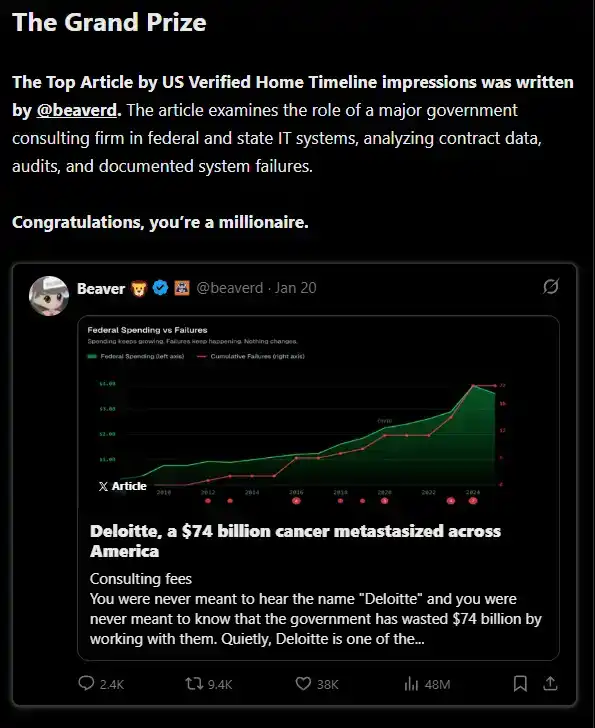
In the English-speaking crypto community, Beaver is a relatively well-known meme coin player, so his win excited the crypto circle. However, the day before yesterday, Bubblemaps posted a tweet accusing him of being a "serial rugger," alleging that he manipulated coin prices to profit $600,000.

Bubblemaps stated that based on Beaver's public Solana address, they discovered an associated address "2mQB8o," which launched the token $SIAS on pump.fun. $SIAS quickly reached a market cap of $6 million within 7 minutes of deployment, but then rapidly plummeted to zero in the next 10 minutes due to large sell-offs by the dev.
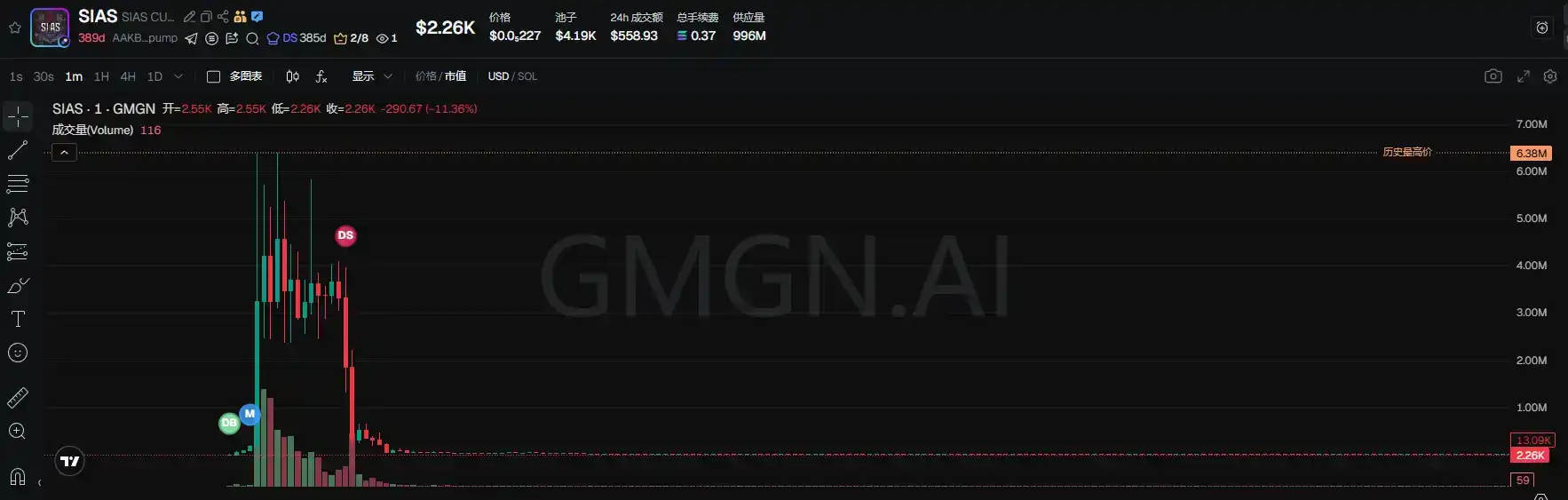
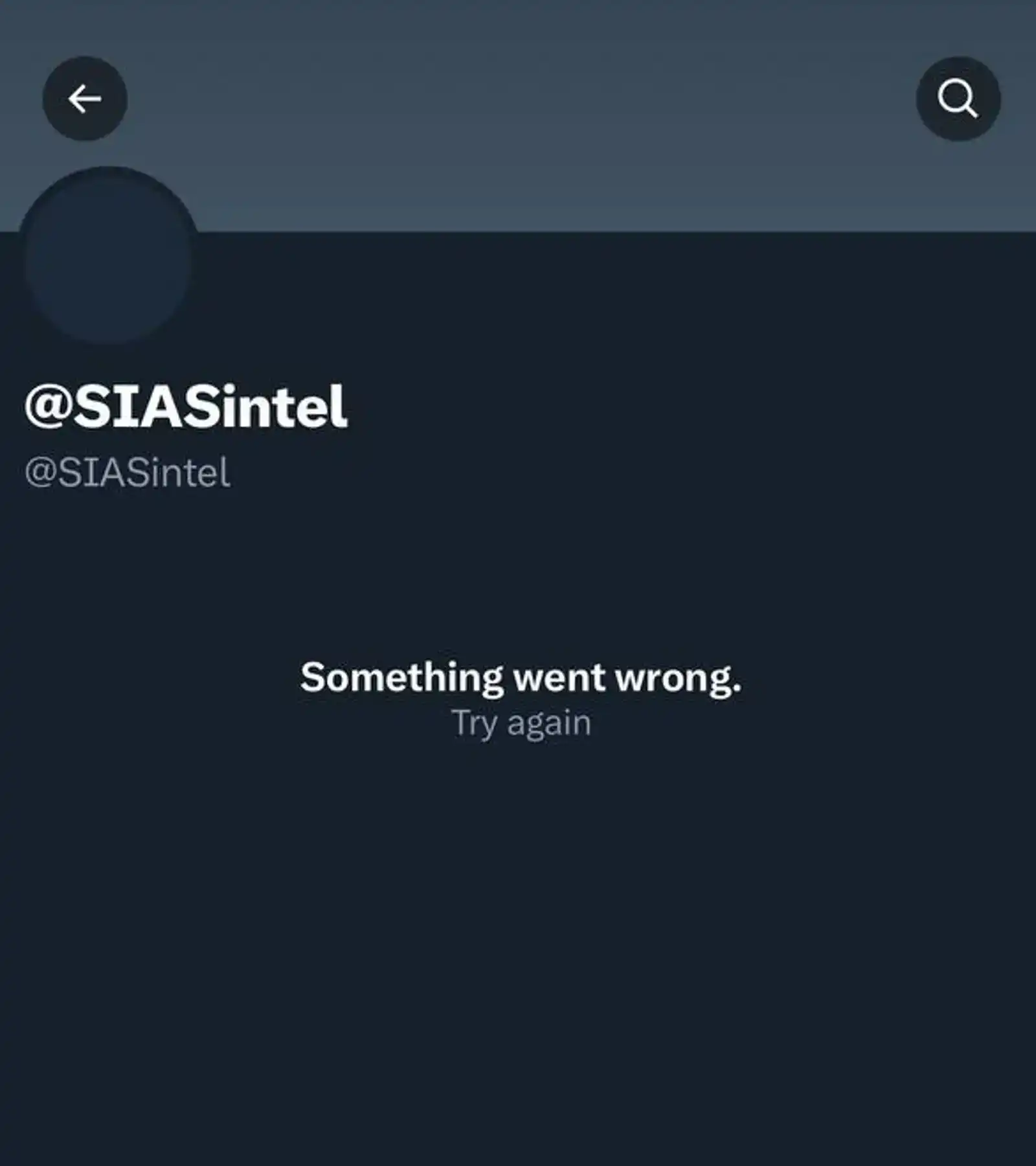
After the token crashed to zero, its X account was also deleted.
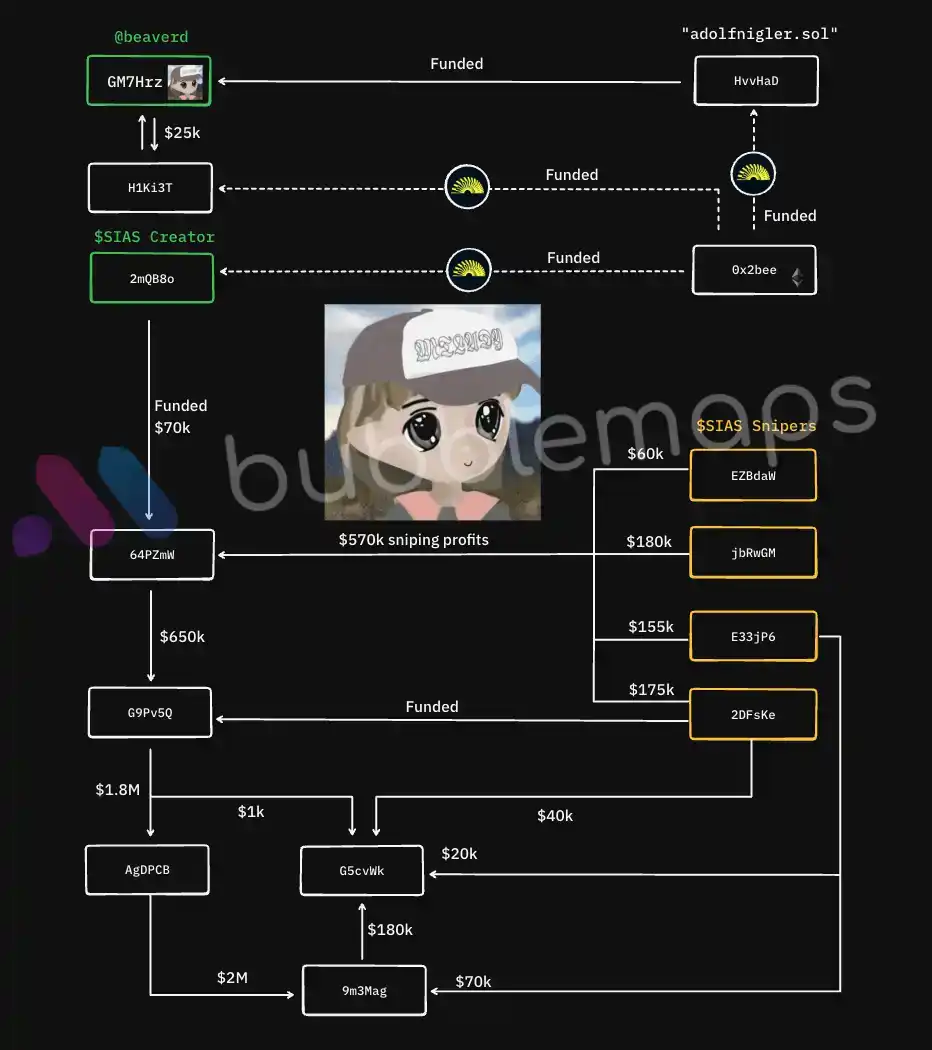
Through further on-chain analysis, Bubblemaps pointed out that Beaver was not only the dev but also used four other addresses to snipe the token, totaling a profit of $600,000.
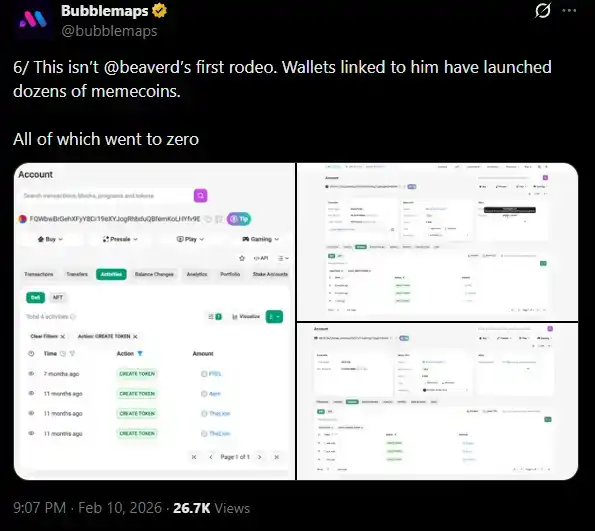
Finally, Bubblemaps also noted that all tracked addresses related to Beaver did not just launch this one token but many others, all of which crashed to zero.
In response to Bubblemaps' accusations, Beaver's reply was as wild as his Milady avatar:

Precisely because of Beaver's response, he gained considerable support. In the English-speaking community, Beaver is popular for being "fun," similar to figures like Bob Lax and mitch. To make an imperfect analogy, it's somewhat like Liang Xi in the Chinese circle.

This is an interesting manifestation of the crypto subculture. Whether in the Chinese or English-speaking circles, a significant portion of players hold the view of "you win some, you lose some"—meme coins are essentially a gamble, and if devs can make money through clever means, that's their skill. Since you gambled, you should take responsibility for yourself.

There is also the view that Beaver did not promote $SIAS through his X account (Bubblemaps' accusation also acknowledged this but pointed out that Beaver even profited from the token using his public address, which is an act of audacity). Therefore, Beaver is not guilty of "fraud"; rather, those who bet against him lost to him.

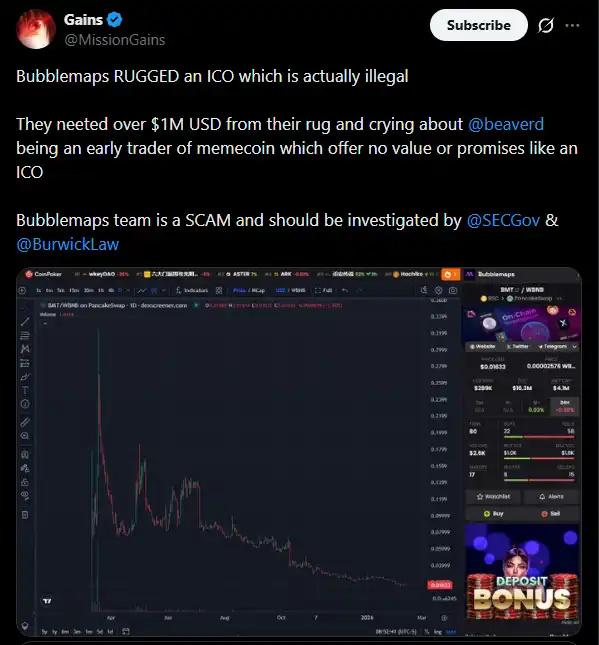
Players siding with Beaver even mocked the market performance of Bubblemaps' token $BMT, arguing that compared to Beaver, Bubblemaps—which conducted an ICO and made promises—is the illegal scam that should be held accountable:
Besides the有趣的 subculture of the crypto world, another reason for Beaver's popularity is his project Somaliscan. Somaliscan is an open-source data website that tracks over $55 trillion in U.S. government fiscal expenditures, exposing massive corruption in the U.S. government's refugee resettlement programs, particularly aid to Somalia. The data on this website covers U.S. government spending, political donations to officials, healthcare system fund allocations, federal loans, and summaries of individuals linked to the Epstein files. Beaver's million-dollar-winning article exposed the massive corruption of Deloitte, which received a $40 billion contract from the U.S. government but caused an estimated $34 billion in losses—a discovery he made while building the database for Somaliscan.

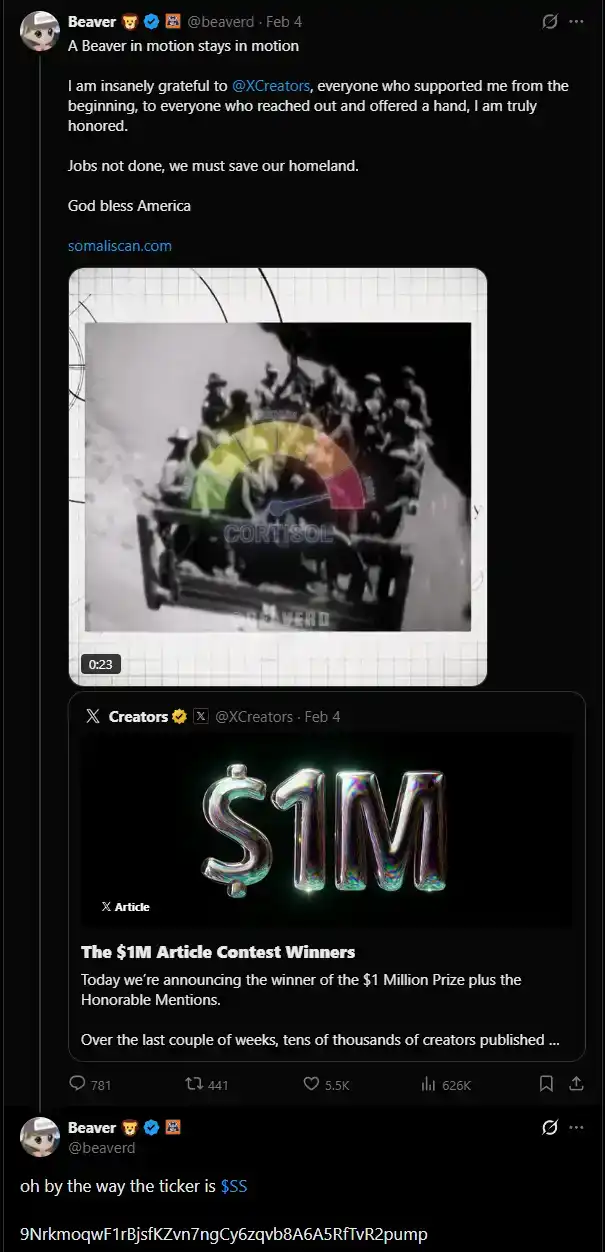
As a result, Beaver is seen as a hero by right-leaning players in the English-speaking community (especially in the U.S.). After X announced his million-dollar article prize, he immediately promoted Somaliscan and included the CA in the tweet's comments:
Setting aside emotional factors, this incident has indeed reignited a long-standing debate in the crypto community—if someone launches a token and manipulates its price but does not promote it, should they be criticized?

This debate will not cease unless the market ceases to be残酷.

Domande pertinenti

QWho won the $1 million article competition on X and what was the title of their winning article?

AThe winner was @beaverd with the article titled 'Deloitte, a $74 billion cancer metastasized across America'.

QWhat accusation did Bubblemaps make against Beaver regarding his activities in the crypto space?

ABubblemaps accused Beaver of being a 'serial rugger' who manipulated the price of a token called $SIAS on pump.fun, making a profit of $600,000 by quickly selling off his holdings and causing the token's value to plummet to zero.

QHow did Beaver respond to the allegations made by Bubblemaps?

ABeaver responded defiantly and with a wild attitude, which actually garnered him significant support from parts of the crypto community who view meme coin trading as a form of gambling where participants are responsible for their own risks.

QWhat is Somaliscan, and how is it related to Beaver's public image?

ASomaliscan is an open-source data website created by Beaver that tracks over $55 trillion in U.S. government spending, exposing corruption in programs like refugee安置 (especially aid to Somalia). It enhanced his reputation, particularly among right-leaning circles, who see him as a hero for uncovering government waste and corruption.

QWhat ongoing debate in the crypto community does the article highlight through Beaver's story?

AThe article highlights the debate over whether creating a token and manipulating its price without promoting it should be considered fraudulent or simply a risky bet that participants enter into willingly, reflecting the community's divided views on responsibility and ethics in meme coin trading.

Letture associate

Bitcoin Mining Farms Are Becoming AI Factories

Bitcoin mines are transforming into AI factories. This shift is driven by the convergence of three key assets from the previous crypto cycle: infrastructure, talent, and capital. Crypto mining companies like Crusoe, CoreWeave, and Bitdeer are repurposing their core competency—securing power, land, and grid connections in remote locations—to build data centers for AI clients. These firms are signing multi-billion dollar, long-term contracts with companies like Anthropic, AWS, and Microsoft, as AI's demand for reliable, high-capacity compute surpasses the profitability of Bitcoin mining. Simultaneously, crypto entrepreneurs and engineers are applying their skills to new AI ventures. Examples include OpenSea's co-founder launching OpenRouter (an AI model aggregator), and former Coinbase engineers building Fal.ai (a generative media infrastructure platform). Their experience in building scalable, global software networks translates effectively to the AI space. Furthermore, capital accumulated during the crypto boom is now fueling AI. Figures like Jed McCaleb (co-founder of Ripple) funded Voltage Park, a large-scale GPU cloud provider. Notably, some crypto investments, like FTX's early bets on Anthropic and Cursor, have generated astronomical paper returns, demonstrating how high-risk crypto capital flowed into AI before it became mainstream. The transition is not just about repurposing hardware, but about redirecting critical resources—power infrastructure, distributed systems expertise, and venture funding—to the next technological frontier: artificial intelligence.

链捕手18 min fa

Bitcoin Mining Farms Are Becoming AI Factories

链捕手18 min fa

Morpho Launches Fixed-Rate Product Midnight: Lenders and Borrowers Set Their Own Rates, Ending the Era of Interest Rate Models

Morpho Launches Fixed-Rate Product Midnight: Lenders and Borrowers Set Their Own Rates, Ending the Era of Algorithmic Interest Models On-chain lending has grown to $60 billion but remains minuscule compared to traditional finance's $200 trillion annual credit volume. Morpho identifies the lack of fixed rates and maturity dates as key bottlenecks. Institutions need predictability, not the passive floating rates set by algorithmic models. Midnight allows lenders and borrowers to directly quote rates, set terms, and become price makers, not takers. Fixed-rate lending is now viable due to cheaper, faster blockchains and the entry of institutions demanding control and certainty over returns, costs, and duration. Morpho Blue previously gave users control over risk; Midnight adds control over interest rates. Past attempts at on-chain fixed-rate lending failed primarily because they were built on top of floating-rate pools (creating unpredictability) or lacked sufficient active participants. Midnight avoids these pitfalls as a standalone primitive with fixed rates at its core, built upon Morpho Blue's existing large and active user base. Midnight offers distinct value: institutions gain predictable term structures and full control; fintech companies can offer tailored fixed-rate products; lenders/borrowers achieve predictability and efficiency; and curators can now differentiate by configuring both risk and interest rates. Morpho Midnight is not a replacement for Morpho Blue. The Morpho network will now feature two complementary market structures: floating-rate/open-term (Blue) for flexibility and fixed-rate/fixed-term (Midnight) for predictability. Liquidity can flow between them. The launch will be gradual, prioritizing security. Initially, it will support direct lending on Base network with one trading pair (cbBTC/USDC) and limited maturity dates. Advanced features like auto-rollovers will be introduced later.

marsbit19 min fa

Morpho Launches Fixed-Rate Product Midnight: Lenders and Borrowers Set Their Own Rates, Ending the Era of Interest Rate Models

marsbit19 min fa

Trading

Spot
活动图片