Before Musk Gave Him $1 Million, He Made $600,000 by Launching Coins

marsbitPubblicato 2026-02-12Pubblicato ultima volta 2026-02-12

Introduzione

On February 4th, X awarded user @beaverd $1 million for winning an article competition with a piece criticizing Deloitte. Beaver, a well-known meme coin trader, was later accused by Bubblemaps of being a "serial rugger" who allegedly made $600,000 by deploying and manipulating the price of a token called $SIAS on pump.fun, which rapidly rose to a $6 million market cap before crashing to zero. Bubblemaps claimed Beaver used multiple wallets to snipe and profit from the token. In response, Beaver gave a defiant reply, garnering significant support from parts of the crypto community. Supporters argued that since he did not promote the token on his social media, his actions weren’t fraudulent—just a high-risk bet that others lost. Some even criticized Bubblemaps’ own token $BMT as a worse offender. Beaver is also known for Somaliscan, a data site tracking U.S. government spending and exposing corruption, which earned him admiration, particularly among right-leaning audiences. The incident reignites the ongoing debate in crypto over whether launching and manipulating tokens without promotion constitutes unethical behavior or simply reflects the risky nature of meme coin trading.

On February 4th, X announced the winner of its million-dollar article competition. @beaverd, with his piece "Deloitte, a $74 billion cancer metastasized across America," became the ultimate winner, receiving a $1 million reward.
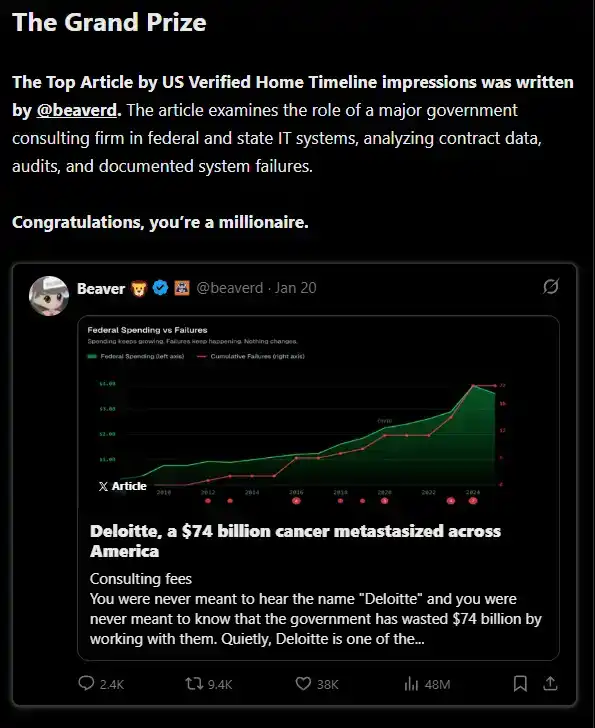
In the English-speaking crypto community, Beaver is a relatively well-known meme coin player, so his win excited the crypto circle. However, the day before yesterday, Bubblemaps posted a tweet accusing him of being a "serial rugger," alleging that he manipulated coin prices to profit $600,000.

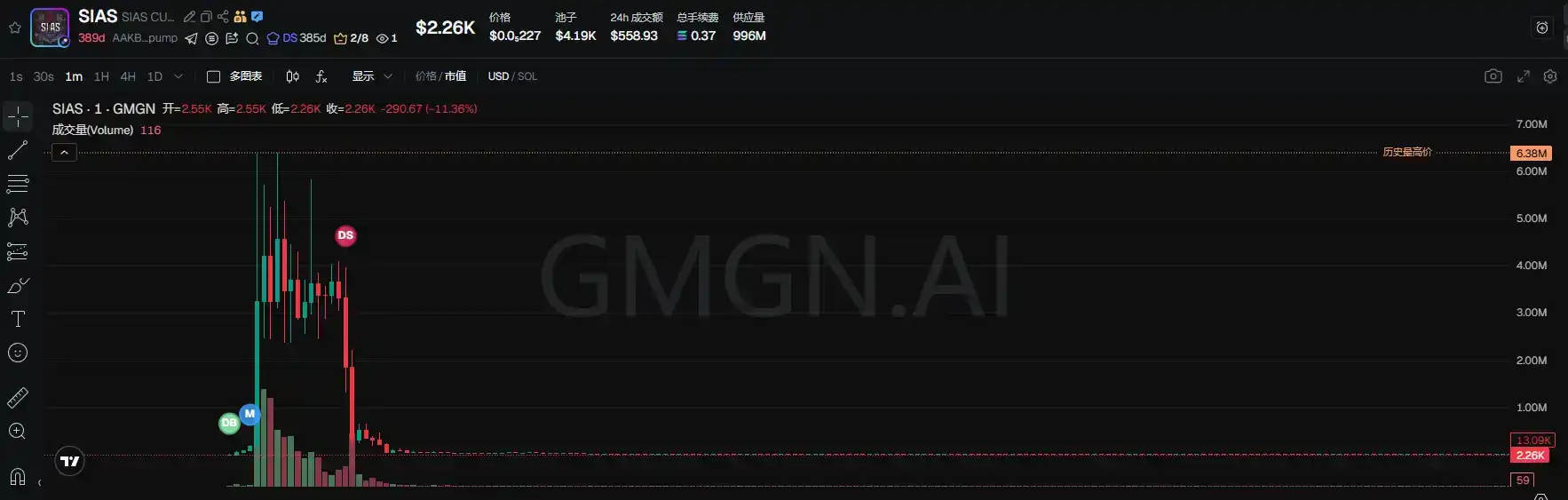
Bubblemaps stated that based on Beaver's public Solana address, they discovered an associated address "2mQB8o," which launched the token $SIAS on pump.fun. $SIAS quickly reached a market cap of $6 million within 7 minutes of deployment, but then rapidly plummeted to zero in the next 10 minutes due to large sell-offs by the dev.
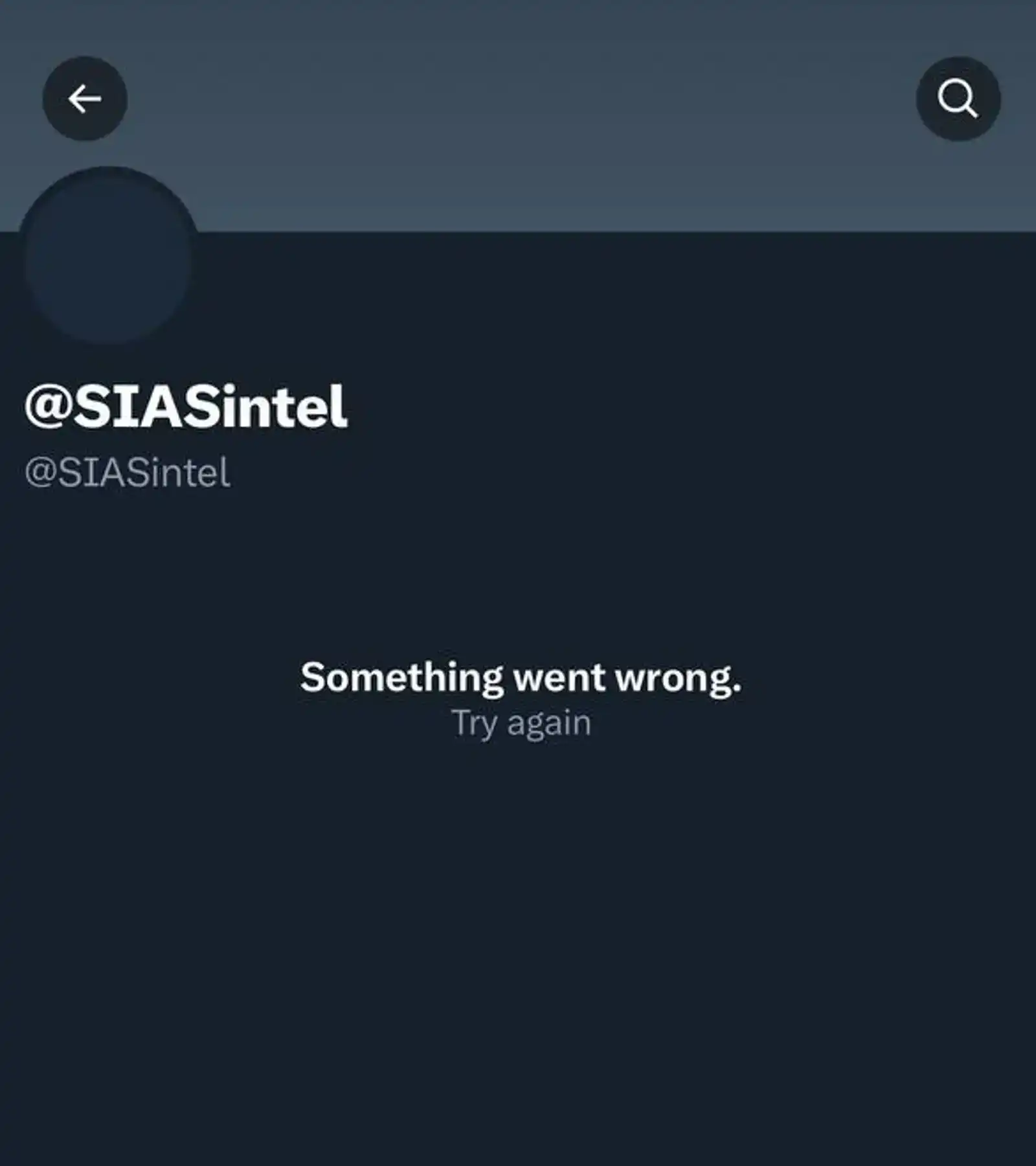
After the token crashed to zero, its X account was also deleted.
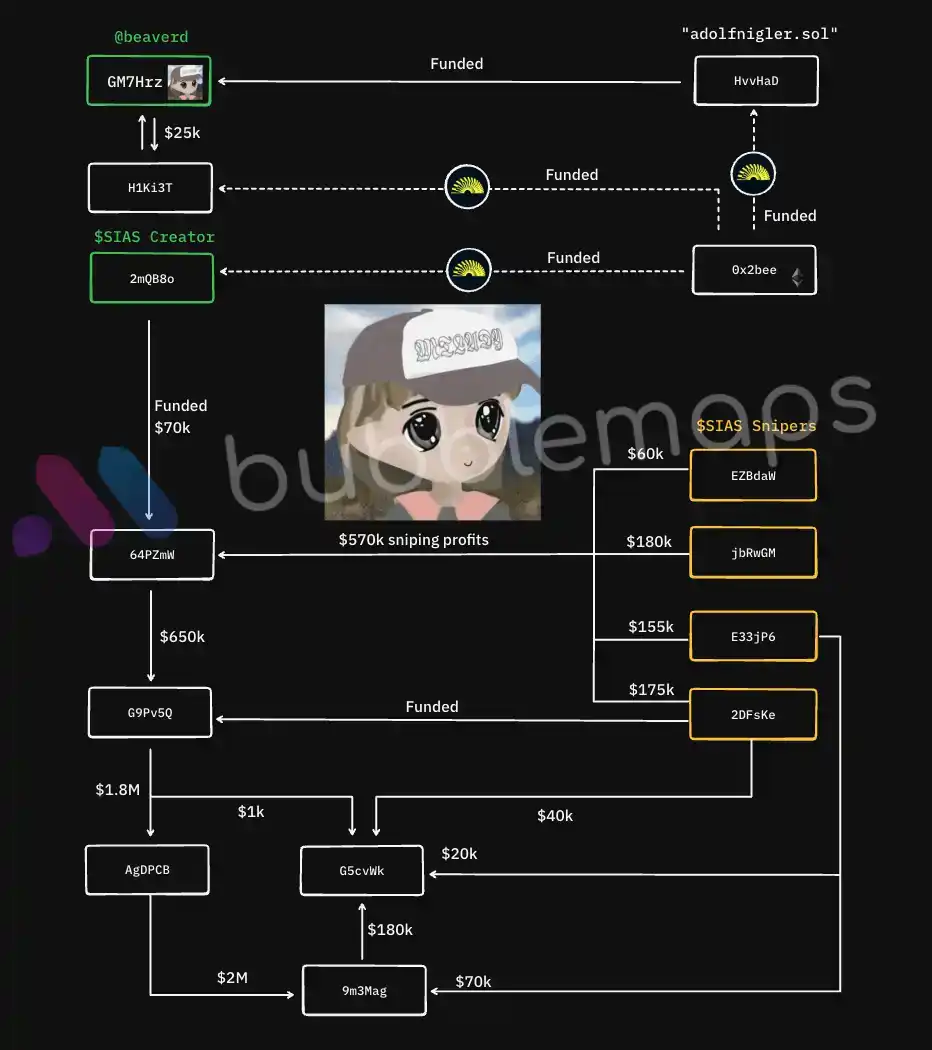
Through further on-chain analysis, Bubblemaps pointed out that Beaver was not only the dev but also used four other addresses to snipe the token, totaling a profit of $600,000.
Finally, Bubblemaps also noted that all tracked addresses related to Beaver did not just launch this one token but many others, all of which crashed to zero.
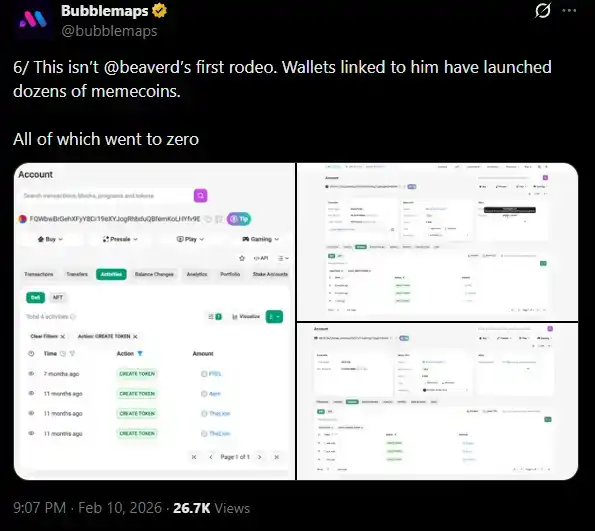
In response to Bubblemaps' accusations, Beaver's reply was as wild as his Milady avatar:

Precisely because of Beaver's response, he gained considerable support. In the English-speaking community, Beaver is popular for being "fun," similar to figures like Bob Lax and mitch. To make an imperfect analogy, it's somewhat like Liang Xi in the Chinese circle.

This is an interesting manifestation of the crypto subculture. Whether in the Chinese or English-speaking circles, a significant portion of players hold the view of "you win some, you lose some"—meme coins are essentially a gamble, and if devs can make money through clever means, that's their skill. Since you gambled, you should take responsibility for yourself.
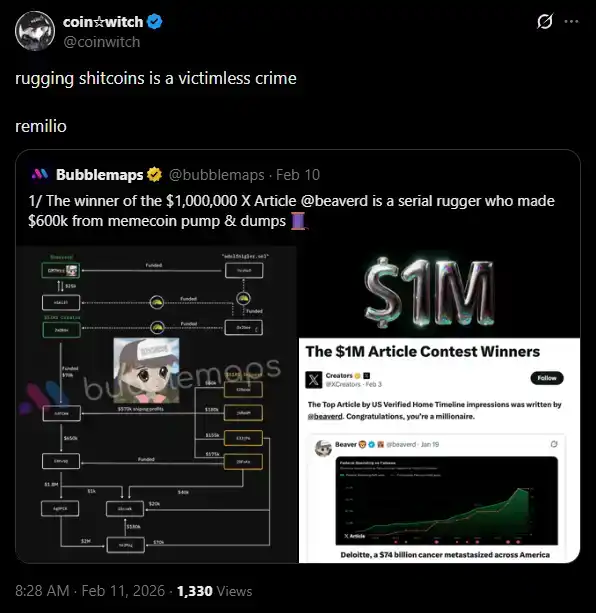
There is also the view that Beaver did not promote $SIAS through his X account (Bubblemaps' accusation also acknowledged this but pointed out that Beaver even profited from the token using his public address, which is an act of audacity). Therefore, Beaver is not guilty of "fraud"; rather, those who bet against him lost to him.

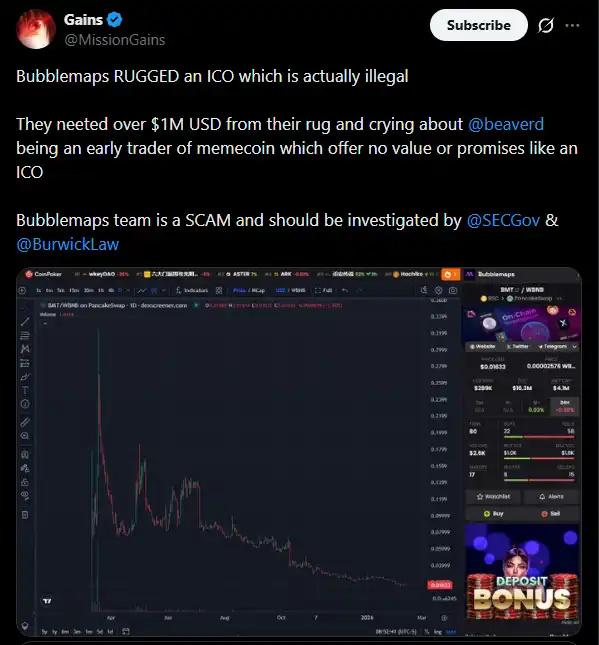
Players siding with Beaver even mocked the market performance of Bubblemaps' token $BMT, arguing that compared to Beaver, Bubblemaps—which conducted an ICO and made promises—is the illegal scam that should be held accountable:
Besides the有趣的 subculture of the crypto world, another reason for Beaver's popularity is his project Somaliscan. Somaliscan is an open-source data website that tracks over $55 trillion in U.S. government fiscal expenditures, exposing massive corruption in the U.S. government's refugee resettlement programs, particularly aid to Somalia. The data on this website covers U.S. government spending, political donations to officials, healthcare system fund allocations, federal loans, and summaries of individuals linked to the Epstein files. Beaver's million-dollar-winning article exposed the massive corruption of Deloitte, which received a $40 billion contract from the U.S. government but caused an estimated $34 billion in losses—a discovery he made while building the database for Somaliscan.

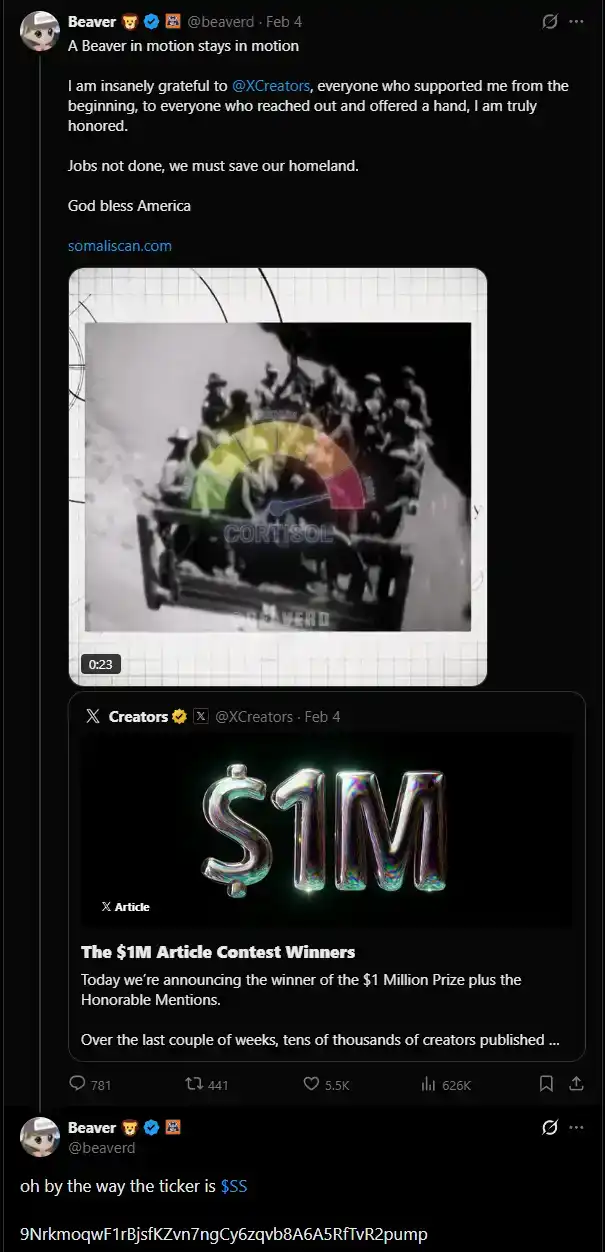
As a result, Beaver is seen as a hero by right-leaning players in the English-speaking community (especially in the U.S.). After X announced his million-dollar article prize, he immediately promoted Somaliscan and included the CA in the tweet's comments:
Setting aside emotional factors, this incident has indeed reignited a long-standing debate in the crypto community—if someone launches a token and manipulates its price but does not promote it, should they be criticized?

This debate will not cease unless the market ceases to be残酷.

Domande pertinenti

QWho won the $1 million article competition on X and what was the title of their winning article?

AThe winner was @beaverd with the article titled 'Deloitte, a $74 billion cancer metastasized across America'.

QWhat accusation did Bubblemaps make against Beaver regarding his activities in the crypto space?

ABubblemaps accused Beaver of being a 'serial rugger' who manipulated the price of a token called $SIAS on pump.fun, making a profit of $600,000 by quickly selling off his holdings and causing the token's value to plummet to zero.

QHow did Beaver respond to the allegations made by Bubblemaps?

ABeaver responded defiantly and with a wild attitude, which actually garnered him significant support from parts of the crypto community who view meme coin trading as a form of gambling where participants are responsible for their own risks.

QWhat is Somaliscan, and how is it related to Beaver's public image?

ASomaliscan is an open-source data website created by Beaver that tracks over $55 trillion in U.S. government spending, exposing corruption in programs like refugee安置 (especially aid to Somalia). It enhanced his reputation, particularly among right-leaning circles, who see him as a hero for uncovering government waste and corruption.

QWhat ongoing debate in the crypto community does the article highlight through Beaver's story?

AThe article highlights the debate over whether creating a token and manipulating its price without promoting it should be considered fraudulent or simply a risky bet that participants enter into willingly, reflecting the community's divided views on responsibility and ethics in meme coin trading.

Letture associate

Podcast Notes | Conversation with GSR Asset Management Head: To Determine if This Crypto Rally is Real, Just Watch the Lending Rates on Aave

Podcast Summary: Dialogue with GSR's Head of Asset Management: To Determine if This Crypto Rally is Real, Just Check Lending Rates on Aave Andy Baehr, Managing Director of Asset Management at GSR, discusses the current crypto market, characterizing it as stuck in a state of "ambivalence" with short-lived, unsustainable rallies. He outlines a simple framework: the market moves between "ambivalence" and "conviction" (sustained upward momentum). Currently, every rally resembles a single-stage rocket booster that quickly fizzles out. Baehr identifies three key signals to watch: 1) DeFi lending rates, 2) the potential passage of the CLARITY Act, and 3) the market forming a consensus on the "Fed hawkish peak." He emphasizes that the most immediate indicator for the sustainability of the recent CPI-triggered rally is the USDC borrowing rate on Aave, currently around 3.75%—close to U.S. Treasury yields. The absence of a credit spread indicates low leverage demand and a lack of market energy. He explains that a healthy, sustained rally requires layered buying pressure. Last year's rally progressed from an ETH short squeeze to crypto-native trader influx and finally to ETF inflows. Currently, this structure is missing. Other potential structural buyers like Digital Asset Treasury (DAT) companies are absent, and ETF flows have proven transient. Baehr notes that while small-cap crypto tokens outperformed large caps in Q2—a potential sign of capitation in major assets—capital is also flowing to more exciting opportunities like AI stocks and tech IPOs, leaving crypto sidelined. Regarding DeFi, he highlights that platforms like Aave provide a clear, real-time signal of leverage demand through their supply/demand-driven interest rates. A significant, sustained rate increase would signal genuine market conviction. He also observes the quiet emergence of fixed-income-like products and vaults in DeFi. On regulation, the probability of the CLARITY Act passing before the August 7th deadline has dropped linearly from 75% to below 40% on Polymarket. Baehr suggests its passage would be treated as a bullish surprise, a potent driver for price movement. However, political hurdles, including ethical clause debates and disclosures about the First Family's crypto profits, remain significant obstacles. Ultimately, the market awaits clarity on the Fed's terminal rate under Chair Warsh. Until the "Fed Solstice"—the point where the market collectively understands the peak of hawkish policy—sustained conviction will be difficult to achieve.

marsbit14 min fa

Podcast Notes | Conversation with GSR Asset Management Head: To Determine if This Crypto Rally is Real, Just Watch the Lending Rates on Aave

marsbit14 min fa

7 Months After the Collapse of Huiwang, Southeast Asia's Escrow Platforms Undergo a Major Reshuffle

Following the collapse of Huione Pay—dubbed the "Alipay of Southeast Asia"—seven months ago, the region's underground financial guarantee platform sector is undergoing a significant reshuffle. This power vacuum has been swiftly filled by emerging platforms such as XinBi, Tiger/Navigator, JinBei (renamed JinBo), Dali/Tiancheng, and FullyLight. These platforms, operating largely via Telegram and offering services like escrow for illicit transactions, have absorbed the vast user base and markets left behind by Huione. While positioning themselves as "trust intermediaries," their primary clientele consists of networks involved in online scams, money laundering, illegal gambling, and even human trafficking. For instance, the Tiger/Navigator platform explicitly provides "escrow" services for kidnapping-for-ransom operations ("强押车交易"). Data underscores the immense scale: Huione alone processed over $103 billion in cryptocurrency payments and facilitated over $31 billion through its escrow market before its downfall, linking it to Cambodia's notorious Prince Group. Since its collapse, competitors have seen explosive growth. For example, the XinBi platform has accumulated over $1.6 billion in total USDT revenue, while platforms like NewPay, OkPay (under Dali), and FullyLight Wallet collectively processed over $4.8 billion in USDT in a single year. This ecosystem thrives in regions like Cambodia and Myanmar, where regulatory gaps allow these platforms to act as critical financial infrastructure for sprawling cybercrime industries, from scam compounds to online casinos. The article concludes that the moniker "Southeast Asian Alipay" is a misnomer, obscuring the platforms' fundamental role in enabling serious criminal enterprises rather than representing legitimate financial innovation.

Odaily星球日报1 h fa

7 Months After the Collapse of Huiwang, Southeast Asia's Escrow Platforms Undergo a Major Reshuffle

Odaily星球日报1 h fa

Trading

Spot
活动图片





