Bear Market Script: Which Act Is Your 'Faith' Experiencing?

marsbitPubblicato 2026-03-05Pubblicato ultima volta 2026-03-05

Introduzione

The article "Bear Market Script: Which Act Is Your 'Faith' Experiencing?" by TVBee analyzes the typical stages of a cryptocurrency bear market, using Bitcoin (BTC) and Tether (USDT) market capitalization as key indicators. It identifies 3-4 phases: 1. **Reaction Phase (Faith Intact)**: BTC declines while USDT rises, indicating some investors still hold hope. 2. **Confirmation Phase (Faith Collapses)**: BTC may fall or stagnate, and USDT decreases, confirming the bear market as capital exits. 3. **Accumulation Phase (Faith Consolidates)**: BTC may drop or trade sideways, but USDT rises again, suggesting stronger believers are preparing to re-enter. 4. **Final Panic Phase (Black Swan)**: A optional phase where both BTC and USDT fall sharply due to extreme events (e.g., 2022’s Luna collapse). The author suggests the current market (early 2026) is likely in Phase 2, driven by geopolitical tensions like the Iran conflict. The duration of this phase depends on external factors such as Trump administration policies, monetary changes, and potential black swan events. Ideal entry points for investors are during Phase 3 (USDT rising) or in the recovery phase (right-side entry), where USDT growth and BTC stabilization signal a market rebound. The analysis notes that bear markets are evolving—Phase 1 is shortening, but Phase 2 remains unpredictable due to external shocks. Caution and patience are advised.

Author: TVBee

The 3-4 Stages of a Bear Market Experience

Bear Market Stage 1: Reaction Phase (Faith Remains)

⬩Approx. Dec 16, 2017 ~ Oct 08, 2018

⬩Approx. Nov 07, 2021 ~ May 12, 2022

⬩Suspected Oct 06, 2025 ~ Jan 06, 2026

In this stage, BTC is falling, but the market cap of USDT is rising.

Funds flowing out of crypto are still accumulating partly in USDT; some people likely hold illusions about the market trend. This is the market's reaction phase to the bear market, the stage where faith still remains.
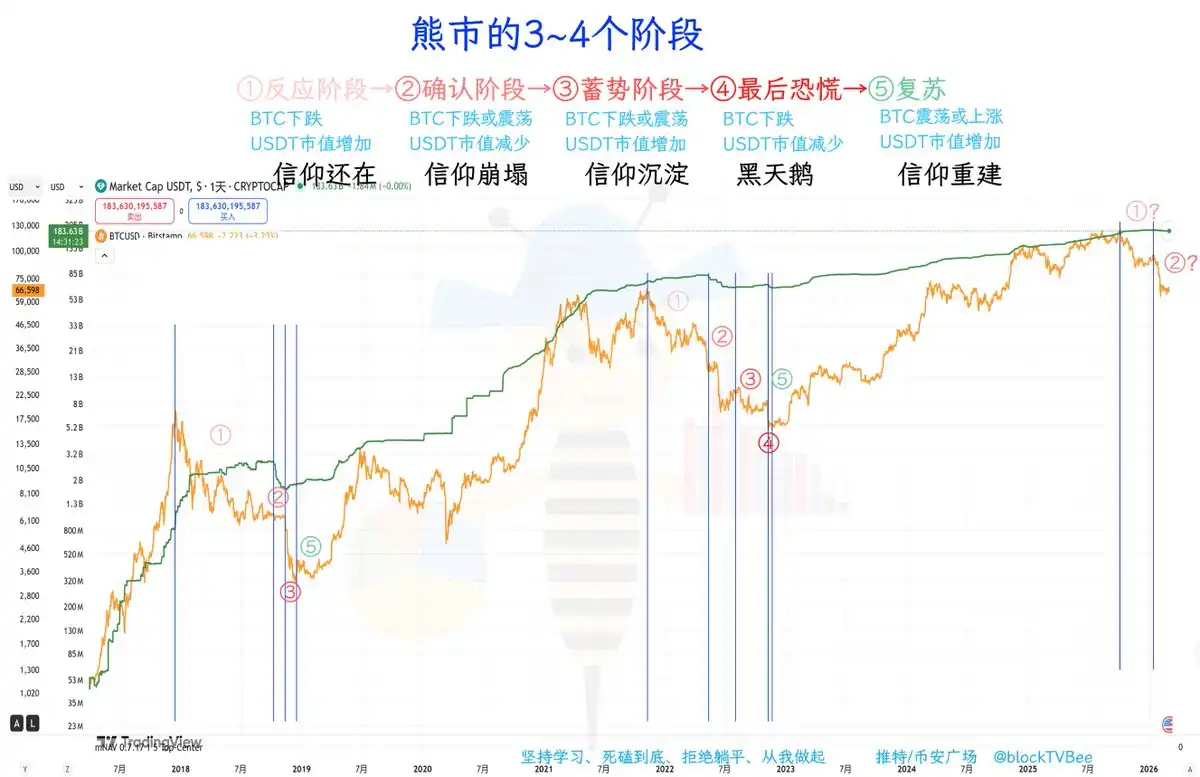
It is suspected that Oct 06, 2025 ~ Jan 06, 2026 completed this stage.

Bear Market Stage 2: Confirmation Phase (Faith Collapses)

⬩Approx. Oct 08, 2018 ~ Nov 14, 2018

⬩Approx. May 12, 2022 ~ Aug 04, 2022

⬩Suspected Jan 06, 2026 ~ ?

In this stage, BTC may be falling or moving sideways, but the market cap of USDT is decreasing.

Funds flowing out of crypto are now exiting USDT; the market confirms the bear market, and capital begins to exit as the main trend. This is also the stage where faith collapses.

2018 had no major negative events, so BTC moved mainly sideways, while 2022 had Luna + Three Arrows, so BTC fell primarily.

It is suspected that Jan 06, 2026 began entering this stage, with the USDT market cap starting to decrease, and the market beginning to question BTC, its digital gold properties, believing BTC will fall to the 30k range......

However, there are currently no signs that Stage 2 has ended.

Bear Market Stage 3: Accumulation Phase (Faith Sediments)

⬩Approx. Nov 14, 2018 ~ Dec 15, 2018

⬩Approx. Aug 04, 2022 ~ Nov 09, 2022

In this stage, BTC may be falling or moving sideways, but the market cap of USDT is increasing.

In 2018, because the previous phase was sideways, this phase was a decline. In 2022, the previous phase was primarily a decline, so this phase first fell and then moved mainly sideways.

Either funds from selling BTC are no longer primarily exiting, or capital is entering, causing the USDT market cap to increase. The weakest believers have already left, while the steadfast believers begin holding U or injecting capital, accumulating and waiting. Market faith also enters a sedimentation stage.

Bear Market Stage 4: Final Panic (Black Swan)

⬩Approx. Nov 09, 2022 ~ Nov 22, 2022

In this stage, BTC is falling, and the USDT market cap is also decreasing.

This is the final panic stage, mainly influenced by a black swan event. 2018 did not have this stage.

Recovery

After BTC bottoms out, it may gradually move upward or oscillate at the bottom. However, the USDT market cap increases. This is a stage of market recovery and faith rebuilding.

When to Buy the Dip

The earliest should be in Stage 3, when the USDT market cap is rising, using partial positions to buy the dip in batches.

The best buying opportunity, the phase where BTC crashes and the USDT market cap falls, may not necessarily occur; 2018 did not have this phase.

For retail investors, a more ideal buying range might be on the right side, i.e., the recovery stage. This stage features sustained growth in the USDT market cap, and BTC has experienced a bottom and shows signs of stabilization or even upward movement.

Final Thoughts

By comparison, it can be seen that each cycle's Stage 1 is getting shorter, because the market is reacting to the bear market faster and faster.

However, Stage 2 has not gotten shorter. Stage 2 may be related to the impact of negative events. The first half of 2018 had no negative events; it even had the mainnet launches of EOS and Tron. In 2022, the Luna crash followed by Three Arrows bankruptcy made this cycle's Stage 2 longer and the decline greater.

We are most likely already in Stage 2 now; the USDT market cap is decreasing, and the current negative is the Iran conflict. It is still uncertain when this negative will end.

Price-wise, Brother Bee believes the impact of the conflict on liquidity is relatively weak, but US stocks have a correction demand, so the current situation might be between the 2018 and 2022 Stage 2, possibly a downward. Of course, the certainty of this guess is not high; the uncertainties around Trump and Iran are quite significant.

In terms of cycles, Brother Bee's speculation is that around the time of Trump's visit to China, the geopolitical negatives might end. Because Trump's visit to China would mean that regarding countries like Iran, Trump already holds sufficient negotiation chips.

However, whether black swans will appear during the process of communication and coordination between the two sides is unknown. Furthermore, there are subsequent key events like Wash's inauguration and Japan's interest rate hike.

Therefore, when Stage 2 will end still requires continued observation. The first opportunity to buy the dip still requires patience, waiting for the USDT market cap to resume its rise after experiencing a decline. Since USDT's current use is not limited to crypto trading, the changes in its market cap this cycle might be less obvious. Thus, it's also necessary to consider factors like geopolitics and monetary policy.


Domande pertinenti

QWhat are the main stages of a bear market according to the article, and what characterizes each stage?

AThe article outlines 3-4 stages: 1. Reaction Stage (Faith Remains): BTC falls, but USDT market cap rises as some funds remain hopeful. 2. Confirmation Stage (Faith Collapses): BTC may fall or stagnate, USDT market cap decreases as funds exit, confirming the bear market. 3. Accumulation Stage (Faith Sediments): BTC may fall or stagnate, but USDT market cap increases as weak holders leave and strong holders accumulate. 4. Final Panic Stage (Black Swan, not present in 2018): BTC falls sharply with USDT market cap decreasing due to a black swan event.

QBased on the historical patterns described, when did the author suggest the 'Reaction Stage' of the current bear market (circa 2025-2026) likely began and ended?

AThe author suggested the Reaction Stage for the current cycle疑似 (suspectedly) began around October 6, 2025, and ended around January 6, 2026.

QWhat is the key on-chain metric the author uses to identify the transition between bear market stages, particularly between Stage 1 and Stage 2?

AThe key on-chain metric is the market capitalization of USDT. A rising USDT market cap characterizes Stage 1, while a decreasing USDT market cap signals the transition into Stage 2.

QAccording to the author, what is the earliest recommended time for investors to consider buying the dip (accumulating assets) in a bear market?

AThe earliest recommended time to start accumulating is during Stage 3 (the Accumulation Stage), when the USDT market cap is increasing. The author advises using a portion of capital to buy in batches at this stage.

QWhat are some of the specific geopolitical and economic events mentioned as potential factors prolonging the current 'Confirmation Stage' (Stage 2)?

AThe events mentioned are the Iran conflict, potential U.S. stock market correction, uncertainty surrounding former President Trump's actions (including a potential visit to China), the upcoming term of Fed Chair Waller, and a potential interest rate hike by Japan.

Letture associate

From 'Old Dogs' to 'New Darlings': How AI is Revaluing Old Infrastructure, from Dell to Nokia

"Old Dogs" Become AI's New Darlings: Revaluing Legacy Infrastructure The AI investment narrative is shifting. Beyond the spotlight on core chipmakers like Nvidia, a new wave of interest is rising for legacy tech companies—Dell, HPE, Nokia, Cisco, Corning, Western Digital—once labeled as slow-growth, outdated stories. This resurgence stems from AI's evolution from model development to real-world deployment, creating massive demand for physical infrastructure. As AI moves into data center construction and enterprise adoption, the focus turns to who can actually build and deliver complex systems. These established players hold decades of experience in supply chains, integration, networking, and enterprise delivery—assets now critical for scaling AI. The revaluation can be grouped into three key infrastructure areas: 1. **Servers & Integration (e.g., Dell, HPE):** They are becoming essential system integrators, transforming GPUs into full-scale AI servers with networking, power, and cooling, then delivering them to clients. Strong recent earnings and AI-specific revenue/order growth for Dell and HPE underscore this shift. 2. **Networking & Connectivity (e.g., Corning, Nokia, Cisco):** As AI clusters grow, high-speed data transfer becomes paramount. Corning benefits from fiber demand for data center links, Nokia is exploring AI-integrated wireless networks (AI-RAN), and Cisco sees surging orders for data center switches—all critical for efficient AI operations. 3. **Storage (e.g., Western Digital, Seagate):** The AI data explosion requires vast capacity. Beyond high-speed memory (HBM), there's growing need for high-capacity HDDs to store training data, logs, video, and cold/archival data cost-effectively. This revaluation, however, is not a blanket endorsement. True reassessment requires concrete proof: AI-driven orders and revenue growth, upward revisions to company guidance, and sustainable improvements in profit quality, not just top-line sales. In essence, AI is not turning all old tech firms into high-growth stocks; it is selectively re-pricing the "old assets" of companies that are mission-critical for building the new AI infrastructure, transforming their legacy capabilities into renewed growth engines.

marsbit10 min fa

From 'Old Dogs' to 'New Darlings': How AI is Revaluing Old Infrastructure, from Dell to Nokia

marsbit10 min fa

Probability in the Price: How World Cup Odds Are Calculated

**The Probability in the Price: How World Cup Odds Are Calculated** Two major systems released their "championship probabilities" before the 2026 World Cup, and they disagreed on the favorite. Prediction market aggregators listed France at around **17%**, while the Opta supercomputer gave European champion Spain **16.1%**. These numbers look similar, but their production methods are fundamentally different. The market's **17%** is the **price** that clears after hundreds of millions of dollars in trading across platforms like Polymarket and Kalshi, where contracts trade between 0 and 100 cents, directly representing implied probability. This liquidity is provided by crypto-native market makers like Wintermute, though the market still has "the liquidity profile of an early-stage" asset class. In contrast, Opta's **16.1%** is a **simulated frequency**. Its model uses team data (including betting market odds as an input) to estimate match probabilities, then runs **10,000 full tournament simulations**, counting how often each team wins. Which is more accurate? There is **no rigorous, cross-tournament academic study** directly comparing their track records. However, a persistent **longshot bias**—where low-probability outcomes are systematically overvalued—observed in traditional betting for nearly a century, has also been found in modern crypto prediction markets. Research shows low-price contracts on Kalshi/Polymer less likely to pay out than their implied odds suggest. Unlike traditional bookmakers, prediction markets operate on **public blockchain ledgers**, making every transaction auditable and enabling such research. However, price formation is also influenced by **regulatory uncertainty**, as seen in recent US state-level bans and legal battles over jurisdiction. In summary, the "probability" you see is either a **market-clearing price** subject to behavioral biases and liquidity constraints, or a **model-simulated frequency** that partially incorporates market data. The question of which method is more reliable remains open, highlighting the importance of asking: **How was this number produced?**

marsbit39 min fa

Probability in the Price: How World Cup Odds Are Calculated

marsbit39 min fa

Trading

Spot
Futures

Articoli Popolari

Come comprare 4

Benvenuto in HTX.com! Abbiamo reso l'acquisto di 4 (4) semplice e conveniente. Segui la nostra guida passo passo per intraprendere il tuo viaggio nel mondo delle criptovalute.Step 1: Crea il tuo Account HTXUsa la tua email o numero di telefono per registrarti il tuo account gratuito su HTX. Vivi un'esperienza facile e sblocca tutte le funzionalità,Crea il mio accountStep 2: Vai in Acquista crypto e seleziona il tuo metodo di pagamentoCarta di credito/debito: utilizza la tua Visa o Mastercard per acquistare immediatamente 44.Bilancio: Usa i fondi dal bilancio del tuo account HTX per fare trading senza problemi.Terze parti: abbiamo aggiunto metodi di pagamento molto utilizzati come Google Pay e Apple Pay per maggiore comodità.P2P: Fai trading direttamente con altri utenti HTX.Over-the-Counter (OTC): Offriamo servizi su misura e tassi di cambio competitivi per i trader.Step 3: Conserva 4 (4)Dopo aver acquistato 4 (4), conserva nel tuo account HTX. In alternativa, puoi inviare tramite trasferimento blockchain o scambiare per altre criptovalute.Step 4: Scambia 4 (4)Scambia facilmente 4 (4) nel mercato spot di HTX. Accedi al tuo account, seleziona la tua coppia di trading, esegui le tue operazioni e monitora in tempo reale. Offriamo un'esperienza user-friendly sia per chi ha appena iniziato che per i trader più esperti.

351 Totale visualizzazioniPubblicato il 2025.10.20Aggiornato il 2026.06.02

Come comprare 4

Discussioni

Benvenuto nella Community HTX. Qui puoi rimanere informato sugli ultimi sviluppi della piattaforma e accedere ad approfondimenti esperti sul mercato. Le opinioni degli utenti sul prezzo di 4 4 sono presentate come di seguito.

活动图片