Base MCP, The Next Step for x402

marsbitPubblicato 2026-05-28Pubblicato ultima volta 2026-05-28

Introduzione

Base has officially launched Base MCP, allowing users to connect their Base Account to AI Agents to perform actions like swaps, transfers, portfolio tracking, and transaction history queries through conversational commands. This move aligns with Base's strategic focus on AI, driven by the broader competition in the emerging Agent-to-Agent payment sector. The evolution of Agent payments has accelerated. In late 2024, the primary method involved insecure browser automation. By 2025, solutions like Coinbase's x402 (providing crypto wallets for Agents), Google's AP2, and Visa's token-based system emerged. x402 has since processed 176 million transactions totaling over $70 million, with a median value between $0.01 and $0.10. Stablecoins, particularly USDC, dominate these settlements due to their negligible transaction costs compared to traditional payment fees, which are prohibitive for micro-payments. Coinbase faces competition from Stripe, which has built a comparable infrastructure for Agent payments with its Tempo blockchain, Privy wallets, Bridge routing (acquired for $1.1B), and the recently launched MPP protocol. Both companies are now competing at the application layer. The core reason AI is central to Base's strategy is to expand the scenarios for Agent payments, ensuring more transactions occur on its network. By securing a dominant position and scale advantage in this nascent field, Coinbase aims to capture the future commercial potential of Agent-driven payments. T...

Yesterday, Base officially launched Base MCP. By connecting Base Account to AI Agent through Base MCP, you can use colloquial language, like chatting, to have the Agent perform operations such as Swap, transfers, position tracking, and transaction history queries.

Players familiar with Base know that the main focus on the Base chain right now is AI, so such an update from Base doesn't come as a surprise. Some players even anticipate new gameplay on the Base chain, similar to the AI meme coin $SHIT on Ethereum before, where they could directly use Base MCP to let an Agent participate in chain-based token launches through chat.

But if we step back from the perspective of a chain degen and look at the competition in Agent-to-Agent payments, we might find a new answer as to why AI has become the main focus for Base.

Rapidly Developing Agent Payments

Let's rewind to September 2024. Back then, if you wanted an AI Agent to complete a payment for something, humans basically had only one choice: use browser automation tools (like headless browsers such as Playwright, Selenium) to let the AI Agent simulate human actions and complete the checkout process on a webpage.

Since this required providing payment credentials (like full credit/debit card numbers, CVV, expiration dates, etc.) to the AI Agent, this sole option was not secure.

By May 2025, Coinbase launched x402, providing an AI Agent with a crypto wallet and solving this problem in a crypto-native way. But Coinbase wasn't the only one to recognize this as a potential market, and the solutions weren't limited to just crypto-native ones. In 2025, Google launched AP2, allowing users to authorize spending permissions to an Agent. Visa expanded its existing card payment channels, launching Visa Intelligent Commerce, which doesn't give the Agent sensitive information like credit card numbers or CVV, but instead provides the Agent with specific, limited tokens to complete payments.

Today, x402 has processed 176 million transactions from AI Agents, with a total transaction volume exceeding $70 million. This amount might not seem huge, but neither Coinbase nor the traditional giants are taking this emerging payment competition lightly:

- On January 22, 2026, Capital One, the sixth-largest bank in the US with $470 billion in assets, $330 billion in deposits, and the third-largest credit card issuer in the nation, announced the acquisition of Brex for $5.15 billion to enhance AI payment capabilities.

- In March 2026, Mastercard acquired the stablecoin infrastructure company BVNK for $1.8 billion.

- In February 2025, Stripe acquired the stablecoin payment platform Bridge for $1.1 billion.

While they haven't explicitly stated it, acquiring stablecoin-related companies is likely a move to prepare for the upcoming era of Agent payments. Stablecoins are indeed crucial for Agent payments.

Why Are Stablecoins Important for Agent Payments?

According to data statistics from Keyrock, the median transaction amount for Agent transactions processed on x402 so far is between $0.01 and $0.10, with 76% of transactions being under $0.30.
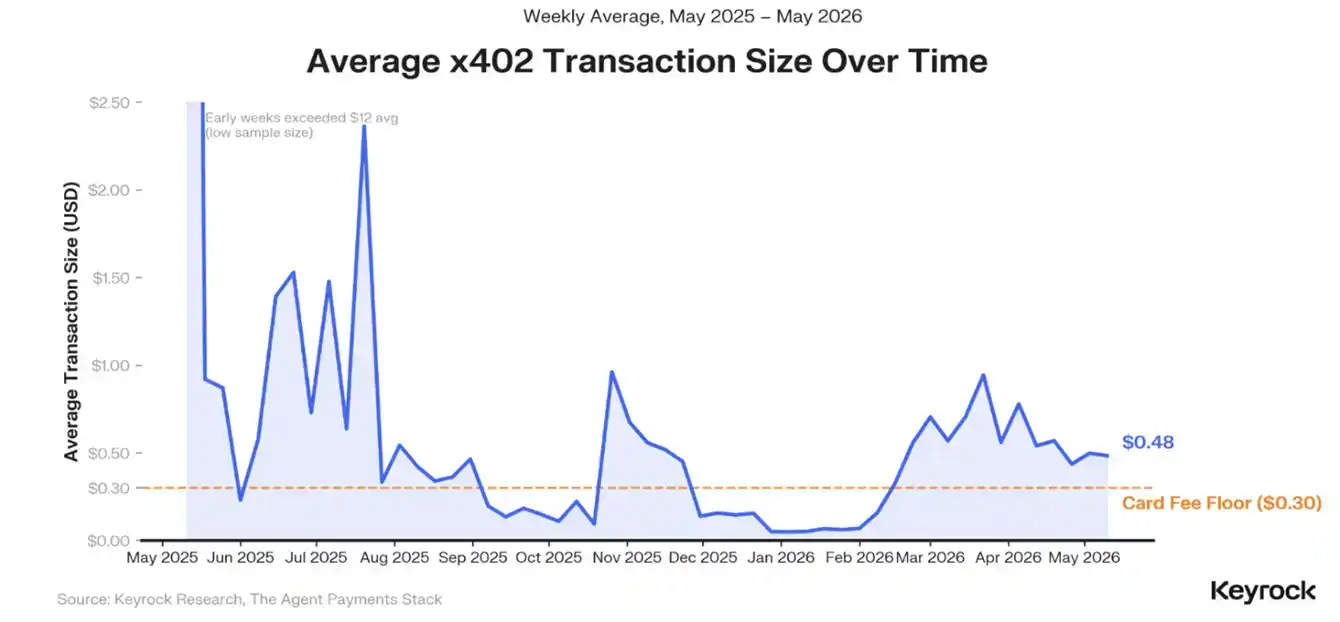
$0.30 is the most common flat fee per transaction in the US and many major markets. This fee is like a wall, making micropayments under $1 very uneconomical. For example, for a 3-cent API call, a $0.30 fee is 10 times the call cost; if an Agent pays with a credit card, the cumulative cost would be prohibitively high.

Blockchain solves this problem well. On Base, the transaction settlement cost is $0.0001. With this immense advantage, stablecoins have almost naturally won the competition against traditional payment giants in the realm of Agent payments.

Of the 176 million Agent transactions processed by x402, 98.6% were settled in USDC. Given the close relationship between Coinbase and Circle, it's fair to say Coinbase is also a big winner at the settlement layer.

But the settlement layer is just one layer in Agent payments. In the track of solving Agent payments via crypto-native means, Coinbase has a competitor—Stripe.

The Challenge from Stripe

This March, Stripe launched the Agent Payment Protocol MPP, which has brought Stripe's architecture map for Agent payments almost on par with Coinbase's.

- From the settlement layer: Coinbase has Base, Stripe has Tempo.

- From the wallet layer: Coinbase has Agent Wallet, Stripe has Privy.

- From the routing layer: Coinbase has built-in routing facilities, Stripe has Bridge, acquired for $1.1 billion.

- From the payment protocol: Coinbase has x402, Stripe has MPP.

Now let's return to the Base MCP mentioned at the beginning of the article. Since both competing sides now have these four layers of supporting infrastructure, the next battlefront is naturally the application layer.

This is the core reason why AI can become Base's main focus—Base needs to ensure that AI (at least in the cryptocurrency space) happens on Base. This is not actually about providing a perspective for degens on the Base chain, but about broadening the scenarios for Agent payments, enabling more Agents to conduct more transactions for more applications, thereby securing its leading position in the Agent payment track.

Once a dominant scale advantage is established, when Agent payments enter the commercial domain in the future, Coinbase stands to win even bigger.

Looking at the launch of Base MCP from this angle, one can sense that this is just a small step in Coinbase's grand ambition.


Domande pertinenti

QWhat is Base MCP and what key functionality does it enable for AI Agents?

ABase MCP is a protocol recently launched by Base. It allows users to connect their Base Account to an AI Agent. Once connected, users can use natural, conversational language to instruct the Agent to perform actions such as executing token swaps, making transfers, tracking portfolio positions, and querying transaction history.

QAccording to the article, why are stablecoins considered crucial for Agent payments?

AStablecoins are crucial for Agent payments because they enable micro-transactions economically. Traditional payment methods often have fixed fees around $0.30 per transaction, which makes small payments (e.g., a few cents for an API call) prohibitively expensive. In contrast, settlement costs on Base are around $0.0001, allowing stablecoins like USDC to facilitate vast numbers of small-value transactions efficiently, as evidenced by 98.6% of x402 transactions being settled in USDC.

QHow does the article contrast Coinbase's and Stripe's approaches to the Agent payment infrastructure?

AThe article contrasts their approaches by outlining the similar four-layer infrastructure both companies have built: Settlement Layer (Coinbase has Base, Stripe has Tempo), Wallet Layer (Coinbase has Agent Wallet, Stripe has Privy), Routing Layer (Coinbase has internal routing, Stripe acquired Bridge), and Payment Protocol Layer (Coinbase has x402, Stripe has MPP). This positions them as direct competitors in the Agent payment space.

QWhat strategic reason does the article suggest is behind Base making AI its main narrative?

AThe article suggests that Base's strategic focus on AI is not primarily for on-chain 'degen' activities but to expand the scenarios for Agent payments. By ensuring more AI activity (at least in the crypto space) happens on Base, Coinbase aims to generate more Agent-driven transactions across more applications. This builds a dominant scale advantage, securing Coinbase's leading position in the emerging Agent payment competition for future commercial applications.

QWhat does the median transaction amount on x402 indicate about the nature of Agent payments?

AThe median transaction amount on x402 falls between $0.01 and $0.10, with 76% of transactions being under $0.30. This data indicates that Agent payments are predominantly micro-transactions, involving very small sums of money per transaction.

Letture associate

Alibaba 'Stocks Up', ByteDance 'Trains'

"In late May, two closely timed events in China's AI industry clearly revealed the divergent strategic approaches of two tech giants: Alibaba and ByteDance. Alibaba is aggressively integrating AI into its existing commercial ecosystem, prioritizing immediate monetization. Its Qwen App now fully integrates with Taobao, leveraging the platform's 4-billion-item database for AI-powered shopping features like virtual try-on and price comparison. Internally, Alibaba has reorganized to incentivize AI-driven business growth, notably through the 'Agentic Commerce Trust Protocol' to enable AI-agent transactions. Financially, it emphasizes ROI, with CEO Daniel Wu stating every AI chip purchased is generating revenue. Alibaba's strategy bets that foundational AI model capabilities won't be leapfrogged in the next five years, allowing its 'AI-as-a-utility' approach to succeed. In stark contrast, ByteDance's Seed division focuses on pushing the frontiers of AGI with a long-term, research-oriented mindset. Its video generation model, Seedance 2.0, topped international benchmarks. The division, led by researchers Wu Yonghui and product head Zhu Wenjia, is tasked with 'exploring the upper limits of intelligence,' even considering open-sourcing its models—a rare move among Chinese firms. ByteDance is investing heavily, with reports of its 2026 capital expenditure plan being nearly triple that of 2024, funded by its substantial private profits. This allows it to pursue projects like an 8-month research paper questioning if video models are true 'world models,' devoid of immediate commercial pressure. The core divergence is less about corporate philosophy and more about structural constraints. As a publicly traded company, Alibaba is bound to quarterly financial expectations, forcing a pragmatic, revenue-focused AI integration. As a private entity, ByteDance has the luxury to fund long-term, high-risk foundational research without answering to public markets. The article concludes that the true determinant of a Chinese company's AI path is its IPO status, suggesting that if ByteDance were public, or if Alibaba were private, their strategies might well be reversed."

marsbit57 min fa

Alibaba 'Stocks Up', ByteDance 'Trains'

marsbit57 min fa

Why More AI Agents Does Not Equal Higher Productivity?

Editor's Note: As AI Agents become cheaper and easier to use, a new constraint emerges: the cost isn't in launching more Agents, but in the human attention required to manage, judge, and integrate their outputs. This hidden cost is called the "orchestration tax." The article argues that a developer's cognitive bandwidth is the key bottleneck—a serial, non-parallelizable resource akin to a Global Interpreter Lock (GIL). While many Agents can run concurrently, their results ultimately require human judgment for review, conflict resolution, and final integration. Therefore, more Agents don't automatically mean higher productivity; they can simply create longer queues, lead to cognitive fatigue, and create the illusion of busyness without real output. The core solution is to design workflows around this scarce human attention. Key strategies include: scaling the number of Agents to match review capacity (not UI capacity), categorizing tasks (delegating independent ones, keeping complex judgment-heavy ones serial), batch reviewing results to minimize context-switching costs, automating verifiable checks to reserve human judgment for critical decisions, and protecting focused, uninterrupted thinking time. Ultimately, the critical skill is not launching many Agents, but architecting systems that respect the fundamental limit of human attention. Unpaid "orchestration tax" accumulates as both technical and cognitive debt, undermining system understanding and quality. True productivity comes from thoughtfully managing the single-threaded resource—your focus.

marsbit2 h fa

Why More AI Agents Does Not Equal Higher Productivity?

marsbit2 h fa

Three Years Later: Looking Back at My Predictions About ChatGPT in 2023

Three Years Later: Revisiting My 2023 Predictions on ChatGPT In March 2023, shortly after ChatGPT's launch, I made 20 predictions about its future. Now, in mid-2026, I've used AI agents to fact-check each one against the latest data. Overall, most major directional forecasts were correct, with only one outright error (incorrectly stating GPT-4 had 100 trillion parameters). Key successes included predicting that RAG and retrieval architectures would become the standard for handling knowledge and hallucinations, that natural language interfaces (LUI) would create a massive new industry layer beyond the models themselves, and that China would develop viable large language models, significantly closing the performance gap with Western counterparts within about three years. Predictions about the absence of mass unemployment, the rise of a new "robot network" for agent communication, and ChatGPT not possessing consciousness also held true in their core arguments. However, the "devil was in the details." Errors frequently involved specific numbers, timelines, or overlooking distributional effects. I tended to overestimate the speed of adoption (e.g., for agent networks) while underestimating the ultimate scale of capabilities or costs (e.g., AI winning IMO gold without tools, or the extreme capital required for frontier models). Other misjudgments included: underestimating how AI would reinforce, not dissolve, information filter bubbles; incorrectly assuming AI-generated content would easily circumvent copyright (it has instead triggered record-breaking settlements); and misidentifying where value would be captured (it accrued overwhelmingly to the compute layer, like Nvidia, not just the application or model layers). Key lessons from reviewing these predictions are: 1) Directional and mechanistic insights are far more reliable than precise numbers or absolute statements. 2) There's a consistent bias to overestimate short-term speed but underestimate long-term magnitude. 3) Errors often lie in missing distributional impacts within a generally correct aggregate trend. 4) Predictions phrased with nuance and caveats aged the best. 5) Some fundamental debates (e.g., on machine consciousness or the ultimate value chain) remain unresolved even after three years. This exercise is less about scoring the past and more about establishing rules for clearer thinking about the next three years of AI.

marsbit9 h fa

Three Years Later: Looking Back at My Predictions About ChatGPT in 2023

marsbit9 h fa

Trading

Spot
Futures
活动图片




