Barclays Backs Crypto Company Ubyx Amid Growing Stablecoin Clearing Race

bitcoinistPubblicato 2026-01-08Pubblicato ultima volta 2026-01-08

Introduzione

Barclays has made its first direct investment in the stablecoin sector by acquiring an equity stake in Ubyx, a startup that provides a clearing and settlement layer for stablecoins. This move reflects a broader trend of traditional banks exploring digital currency infrastructure within regulatory boundaries. Ubyx aims to reduce market fragmentation by enabling standardized redemption and settlement of stablecoins across different issuers and blockchains. The investment aligns with Barclays' ongoing initiatives in digital money, including participation in a consortium exploring a G7-backed stablecoin and tokenized deposit pilots. While stablecoins like Tether dominate crypto liquidity, regulators remain cautious about systemic risks. Barclays' backing signals growing institutional interest in compliant stablecoin infrastructure.

Barclays has made its first direct move into the stablecoin sector, taking an equity stake in Ubyx, as global banks quietly position themselves for a future where digital settlement becomes more common.

While the investment is modest in disclosed detail, it signals how traditional lenders are approaching stablecoins not as speculative assets, but as infrastructure that could reshape payments and treasury operations if regulation allows.

Ubyx, founded in 2025, operates a clearing and settlement layer for stablecoins, digital tokens typically pegged one-to-one with fiat currencies such as the U.S. dollar. Its goal is to reduce market fragmentation by allowing stablecoins from different issuers and blockchains to be settled and redeemed in a more standardized manner.
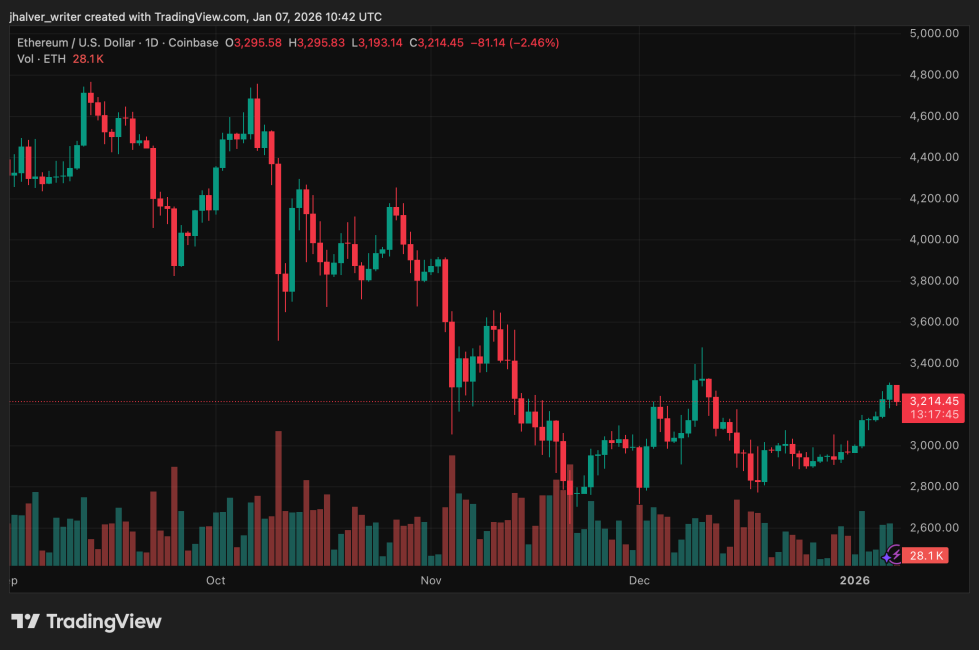
ETH's price moving sideways on the daily chart. Source: ETHUSD on Tradingview

The Case for Regulated Tokenized Cash

Barclays said the investment aligns with its broader work on “new forms of digital money,” emphasizing that any development would sit within existing regulatory boundaries.

The bank did not disclose the size of its stake or Ubyx’s valuation. However, the decision places Barclays among a growing list of large financial institutions seeking exposure to stablecoin rails without directly issuing tokens or operating outside compliance frameworks.

The bank’s interest is not new. In October, Barclays joined a group of global lenders, including Goldman Sachs and UBS, to explore the issuance of a jointly backed stablecoin by G7 currencies.

It has also participated in tokenized deposit pilots and other distributed ledger initiatives, reflecting a cautious but consistent approach to blockchain-based settlement.

Ubyx’s Role in a Crowded Infrastructure Layer

Ubyx positions itself as an intermediary between stablecoin issuers and regulated banks or fintech firms. Its platform supports what it calls universal redemption, allowing businesses to deposit stablecoins from multiple issuers directly into existing accounts at face value.

The startup raised $10 million in seed funding in mid-2025, with backing from Galaxy Ventures, Coinbase Ventures, Founders Fund, and Paxos. Barclays’ entry adds a major UK banking name to that list, blending traditional finance interest with crypto-native capital.

Regulation Support for the Competitive Market

Stablecoins already play a central role in the crypto market’s liquidity, led by Tether, which has approximately $187 billion in circulation.

However, most usage remains inside trading venues. Regulators, including the Bank of England, continue to weigh limits and safeguards to prevent risks such as deposit flight during periods of stress.

That tension defines the current stablecoin race. Banks want faster, programmable settlement. Regulators want control and clear accountability. Infrastructure providers like Ubyx are betting that standardized, compliant clearing can bridge the two worlds, and Barclays’ backing suggests that major lenders are watching closely.

Cover image from ChatGPT, ETHUSD chart from Tradingview

Domande pertinenti

QWhat is the significance of Barclays' investment in Ubyx?

ABarclays' investment in Ubyx marks its first direct move into the stablecoin sector and signals how traditional lenders are approaching stablecoins not as speculative assets, but as infrastructure that could reshape payments and treasury operations if regulation allows.

QWhat does Ubyx do in the stablecoin ecosystem?

AUbyx operates a clearing and settlement layer for stablecoins, aiming to reduce market fragmentation by allowing stablecoins from different issuers and blockchains to be settled and redeemed in a more standardized manner.

QWhich other major financial institutions has Barclays collaborated with regarding stablecoins?

AIn October, Barclays joined a group of global lenders, including Goldman Sachs and UBS, to explore the issuance of a jointly backed stablecoin by G7 currencies.

QWho were the initial backers of Ubyx in its seed funding round?

AUbyx raised $10 million in seed funding in mid-2025 with backing from Galaxy Ventures, Coinbase Ventures, Founders Fund, and Paxos.

QWhat is the main tension in the current stablecoin market according to the article?

AThe main tension is between banks, which want faster, programmable settlement, and regulators, who want control and clear accountability to prevent risks such as deposit flight during periods of stress.

Letture associate

Can Japan Buy Growth with AI? Will the Bond Market Believe It?

Japan's cabinet has introduced the 2026 Basic Policy on Economic and Fiscal Management and Reform, shifting its primary fiscal target. The new framework moves away from the traditional annual primary balance goal and instead prioritizes a stable reduction of the debt-to-GDP ratio. This change is tied to a strategy of increased "responsible proactive fiscal" spending, aiming to boost long-term growth through investments in strategic sectors like AI, semiconductors, energy, and robotics. The government estimates total public and private investment in 62 key technologies could exceed 370 trillion yen by 2040. The market reaction has been mixed and cautious. While equity markets may respond to policy signals, bond markets are focused on fiscal credibility. Concerns center on whether the weakening of the clear primary balance anchor could lead to looser fiscal discipline. If investors doubt that these strategic investments will generate sufficient productivity gains, tax revenue, and nominal growth to outpace rising interest costs, they may demand higher yields on Japanese Government Bonds (JGBs). Recent volatility in the yen and JGB yields, with the 10-year yield briefly reaching 2.9%, reflects this skepticism. The success of this new framework hinges on two factors: whether Japan can achieve a nominal growth rate consistently higher than its long-term interest rates, and whether future budgets demonstrate disciplined control over bond issuance. The government's narrative is that strategic investment is essential to break Japan's cycle of low growth, aging, and labor shortages. However, the bond market will continuously assess the credibility of this plan, pricing the risk that it may represent fiscal expansion rather than a viable growth strategy.

marsbit3 min fa

Can Japan Buy Growth with AI? Will the Bond Market Believe It?

marsbit3 min fa

Misjudged A-Shares: Resilience, Expectations, and Confidence

China's A-share market recently faced selling pressure, especially in tech sectors, initially triggered by a global tech sell-off that began in South Korea. However, the article argues this is a case of "mistaken injury" and highlights the market's underlying resilience. This resilience stems from three main pillars: **1) Tech Sector Fundamentals:** Unlike Korea's market dominated by a few memory chip stocks, China's tech sector is diversified across computing, communications, electronics, and semiconductors, supported by dual narratives of global AI supply chains and domestic substitution. Core areas like optical modules and fiber optics continue to show strong earnings growth. **2) "National Team" Support:** State-backed institutions and large corporations have made significant market purchases and announced buybacks, providing liquidity and signaling confidence. This is seen as a stabilizing policy signal, often associated with market bottoms. **3) Broader Market Pillars:** Other major sectors are showing endogenous recovery momentum. Consumer stocks benefit from stabilizing CPI and signs of sector recovery (e.g., liquor price hikes). Cyclical sectors like aluminum have high earnings, potential price increases due to tight supply, and low valuations. The financial sector offers stable dividends and low valuations. The conclusion is that the sell-off was driven by external contagion, not a collapse in fundamentals. With strong policy support and recovering momentum across key sectors, the A-share market possesses the toughness to regain stability.

marsbit34 min fa

Misjudged A-Shares: Resilience, Expectations, and Confidence

marsbit34 min fa

The Clarity Act's Journey Through Congress: The Thorny Path of Bipartisan Compromise in the U.S.

The U.S. Congress is struggling to advance the crypto market structure bill known as the Clarity Act, with bipartisan compromise proving difficult. Key hurdles include unresolved disputes over "yield" products and, more critically, the inclusion of strong ethics provisions for elected officials—a non-negotiable demand for many Democrats. While a compromise on yield was reached in May, securing only limited Democratic support in committee, the separate Senate Agriculture Committee version later passed with no Democratic votes due to the ethics impasse. As Republicans push for a full Senate vote in July, demands for ethics rules have expanded, and other contentious issues like developer protections and concerns from law enforcement and large banks further complicate negotiations. Despite consensus on the need for legislation, the path forward is unclear. Recent discussions between senators and White House officials aim to find acceptable ethics language. Some lawmakers question whether a compromise text can garner enough bipartisan support, with one Democrat stating the current proposal lacks the strong ethics provisions required for their vote. Potential short-term goals for the crypto community include symbolic Senate action before the August recess, a longer-term aim for passage by 2026, or establishing a detailed framework that addresses ethics and other compromises. The process remains arduous, relying on the traditional, vote-by-vote effort to build bipartisan support.

marsbit53 min fa

The Clarity Act's Journey Through Congress: The Thorny Path of Bipartisan Compromise in the U.S.

marsbit53 min fa

Trading

Spot
活动图片





