Banks Need CLARITY Act More Than Crypto – Former CFTC Chair Explains Why

bitcoinistPubblicato 2026-03-10Pubblicato ultima volta 2026-03-10

Introduzione

Former CFTC Chairman Chris Giancarlo argues that US banks need the regulatory clarity provided by the CLARITY Act more than the crypto industry does. He states that without clear rules, banks' general counsels are preventing large investments in new technology, risking that US institutions fall behind global counterparts. In contrast, the crypto industry, composed of risk-takers, will continue to build and innovate in other jurisdictions if necessary. Giancarlo believes the odds of the stalled bill passing are 60-40, noting it has become a political issue pitting Republicans against Democrats and TradFi against DeFi. He warns that if the legislation fails, agencies like the SEC and CFTC will likely establish temporary rules, but this won't provide the long-term certainty that banks require to modernize.

US banks may need regulatory clarity more than the crypto industry, a former Commodity Futures Trading Commission (CFTC) chief said, arguing they risk falling behind the rest of the world.

Regulatory Uncertainty Could Leave US Banks Behind

On Sunday, Chris Giancarlo, former chairman of the CFTC, discussed the significant policy reversal under the Trump administration that has been driving crypto innovation in the US, including the highly anticipated market structure bill.

In an interview for Scott Melker’s The Wolf Of All Streets podcast, the ex-CFTC chief affirmed that landmark stablecoin legislation enacted last July, the GENIUS Act, was “the appetizer” for crypto regulation, while the market structure bill, also known as the CLARITY Act, represents the main dish but has become the “hard part.”

For context, the CLARITY Act has been stalled for nearly two months after the Senate Banking Committee published its bill draft in mid-January. Multiple policies, including key restrictions for stablecoin issuers, were criticized by crypto leaders, leading to a prolonged fight between banks and the digital assets industry.

Giancarlo affirmed that banks need regulatory clarity more than the crypto industry, arguing that they will be hesitant to invest in new technology without clear rules, and their systems will be superseded.

The banks, however, can’t afford regulatory uncertainty. Their general counselors are telling their boards, you can’t invest billions of dollars in this (...) unless you’ve got regulatory certainty. (...) The banks need this clarity because they need to build this. They need to be in the forefront, not in the rear guard of this innovation.

On the contrary, the crypto industry will continue to build and innovate in other jurisdictions. “They are risk-takers. They’re going to build it here, or they’re going to build it abroad,” the former CFTC chairman asserted.

If the CLARITY Act isn’t passed, Giancarlo believes the leaders of financial regulatory agencies, such as the Securities and Exchange Commission (SEC) and CFTC, will likely establish the necessary rules to oversee the sector.

“They won’t have the support of legislation that makes it work forever or at least into the next presidential cycle, but it’ll make it work for now. Now, does that give the industry the certainty they want? No. And who needs that certainty more than the banks? Crypto doesn’t need it. They were building even under the whip hand of Gary Gensler,” he added.

Are The Odds In Crypto Regulation’s Favor?

Giancarlo emphasized that the digital assets legislation has become a political issue, with Republicans opposing Democrats, and traditional finance (TradFi) opposing decentralized finance (DeFi) and new technologies.

The ex-CFTC chief also noted that the challenges of the regulatory timing, asserting that “If we could not be in a worse time, we’re in an election year.” During this period, politicians’ focus is on the upcoming mid-term elections, he detailed, and “everything that takes place in Washington (...) is all about swaying the voters for the elections.”

Last month, Treasury Secretary Scott Bessent urged lawmakers to pass the stalled bill this spring. He acknowledged the efforts of a bipartisan working group to advance the legislation, emphasizing that Democrats are open to collaborating with Republicans.

He also warned that the chances of reaching a deal could crumble if Democrats gain control of the House of Representatives in November, given the Biden administration’s stringent regulations on the industry.

Despite the delay, Giancarlo believes the odds are 60-40 in favor of passing the legislation, arguing that there’s “a lot of good in the bill for all sides” and its importance is recognized by all parties.

“I think there’s a recognition that this is the new architecture of finance and America, our financial institutions are the world’s dominant financial institutions. We need to modernize that. We need to adopt this technology,” he concluded.
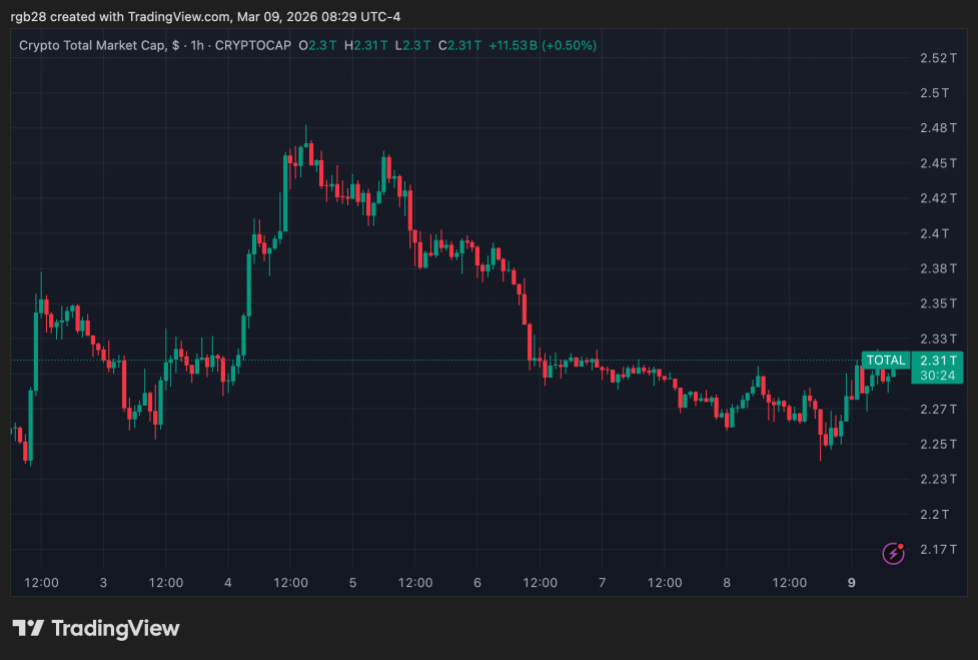
The total crypto market capitalization is at $2.31 trillion in the one-week chart. Source: TOTAL on TradingView


Domande pertinenti

QAccording to the former CFTC chair, why do US banks need regulatory clarity more than the crypto industry?

ABecause their general counsels advise that they cannot invest billions of dollars in new technology without regulatory certainty, and they risk having their systems superseded and falling behind the rest of the world.

QWhat are the two key pieces of legislation mentioned, and how does the former CFTC chairman describe their relationship?

AThe two key pieces are the GENIUS Act and the CLARITY Act. He describes the GENIUS Act as 'the appetizer' for crypto regulation, while the CLARITY Act (market structure bill) represents 'the main dish' but is the 'hard part.'

QWhat does Chris Giancarlo believe will happen if the CLARITY Act is not passed by Congress?

AHe believes that financial regulatory agencies like the SEC and CFTC will likely establish the necessary rules to oversee the sector, but this will not provide the long-term certainty that the industry, particularly banks, desires.

QWhy is the current timing particularly challenging period for passing crypto regulation, according to the article?

ABecause it is an election year, where politicians' focus is on swaying voters for the upcoming mid-term elections, making it a difficult time to pass significant legislation.

QWhat odds does Giancarlo give for the CLARITY Act eventually being passed, and what is his reasoning?

AHe gives 60-40 odds in favor of passing the legislation, reasoning that there is 'a lot of good in the bill for all sides' and a recognition that modernizing financial architecture with this technology is necessary for the US to maintain its dominant position.

Letture associate

Gensyn AI: Don't Let AI Repeat the Mistakes of the Internet

In recent months, the rapid growth of the AI industry has attracted significant talent from the crypto sector. A persistent question among researchers intersecting both fields is whether blockchain can become a foundational part of AI infrastructure. While many previous AI and Crypto projects focused on application layers (like AI Agents, on-chain reasoning, data markets, and compute rentals), few achieved viable commercial models. Gensyn differentiates itself by targeting the most critical and expensive layer of AI: model training. Gensyn aims to organize globally distributed GPU resources into an open AI training network. Developers can submit training tasks, nodes provide computational power, and the network verifies results while distributing incentives. The core issue addressed is not decentralization for its own sake, but the increasing centralization of compute power among tech giants. In the era of large models, access to GPUs (like the H100) has become a decisive bottleneck, dictating the pace of AI development. Major AI companies are heavily dependent on large cloud providers for compute resources. Gensyn's approach is significant for several reasons: 1) It operates at the core infrastructure layer (model training), the most resource-intensive and technically demanding part of the AI value chain. 2) It proposes a more open, collaborative model for compute, potentially increasing resource utilization by dynamically pooling idle GPUs, similar to early cloud computing logic. 3) Its technical moat lies in solving complex challenges like verifying training results, ensuring node honesty, and maintaining reliability in a distributed environment—making it more of a deep-tech infrastructure company. 4) It targets a validated, high-growth market with genuine demand, rather than pursuing blockchain integration without purpose. Ultimately, the boundaries between Crypto and AI are blurring. AI requires global resource coordination, incentive mechanisms, and collaborative systems—areas where crypto-native solutions excel. Gensyn represents a step toward making advanced training capabilities more accessible and collaborative, moving beyond a niche controlled by a few giants. If successful, it could evolve into a fundamental piece of AI infrastructure, where the most enduring value in the AI era is often created.

marsbit8 h fa

Gensyn AI: Don't Let AI Repeat the Mistakes of the Internet

marsbit8 h fa

Why is China's AI Developing So Fast? The Answer Lies Inside the Labs

A US researcher's visit to China's top AI labs reveals distinct cultural and organizational factors driving China's rapid AI development. While talent, data, and compute are similar to the West, Chinese labs excel through a pragmatic, execution-focused culture: less emphasis on individual stardom and conceptual debate, and more on teamwork, engineering optimization, and mastering the full tech stack. A key advantage is the integration of young students and researchers who approach model-building with fresh perspectives and low ego, prioritizing collective progress over personal credit. This contrasts with the US culture of self-promotion and "star scientist" narratives. Chinese labs also exhibit a strong "build, don't buy" mentality, preferring to develop core capabilities—like data pipelines and environments—in-house rather than relying on external services. The ecosystem feels more collaborative than tribal, with mutual respect among labs. While government support exists, its scale is unclear, and technical decisions appear driven by labs, not state mandates. Chinese companies across sectors, from platforms to consumer tech, are building their own foundational models to control their tech destiny, reflecting a broader cultural drive for technological sovereignty. Demand for AI is emerging, with spending patterns potentially mirroring cloud infrastructure more than traditional SaaS. Despite challenges like a less mature data industry and GPU shortages, Chinese labs are propelled by vast talent, rapid iteration, and deep integration with the open-source community. The competition is evolving beyond a pure model race into a contest of organizational execution, developer ecosystems, and industrial pragmatism.

marsbit9 h fa

Why is China's AI Developing So Fast? The Answer Lies Inside the Labs

marsbit9 h fa

3 Years, 5 Times: The Rebirth of a Century-Old Glass Factory

Corning, a 175-year-old glass company, is experiencing a dramatic revival as a key player in AI infrastructure, driven by surging demand for high-performance optical fiber in data centers. AI data centers require vastly more fiber than traditional ones—5 to 10 times as much per rack—to handle high-speed data transmission between GPUs. This structural demand shift, coupled with supply constraints from the lengthy expansion cycle for fiber preforms, has created a significant supply-demand gap. Nvidia has invested in Corning, along with Lumentum and Coherent, in a $4.5 billion total commitment to secure the optical supply chain for AI. Corning's competitive edge lies in its expertise in producing ultra-low-loss, high-density, and bend-resistant specialty fiber, which is critical for 800G+ and future 1.6T data rates. Its deep involvement in co-packaged optics (CPO) with partners like Nvidia further solidifies its position. While not the largest fiber manufacturer globally, Corning's revenue from enterprise/data center clients now exceeds 40% of its optical communications sales, and it has secured multi-year supply agreements with major hyperscalers including Meta and Nvidia. Financially, Corning's optical communications revenue has surged, doubling from $1.3 billion in 2023 to over $3 billion in 2025. Its stock price has risen nearly 6-fold since late 2023. Key future catalysts include the rollout of Nvidia's CPO products and the scale of undisclosed customer agreements. However, risks include high current valuations and potential disruption from next-generation technologies like hollow-core fiber. The company's long-term bet on light over electricity, maintained even through the telecom bubble crash, is now being validated by the AI boom.

marsbit10 h fa

3 Years, 5 Times: The Rebirth of a Century-Old Glass Factory

marsbit10 h fa

Trading

Spot
Futures
活动图片




