Banks’ Concerns Over Stablecoin Interest Payments Are ‘Totally Absurd’, Circle CEO Says

bitcoinistPubblicato 2026-01-23Pubblicato ultima volta 2026-01-23

Introduzione

Circle CEO Jeremy Allaire dismissed banking industry concerns over interest payments on stablecoins as "totally absurd," arguing that fears of massive deposit flight are unfounded. Speaking at the World Economic Forum, he compared stablecoin rewards to other common financial products like credit cards, emphasizing their role in customer engagement rather than systemic risk. Allaire countered bank claims that stablecoins could drain up to $6 trillion in deposits, noting that similar concerns emerged with money market funds yet lending continued unaffected. He highlighted the shift toward private credit and capital markets, asserting that stablecoins should function as safe, regulated cash instruments while lending evolves independently through new models.

The CEO of stablecoin issuer Circle has weighed in on the importance of stablecoin rewards and why he believes the banking industry’s concerns about interest payments on these assets are “absurd.”

Circle CEO Rejects Banks’ Stablecoin Fears

Speaking at the World Economic Forum (WEF) in Davos, Circle’s CEO, Jeremy Allaire, discussed banks’ growing concerns that paying interest on stablecoins poses a threat to the industry, calling the deposit flight narrative “totally absurd.”

The banking sector has expressed concerns about stablecoin rewards, arguing that interest payments will distort market dynamics and affect credit creation. In the US, banks have heavily criticized the GENIUS Act, claiming that it has loopholes that could pose risks to the financial system.

The executive rejected the sector’s general arguments, citing historical and practical reasons. He asserted that this exact argument has been historically used when new financial products, such as government money market funds, have emerged.

Notably, Bank of America CEO Brian Moynihan recently compared the digital assets to money market mutual funds, which require reserves to be held in short-term instruments, such as US Treasuries, reducing lending capacity in the system.

The executive told investors that the banking sector, small- and medium-sized businesses in particular, could face significant challenges if the US Congress does not prohibit interest-bearing stablecoins, as up to $6 trillion in deposits, or 30% to 35% of all US commercial bank deposits, could flow out of the banking system and into the stablecoin sector.

However, Allaire pointed out that, despite institutions claiming that financial products would “draw all the deposit base,” their growth has not “stopped the ability for lending to happen.”

The importance Of Rewards

Circle’s CEO also argued that stablecoins should not be singled out when rewards for other financial products exist and contribute to the system. “Those rewards (...) exist in every balance that you have with a credit card that you use. They exist around so many other financial products and services that we have,” he detailed.

“These rewards are actually very important,” Allaire continued. “They help with stickiness, they help with customer traction. They are not themselves like these huge monetary policy dampers.”

Most importantly, he pointed out that lending is moving away from the risk-taking of banks, with “a huge amount of lending is moving towards private credit.”

He cited a Wednesday WEF panel, in which a capital markets participant highlighted how the vast majority of GDP growth in the United States was “formed by capital market formation around junk bonds.”

“So private credit issuing junk bonds, capitalizing the build out of the American technology advancements, not bank credit,” the executive added.

Previously, Coinbase Institute shared a similar argument, affirming that “credit is evolving, not shrinking. Lending is shifting to private credit, fintech, and DeFi channels that don’t depend on deposits. Liquidity moves—it doesn’t vanish.”

Allaire concluded that “we want stablecoin money to be cash instrument money, prudentially supervised, very, very safe money. And then I think what we want to do is we want to build models for lending that build on top of stablecoins.”
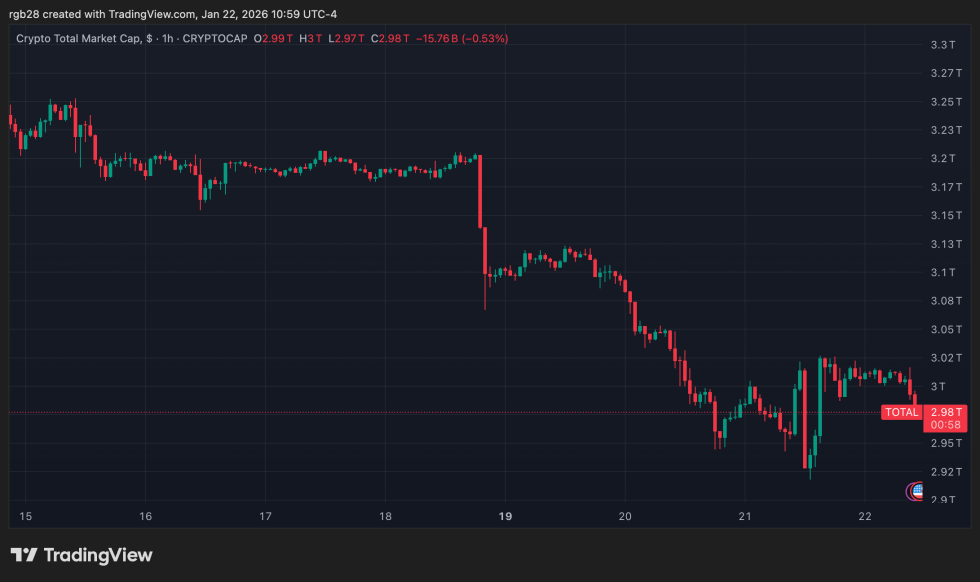
The total crypto market capitalization is at $2.98 trillion in the one-week chart. Source: TOTAL on TradingView


Domande pertinenti

QWhat is Circle CEO Jeremy Allaire's view on banks' concerns about interest payments on stablecoins?

AJeremy Allaire calls the banking industry's concerns about interest payments on stablecoins 'totally absurd' and rejects the narrative that they pose a threat to the industry or will cause significant deposit flight.

QAccording to the banking sector, what risk does the GENIUS Act pose?

ABanks have criticized the GENIUS Act, claiming it has loopholes that could distort market dynamics, affect credit creation, and pose risks to the overall financial system.

QWhat historical financial product does Allaire compare stablecoins to when refuting the banks' arguments?

AAllaire compares stablecoins to government money market funds, which also faced similar criticisms when they emerged, yet their growth did not stop the ability for lending to happen.

QHow much in bank deposits could potentially flow into the stablecoin sector according to the concerns raised by bank executives?

ABank executives warned that up to $6 trillion in deposits, or 30% to 35% of all US commercial bank deposits, could flow out of the banking system and into the stablecoin sector if interest-bearing stablecoins are not prohibited.

QWhere does Jeremy Allaire argue that lending is increasingly moving towards?

AAllaire argues that a huge amount of lending is moving away from traditional banks and towards private credit, fintech, and DeFi channels, citing the growth of the junk bond market as an example of capital formation that doesn't rely on bank credit.

Letture associate

'Backstabbing' or 'Win-Win'? How Likely Is TradeXYZ to Break Away from Hyperliquid and Go Solo?

The article discusses the growing debate over whether TradeXYZ, which dominates Hyperliquid's HIP-3 market with over 90% of its volume, might break away to build its own independent trading platform. This possibility is fueled by TradeXYZ's immense market influence and the common industry trend of successful projects seeking more control and profit capture. Key arguments for a potential split include TradeXYZ's overwhelming contribution to Hyperliquid's metrics and the financial incentive to retain all transaction fees, as it currently splits them 50/50 with Hyperliquid. The piece draws parallels to other cases, like Anthropic's "Claude Code" competing with its former partner Cursor, suggesting "betrayal" can occur when business leverage shifts. However, strong counterarguments suggest a split is unlikely or would be detrimental. TradeXYZ relies on Hyperliquid's high-performance infrastructure and its platform as a primary user acquisition channel. Building a comparable system would be challenging. Furthermore, the founders of both projects share a history of trust and mutual admiration. The analysis concludes that a separation would likely be a lose-lose scenario: Hyperliquid would lose a major growth narrative and trading volume, while TradeXYZ would face technical hurdles, user migration issues, and reputational damage, potentially allowing competitors to seize market share. The most rational path is seen as continued collaboration, with TradeXYZ potentially negotiating better terms while leveraging Hyperliquid's established strengths.

marsbit4 min fa

'Backstabbing' or 'Win-Win'? How Likely Is TradeXYZ to Break Away from Hyperliquid and Go Solo?

marsbit4 min fa

The Artificial Intelligence Economy Could Accelerate the Establishment of Dominance for Dollar-Pegged Stablecoins

Economists from the ASEAN+3 Macroeconomic Research Office (AMRO) suggest that the winner in the artificial intelligence (AI) race may not be the country developing the most powerful AI model, but the one whose currency underpins these models and their infrastructure. Their thesis outlines a potential cycle where AI-related costs—such as energy for data centers, infrastructure, and usage fees—are denominated in U.S. dollars. As AI grows into a massive industry, this could significantly increase global demand for U.S. dollar liquidity (first channel of dollar dominance). A second channel involves the currency used for payments between AI agents, expected to become widespread in logistics, inventory, and treasury management. Dollar-pegged stablecoins could provide the programmable settlements required for such agent commerce. These two channels may converge, creating a self-reinforcing "dollar loop" where AI computational payments are settled in stablecoins. Stablecoins could gain an early advantage over alternatives like CBDCs due to existing network effects, further entrenching dollar dominance. This would also boost demand for U.S. Treasury bonds used as collateral for stablecoin reserves. The report warns ASEAN+3 nations of over-reliance on this dollar loop and suggests developing regional data centers and tokenized money based on local currencies to participate in the AI economy without reinforcing dollar dependency.

cryptonews.ru7 min fa

The Artificial Intelligence Economy Could Accelerate the Establishment of Dominance for Dollar-Pegged Stablecoins

cryptonews.ru7 min fa

Base Claims Its Distribution Advantage Can Outlast Robinhood Chain's Initial Surge

Base, a layer-2 blockchain, argues that its established distribution network will outlast Robinhood Chain's initial popularity surge. While Robinhood Chain quickly attracted 230,000 daily active users and over $9 billion in DEX volume (primarily from meme coins) shortly after launch, its core feature of tokenized stocks saw minimal use. Base acknowledged shortcomings in focusing on social blockchain products and lagging in areas like perpetual contracts, predictions markets, and on-chain tokenized stocks—a move Robinhood got right. In response, Base highlights its nearly three-year head start in building infrastructure. It emphasizes its x402 payment protocol, which has processed 187.8 million agent payments, its $3.9 billion in stablecoin deposits (mostly USDC), and its integration with partners like Visa, Shopify, and JPMorgan for institutional and merchant settlements. Base contends these capabilities for corporate payments and stablecoin liquidity represent a more durable and defensible ecosystem than Robinhood's retail trading metrics. Coinbase plans to launch its own on-chain, share-backed tokenized stocks on Base, which would directly challenge Robinhood's key differentiating feature. Base's strategy bets that its deep-rooted distribution and institutional partnerships will prove harder to overcome than Robinhood's early, meme-driven volume, which may fade after the initial launch hype.

cryptonews.ru9 min fa

Base Claims Its Distribution Advantage Can Outlast Robinhood Chain's Initial Surge

cryptonews.ru9 min fa

Trading

Spot
活动图片